This comprehensive analysis evaluates whether Stable (STABLE) represents a sound investment opportunity in 2024-2026. STABLE is a USDT-native Layer 1 blockchain designed for stablecoin payments, backed by $28 million in seed funding from institutional investors including Hack VC and Bitfinex, currently trading at $0.015865 with a market capitalization of $285.57 million as of January 2026. The article examines STABLE's price trajectory from its December 2025 launch, current market performance, and provides short-term forecasts ($0.013948-$0.017752 for 2026) alongside long-term projections through 2031, while addressing key investment factors including supply mechanisms, institutional adoption, macroeconomic influences, and technological differentiation. Critical investment risks including market volatility, regulatory uncertainty, technical challenges, and token dilution potential are thoroughly analyzed. The guide offers tailored investment strategies for beginners through institutional investors, emphasizin
Introduction: Stable (STABLE) Investment Position and Market Outlook
Stable (STABLE) represents a notable digital asset in the cryptocurrency sector, positioning itself as a USDT-native Layer 1 blockchain designed specifically for stablecoin payments. As of January 15, 2026, STABLE holds a market capitalization of approximately $285.57 million with a circulating supply of 18 billion tokens, currently trading at around $0.015865. With its ranking at #193 in the cryptocurrency market and a market dominance of 0.046%, the token has demonstrated measurable price movements, including a 4.34% increase over 24 hours and a 10.11% rise over the past week. The platform emphasizes sub-second transaction finality, low fees, and settlement in USDT for every transaction, aiming to address global payment infrastructure needs. This article provides a comprehensive analysis of STABLE's investment characteristics, historical price performance, future price outlook, and associated investment risks to assist investors in their research process.
I. Stable (STABLE) Price History Review and Investment Value Status
Stable (STABLE) launched on December 8, 2025, establishing itself as a USDT-native Layer 1 blockchain designed specifically for stablecoin payments. The token's price trajectory reflects its early-stage market positioning:
-
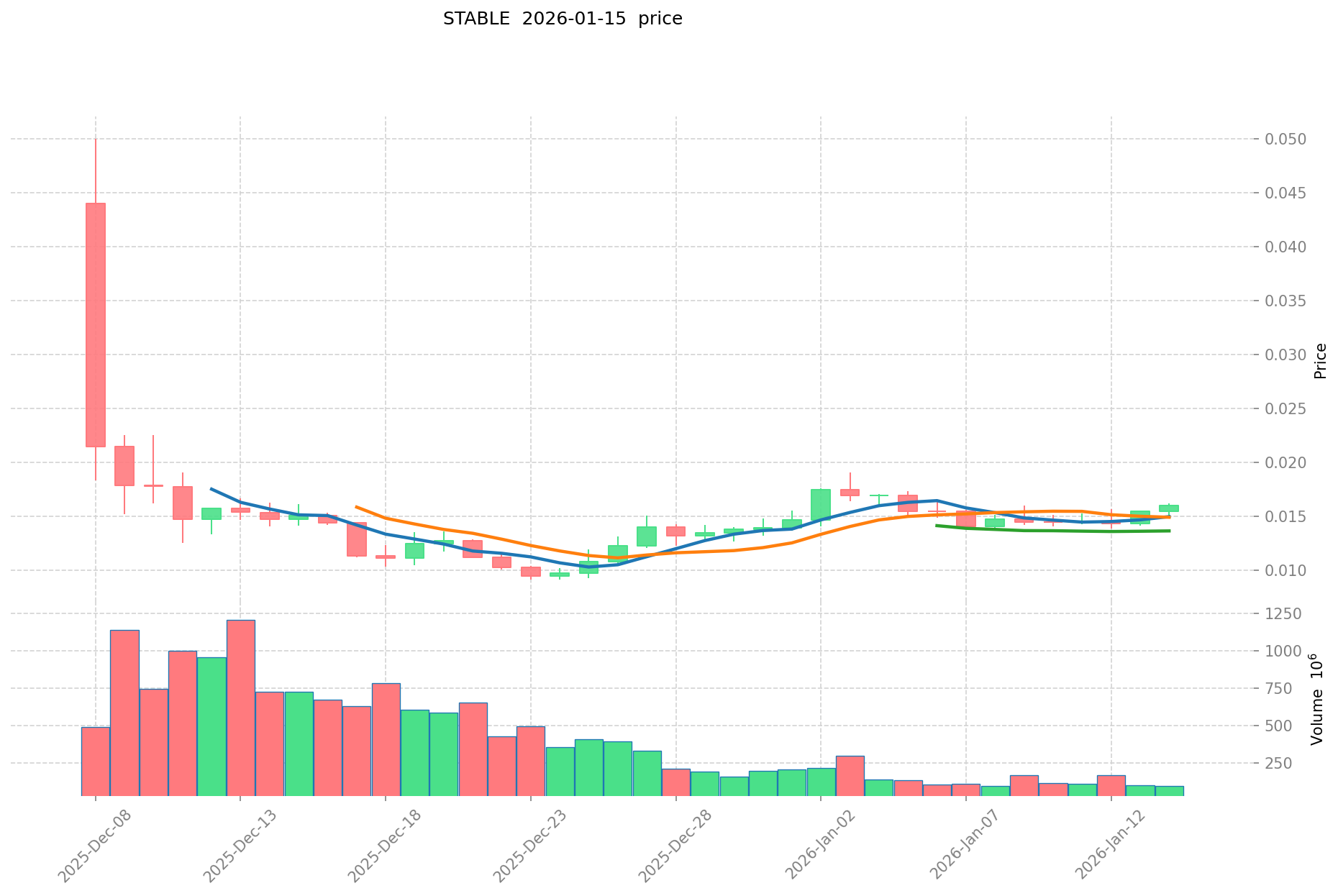
December 2025: Following its December 8 debut, STABLE reached a price level of $0.05 within the initial weeks of trading, demonstrating early market interest in the project's stablecoin payment infrastructure.
-
Late December 2025: The token experienced a price adjustment, with values declining to approximately $0.00913 by December 23, 2025, representing a notable correction phase during the holiday trading period.
-
January 2026: As of January 15, 2026, STABLE has shown recovery momentum, trading at $0.015865 with a 24-hour price change of +4.34% and a 7-day increase of 10.11%. The recent 30-day performance indicates a gain of 6.47%.
Current STABLE Investment Market Status (January 2026)
- Current Price: $0.015865 (as of January 15, 2026)
- 24-Hour Trading Range: High of $0.016177, Low of $0.014983
- 24-Hour Trading Volume: $1,827,946.19
- Circulating Supply: 18 billion STABLE tokens
- Market Capitalization: $285.57 million
- Fully Diluted Valuation: $1.586 billion
- Market Cap to FDV Ratio: 18%
- Circulation Rate: 18.0% of total supply
- Trading Availability: Listed on 1 exchange platform
Click to view real-time STABLE market price
The project positions itself as a USDT-native Layer 1 solution offering sub-second finality and low transaction fees for global payment applications. With its focus on stablecoin payment infrastructure, STABLE operates within the broader context of growing institutional interest in digital assets, as evidenced by the approval of spot Bitcoin ETFs in January 2024 and increasing adoption of stablecoin solutions for settlement purposes. The token's circulating supply represents 18% of its maximum supply of 100 billion tokens, indicating potential for future token distribution activities.
II. Core Factors Influencing Whether STABLE is a Good Investment
Supply Mechanism and Scarcity (STABLE investment scarcity)
- Total supply cap: 100 billion STABLE tokens with 18 billion currently in circulation (18% of total supply)
- The circulating supply represents a relatively small portion of the maximum supply, which may influence price dynamics as more tokens enter the market
- Investment consideration: The ratio between circulating supply and total supply suggests potential dilution effects should be monitored by prospective investors
Institutional Investment and Mainstream Adoption (Institutional investment in STABLE)
- Institutional backing: STABLE secured $28 million in seed funding co-led by Hack VC, Bitfinex, and USDT0
- The project targets the $150 billion stablecoin market, positioning itself within a substantial existing ecosystem
- Market presence: Currently listed on one exchange with STABLE/USDT spot and perpetual futures available on Phemex
- Investment consideration: Early-stage institutional support provides foundational credibility, though broader adoption metrics remain in development
Macroeconomic Environment's Impact on STABLE Investment
- The stablecoin sector has experienced notable regulatory developments, including the U.S. GENIUS Act signed in 2025, which provides a regulatory framework for stablecoin issuers
- Global stablecoin market conditions show record growth trends, with major issuers receiving provisional banking charters from the Office of the Comptroller of the Currency
- Investment consideration: Regulatory clarity in key markets may influence the operational environment for USDT-native platforms
Technology and Ecosystem Development (Technology & Ecosystem for STABLE investment)
- StableChain architecture: USDT-native Layer 1 blockchain designed specifically for stablecoin payments
- Technical features: Sub-second transaction finality with USDT as the native gas token for settlement
- Ecosystem positioning: Targets global payment infrastructure with emphasis on speed, scalability, security, and reliability
- Investment consideration: The specialized focus on USDT-based payments differentiates the platform within the broader blockchain infrastructure landscape, though ecosystem maturity will require ongoing assessment
III. STABLE Future Investment Forecast and Price Outlook (Is Stable(STABLE) worth investing in 2026-2031)
Short-term Investment Forecast (2026, short-term STABLE investment outlook)
- Conservative forecast: $0.013948 - $0.01585
- Neutral forecast: $0.01585 - $0.016801
- Optimistic forecast: $0.016801 - $0.017752
Mid-term Investment Outlook (2027-2029, mid-term Stable(STABLE) investment forecast)
- Market phase expectation: StableChain may experience gradual adoption as a USDT-native Layer 1 solution for stablecoin payments, with potential growth driven by increased validator participation and total value locked (TVL) expansion.
- Investment return forecast:
- 2027: $0.01092065 - $0.0235214
- 2028: $0.010483824 - $0.02419344
- 2029: $0.0164112168 - $0.0297176088
- Key catalysts: Growth in validator network, expansion of TVL, adoption of sub-second finality payment infrastructure, and market acceptance of USDT-settled transactions.
Long-term Investment Outlook (Is Stable a good long-term investment?)
- Base scenario: $0.0216920802384 - $0.028282736196 (assuming steady ecosystem development and moderate market conditions through 2030-2031)
- Optimistic scenario: $0.027115100298 - $0.02901315731886 (assuming accelerated adoption of StableChain payment infrastructure and favorable regulatory environment)
- Risk scenario: Below $0.01092065 (under conditions of limited adoption, increased competition from alternative Layer 1 solutions, or adverse market conditions)
View STABLE long-term investment and price prediction: Price Prediction
2026-01-15 - 2031 Long-term Outlook
- Base scenario: $0.0216920802384 - $0.0259474644 USD (corresponding to steady progress and gradual mainstream application adoption)
- Optimistic scenario: $0.027115100298 - $0.02901315731886 USD (corresponding to large-scale adoption and favorable market environment)
- Transformative scenario: Above $0.03 USD (if ecosystem achieves breakthrough developments and mainstream adoption)
- 2031-12-31 forecast high: $0.02901315731886 USD (based on optimistic development assumptions)
Disclaimer: Price predictions are speculative and based on available data and market models. Cryptocurrency investments carry inherent risks, and actual prices may differ significantly from forecasts. This analysis does not constitute investment advice.
| Year |
Predicted High Price |
Predicted Average Price |
Predicted Low Price |
Price Change |
| 2026 |
0.017752 |
0.01585 |
0.013948 |
0 |
| 2027 |
0.0235214 |
0.016801 |
0.01092065 |
5 |
| 2028 |
0.02419344 |
0.0201612 |
0.010483824 |
27 |
| 2029 |
0.0297176088 |
0.02217732 |
0.0164112168 |
39 |
| 2030 |
0.028282736196 |
0.0259474644 |
0.02465009118 |
63 |
| 2031 |
0.02901315731886 |
0.027115100298 |
0.0216920802384 |
70 |
IV. STABLE Investment Strategy and Risk Management (How to invest in STABLE)
Investment Strategy (STABLE investment strategy)
Long-term Holding (HODL STABLE)
Long-term holding may be suitable for investors seeking exposure to stablecoin payment infrastructure. STABLE operates as a USDT-native Layer 1 blockchain designed for stablecoin transactions, with features including sub-second finality and low transaction fees. The project aims to provide scalability and reliability for global payment systems.
Active Trading
Active trading strategies for STABLE may involve technical analysis and swing trading approaches. With a 24-hour trading volume of approximately $1.83 million and recent price fluctuations (24h high: $0.016177, 24h low: $0.014983), traders may find opportunities in short-term price movements. The token has shown a 7-day increase of 10.11% and a 30-day increase of 6.47%.
Risk Management (Risk management for STABLE investment)
Asset Allocation Ratio
- Conservative investors: May consider a minimal allocation given the project's recent launch (December 2025) and limited trading history
- Moderate investors: Could allocate a small portion of their portfolio while monitoring project development
- Professional investors: May adjust allocation based on comprehensive due diligence and risk tolerance
Risk Hedging Solutions
Investors may consider diversifying across multiple digital assets and implementing hedging strategies. Portfolio construction should account for STABLE's specific characteristics as a payment-focused Layer 1 blockchain.
Secure Storage
STABLE tokens can be stored using various wallet solutions:
- Hot wallets: For active trading and frequent transactions
- Cold storage: For long-term holdings
- Hardware wallets: Recommended for enhanced security of significant holdings
The token's contract address is available on the STABLE blockchain (0x0000000000000000000000000000000000001003).
V. STABLE Investment Risks and Challenges (Risks of investing in STABLE)
Market Risk
STABLE exhibits notable price volatility. The token's price range spans from a low of $0.00913 (December 23, 2025) to a high of $0.05 (December 8, 2025), representing significant fluctuations within a short period. The current market capitalization stands at approximately $285.57 million, with a circulating supply of 18 billion tokens out of a maximum supply of 100 billion tokens.
Regulatory Risk
The regulatory landscape for blockchain payment systems and stablecoins varies across jurisdictions. Potential changes in regulations regarding stablecoin infrastructure and cross-border payment solutions may impact the project's operations and token value.
Technical Risk
As a Layer 1 blockchain focused on USDT-native transactions, STABLE faces technical considerations including:
- Network security and potential vulnerabilities in the blockchain infrastructure
- Scalability challenges as transaction volume increases
- Technical implementation of sub-second finality mechanisms
- Integration requirements with existing payment systems
The project's limited operational history (launched in December 2025) means that long-term technical stability and security have yet to be fully demonstrated.
VI. Conclusion: Is STABLE a Good Investment?
Investment Value Summary
STABLE represents a specialized approach to blockchain infrastructure, focusing on stablecoin payments with USDT-native settlement. The project's value proposition centers on fast transaction finality, low fees, and scalability for global payment applications. However, the token has experienced considerable price volatility since its recent launch, with the current price representing a significant decrease from its peak value.
Investor Recommendations
✅ Beginners: Consider dollar-cost averaging strategies and prioritize secure wallet storage solutions. Given the project's early stage, thorough research and understanding of the technology are essential before investing.
✅ Experienced Investors: May explore swing trading opportunities while maintaining a diversified portfolio. Monitoring project development milestones and adoption metrics could inform trading decisions.
✅ Institutional Investors: Could evaluate STABLE's potential role in payment infrastructure and stablecoin ecosystem development, considering strategic allocation based on comprehensive risk assessment.
⚠️ Disclaimer: Cryptocurrency investments carry substantial risk. This content is for informational purposes only and does not constitute investment advice. Investors should conduct independent research and consider their financial situation before making investment decisions.
VII. FAQ
Q1: What is Stable (STABLE) and what makes it different from other blockchain platforms?
Stable (STABLE) is a USDT-native Layer 1 blockchain specifically designed for stablecoin payments, launched on December 8, 2025. It differentiates itself by offering sub-second transaction finality, low transaction fees, and uses USDT as the native gas token for all settlements. Unlike general-purpose blockchains, StableChain focuses exclusively on payment infrastructure within the $150 billion stablecoin market, targeting global payment applications with an emphasis on speed, scalability, security, and reliability. The platform secured $28 million in seed funding from institutional investors including Hack VC, Bitfinex, and USDT0.
Q2: What is the current market performance of STABLE tokens?
As of January 15, 2026, STABLE is trading at approximately $0.015865 with a market capitalization of $285.57 million. The token has demonstrated recent positive momentum with a 4.34% increase over 24 hours, a 10.11% rise over the past week, and a 6.47% gain over 30 days. The circulating supply stands at 18 billion tokens out of a maximum supply of 100 billion (18% circulation rate), with a fully diluted valuation of $1.586 billion. The 24-hour trading volume is approximately $1.83 million, and the token is currently listed on one exchange platform.
Q3: What are the main investment risks associated with STABLE?
STABLE presents several investment risks that potential investors should consider. Market risk is evident through significant price volatility, with the token ranging from $0.00913 (December 23, 2025) to a peak of $0.05 (December 8, 2025) shortly after launch. Technical risks include the project's limited operational history since December 2025, requiring ongoing validation of network security, scalability mechanisms, and sub-second finality implementation. Regulatory risk stems from evolving frameworks for stablecoin infrastructure and cross-border payment solutions across different jurisdictions. Additionally, the circulation rate of only 18% suggests potential dilution effects as more tokens enter the market.
Q4: What is the price forecast for STABLE in the medium to long term?
Short-term forecasts for 2026 range from $0.013948 to $0.017752 depending on market conditions. Medium-term projections show potential growth: 2027 ($0.01092065 - $0.0235214), 2028 ($0.010483824 - $0.02419344), and 2029 ($0.0164112168 - $0.0297176088). Long-term outlook through 2030-2031 presents a base scenario of $0.0216920802384 - $0.028282736196, with an optimistic scenario reaching $0.027115100298 - $0.02901315731886. However, these projections are speculative and depend on factors including validator network growth, total value locked expansion, adoption of payment infrastructure, and overall market conditions. Actual prices may differ significantly from forecasts.
Q5: What investment strategies are suitable for STABLE tokens?
Investment strategies for STABLE depend on investor experience and risk tolerance. Long-term holding (HODL) may suit investors seeking exposure to stablecoin payment infrastructure and believing in the project's fundamental value proposition. Active trading strategies can leverage the token's price volatility, with 24-hour trading ranges offering opportunities for swing traders and technical analysis approaches. Conservative investors should consider minimal allocation given the project's recent launch, while moderate investors might allocate a small portfolio portion while monitoring development. Professional investors can adjust allocations based on comprehensive due diligence. Secure storage is essential, with options including hot wallets for active trading, cold storage for long-term holdings, and hardware wallets for significant amounts.
Q6: How does institutional backing affect STABLE's investment potential?
STABLE's institutional foundation provides notable credibility through its $28 million seed funding co-led by prominent investors including Hack VC, Bitfinex, and USDT0. This backing demonstrates professional confidence in the project's approach to addressing the $150 billion stablecoin market. However, the project's early-stage status means broader adoption metrics are still developing. Current exchange presence is limited to one platform (Phemex) offering STABLE/USDT spot and perpetual futures trading. The macroeconomic environment shows positive signals with the U.S. GENIUS Act providing regulatory framework for stablecoin issuers and major issuers receiving provisional banking charters, which may benefit USDT-native platforms like StableChain.
Q7: What factors could drive STABLE's future value appreciation?
Several catalysts could influence STABLE's future value. Growth in the validator network would strengthen network security and decentralization. Expansion of total value locked (TVL) would indicate increasing adoption of the payment infrastructure. Market acceptance of USDT-settled transactions and sub-second finality could drive usage. The broader regulatory clarity in stablecoin markets, evidenced by frameworks like the U.S. GENIUS Act, may create favorable operational conditions. Integration with existing payment systems and partnerships within the stablecoin ecosystem could accelerate adoption. However, these factors represent potential opportunities rather than guaranteed outcomes, and investors should monitor project development milestones and ecosystem maturity metrics.
Q8: How should investors approach portfolio allocation for STABLE?
Portfolio allocation for STABLE should reflect individual risk tolerance and investment objectives. Conservative investors may consider minimal or no allocation given the token's limited operational history since December 2025 and significant price volatility. Moderate investors could allocate a small percentage while actively monitoring project development, validator growth, and adoption metrics. Professional investors might adjust allocation based on comprehensive technical analysis, fundamental research, and portfolio diversification strategies. Risk management should include diversification across multiple digital assets, implementation of hedging strategies where appropriate, and regular portfolio rebalancing. Dollar-cost averaging can help mitigate timing risk for long-term positions. All investors should maintain secure storage solutions appropriate to their holdings and trading frequency.
* The information is not intended to be and does not constitute financial advice or any other recommendation of any sort offered or endorsed by Gate.