This comprehensive analysis examines whether Stacks (STX) represents a sound investment opportunity. Trading at $0.3922 as of January 2026 with a market cap of $715 million, STX offers distinctive value through its Proof of Transfer consensus mechanism and Clarity smart contract language enabling Bitcoin Layer 2 applications. The article evaluates historical price performance—from $0.12 in 2021 to an April 2024 peak of $3.86—and projects 2026-2031 scenarios ranging from conservative ($0.31-$0.39) to optimistic ($0.86-$1.25) ranges. Key investment considerations include sBTC integration driving institutional adoption, ecosystem growth in DeFi and NFTs, and three major risks: extreme volatility, regulatory uncertainty, and technical vulnerabilities. Investment strategies accommodate different profiles—conservative allocations of 1-3%, active trading leveraging 39.44% monthly gains, or institutional positioning. Suitable for investors seeking Bitcoin-connected infrastructure exposure while maintaining appropriat
Introduction: Stacks (STX) Investment Position and Market Outlook
STX is a significant asset in the cryptocurrency space. Since its launch in October 2019, it has made notable progress in building a decentralized internet infrastructure for distributed applications. As of January 14, 2026, Stacks maintains a market capitalization of approximately $714.99 million, with a circulating supply of around 1.82 billion tokens, and the current price is sustained at approximately $0.3922. With its positioning as a layer for smart contracts and decentralized applications connected to Bitcoin, Stacks has gradually become a focal point when investors discuss "Is Stacks (STX) a good investment?" This article will comprehensively analyze the investment value of Stacks, its historical trends, future price outlook, and investment risks to provide reference for investors.
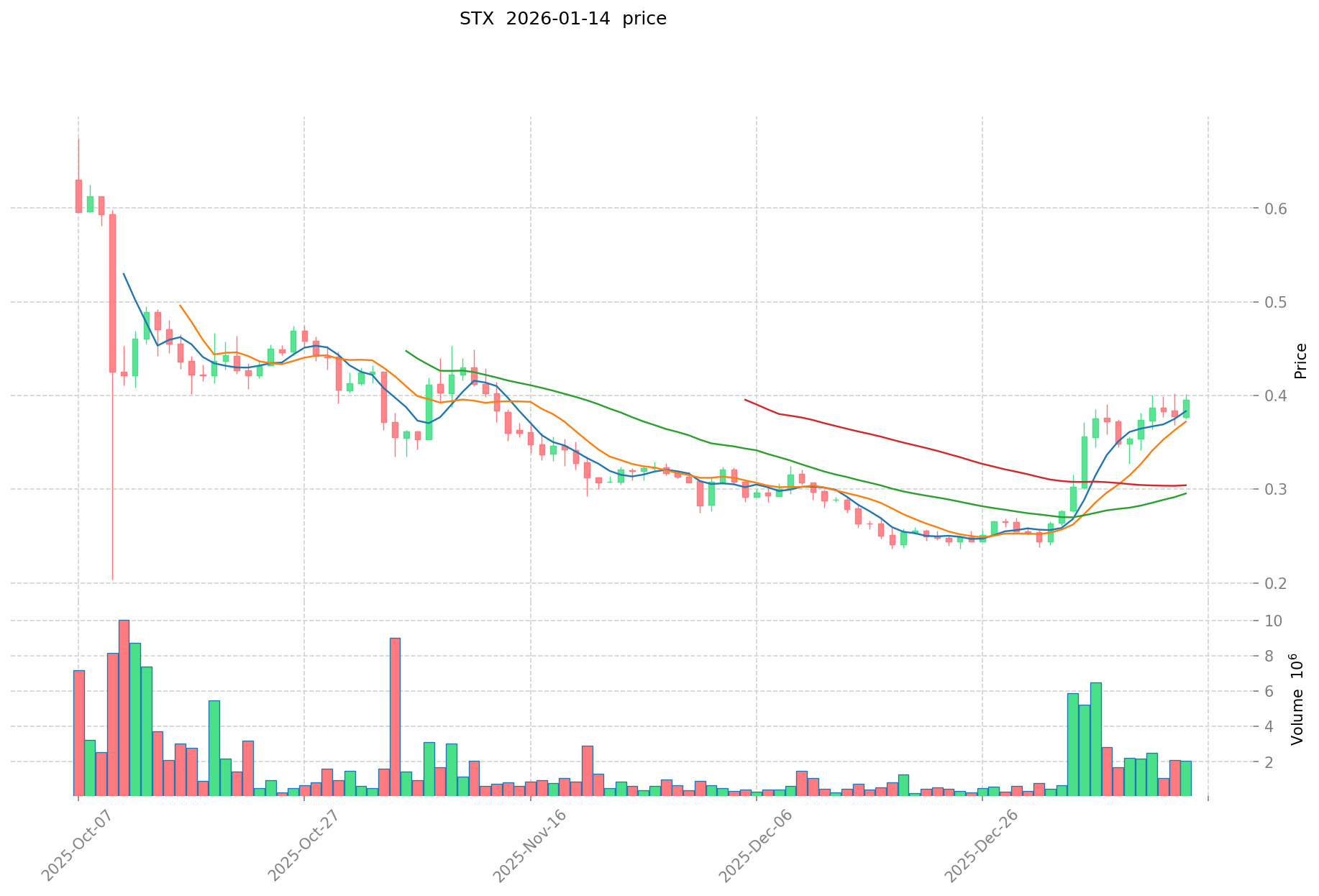
I. Stacks (STX) Price History Review and Current Investment Value Status
- 2021: Stacks 2.0 mainnet launched in January → The project introduced smart contracts capabilities on Bitcoin, with initial price at $0.12
- 2024: Market reached a significant price level of $3.86 in April → STX experienced substantial market activity during this period
- 2024-2026: Market correction phase → Price adjusted from April 2024 levels to current trading range around $0.39
- Historical performance: Since the 2019 SEC-qualified token offering, STX has demonstrated volatility consistent with broader cryptocurrency market cycles
Current STX Investment Market Status (January 2026)
- STX current price: $0.3922
- 24-hour price change: +0.43%
- 7-day price change: +8.27%
- 30-day price change: +39.44%
- 24-hour trading volume: $1,861,391.95
- Current market capitalization: $714,985,544
- Circulating supply: 1,823,012,605.95 STX (100.28% of max supply)
- Market dominance: 0.021%
Click to view real-time STX market price
II. Core Factors Affecting Whether STX is a Good Investment
Supply Mechanism and Scarcity (STX Investment Scarcity)
- Total Supply and Circulation: According to available data, STX has a total supply of 1,823,012,605.95 tokens, with a circulating supply of 1,823,012,605.95 tokens and a max supply of 1,818,000,000 tokens. The circulating ratio stands at approximately 100.28%, indicating that nearly all tokens are in circulation.
- Supply dynamics may influence price movements and investment value over time, though specific historical correlations require further observation.
- Investment Significance: The degree of scarcity, along with token utility and network activity, can contribute to long-term investment considerations.
Institutional Investment and Mainstream Adoption (Institutional Investment in STX)
- Institutional Trends: Reports indicate that BitGo, Copper, and Hex Trust have launched sBTC custodial and stacking support. Additionally, ForDeFi has integrated sBTC into its protocol, while Jump Crypto, UTXO Capital, and SNZ have adopted sBTC into their Bitcoin strategies.
- Enterprise and institutional engagement with STX-related infrastructure may enhance its investment profile and market credibility.
- Policy and regulatory developments in various jurisdictions could also shape the investment outlook for STX.
Macroeconomic Environment's Impact on STX Investment
- Monetary policy shifts and interest rate changes may alter the attractiveness of digital assets, including STX, as investment alternatives.
- In inflationary environments, some digital assets are considered by certain market participants as potential hedges, though STX's specific role in this context requires independent assessment.
- Geopolitical uncertainties and market volatility may influence demand for diversified digital asset exposure, including STX.
Technology and Ecosystem Development (Technology & Ecosystem for STX Investment)
- sBTC Integration: The introduction of sBTC bridges aims to bring Bitcoin liquidity into DeFi applications on the Stacks network, potentially expanding use cases and network utility.
- Network Upgrades and Protocol Improvements: Ongoing upgrades and governance proposals (such as SIP-031) are designed to support developer funding and ecosystem growth, which may contribute to long-term value.
- DeFi, NFT, and Application Expansion: Stacks' smart contract capabilities, powered by the Clarity programming language, enable the creation and trading of digital assets. Growth in DeFi total value locked (TVL) and transaction volume, as observed in H1 2025, reflects increasing ecosystem activity. However, metrics such as user engagement and protocol performance should be monitored for sustained development.
III. STX Future Investment Prediction and Price Outlook (Is Stacks(STX) worth investing in 2026-2031)
Short-term Investment Prediction (2026, short-term STX investment outlook)
Based on current market data and technical indicators, Stacks (STX) demonstrates varied price projection scenarios for 2026. The token is currently trading at $0.3922, representing a notable distance from its historical high of $3.86 recorded on April 1, 2024.
- Conservative Prediction: $0.31 - $0.39
- Neutral Prediction: $0.39 - $0.50
- Optimistic Prediction: $0.50 - $0.58
The short-term outlook reflects recent momentum, with STX showing a 7-day increase of 8.27% and a 30-day gain of 39.44%. However, the token remains down 72.98% over the past year, indicating ongoing recovery dynamics.
Mid-term Investment Outlook (2027-2028, mid-term Stacks(STX) investment forecast)
-
Market Stage Expectations: The mid-term period may witness continued ecosystem development as Stacks advances its Bitcoin Layer 2 positioning and smart contract capabilities through the Clarity programming language.
-
Investment Return Prediction:
- 2027: $0.23 - $0.58 (with average projection around $0.45)
- 2028: $0.39 - $0.70 (with average projection around $0.51)
-
Key Catalysts: The evolution of sBTC functionality, Bitcoin network developments, decentralized application adoption on the Stacks platform, and broader Layer 2 solution integration may influence price trajectories during this period.
Long-term Investment Outlook (Is Stacks a good long-term investment?)
Long-term projections for STX extend through 2031, with various scenarios reflecting different market conditions and ecosystem development trajectories:
- Base Scenario: $0.46 - $0.86 (assuming steady ecosystem growth and maintained Bitcoin Layer 2 positioning)
- Optimistic Scenario: $0.86 - $1.25 (assuming accelerated decentralized application adoption and favorable Bitcoin market conditions)
- Risk Scenario: $0.23 - $0.46 (under conditions of reduced market interest or competitive pressures from alternative Layer 2 solutions)
View STX long-term investment and price prediction: Price Prediction
2026-2031 Long-term Outlook
- Base Scenario: $0.46 - $0.86 (corresponding to steady progress and gradual mainstream application enhancement)
- Optimistic Scenario: $0.86 - $1.25 (corresponding to large-scale adoption and favorable market environment)
- Transformative Scenario: Above $1.25 (if ecosystem achieves breakthrough progress and mainstream penetration)
- December 31, 2031 Predicted High: $1.25 (based on optimistic development assumptions)
Disclaimer: These projections are based on current market analysis and should not be construed as financial advice. Cryptocurrency markets remain highly volatile, and actual performance may differ substantially from predictions. Historical performance does not guarantee future results. Investors should conduct thorough research and consider their risk tolerance before making investment decisions.
| Year |
Predicted High Price |
Predicted Average Price |
Predicted Low Price |
Price Change |
| 2026 |
0.502584 |
0.3896 |
0.31168 |
0 |
| 2027 |
0.5799196 |
0.446092 |
0.23196784 |
13 |
| 2028 |
0.697687888 |
0.5130058 |
0.389884408 |
30 |
| 2029 |
0.85959251848 |
0.605346844 |
0.4842774752 |
54 |
| 2030 |
0.9961587664864 |
0.73246968124 |
0.6885215003656 |
86 |
| 2031 |
1.25325562460164 |
0.8643142238632 |
0.458086538647496 |
120 |
IV. Stacks Investment Strategy and Risk Management (How to invest in Stacks)
Investment Methodology (Stacks investment strategy)
Long-term Holding (HODL Stacks): Suitable for Conservative Investors
Long-term holding represents a fundamental approach for investors seeking exposure to Stacks' decentralized application ecosystem. This strategy involves acquiring STX tokens and maintaining positions through market cycles, aligning with the project's vision of building a new internet for decentralized applications. Investors adopting this approach typically focus on the protocol's technological development, ecosystem growth, and adoption metrics rather than short-term price movements. The historical price performance shows significant volatility, with the token trading at $0.3922 as of January 14, 2026, compared to its all-time high of $3.86 recorded on April 1, 2024, indicating substantial fluctuation potential that long-term holders must be prepared to navigate.
Active Trading: Relying on Technical Analysis and Swing Operations
Active trading strategies for STX involve leveraging technical analysis tools and market timing techniques to capitalize on price movements. With a 24-hour trading volume of approximately $1.86 million and availability on 34 exchanges, the token demonstrates sufficient liquidity for tactical trading approaches. Recent price trends show a 0.43% increase over 24 hours, an 8.27% gain over 7 days, and a notable 39.44% increase over 30 days, while experiencing a significant decline of 72.98% over the past year. These varying timeframe performances suggest opportunities for swing traders to identify entry and exit points based on momentum indicators, support and resistance levels, and volume analysis. The 24-hour price range between $0.3857 and $0.4014 provides insight into intraday volatility patterns that active traders may utilize.
Risk Management (Risk management for Stacks investment)
Asset Allocation Ratios: Conservative / Aggressive / Professional Investors
Appropriate position sizing varies significantly based on investor profiles and risk tolerance. Conservative investors might consider limiting STX exposure to 1-3% of their overall cryptocurrency portfolio, given the project's market capitalization of approximately $715 million and its ranking at position 108 among digital assets. Aggressive investors with higher risk tolerance and conviction in the decentralized application thesis may allocate 5-10% of their crypto holdings to Stacks. Professional investors and institutions might take larger strategic positions of 10-20% within their digital asset allocations, particularly if they have conducted thorough due diligence on the protocol's technical architecture, consensus mechanism (Proof of Transfer), and ecosystem development roadmap. The fully diluted market cap alignment at 100% indicates minimal dilution risk from token unlocks, which may influence allocation decisions.
Diversification represents a primary risk mitigation strategy for STX investors. Combining Stacks holdings with other blockchain infrastructure projects, established cryptocurrencies, and stablecoins can reduce portfolio volatility. Investors may consider pairing STX positions with Bitcoin exposure, given Stacks' technical relationship with the Bitcoin network through its Proof of Transfer consensus mechanism. Additionally, implementing stop-loss orders, utilizing options contracts where available, and maintaining cash reserves for opportunistic buying during market downturns constitute practical hedging approaches. Portfolio rebalancing on a quarterly or semi-annual basis helps maintain target allocation percentages as relative asset values fluctuate.
Secure Storage: Hot and Cold Wallets + Hardware Wallet Recommendations
Secure custody of STX tokens requires understanding different storage solutions based on usage patterns and security priorities. Hot wallets, including mobile and desktop applications that support Stacks, offer convenience for active traders and users interacting with decentralized applications within the ecosystem. However, for long-term holdings representing substantial value, cold storage solutions provide enhanced security by keeping private keys offline. Hardware wallets that support STX enable secure storage while maintaining the ability to participate in stacking (Stacks' native staking mechanism). Investors should implement security best practices including multi-signature configurations where appropriate, secure backup of recovery phrases in multiple physical locations, and regular security audits of their storage solutions. For institutional holdings, custodial services specializing in digital assets may provide insurance coverage and regulatory compliance benefits.
V. Stacks Investment Risks and Challenges (Risks of investing in Stacks)
Market Risk: High Volatility and Price Manipulation
Stacks exhibits significant price volatility characteristic of mid-cap cryptocurrency projects. The token's historical price range from an all-time low of $0.04559639 on March 13, 2020, to an all-time high of $3.86 on April 1, 2024, demonstrates extreme price swings that can result in substantial gains or losses over relatively short periods. The current market capitalization of approximately $715 million represents 0.021% market dominance, indicating limited market depth compared to larger digital assets. This relatively smaller market size may increase susceptibility to price manipulation tactics, including wash trading, spoofing, and coordinated buying or selling pressure. Investors should maintain awareness of unusual volume patterns and price movements that deviate significantly from broader market trends. The 72.98% decline over the past year underscores the potential for prolonged bear market conditions that can test investor conviction and risk tolerance.
Regulatory Risk: Policy Uncertainty Across Different Countries
The regulatory landscape for blockchain-based smart contract platforms and decentralized applications remains in flux across global jurisdictions. Stacks' positioning as infrastructure for decentralized applications, combined with its smart contract capabilities through the Clarity programming language, may attract regulatory scrutiny similar to that faced by other programmable blockchain platforms. Different countries maintain varying approaches to cryptocurrency regulation, ranging from supportive frameworks that encourage innovation to restrictive policies that limit or prohibit certain activities. Changes in regulatory stances, particularly in major markets, could impact STX token utility, exchange listings, and overall project viability. Investors should monitor regulatory developments in their jurisdictions and consider the potential impact of evolving compliance requirements on the Stacks ecosystem and token economics.
Technical Risk: Network Security Vulnerabilities and Upgrade Failures
As blockchain infrastructure supporting decentralized applications, Stacks faces technical risks inherent to complex distributed systems. The protocol's Proof of Transfer consensus mechanism, while innovative in its approach to leveraging Bitcoin's security, introduces unique technical dependencies and potential failure points. Smart contracts written in Clarity, despite the language's design emphasis on predictability and security, may contain vulnerabilities that could be exploited if not properly audited. Network upgrades and protocol changes carry implementation risks, including potential consensus failures, backwards compatibility issues, or unintended consequences affecting network stability. The three-layer architecture (blockchain foundation, peer-to-peer network, and data layer) creates multiple potential points of failure that require ongoing maintenance and monitoring. Additionally, the project's open-source development model, while promoting transparency and community participation, relies on sustained developer engagement and funding for long-term technical viability.
VI. Conclusion: Is Stacks a Good Investment?
Investment Value Summary
Stacks presents a distinctive value proposition within the blockchain ecosystem through its focus on enabling decentralized applications with built-in privacy and user data ownership. The project's technical architecture, utilizing Proof of Transfer consensus and the Clarity programming language, offers differentiated approaches to smart contract development and blockchain security. With a current price of $0.3922 and market capitalization of approximately $715 million, the token trades at a substantial discount from its all-time high, potentially presenting opportunities for investors with conviction in the decentralized application thesis. However, the significant price volatility evidenced by the 72.98% decline over the past year demonstrates that short-term price movements can be severe and unpredictable. The project's long-term potential depends on factors including ecosystem adoption, developer activity, regulatory developments, and successful technical execution of the roadmap.
Investor Recommendations
✅ Beginners: Consider implementing a dollar-cost averaging strategy to accumulate positions gradually while minimizing timing risk. Prioritize secure storage solutions, starting with reputable software wallets before transitioning to hardware wallet solutions as holdings increase. Focus on understanding the fundamental technology and use cases rather than attempting to time short-term price movements. Allocate only capital that can be held through extended market downturns without requiring liquidation.
✅ Experienced Investors: Evaluate swing trading opportunities based on technical analysis while maintaining a core long-term position. Implement portfolio diversification across multiple blockchain infrastructure projects, established cryptocurrencies, and stablecoins to manage concentration risk. Monitor key metrics including ecosystem growth, developer activity, total value locked in Stacks-based applications, and stacking participation rates. Consider tax implications of trading activity and maintain detailed records for reporting purposes.
✅ Institutional Investors: Conduct comprehensive due diligence including technical audits, regulatory analysis, and competitive positioning assessment before establishing strategic allocations. Evaluate Stacks' potential role within broader digital asset portfolios, considering correlation patterns with Bitcoin and other infrastructure projects. Implement institutional-grade custody solutions with insurance coverage and regulatory compliance capabilities. Assess opportunities for active participation in network governance and stacking mechanisms to generate additional yield on holdings.
⚠️ Notice: Cryptocurrency investments carry substantial risk, including the potential for total loss of capital. This analysis is provided for informational purposes only and does not constitute investment advice. Investors should conduct independent research, assess personal risk tolerance, and consult qualified financial advisors before making investment decisions.
VII. FAQ
Q1: What makes Stacks (STX) different from other smart contract platforms?
Stacks distinguishes itself through its unique Proof of Transfer (PoX) consensus mechanism that leverages Bitcoin's security while enabling smart contracts. Unlike other platforms, Stacks uses the Clarity programming language specifically designed for predictability and security, allowing developers to analyze contract behavior before execution. The protocol serves as a Bitcoin Layer 2 solution, bringing decentralized applications and DeFi functionality to Bitcoin's ecosystem while maintaining the base layer's security guarantees. This three-layer architecture (blockchain foundation, peer-to-peer network, and data layer) combined with its focus on user data ownership and built-in privacy creates a distinctive technical positioning within the blockchain infrastructure landscape.
Q2: Is STX suitable for long-term investment or short-term trading?
Both strategies are viable but suit different investor profiles. Long-term holding (HODL) aligns with investors who believe in the decentralized application ecosystem's growth, though they must withstand significant volatility—STX declined 72.98% over the past year despite trading at $0.3922. Active trading leverages technical analysis opportunities, with recent performance showing 39.44% gains over 30 days but with substantial intraday fluctuations ($0.3857-$0.4014 range). Conservative investors typically allocate 1-3% to STX, aggressive traders 5-10%, and professional investors 10-20% of their crypto portfolios. The fully diluted market cap at 100% minimizes dilution risks, supporting long-term thesis, while sufficient trading volume ($1.86 million 24-hour) enables tactical trading approaches.
Q3: What are the primary investment risks associated with Stacks?
Three major risk categories affect STX investments. Market risk stems from extreme volatility—historical range from $0.0456 (March 2020) to $3.86 (April 2024)—and limited market depth with 0.021% market dominance, potentially exposing positions to manipulation. Regulatory risk involves uncertain policies across jurisdictions affecting smart contract platforms, with potential impact on token utility, exchange listings, and project viability. Technical risk includes security vulnerabilities in the Proof of Transfer mechanism, potential smart contract exploits despite Clarity's safety features, network upgrade failures, and reliance on sustained developer engagement. The three-layer architecture creates multiple failure points requiring ongoing maintenance. Investors should implement diversification, position sizing, and secure storage practices to mitigate these risks.
Q4: How does the sBTC integration impact Stacks' investment potential?
The sBTC bridge represents a significant ecosystem development, potentially enhancing STX's investment thesis through several mechanisms. It aims to bring Bitcoin's liquidity—currently the largest cryptocurrency by market capitalization—into DeFi applications on the Stacks network, expanding use cases and network utility. Institutional adoption is notable, with BitGo, Copper, and Hex Trust launching sBTC custodial and stacking support, while ForDeFi integrated sBTC into its protocol. Jump Crypto, UTXO Capital, and SNZ have incorporated sBTC into their Bitcoin strategies, signaling institutional validation. This integration could drive Total Value Locked (TVL) growth and transaction volume increases observed in H1 2025, though sustained user engagement and protocol performance require continued monitoring to validate long-term value creation.
Q5: What price predictions exist for STX through 2031?
Price projections vary significantly based on market conditions and ecosystem development trajectories. Short-term (2026): Conservative $0.31-$0.39, Neutral $0.39-$0.50, Optimistic $0.50-$0.58, reflecting recent momentum with 8.27% weekly gains. Mid-term (2027-2028): 2027 range $0.23-$0.58 (average $0.45), 2028 range $0.39-$0.70 (average $0.51), contingent on sBTC functionality evolution and Bitcoin network developments. Long-term (through 2031): Base scenario $0.46-$0.86 (steady growth), Optimistic scenario $0.86-$1.25 (accelerated adoption), Risk scenario $0.23-$0.46 (competitive pressures). The December 31, 2031 predicted high reaches $1.25 under optimistic assumptions. However, these projections should not be construed as financial advice; historical performance does not guarantee future results in highly volatile cryptocurrency markets.
Q6: How should investors securely store their STX tokens?
Secure custody requires understanding different storage solutions based on usage patterns and security priorities. Hot wallets (mobile/desktop applications) provide convenience for active traders and users interacting with Stacks-based decentralized applications, suitable for frequently accessed funds. Cold storage solutions offer enhanced security for long-term holdings by keeping private keys offline—hardware wallets supporting STX enable secure storage while maintaining stacking participation capabilities. Best practices include implementing multi-signature configurations where appropriate, securing recovery phrase backups in multiple physical locations, and conducting regular security audits. Institutional holdings may benefit from specialized custodial services providing insurance coverage and regulatory compliance benefits. Position size should determine storage approach: smaller active trading amounts in hot wallets, substantial long-term holdings in hardware wallets or institutional custody.
Q7: What role does the Stacks ecosystem play in determining STX investment value?
Ecosystem development fundamentally influences STX's long-term investment potential through multiple value drivers. The protocol's smart contract capabilities powered by Clarity enable DeFi applications, NFT creation and trading, and decentralized application development, with observed TVL and transaction volume growth in H1 2025 indicating increasing network activity. Network upgrades and governance proposals (such as SIP-031) support developer funding and ecosystem expansion, critical for sustained growth. The current market capitalization of $715 million represents infrastructure supporting this ecosystem development. However, investment value ultimately depends on sustained user engagement, protocol performance metrics, developer activity levels, and successful execution of technical roadmaps. Investors should monitor ecosystem metrics including active addresses, transaction counts, total value locked, stacking participation rates, and developer contributions to assess whether the network achieves the adoption necessary to support price appreciation scenarios outlined in long-term forecasts.
Q8: How does macroeconomic environment affect STX investment decisions?
Macroeconomic conditions significantly influence digital asset attractiveness, including STX. Monetary policy shifts and interest rate changes alter opportunity costs—rising rates may reduce appetite for speculative digital assets as traditional fixed-income securities become more attractive, while accommodative policies potentially increase risk-on sentiment favoring cryptocurrencies. Inflationary environments lead some market participants to consider digital assets as potential hedges, though STX's specific role in this context requires independent assessment given its mid-cap status and ecosystem-specific value drivers. Geopolitical uncertainties and market volatility may drive demand for diversified digital asset exposure as investors seek alternatives to traditional markets. However, STX's correlation with broader cryptocurrency markets, particularly Bitcoin given its technical relationship through Proof of Transfer, means it generally moves in tandem with overall crypto market cycles rather than serving as an uncorrelated hedge. Investors should consider macroeconomic context when timing entries and exits while recognizing that project-specific factors ultimately determine long-term value creation.
* The information is not intended to be and does not constitute financial advice or any other recommendation of any sort offered or endorsed by Gate.