This comprehensive analysis evaluates whether Stader Labs (SD) represents a viable investment opportunity in the staking infrastructure sector. SD, trading at $0.2339 as of January 2026, serves as a utility token for proof-of-stake network middleware with 69.62 million tokens circulating. The article examines SD's investment profile across multiple dimensions: price history revealing a 94.8% decline from its $4.50 launch price, current market position with $16.28 million market capitalization across 18 exchanges including Gate, key factors affecting investment value including supply scarcity and ecosystem development, and detailed price forecasts spanning 2026-2031 under various scenarios. Critical investment considerations include substantial market volatility with 77.01% one-year decline, regulatory uncertainties surrounding staking protocols, and technical execution risks. The analysis provides tailored investment strategies for conservative, aggressive, and institutional investors, alongside comprehensive
Introduction: Stader Labs (SD) Investment Position and Market Outlook
SD is a significant asset in the cryptocurrency sector, representing Stader Labs' native token that serves the staking infrastructure ecosystem. As of January 24, 2026, SD maintains a market capitalization of approximately $16.28 million, with a circulating supply of around 69.62 million tokens out of a maximum supply of 150 million. The current trading price stands at approximately $0.2339, reflecting a market share of 0.00088% within the broader crypto market. Since its launch with an initial offering price of $4.5, SD has positioned itself as a utility token for a staking middleware infrastructure designed for Proof-of-Stake (PoS) networks. With over 20,623 token holders and availability across 18 exchanges, SD has established a presence within the decentralized finance staking sector. The token's vision centers on providing convenient and secure staking solutions for retail users, exchanges, custodians, and fintech players. As investors evaluate "Is Stader Labs (SD) a good investment?", this article provides a comprehensive analysis of SD's investment characteristics, historical performance patterns, future price considerations, and associated investment risks to serve as a reference for potential stakeholders.
I. SD Token Price History Review and Current Investment Value Status
- 2022: Token launched at $4.5 initial offering price → Reached peak valuation during early market adoption phase
- 2022 (March): Market activity milestone → SD recorded an all-time high of $30.17 on March 15, 2022
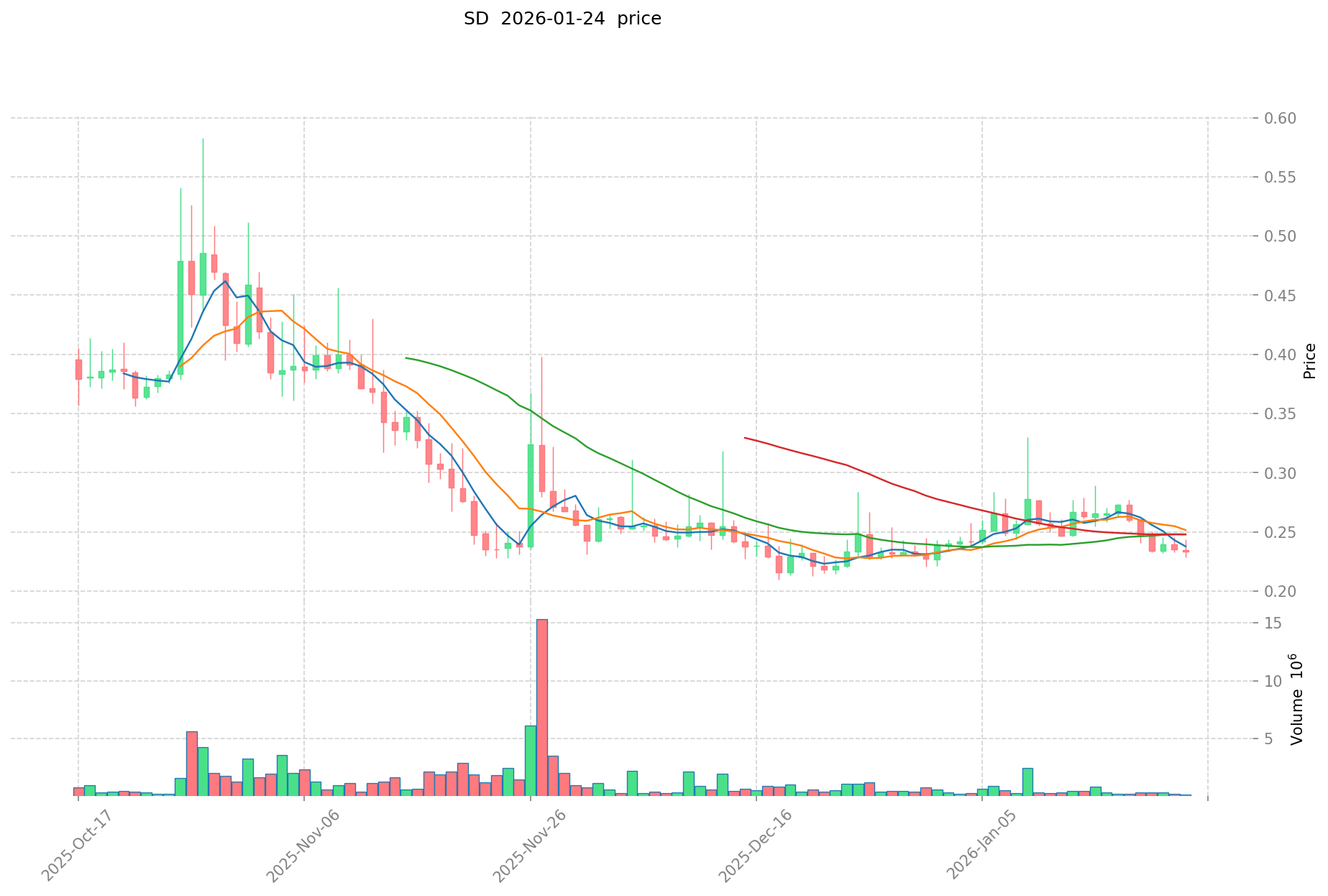
- 2025-2026: Market adjustment cycle → Price declined from higher valuation levels to $0.211989 recorded on December 19, 2025
Current SD Investment Market Status (January 2026)
- SD Current Price: $0.2339 (as of January 24, 2026)
- Market Sentiment (Fear & Greed Index): Data not available in provided materials
- 24-Hour Trading Volume: $34,538.92
- Institutional Investor Holdings: Data regarding institutional positions not available in provided materials
- Token Holders: 20,623 addresses
- Market Capitalization: $16,284,338.54
- Circulating Supply: 69,620,942.90 SD (46.41% of total supply)
- Fully Diluted Valuation: $28,068,000
- Market Dominance: 0.00088%
- Available on 18 exchanges with Gate.com listing support
Click to view real-time SD market price
II. Core Factors Affecting Whether SD is a Good Investment (Is Stader Labs(SD) a Good Investment)
Supply Mechanism and Scarcity (SD investment scarcity)
- Supply mechanism → Impacts price and investment value
- Historical patterns: Supply changes have influenced SD price movements
- Investment significance: Scarcity is a key factor supporting long-term investment
Stader Labs (SD) operates with a defined token supply structure that influences its investment profile. The circulating supply stands at approximately 69.62 million SD tokens, representing 46.41% of the maximum supply of 150 million tokens. This indicates a controlled release schedule with approximately 53.59% of tokens yet to enter circulation. The total supply is capped at 120 million tokens, suggesting a pre-defined allocation mechanism that balances immediate liquidity with future distribution.
From a scarcity perspective, the token has experienced significant price volatility since its launch. Historical data shows the token reached higher price levels in March 2022, while more recent periods in December 2025 saw lower price points. This price range reflects market responses to supply dynamics and demand fluctuations. The relatively modest circulating supply compared to maximum supply could potentially influence future price movements as additional tokens enter the market, though the impact would depend on release schedules and concurrent demand factors.
The market capitalization to fully diluted valuation ratio of 46.41% indicates that current valuation accounts for less than half of the total potential supply. This metric suggests investors should consider the implications of future token releases when evaluating investment value. The supply mechanism's influence on investment value operates through the interaction between token release schedules, market demand, and the broader adoption of Stader's staking infrastructure across supported blockchain networks.
Institutional Investment and Mainstream Adoption (Institutional investment in SD)
- Holder distribution: Approximately 20,623 addresses hold SD tokens
- Exchange presence: Listed on 18 cryptocurrency exchanges
- Market position: Occupies niche role in staking infrastructure sector
The institutional investment landscape for SD reflects its position as a specialized staking infrastructure protocol. The token maintains presence across 18 exchanges, providing accessibility for various investor categories. The holder count of approximately 20,623 addresses suggests a distributed ownership pattern, though specific institutional allocation data remains unspecified in available materials.
Mainstream adoption of Stader Labs centers on its staking middleware infrastructure designed for Proof-of-Stake networks. The platform's value proposition targets multiple user segments including retail cryptocurrency users, exchanges, custodians, and fintech platforms. The modular smart contract architecture allows third-party integrations for customized staking solutions, potentially expanding the protocol's utility across different blockchain ecosystems.
The investment value proposition relates to Stader's infrastructure role in the staking economy. As blockchain networks increasingly adopt Proof-of-Stake consensus mechanisms, staking infrastructure services occupy a functional position in the ecosystem. The platform's multi-chain approach, supporting various blockchain networks, positions it to potentially benefit from broader staking adoption trends. However, investment outcomes depend on the platform's ability to maintain competitive positioning within the evolving staking services landscape.
Macroeconomic Environment's Impact on SD Investment
- Monetary policy and interest rate changes → Alter investment attractiveness
- Cryptocurrency market conditions → Influence risk appetite for specialized tokens
- Regulatory developments → Shape staking infrastructure viability
The macroeconomic environment influences SD investment through several transmission channels. Interest rate policies affect opportunity costs for holding crypto assets versus traditional yield-bearing instruments. In higher interest rate environments, the relative attractiveness of staking yields may face comparison with risk-free rates, potentially influencing investor allocation decisions.
Cryptocurrency market conditions broadly impact specialized infrastructure tokens like SD. Market sentiment shifts between risk-on and risk-off phases affect capital flows into niche protocol tokens. During periods of heightened market uncertainty, investors may consolidate holdings into more established assets, potentially affecting liquidity and valuations for smaller market capitalization tokens.
Regulatory developments concerning staking services and DeFi infrastructure carry implications for SD's investment profile. Policy frameworks governing staking operations, token classifications, and cross-border cryptocurrency services shape the operational environment for protocols like Stader Labs. Changes in regulatory approaches across major jurisdictions could influence both the demand for staking services and the compliance requirements for infrastructure providers.
Technology and Ecosystem Development (Technology & Ecosystem for SD investment)
- Staking infrastructure development: Enhances network performance → Strengthens investment proposition
- Multi-chain expansion: Broadens ecosystem applications → Supports long-term value
- DeFi integration potential → Contributes to investment value through utility expansion
The technological foundation of Stader Labs centers on its staking middleware infrastructure for Proof-of-Stake networks. The platform's modular smart contract architecture allows customization for different staking requirements across multiple blockchain networks. This technical approach positions the protocol to serve various user segments with differing staking needs and preferences.
Ecosystem development involves expansion across multiple blockchain networks. The multi-chain strategy aims to establish staking infrastructure presence across different Proof-of-Stake ecosystems, potentially increasing the protocol's addressable market. Technical improvements to staking efficiency, user experience, and integration capabilities could influence the platform's competitive positioning within the staking services sector.
The investment value from technology and ecosystem development relates to adoption metrics and market share within the staking infrastructure space. Integration with DeFi protocols, institutional custody solutions, and mainstream fintech platforms could expand utility and demand for the platform's services. The realized investment impact depends on execution of technical roadmaps, competitive dynamics within the staking services market, and the overall growth trajectory of Proof-of-Stake blockchain adoption.
III. SD Future Investment Forecast and Price Outlook (Is Stader Labs(SD) worth investing in 2026-2031)
Short-term Investment Forecast (2026, short-term SD investment outlook)
- Conservative Forecast: $0.168 - $0.234
- Neutral Forecast: $0.234 - $0.290
- Optimistic Forecast: $0.290 - $0.346
Mid-term Investment Outlook (2027-2028, mid-term Stader Labs(SD) investment forecast)
-
Market Stage Expectation: Based on historical data, SD may experience moderate fluctuations during the mid-term period, with potential price consolidation and possible upward momentum depending on broader market conditions and ecosystem developments.
-
Investment Return Forecast:
- 2027: $0.211 - $0.394
- 2028: $0.301 - $0.362
-
Key Catalysts: Staking infrastructure expansion, strategic partnerships with exchanges and custodians, increased adoption of staking solutions across PoS networks, and overall cryptocurrency market sentiment.
Long-term Investment Outlook (Is SD a good long-term investment?)
- Base Scenario: $0.226 - $0.359 (assuming steady development of staking middleware infrastructure and moderate market growth)
- Optimistic Scenario: $0.338 - $0.437 (assuming accelerated adoption of staking solutions, successful multi-chain expansion, and favorable regulatory environment)
- Risk Scenario: $0.169 - $0.241 (under adverse market conditions, increased competition in staking services, or technical challenges)
View SD long-term investment and price forecast: Price Prediction
2026-01-24 - 2031 Long-term Outlook
- Base Scenario: $0.226 - $0.359 (corresponding to steady progress and gradual mainstream application improvement)
- Optimistic Scenario: $0.338 - $0.437 (corresponding to large-scale adoption and favorable market environment)
- Transformative Scenario: Above $0.437 (if ecosystem achieves breakthrough progress and mainstream adoption)
- 2031-12-31 Forecast High: $0.437 (based on optimistic development assumptions)
Disclaimer: This forecast is for informational purposes only and should not be construed as financial advice. Cryptocurrency investments carry significant risks, and past performance does not guarantee future results. Investors should conduct their own research and consult with financial professionals before making investment decisions.
| Year |
Predicted High Price |
Predicted Average Price |
Predicted Low Price |
Price Change |
| 2026 |
0.345728 |
0.2336 |
0.168192 |
0 |
| 2027 |
0.39394304 |
0.289664 |
0.21145472 |
23 |
| 2028 |
0.3623117312 |
0.34180352 |
0.3007870976 |
46 |
| 2029 |
0.366139930624 |
0.3520576256 |
0.337975320576 |
50 |
| 2030 |
0.36987174145536 |
0.359098778112 |
0.22623223021056 |
53 |
| 2031 |
0.437382311740416 |
0.36448525978368 |
0.240560271457228 |
55 |
IV. SD Investment Strategy and Risk Management (How to invest in Stader Labs)
Investment Strategy (SD investment strategy)
Long-term Holding (HODL SD)
For conservative investors seeking exposure to staking infrastructure protocols, a long-term holding strategy may be appropriate. This approach involves acquiring SD tokens and maintaining positions through market cycles, allowing potential value appreciation as the Stader protocol develops its multi-chain staking solutions. Investors should consider dollar-cost averaging to mitigate entry timing risks given the token's historical volatility.
Active Trading
Active traders may employ technical analysis and swing trading strategies based on SD's price movements. The token has demonstrated notable volatility, with 24-hour fluctuations and weekly changes of approximately -11.87% as of January 24, 2026. Traders should establish clear entry and exit points, utilizing support and resistance levels identified through chart analysis. Risk parameters should be strictly defined before initiating positions.
Risk Management (Risk management for SD investment)
Asset Allocation Ratios
- Conservative Investors: Allocate 1-3% of crypto portfolio to SD, emphasizing established assets for remaining holdings
- Aggressive Investors: May allocate 5-10% to SD as part of a diversified DeFi and infrastructure-focused portfolio
- Professional Investors: Position sizing should align with institutional risk frameworks and liquidity requirements
Risk Hedging Strategies
Implement portfolio diversification across multiple asset classes and blockchain ecosystems. Consider correlation analysis between SD and broader market indicators. Utilize stop-loss orders and position sizing techniques to limit downside exposure. Multi-asset portfolios should balance growth-oriented tokens with established cryptocurrencies.
Secure Storage Solutions
SD tokens on the Ethereum network (contract address: 0x30D20208d987713f46DFD34EF128Bb16C404D10f) should be stored according to security best practices:
- Hot Wallets: Suitable for active trading positions with regular access needs; implement two-factor authentication and strong passwords
- Cold Wallets: Recommended for long-term holdings; hardware wallets provide enhanced security through offline private key storage
- Hardware Wallet Options: Consider established hardware wallet providers that support ERC-20 tokens for maximum security
V. SD Investment Risks and Challenges (Risks of investing in Stader Labs)
Market Risks
SD has experienced substantial price volatility, with the token declining approximately -77.01% over a one-year period ending January 24, 2026. The 24-hour trading volume of approximately 34,538.92 units suggests relatively limited liquidity compared to major cryptocurrencies, which may amplify price swings during periods of market stress. The token's all-time high of 30.17 USD and all-time low of 0.211989 USD illustrate the significant price range experienced since launch.
Regulatory Risks
Staking protocols operate within evolving regulatory frameworks that vary significantly across jurisdictions. Changes in securities laws, staking regulations, or DeFi oversight could impact the protocol's operations and token utility. Investors should monitor regulatory developments in their respective jurisdictions and assess how policy changes might affect staking infrastructure platforms.
Technical Risks
As middleware infrastructure for proof-of-stake networks, Stader faces technical challenges including:
- Smart contract vulnerabilities that could affect user funds
- Integration complexities across multiple blockchain networks
- Competition from other staking solutions
- Protocol upgrade risks during implementation of new features
The protocol's modular smart contract architecture, while enabling customization, introduces additional complexity that requires ongoing security auditing and maintenance.
VI. Conclusion: Is Stader Labs a Good Investment?
Investment Value Summary
SD represents exposure to the growing staking infrastructure sector within the proof-of-stake blockchain ecosystem. The protocol's multi-chain approach and middleware positioning offer differentiation, though the token has faced significant price pressure with a -77.01% decline over the past year. Long-term potential depends on the protocol's ability to expand across additional networks and capture market share in the competitive staking landscape. Short-term price movements have demonstrated considerable volatility, with weekly fluctuations exceeding 10%.
Investor Recommendations
✅ Beginners: Consider dollar-cost averaging strategies with small allocations; prioritize secure storage through hardware wallets; dedicate time to understanding staking mechanics and protocol fundamentals before investing
✅ Experienced Investors: Implement swing trading strategies based on technical analysis; maintain diversified portfolio allocation across multiple DeFi protocols; actively monitor protocol developments and competitive positioning
✅ Institutional Investors: Evaluate strategic allocation as part of broader DeFi infrastructure exposure; conduct thorough due diligence on protocol security audits and team credentials; assess liquidity requirements against available trading volumes
⚠️ Disclaimer: Cryptocurrency investments carry substantial risk, including potential total loss of capital. This content is provided for informational purposes only and does not constitute investment advice. Conduct independent research and consult with qualified financial advisors before making investment decisions.
VII. FAQ
Q1: What makes Stader Labs (SD) different from other staking infrastructure protocols?
Stader Labs distinguishes itself through its modular smart contract architecture designed specifically as middleware for Proof-of-Stake networks. Unlike single-chain staking solutions, SD's multi-chain approach enables deployment across various blockchain ecosystems, supporting retail users, exchanges, custodians, and fintech platforms simultaneously. The platform's customizable infrastructure allows third-party integrations for tailored staking solutions, positioning it as a flexible middleware layer rather than a network-specific staking service. This architectural differentiation enables Stader to potentially capture market share across multiple growing PoS ecosystems rather than being limited to a single blockchain's staking economy.
Q2: How has SD's price performance compared to its initial offering price?
SD has experienced significant price decline from its initial offering price of $4.50. As of January 24, 2026, the token trades at approximately $0.2339, representing a decline of approximately 94.8% from its launch price. The token reached an all-time high of $30.17 on March 15, 2022, followed by substantial retracement. Over the most recent one-year period, SD declined approximately 77.01%, with the all-time low recorded at $0.211989 on December 19, 2025. This price history reflects broader cryptocurrency market volatility and specific challenges within the staking infrastructure sector during the observed period.
Q3: What percentage of SD's total supply is currently in circulation?
Approximately 46.41% of SD's maximum supply is currently in circulation. Specifically, 69.62 million tokens are circulating out of a maximum supply of 150 million tokens and a total supply of 120 million tokens. This indicates that roughly 53.59% of tokens remain to be released into the market. The circulating-to-maximum supply ratio is a critical consideration for investors, as future token releases could potentially impact price dynamics depending on distribution schedules and concurrent demand factors. The market capitalization to fully diluted valuation ratio of 46.41% suggests current valuations account for less than half of the total potential supply.
Q4: What are the primary risks associated with investing in SD tokens?
SD investment carries multiple risk categories. Market risks include substantial historical volatility, with a one-year decline of approximately 77.01% and relatively limited trading volume of around $34,538.92 daily, which may amplify price swings. Regulatory risks stem from evolving frameworks governing staking protocols and DeFi infrastructure across jurisdictions. Technical risks encompass smart contract vulnerabilities, integration complexities across multiple blockchain networks, and competitive pressures from alternative staking solutions. Additionally, the protocol faces execution risks related to its multi-chain expansion strategy and ability to capture market share within the competitive staking services landscape.
Q5: What is the recommended investment allocation for SD based on investor profile?
Investment allocation recommendations vary by investor sophistication and risk tolerance. Conservative investors should consider allocating 1-3% of their cryptocurrency portfolio to SD, emphasizing established assets for remaining holdings. Aggressive investors may allocate 5-10% to SD as part of a diversified DeFi and infrastructure-focused portfolio. Professional institutional investors should size positions according to institutional risk frameworks and liquidity requirements, conducting comprehensive due diligence on protocol security and competitive positioning. All investor categories should implement diversification strategies and utilize secure storage solutions, with hardware wallets recommended for long-term holdings.
Q6: How does SD's market capitalization compare to its fully diluted valuation?
SD's market capitalization stands at approximately $16.28 million, while its fully diluted valuation reaches approximately $28.07 million, representing a ratio of approximately 58%. This disparity indicates that current market valuation accounts for the circulating supply of 69.62 million tokens but does not reflect the full potential supply of 120-150 million tokens. The gap between market capitalization and fully diluted valuation suggests potential dilution effects as additional tokens enter circulation. Investors should monitor token release schedules and consider how future supply increases might interact with demand dynamics to influence price movements over time.
Q7: What technical infrastructure does Stader Labs provide to the staking ecosystem?
Stader Labs provides middleware staking infrastructure designed for Proof-of-Stake networks through modular smart contract architecture. The platform enables customized staking solutions for diverse user segments including retail participants, cryptocurrency exchanges, institutional custodians, and fintech platforms. The technical infrastructure supports multi-chain deployment, allowing integration across various blockchain ecosystems beyond a single network. This middleware positioning enables third-party developers and institutions to implement tailored staking services while leveraging Stader's underlying infrastructure. The protocol's value proposition centers on simplifying staking participation while maintaining security and efficiency across supported networks.
Q8: What are the price forecast ranges for SD through 2031?
Price forecasts for SD indicate varying scenarios based on market conditions and protocol development. For 2026, conservative forecasts range from $0.168-$0.234, neutral forecasts from $0.234-$0.290, and optimistic forecasts from $0.290-$0.346. Mid-term projections for 2027 range from $0.211-$0.394, while 2028 forecasts span $0.301-$0.362. Long-term scenarios through 2031 include: base case of $0.226-$0.359 assuming steady infrastructure development; optimistic scenario of $0.338-$0.437 with accelerated adoption; and risk scenario of $0.169-$0.241 under adverse conditions. These forecasts depend on numerous variables including staking adoption rates, competitive dynamics, regulatory developments, and broader cryptocurrency market trends. Investors should treat these as reference points rather than guaranteed outcomes.
* The information is not intended to be and does not constitute financial advice or any other recommendation of any sort offered or endorsed by Gate.