This comprehensive analysis examines whether Stafi (FIS), a liquid staking DeFi protocol launched in 2020, represents a viable investment. With a current market cap of $3.10 million and price near $0.01996, FIS enables staking liquidity through rToken derivatives. The article evaluates historical price trends (from $0.15 launch price to $4.70 peak in 2021), current market status, and core factors including unlimited token supply, limited institutional adoption following Binance delisting, and modest trading volume. Price projections range from $0.0136-$0.0288 (2026) to $0.0141-$0.0365 long-term under baseline scenarios. Investment strategies span conservative dollar-cost averaging to active trading, with recommended allocations of 2-15% depending on risk tolerance. Critical risks include extreme volatility, liquidity constraints, regulatory uncertainty, and smart contract vulnerabilities. The analysis concludes FIS suits speculative portfolio portions rather than primary investments, requiring thorough DeFi k
Introduction: Stafi (FIS) Investment Position and Market Outlook
Stafi (FIS) represents a notable asset within the cryptocurrency sector, having been launched in September 2020 as a DeFi protocol focused on unlocking liquidity for staked assets. As of January 31, 2026, FIS maintains a market capitalization of approximately $3.10 million, with a circulating supply of around 155.33 million tokens and a current price hovering near $0.01996. Positioned as a liquidity solution for Proof-of-Stake (PoS) staking, FIS has become a subject of interest among investors evaluating "Is Stafi (FIS) a good investment?" This article provides a comprehensive analysis of FIS's investment value, historical performance, future price projections, and associated risks to serve as a reference for potential investors.
The token's recent market performance reflects notable volatility, with a 24-hour price change of 1.05% and a 30-day gain of 26.46%, contrasting with a one-year decline. FIS currently holds a market dominance of 0.00010% and ranks at position 1807 among cryptocurrencies. The protocol's native token serves multiple functions including staking validation, transaction fee payments, on-chain governance participation, and value capture through platform fee distribution. With approximately 4,209 token holders and availability on 9 exchanges, FIS operates within a specialized niche of the decentralized finance ecosystem, focusing on derivative asset issuance through its rToken mechanism for staked PoS tokens.
I. Stafi (FIS) Historical Price Review and Current Investment Value
- 2020: Token launched at an initial price of $0.15 → Early-stage entry opportunity for initial investors
- 2021: Bull market milestone on March 19 with price reaching $4.7 → Early investors experienced substantial returns of approximately 3,033%
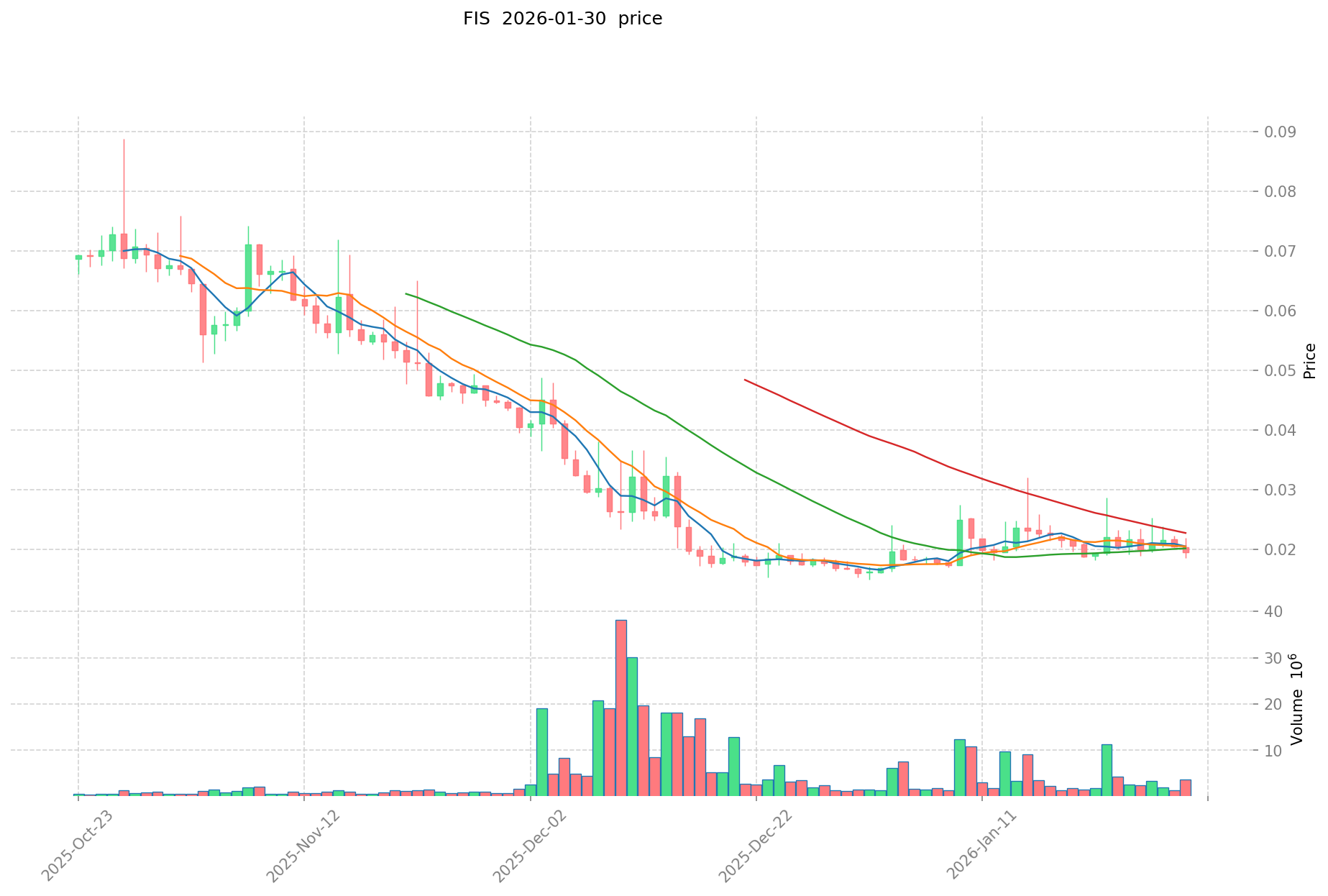
- 2022-2025: Price experienced significant correction from previous peak levels → Declining to lower price ranges amid broader market adjustments
- 2026: As of January 31, price stabilized around $0.01996 → Representing a decline from earlier elevated levels
Current FIS Investment Market Status (January 2026)
- FIS current price: $0.01996
- 24-hour trading volume: Approximately $49,000.94
- Market capitalization: $3.10 million
- Circulating supply: 155.33 million FIS tokens
- Price performance: +1.05% (24H), -2.46% (7D), +26.46% (30D)
Click to view real-time FIS market price
II. Core Factors Influencing Whether FIS is a Good Investment
Supply Mechanism and Scarcity (FIS Investment Scarcity)
- Total Supply: 155,334,804 FIS tokens with infinite maximum supply
- Circulating Supply: 155,334,804 FIS (100% circulation ratio)
- Market Cap to FDV: 100%, indicating full token circulation
The unlimited maximum supply mechanism suggests that FIS does not rely on supply scarcity as a primary value driver. With all tokens currently in circulation, the supply-side pressure remains constant unless additional issuance mechanisms are implemented. This full circulation status means that traditional scarcity-based value appreciation models may have limited applicability to FIS investment analysis.
Institutional Investment and Mainstream Adoption (Institutional Investment in FIS)
- Exchange Listings: FIS is traded on 9 exchanges
- Holder Distribution: 4,209 addresses hold FIS tokens
- Delisting Event: FIS was removed from Binance on December 17, 2025, due to concerns regarding liquidity and trading volumes
The delisting from a major exchange represents a significant headwind for institutional confidence. The relatively modest holder count and limited exchange presence suggest that mainstream adoption remains constrained. These factors may limit the asset's appeal to institutional investors seeking liquid, widely-supported tokens.
Macroeconomic Environment Impact on FIS Investment
- Market Capitalization: $3,100,482.69 (0.00010% market dominance)
- 24-Hour Trading Volume: $49,000.94
- Volume-to-Market-Cap Ratio: Approximately 1.58%
FIS occupies a minimal position within the broader cryptocurrency market. The low market dominance and trading volume suggest that macroeconomic factors affecting the crypto sector may have amplified effects on FIS. During periods of market contraction or regulatory uncertainty, smaller-cap assets like FIS may experience heightened volatility and reduced investor interest.
Technology and Ecosystem Development (Technology & Ecosystem for FIS Investment)
- Core Protocol Function: StaFi enables liquid staking through rToken derivatives, allowing users to stake PoS tokens while maintaining liquidity
- Token Utility: FIS serves multiple functions including staking for validators, transaction fee payments, on-chain governance participation, and value capture through fee-based buyback and burn mechanisms
- Technical Infrastructure: The protocol utilizes staking contracts, multi-signature accounts, and StaFi Special Validators (SSVs) for managing staked assets and transaction verification
The StaFi protocol addresses a specific use case within the DeFi ecosystem by providing liquidity solutions for staked assets. The protocol's technical framework supports derivative token issuance (rTokens) that represent staked assets, enabling holders to access staking rewards while maintaining trading flexibility. This functionality positions FIS within the liquid staking sector, an area that has seen development across multiple blockchain networks. The governance and fee-burning mechanisms embedded in the protocol design create ongoing utility for FIS tokens beyond simple transaction functions.
III. FIS Future Investment Forecast and Price Outlook (Is Stafi(FIS) worth investing in 2026-2030)
Short-term Investment Forecast (2026, short-term FIS investment outlook)
- Conservative forecast: $0.0136 - $0.0200
- Neutral forecast: $0.0200 - $0.0250
- Optimistic forecast: $0.0250 - $0.0288
Mid-term Investment Outlook (2027-2028, mid-term Stafi(FIS) investment forecast)
- Market phase expectation: The protocol may experience gradual adoption growth with potential expansion in DeFi staking solutions and cross-chain liquidity mechanisms.
- Investment return forecast:
- 2027: $0.0163 - $0.0263
- 2028: $0.0215 - $0.0261
- Key catalysts: Protocol upgrades, expansion of rToken offerings, validator network growth, and broader PoS ecosystem integration.
Long-term Investment Outlook (Is FIS a good long-term investment?)
- Baseline scenario: $0.0141 - $0.0365 (assuming steady protocol development and moderate market conditions)
- Optimistic scenario: $0.0218 - $0.0442 (assuming significant adoption increase and favorable regulatory environment)
- Risk scenario: $0.0136 - $0.0160 (under prolonged market downturn or increased competitive pressure)
View FIS long-term investment and price forecast: Price Prediction
2026-01-31 - 2031 Long-term Outlook
- Baseline scenario: $0.0141 - $0.0365 (corresponding to steady progress and gradual mainstream application growth)
- Optimistic scenario: $0.0218 - $0.0442 (corresponding to large-scale adoption and favorable market environment)
- Transformative scenario: Above $0.0450 (contingent on breakthrough ecosystem developments and mainstream adoption)
- 2031-12-31 forecast high: $0.0441 (based on optimistic development assumptions)
Disclaimer: The above forecasts are based on historical data and analytical models. Cryptocurrency markets are highly volatile and subject to various risks including regulatory changes, technological developments, and market sentiment shifts. Past performance does not guarantee future results. Investors should conduct thorough research and consider their risk tolerance before making investment decisions.
| Year |
Predicted High Price |
Predicted Average Price |
Predicted Low Price |
Price Change |
| 2026 |
0.0287568 |
0.01997 |
0.0135796 |
0 |
| 2027 |
0.026312472 |
0.0243634 |
0.016323478 |
22 |
| 2028 |
0.02609807408 |
0.025337936 |
0.0215372456 |
26 |
| 2029 |
0.0365195671568 |
0.02571800504 |
0.014144902772 |
28 |
| 2030 |
0.044188676259728 |
0.0311187860984 |
0.02178315026888 |
55 |
| 2031 |
0.044054865479504 |
0.037653731179064 |
0.025981074513554 |
88 |
IV. FIS Investment Strategy and Risk Management (How to invest in DeFi Liquid Staking)
Investment Methodology (FIS investment strategy)
Long-term Holding (HODL FIS)
For conservative investors seeking exposure to liquid staking protocols, a long-term holding strategy may be considered. This approach involves:
- Accumulating FIS tokens gradually through dollar-cost averaging to reduce timing risk
- Monitoring StaFi protocol development, adoption metrics, and ecosystem expansion
- Understanding the protocol's utility value derived from staking operations, governance participation, and fee capture mechanisms
Active Trading
Active traders may employ technical analysis and swing trading strategies:
- Identifying support and resistance levels based on historical price action
- Utilizing momentum indicators and volume analysis for entry and exit points
- Monitoring DeFi sector trends and liquid staking demand fluctuations
- Tracking protocol usage metrics and rToken issuance volumes
Risk Management (Risk management for FIS investment)
Asset Allocation Ratio
- Conservative investors: Limit DeFi protocol tokens to 2-5% of overall crypto portfolio
- Moderate investors: Allocate 5-10% to liquid staking and DeFi infrastructure tokens
- Aggressive investors: May consider 10-15% allocation with active risk monitoring
Risk Hedging Strategies
- Diversify across multiple liquid staking protocols and DeFi infrastructure projects
- Maintain positions in established cryptocurrencies (BTC, ETH) as portfolio anchors
- Consider stablecoin reserves for opportunistic rebalancing during volatility
- Monitor correlation with broader DeFi sector performance
Secure Storage
- Cold wallet storage: Hardware wallets (Ledger, Trezor) for long-term holdings
- Hot wallet considerations: MetaMask or compatible wallets for smaller amounts and active trading
- Multi-signature solutions for institutional or larger holdings
- Regular security audits and backup procedures for wallet access credentials
V. FIS Investment Risks and Challenges (Risks of investing in DeFi Liquid Staking)
Market Risks
- High volatility: FIS has experienced significant price fluctuations, with historical data showing substantial drawdowns from peak levels
- Liquidity concerns: Trading volume of approximately $49,000 in recent periods may present challenges for larger position entries or exits
- Market capitalization considerations: With a market cap around $3.1 million, FIS represents a smaller-cap asset with associated volatility characteristics
Regulatory Risks
- Evolving DeFi regulations: Liquid staking protocols may face scrutiny from financial regulators across different jurisdictions
- Token classification uncertainty: Regulatory treatment of utility tokens with staking and governance functions remains subject to interpretation
- Cross-border compliance: Multi-chain operations may encounter varying regulatory frameworks
Technical Risks
- Smart contract vulnerabilities: Staking contracts and multi-signature mechanisms require ongoing security audits
- Protocol upgrade risks: Changes to StaFi consensus mechanisms or rToken architecture may introduce technical challenges
- Network security: Validator operations and multi-signature account management require robust security protocols
- Integration dependencies: Reliance on underlying PoS networks for staking operations creates systemic dependencies
VI. Conclusion: Is DeFi Liquid Staking a Good Investment?
Investment Value Summary
FIS represents exposure to the liquid staking infrastructure sector within DeFi, offering utility through protocol operations, governance participation, and potential value accrual mechanisms. The protocol addresses liquidity challenges in PoS staking through rToken derivatives. However, investors should recognize the substantial price volatility characteristic of smaller-cap DeFi tokens and the evolving nature of liquid staking protocols.
Investor Recommendations
✅ Beginners: Consider periodic small purchases (dollar-cost averaging) combined with secure hardware wallet storage; thoroughly research DeFi protocols and liquid staking mechanisms before investment.
✅ Experienced Investors: May employ swing trading strategies while maintaining diversified DeFi portfolio allocation; monitor protocol metrics, adoption rates, and sector developments; implement appropriate position sizing.
✅ Institutional Investors: Conduct comprehensive due diligence on protocol architecture, security audits, and competitive positioning; consider strategic allocation within broader DeFi infrastructure exposure; implement institutional-grade custody solutions.
⚠️ Disclaimer: Cryptocurrency investments carry substantial risk including potential total loss of capital. This content is for informational purposes only and does not constitute investment advice, financial guidance, or recommendation to buy or sell any asset.
VII. FAQ
Q1: Is Stafi (FIS) a good investment for beginners in 2026?
FIS may be suitable for beginners only as a small, speculative portion of a diversified portfolio, not as a primary investment. Given its market capitalization of approximately $3.10 million, daily trading volume around $49,000, and significant historical volatility, FIS represents a higher-risk asset within the cryptocurrency sector. Beginners should approach FIS investment with caution, limiting allocation to 2-5% of their crypto portfolio and employing dollar-cost averaging strategies to mitigate timing risks. The protocol's focus on liquid staking solutions offers utility value, but investors must understand DeFi mechanics, smart contract risks, and the technical aspects of staking derivatives before committing capital. Secure storage using hardware wallets is essential for long-term holdings.
Q2: What are the main risks of investing in Stafi (FIS)?
The primary risks include extreme price volatility, limited liquidity, regulatory uncertainty, and technical vulnerabilities. FIS has experienced substantial price corrections from historical peaks, with current trading at approximately $0.01996 compared to the March 2021 high of $4.70. The token's delisting from Binance in December 2025 due to liquidity concerns highlights market accessibility challenges. Regulatory risks stem from evolving DeFi regulations and uncertain token classification frameworks across jurisdictions. Technical risks involve smart contract vulnerabilities in staking contracts, potential protocol upgrade complications, and dependencies on underlying PoS networks. The low trading volume and market capitalization also expose investors to heightened volatility during broader market downturns.
Q3: How does the StaFi protocol generate value for FIS token holders?
FIS derives value through multiple utility mechanisms within the StaFi ecosystem. Token holders participate in validator staking, earning rewards while securing the network through Nominated Proof-of-Stake consensus. FIS serves as the native payment method for transaction fees across the platform, creating ongoing demand. Governance participation allows FIS holders to influence protocol decisions and parameter adjustments. The protocol implements a value capture mechanism through fee-based buyback and burn operations, which may reduce circulating supply over time. Additionally, the rToken derivative system generates platform fees distributed to stakeholders, creating revenue streams linked to protocol adoption and usage volume.
Q4: What price forecasts exist for FIS through 2030?
Price projections for FIS vary significantly based on adoption scenarios and market conditions. Short-term forecasts for 2026 range from $0.0136 to $0.0288 depending on conservative versus optimistic assumptions. Mid-term projections suggest prices between $0.0163-$0.0263 for 2027 and $0.0215-$0.0261 for 2028, contingent on protocol upgrades and ecosystem expansion. Long-term baseline scenarios estimate $0.0141-$0.0365 through 2031 assuming steady development, while optimistic scenarios project $0.0218-$0.0442 under favorable conditions. The 2031 predicted high reaches approximately $0.0441. These forecasts depend heavily on liquid staking sector growth, competitive positioning, regulatory developments, and broader cryptocurrency market dynamics. Investors should treat these projections as speculative models rather than guaranteed outcomes.
Q5: How does FIS compare to other liquid staking protocols?
FIS operates within the specialized liquid staking infrastructure sector, competing with various protocols offering similar liquidity solutions for staked assets. While the StaFi protocol provides rToken derivatives enabling simultaneous staking rewards and trading flexibility, its market position reflects limited mainstream adoption compared to larger liquid staking platforms. The protocol's market capitalization of $3.10 million and ranking at position 1807 indicates a smaller-scale operation relative to established competitors. FIS distinguishes itself through multi-chain staking support and specialized validator infrastructure, but faces challenges including limited exchange listings, modest trading volumes, and recent delistings from major platforms. Competitive differentiation depends on protocol development velocity, security track record, and ability to capture market share within the expanding PoS ecosystem.
Q6: What investment strategies work best for FIS holdings?
Effective FIS investment strategies depend on risk tolerance and market expertise. Conservative long-term holding (HODL) approaches suit investors seeking DeFi infrastructure exposure, employing dollar-cost averaging to accumulate positions while monitoring protocol development metrics. This strategy requires patience and acceptance of volatility while focusing on fundamental value drivers like adoption rates and ecosystem growth. Active trading strategies leverage technical analysis, identifying support/resistance levels and momentum indicators for short-term positions. Traders should monitor DeFi sector trends, rToken issuance volumes, and protocol usage metrics for timing decisions. Position sizing remains critical across all strategies, with conservative allocations of 2-5%, moderate allocations of 5-10%, and aggressive positions up to 10-15% depending on risk appetite. Diversification across multiple liquid staking protocols and DeFi infrastructure tokens helps manage protocol-specific risks.
Q7: Should institutional investors consider FIS for portfolio allocation?
Institutional investors should approach FIS with extensive due diligence given its smaller market capitalization, limited liquidity, and specialized protocol focus. While liquid staking infrastructure represents a growing DeFi sector with long-term potential, FIS's characteristics may not meet institutional requirements for liquidity, regulatory clarity, and risk management frameworks. The token's delisting from major exchanges and modest holder base suggest challenges for institutional-scale position building or exit strategies. Institutions considering FIS exposure should conduct comprehensive protocol architecture reviews, security audit assessments, and competitive landscape analysis. Strategic allocation within broader DeFi infrastructure portfolios may be appropriate for venture-oriented institutional investors, but requires institutional-grade custody solutions, robust risk monitoring systems, and acceptance of higher volatility profiles. Most institutions would likely prioritize more established liquid staking platforms with greater liquidity depth and regulatory clarity.
Q8: What factors could drive FIS price appreciation in coming years?
Several catalysts could potentially support FIS price appreciation through 2030. Protocol development milestones including expanded rToken offerings, enhanced validator network capabilities, and improved cross-chain interoperability may attract increased user adoption. Growth in the broader PoS ecosystem and liquid staking demand could benefit FIS as infrastructure provider. Successful implementation of governance proposals and protocol upgrades demonstrating technical innovation might restore investor confidence. Regulatory clarity around DeFi staking mechanisms and token classifications could reduce uncertainty premiums. Additional exchange listings and improved liquidity conditions would facilitate institutional access. Macroeconomic factors favoring cryptocurrency adoption and DeFi growth could provide sector-wide tailwinds. However, these positive scenarios require execution on technical roadmaps, competitive differentiation, and favorable market conditions that remain uncertain.
* The information is not intended to be and does not constitute financial advice or any other recommendation of any sort offered or endorsed by Gate.