Is StaFi (FIS) a viable investment in 2024? This article offers a detailed evaluation of its token value, market potential, and risk factors. It explores FIS’s multi-faceted functions within the StaFi protocol, including staking, transaction fees, and governance, framing it as a strategic asset in DeFi. Readers will gain insights into historical and current market performance, technology, and liquidity challenges affecting FIS, alongside projections for its investment outlook. Key sections cover price history, protocol structure, utility, governance, market trends, and strategic risks, optimized for clarity and quick comprehension.
Introduction: Stafi (FIS) Investment Position and Market Prospects
FIS is an important asset in the cryptocurrency field. As the native functional token of the StaFi protocol, it has gained significant traction since its launch in 2020. As of December 2025, FIS maintains a market capitalization of approximately $2.90 million, with a circulating supply of around 155.04 million tokens and a current price hovering near $0.01871. Positioned as a liquidity unlocking solution for staked assets within the DeFi ecosystem, FIS has gradually become a focal point when investors discuss whether StaFi represents a viable investment opportunity.
The token's utility spans multiple critical functions within the StaFi protocol: serving as a staking requirement for validators and nominators to participate in network consensus, functioning as a transaction fee mechanism to prevent system abuse, enabling on-chain governance through voting rights, and facilitating value capture through platform fee buybacks and burns. These multifaceted use cases establish FIS as a functional component of the broader DeFi infrastructure rather than a purely speculative asset.
However, the token's performance reveals a challenging market backdrop. FIS has experienced a significant downturn, declining 95.67% over the past year and dropping 59.09% in the past month, reaching near all-time lows of $0.01624717. Despite recent 24-hour gains of 7.01%, the token ranks 1,894 by market capitalization, reflecting its current marginalized position in the cryptocurrency landscape.
This article provides a comprehensive analysis of FIS's investment value proposition, historical price trends, future price forecasts, and associated investment risks to inform investor decision-making.
StaFi (FIS) Cryptocurrency Research Report
I. FIS Price History Review and Current Investment Status
- 2020: Token launched at initial price of USD 0.15 → Foundation phase for early investors
- 2021: Bull market peak reached on March 19 with all-time high of USD 4.7 → Exceptional early investor returns of approximately 3,033%
- 2025: Bear market trough on December 24 at current price of USD 0.01871 → Overall decline of 95.67% from ATH
Current FIS Market Status (December 24, 2025)
- Current Price: USD 0.01871
- 24-Hour Change: +7.01%
- 1-Hour Change: +4.54%
- 7-Day Change: +5.81%
- 30-Day Change: -59.089%
- 1-Year Change: -95.67%
- 24-Hour Trading Volume: USD 109,317.06
- Market Capitalization: USD 2,900,731.93
- Market Dominance: 0.000091%
- Market Ranking: 1,894th
- Token Holders: 3,998 addresses
- Circulating Supply: 155,036,447.45 FIS
- Total Supply: 155,036,447.45 FIS (100% circulating)
Current real-time FIS market price available at Gate
II. Protocol Overview and Functional Mechanisms
StaFi Protocol Fundamentals
StaFi is a DeFi protocol designed to unlock liquidity for pledged assets. Users can stake Proof-of-Stake (PoS) tokens such as DOT and FIS through StaFi smart contracts and receive corresponding rTokens (such as rDOT and rFIS) in return. These derivative tokens enable users to trade and hedge market volatility while simultaneously earning staking rewards.
Core Protocol Architecture
The StaFi protocol operates through several key components:
I. rToken (Derivative Assets)
rTokens are derivative assets issued by StaFi based on underlying staked tokens. Token holders can redeem native staked tokens at any time, and rToken holders maintain entitlement to staking rewards generated by the underlying collateral.
II. Staking Contracts
Smart contract code containing core StaFi functionalities including staking, redemption, and token swaps. These contracts maintain mapping relationships between rTokens and underlying staked assets, functioning similarly to MakerDAO's CDP contracts.
III. Multi-Signature Accounts
Temporary accounts managed by StaFi for handling staked tokens and coordinating staking activities across validators.
IV. StaFi Special Validators (SSV)
Distinguished from standard validators, SSVs manage multi-signature accounts and verify transaction states on original blockchains. They process staked token transactions using multi-signature mechanisms.
III. FIS Token Utility and Governance Structure
Token Function and Use Cases
FIS is the native utility token of the StaFi protocol with multiple functional roles:
I. Network Staking
- Validators must stake FIS to join the StaFi consensus network
- Nominators must stake FIS to participate in the consensus mechanism
II. Transaction Fees
- Transaction initiators must pay FIS to access computing resources
- Fee mechanism prevents system abuse and eliminates invalid transactions
- Functionally similar to transaction fee mechanisms on other Polkadot-compatible blockchains
III. On-Chain Governance
- FIS holders participate in modifying StaFi protocol parameters
- Voting rights on protocol upgrades and development priorities
- Governance model: 1 FIS account = 1 vote
- Any user may submit proposals; only FIS holders may vote on proposals
IV. Value Capture Mechanism
- Majority of StaFi protocol platform fees (transaction fees and liquidity fees) fund FIS token buybacks and burns
- Revenue distribution may be adjusted according to governance decisions
- Deflationary mechanism designed to increase token scarcity over time
Price Volatility Metrics
| Time Period |
Price Change |
Change Amount (USD) |
| 1 Hour |
+4.54% |
+0.000812544 |
| 24 Hours |
+7.01% |
+0.001225653 |
| 7 Days |
+5.81% |
+0.001027361 |
| 30 Days |
-59.089% |
-0.027023421 |
| 1 Year |
-95.67% |
-0.413391617 |
- 24-Hour High: USD 0.02104
- 24-Hour Low: USD 0.01525
- All-Time High (ATH): USD 4.7 (March 19, 2021)
- All-Time Low (ATL): USD 0.01624717 (December 24, 2025)
- Contract Address (Ethereum): 0xef3a930e1ffffacd2fc13434ac81bd278b0ecc8d
Market Indicators
- Fully Diluted Valuation (FDV): USD 2,900,731.93
- FDV to Market Cap Ratio: 100%
- Exchange Listings: 10 major exchanges
V. Key Project Resources
Official Channels
VI. Summary and Observations
StaFi addresses a significant challenge in the DeFi ecosystem: enabling liquidity for staked assets. Through its rToken derivative mechanism and protocol architecture, users can participate in staking while maintaining trading flexibility and earning yield simultaneously. The FIS token's multi-functional design—encompassing staking, governance, and transaction fees—creates utility within the protocol ecosystem.
However, the token has experienced substantial price depreciation from its 2021 peak, reflecting broader cryptocurrency market cycles and sector-specific challenges. Current market conditions and liquidity metrics should be evaluated carefully in any investment consideration.
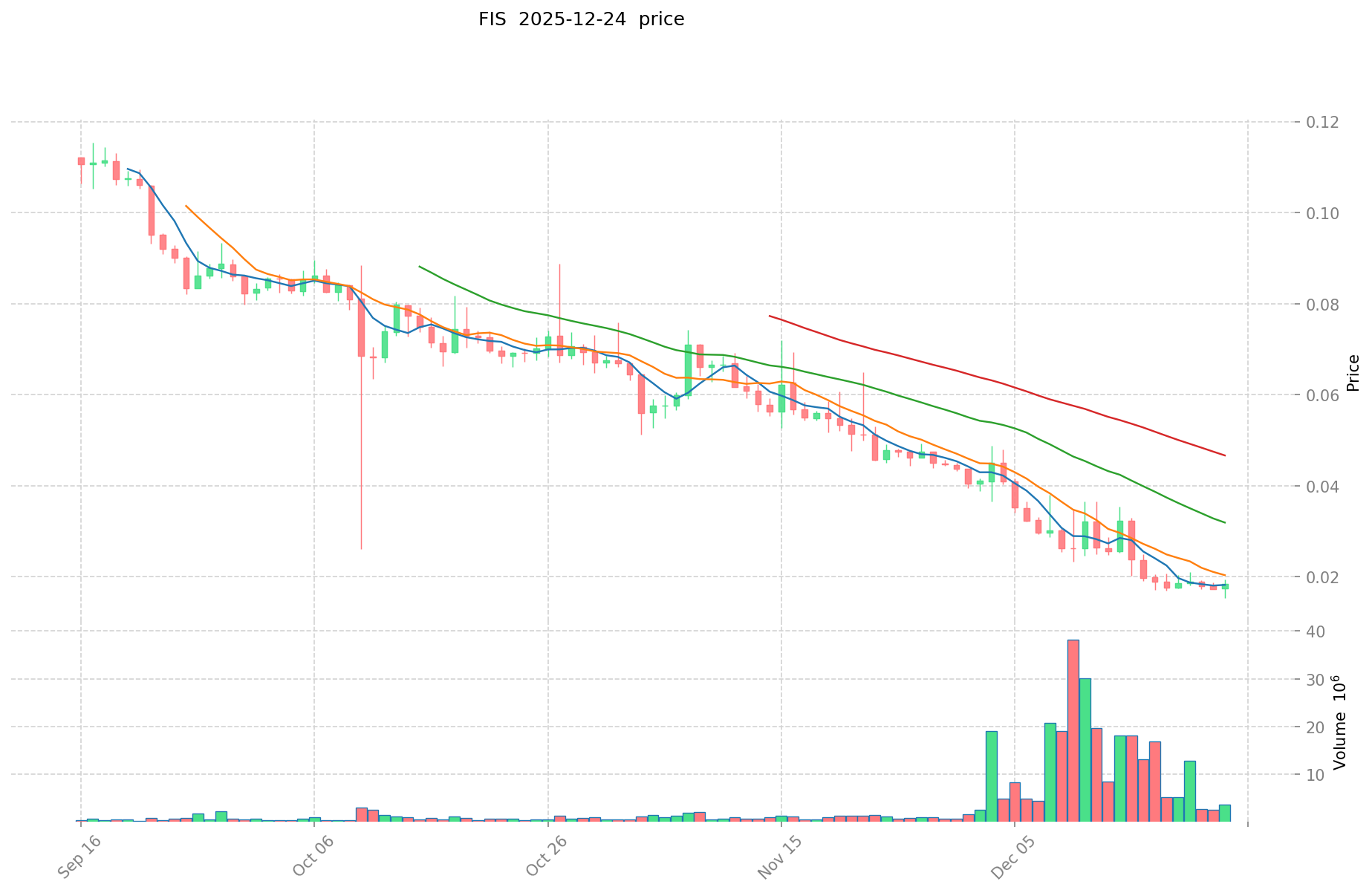
StaFi (FIS) Investment Analysis Report
Report Date: December 24, 2025
I. Executive Summary
StaFi is a decentralized finance (DeFi) protocol designed to unlock liquidity from staked assets. FIS serves as the native utility token of the StaFi protocol, enabling staking, transaction fee payments, and on-chain governance. As of December 24, 2025, FIS is trading at $0.01871 with a market capitalization of approximately $2.9 million, ranking #1894 in the cryptocurrency market.
II. Core Factors Affecting Whether StaFi (FIS) is a Good Investment
Supply Mechanism and Scarcity
The current data indicates that FIS has a total supply of 155,036,447.45 tokens with unlimited maximum supply (∞). This unlimited supply structure presents a fundamental consideration for long-term value appreciation. Historically, tokens with unlimited maximum supplies face inherent inflationary pressures that may constrain upward price momentum. The circulating supply equals total supply at 100% circulation ratio, indicating all tokens are currently in active circulation.
The price history of FIS demonstrates significant volatility:
- All-Time High: $4.7 (March 19, 2021)
- All-Time Low: $0.01624717 (December 24, 2025)
- One-Year Performance: -95.67% decline
- 30-Day Performance: -59.089% decline
- 24-Hour Performance: +7.01% gain
- Current Price: $0.01871
The substantial long-term decline reflects significant headwinds facing the project. The recent negative 30-day and one-year returns indicate sustained downward pressure on valuations.
Liquidity and Trading Conditions
- 24-Hour Volume: $109,317.06
- Market Share: 0.000091%
- Trading Exchanges: 10 platforms
The relatively low trading volume and minimal market share suggest liquidity constraints. A notable development occurred with Binance delisting FIS on December 17, 2025, which eliminated approximately $1.2 million in daily pre-announcement trading volume. This represents a significant reduction in liquidity infrastructure and may further constrain price discovery and trading accessibility.
Technology and Ecosystem Architecture
StaFi's core technical components include:
rToken System: The protocol issues derivative assets (rTokens) representing staked tokens. Holders can redeem underlying assets at any time while maintaining access to staking rewards, enabling capital efficiency in staked asset management.
Staking Contracts: Core smart contracts handle pledging, redemption, and trading functions while maintaining mapping relationships between rTokens and underlying staked assets.
Multi-Signature Accounts: Temporary accounts for managing staked tokens and staking participation, providing operational security.
StaFi Special Validators (SSV): Specialized validators manage multi-signature accounts and verify original chain transaction states using multi-signature transactions.
On-Chain Governance and Token Utility
FIS token provides governance functionality enabling holders to:
- Participate in protocol parameter modifications
- Vote on protocol upgrades
- Influence development priorities
The one-token-one-vote mechanism creates direct governance participation opportunities. Additionally, platform fees (transaction and liquidity fees) fund FIS token repurchase and burning mechanisms, creating potential deflationary dynamics.
Transaction Fee Structure
Transaction initiators must pay FIS fees to access computing resources, following a pattern similar to other Polkadot ecosystem chains. This fee mechanism supports network security and prevents system abuse.
III. Technical and Market Sentiment Analysis
Price Trend Analysis
| Time Period |
Change Percentage |
Price Movement |
| 1 Hour |
+4.54% |
+$0.000812544 |
| 24 Hours |
+7.01% |
+$0.001225652 |
| 7 Days |
+5.81% |
+$0.001027361 |
| 30 Days |
-59.089% |
-$0.027023421 |
| 1 Year |
-95.67% |
-$0.413391616 |
Short-term price movements show modest gains over 1-hour and 24-hour periods, while medium and long-term trends remain deeply negative.
Holder Distribution
The protocol has 3,998 token holders, indicating a relatively concentrated holder base compared to major cryptocurrency projects.
IV. Risk Factors
Liquidity Risk: The Binance delisting significantly reduces available trading liquidity and may create slippage challenges for market participants attempting to establish or exit positions.
Market Sentiment Risk: Sustained one-year decline of -95.67% reflects negative market assessment of the project's prospects and competitive positioning.
Supply Inflation Risk: Unlimited maximum supply creates long-term inflationary pressure that may constrain price appreciation potential.
Execution Risk: Token utility depends on protocol adoption and active ecosystem participation. Limited trading volume and holder base suggest current adoption levels remain modest.
V. Conclusion
StaFi presents a specialized DeFi protocol focused on staking liquidity markets. The FIS token exhibits significant technical functionality within its ecosystem including governance, fee mechanisms, and value capture through repurchase and burning. However, current market conditions reflect substantial challenges including severe long-term price depreciation, reduced liquidity infrastructure following the Binance delisting, and unlimited token supply creating long-term inflationary dynamics.
Data Source: Gate cryptocurrency data (updated December 24, 2025, 22:17:05 UTC)
III. FIS Future Investment Predictions and Price Outlook (Is Stafi(FIS) worth investing in 2025-2030)
Short-term Investment Prediction (2025, short-term FIS investment outlook)
- Conservative forecast: $0.01369 - $0.02054
- Neutral forecast: $0.01902 (average predicted price)
- Optimistic forecast: $0.02054 - $0.03800
Mid-term Investment Outlook (2026-2028, mid-term Stafi(FIS) investment forecast)
-
Market stage expectation: FIS is projected to experience gradual recovery from its historic low, with moderate volatility expected as the DeFi staking protocol continues to develop its ecosystem functionality and user adoption.
-
Investment return predictions:
- 2026: $0.01147 - $0.02275 (+5% change from 2025)
- 2027: $0.01382 - $0.02977 (+13% change from 2025)
- 2028: $0.02424 - $0.02730 (+36% change from 2025)
-
Key catalysts: Protocol upgrades and improvements to rToken functionality, increased adoption of liquid staking solutions, expansion of StaFi's validator ecosystem, and broader DeFi market recovery sentiment.
Long-term Investment Outlook (Is Stafi(FIS) a good long-term investment?)
-
Base case scenario: $0.02421 - $0.03319 USD (assumes steady ecosystem development and moderate user adoption growth through 2030)
-
Optimistic scenario: $0.03800 - $0.05484 USD (assumes significant institutional adoption of liquid staking services and successful protocol expansions)
-
Risk scenario: $0.01469 - $0.02400 USD (assumes prolonged market downturn or failure to achieve meaningful DeFi adoption)
Click to view FIS long-term investment and price predictions: Price Prediction
2025-2030 Long-term Outlook
-
Base case scenario: $0.02421 - $0.03319 USD (corresponding to steady ecosystem progress and gradual mainstream adoption of staking solutions)
-
Optimistic scenario: $0.03800 - $0.05484 USD (corresponding to large-scale institutional adoption and favorable market environment)
-
Transformative scenario: $0.05484 USD and above (if the ecosystem achieves breakthrough progress and mainstream adoption of liquid staking)
-
2030-12-31 predicted high: $0.03319 USD (based on optimistic development assumptions)
Disclaimer
This analysis is provided for informational purposes only and should not be construed as investment advice. Cryptocurrency markets are highly volatile and unpredictable. Price predictions are subject to significant uncertainty and may not materialize as anticipated. Past performance does not guarantee future results. Investors should conduct their own research and consult with qualified financial advisors before making investment decisions. All forecasts carry substantial risk of loss.
| 年份 |
预测最高价 |
预测平均价格 |
预测最低价 |
涨跌幅 |
| 2025 |
0.0205416 |
0.01902 |
0.0136944 |
1 |
| 2026 |
0.02274792 |
0.0197808 |
0.011472864 |
5 |
| 2027 |
0.029770104 |
0.02126436 |
0.013821834 |
13 |
| 2028 |
0.02730343824 |
0.025517232 |
0.0242413704 |
36 |
| 2029 |
0.0279949552272 |
0.02641033512 |
0.0240334049592 |
41 |
| 2030 |
0.033187227111792 |
0.0272026451736 |
0.014689428393744 |
45 |
StaFi (FIS) Investment Analysis Report
I. Project Overview
What is StaFi?
StaFi is a DeFi protocol designed to unlock the liquidity of staked assets. Users can stake Proof-of-Stake (PoS) tokens such as DOT and FIS through StaFi's staking contracts and receive derivative tokens (rTokens such as rDOT and rFIS) in return. These rTokens can be traded to hedge against market volatility while simultaneously earning staking rewards.
FIS Token Utility
FIS is the native functional token of the StaFi protocol with the following use cases:
- Staking & Network Participation: Validators in the StaFi consensus mechanism must stake FIS to join the network, and nominators must stake FIS to participate.
- Transaction Fees: Transaction initiators must pay FIS to access computing resources, preventing system abuse and eliminating invalid transactions.
- On-Chain Governance: FIS holders can participate in changing StaFi protocol parameters, vote on protocol upgrades, and influence development direction. One FIS account represents one vote.
- Value Capture: The majority of StaFi protocol platform fees (transaction fees and liquidity fees) fund FIS token buybacks and burns, with distribution determined by governance decisions.
Core Architecture Components
rToken: Derivative assets issued by StaFi based on staked tokens. rToken holders can redeem native staked tokens at any time and are entitled to staking rewards.
Staking Contracts: Code containing StaFi's core functions including staking, redemption, and trading, with mappings between rTokens and underlying staked tokens (analogous to MakerDAO's CDP contracts).
Multi-Signature Accounts: Temporary accounts used to manage staked tokens and participate in staking activities.
StaFi Special Validators (SSV): Responsible for managing multi-signature accounts and verifying original chain transaction status using multi-signature transactions.
Current Market Position
| Metric |
Value |
| Current Price |
$0.01871 |
| Market Capitalization |
$2,900,731.93 |
| Circulating Supply |
155,036,447.45 FIS |
| Total Supply |
155,036,447.45 FIS |
| Max Supply |
Unlimited |
| 24-Hour Volume |
$109,317.06 |
| Market Rank |
1,894 |
| Market Dominance |
0.000091% |
| Time Period |
Change |
Amount |
| 1 Hour |
+4.54% |
+$0.00081 |
| 24 Hours |
+7.01% |
+$0.00123 |
| 7 Days |
+5.81% |
+$0.00103 |
| 30 Days |
-59.09% |
-$0.02702 |
| 1 Year |
-95.67% |
-$0.41339 |
Historical Price Extremes
- All-Time High: $4.70 (March 19, 2021)
- All-Time Low: $0.01624717 (December 24, 2025)
- 24-Hour Range: $0.01525 - $0.02104
Key Observations
The token has experienced severe long-term depreciation, declining 95.67% over the past year. The recent 7-day and 24-hour gains show modest short-term recovery, though the token remains significantly below historical valuations.
III. Investment Strategy & Risk Management
Investment Methodology
Long-Term HODL Strategy: Suitable for investors with high risk tolerance who believe in StaFi's fundamental value proposition as a liquidity-unlocking protocol. This approach requires patience through market cycles and conviction in the protocol's utility.
Active Trading: For experienced traders, technical analysis can identify short-term trading opportunities given the token's volatility. However, the limited 24-hour trading volume ($109,317) suggests low liquidity for large positions.
Risk Management Framework
Portfolio Allocation Guidance:
- Conservative investors: 1-3% of crypto holdings (due to high risk profile)
- Active traders: 2-5% with strict stop-loss discipline
- Institutional investors: Minimal allocation pending greater adoption metrics
Risk Hedging Strategies:
- Diversify across multiple DeFi protocols and asset classes
- Use stablecoin reserves to manage downside exposure
- Consider collateralized positions only with professional risk frameworks
Secure Storage Recommendations:
- Small holdings: Non-custodial wallets (MetaMask, Trust Wallet)
- Medium holdings: Hardware wallets (Ledger, Trezor)
- Large holdings: Multi-signature cold storage solutions with institutional-grade security
IV. Investment Risks & Challenges
Market Risks
- Extreme Volatility: 95.67% annual decline demonstrates severe price instability
- Low Liquidity: 24-hour volume of ~$109k limits trading capacity for institutional positions
- Price Concentration: Limited trading venues may expose positions to slippage
Technology Risks
- Smart Contract Security: DeFi protocols face inherent risks from code vulnerabilities
- Cross-Chain Complexity: StaFi's operation across multiple chains (Polkadot ecosystem) introduces technical interdependencies
- Protocol Upgrade Risk: Changes to staking mechanics or governance could affect token utility
Regulatory Risks
- Evolving Compliance Framework: Cryptocurrency regulations remain uncertain across jurisdictions
- Staking Regulations: DeFi staking protocols may face regulatory scrutiny regarding securities classification
- Jurisdiction-Specific Restrictions: Some countries may restrict participation in specific DeFi protocols
Adoption & Competition Risks
- Low Market Capitalization: $2.9M market cap reflects limited institutional adoption
- Competitive Landscape: Competing liquid staking solutions (Lido, Rocket Pool) have captured significant market share
- User Adoption: Limited holder base (3,998 addresses) indicates modest ecosystem engagement
V. Conclusion: Is StaFi (FIS) a Good Investment?
Investment Value Summary
StaFi addresses a genuine problem in the cryptocurrency ecosystem—unlocking liquidity from staked assets through derivative tokens. The protocol's technical architecture is sound, and its on-chain governance model aligns incentives. However, the token's 95.67% annual decline and minimal market capitalization reflect serious challenges in market adoption and competitive positioning within the liquid staking sector.
The risk-reward profile is heavily weighted toward risk given current valuations and market conditions.
Investor Guidelines
✅ For Newcomers: If interested in DeFi liquid staking exposure, consider established alternatives with greater liquidity and adoption metrics first. Dollar-cost averaging into a small position (<<1% of crypto allocation) may be appropriate only after thorough due diligence.
✅ For Experienced Traders: Current depressed valuations present potential swing-trading opportunities, though the thin liquidity presents execution challenges. Require strict technical analysis discipline and exit rules.
✅ For Institutional Investors: Insufficient market depth and adoption metrics currently unsuitable for meaningful allocation. Monitor for material developments in protocol adoption and ecosystem expansion.
⚠️ Critical Disclaimer: Cryptocurrency investments carry substantial risk including potential total loss of capital. This analysis is provided for informational purposes only and does not constitute investment advice. Investors must conduct independent research, understand their risk tolerance, and consult qualified financial advisors before making investment decisions. Past performance does not guarantee future results.
Report Generated: December 24, 2025
Data Sources: Gate, Stafi Protocol Official Resources
StaFi (FIS) Cryptocurrency Research Report - FAQ Section
VII. FAQ
Q1: What is StaFi (FIS) and what problem does it solve in the DeFi ecosystem?
A: StaFi is a decentralized finance protocol designed to unlock liquidity from staked assets. Users can stake Proof-of-Stake tokens such as DOT and FIS through StaFi's smart contracts and receive derivative tokens (rTokens) in return. These rTokens enable users to trade, hedge market volatility, and earn staking rewards simultaneously—solving the traditional problem of capital being locked in staking with no trading flexibility.
Q2: What are the primary utility functions of the FIS token?
A: FIS serves four critical functions within the StaFi protocol: (I) Network Staking—validators and nominators must stake FIS to participate in consensus; (II) Transaction Fees—users pay FIS to access computing resources; (III) On-Chain Governance—FIS holders vote on protocol parameters and upgrades using a one-token-one-vote mechanism; (IV) Value Capture—platform fees fund FIS token buybacks and burns, creating deflationary dynamics.
Q3: What is the current market performance of FIS, and why has it declined so significantly?
A: As of December 24, 2025, FIS trades at $0.01871 with a market capitalization of $2.9 million, ranking 1,894th. The token has experienced a 95.67% decline over the past year from its all-time high of $4.70 in March 2021. This severe depreciation reflects broader cryptocurrency market cycles, limited adoption metrics, competition from established liquid staking solutions (such as Lido), and reduced liquidity following the Binance delisting on December 17, 2025.
Q4: Is StaFi (FIS) a good investment for 2025-2030?
A: Investment suitability depends on individual risk tolerance and investment objectives. Conservative forecasts project prices of $0.01369-$0.02054 for 2025, with potential recovery to $0.02421-$0.03319 by 2030 under base-case assumptions. However, significant risks exist: unlimited token supply creates long-term inflationary pressure, trading volume of only $109,317 daily indicates severe liquidity constraints, and the 95.67% annual decline reflects weak market sentiment. Only investors with high risk tolerance and conviction in the protocol's utility should consider meaningful allocation.
Q5: What are the main risks associated with investing in FIS?
A: Critical risks include: (I) Extreme Volatility—95.67% annual decline demonstrates price instability; (II) Low Liquidity—limited 24-hour volume and recent Binance delisting restrict trading capacity; (III) Supply Inflation Risk—unlimited maximum supply creates long-term deflationary pressure on valuations; (IV) Adoption Risk—modest holder base of 3,998 addresses and low market capitalization indicate limited ecosystem engagement; (V) Competitive Risk—established alternatives like Lido have captured significant liquid staking market share; (VI) Technology Risk—cross-chain complexity and smart contract vulnerabilities inherent to DeFi protocols.
Q6: How does the Binance delisting impact FIS's investment prospects?
A: The December 17, 2025 Binance delisting represents a significant negative development, eliminating approximately $1.2 million in daily pre-announcement trading volume. This reduction substantially impairs liquidity infrastructure, increases execution slippage for traders, and signals reduced institutional interest. The delisting limits FIS accessibility to retail investors and may trigger further sell-side pressure as market participants seek alternative trading venues. Current trading occurs primarily on secondary exchanges with considerably lower volume.
Q7: What investment strategy should different investor types adopt regarding FIS?
A: Conservative investors should allocate no more than 1-3% of crypto holdings and prioritize dollar-cost averaging into small positions. Active traders may consider 2-5% allocations using strict stop-loss discipline to exploit short-term volatility, though thin liquidity presents execution challenges. Institutional investors should monitor adoption metrics before meaningful allocation, as current market depth remains insufficient. New investors should consider established liquid staking protocols with superior adoption and liquidity metrics as primary alternatives.
Q8: What factors could positively or negatively influence FIS price in the medium-to-long term?
A: Positive catalysts include successful protocol upgrades improving rToken functionality, expanded validator ecosystem adoption, broader DeFi market recovery, and institutional adoption of liquid staking services. Base-case forecasts project 36% upside by 2028 and 45% upside by 2030 assuming steady ecosystem development. Conversely, negative catalysts include prolonged cryptocurrency market downturn, failure to achieve meaningful DeFi adoption, additional exchange delistings, regulatory restrictions on staking protocols, and intensified competition from better-capitalized liquid staking solutions. Severe downside risk scenarios project 30-50% further decline if adoption fails to materialize.
Disclaimer: This analysis is provided for informational purposes only and does not constitute investment advice. Cryptocurrency markets are highly volatile and unpredictable. All price predictions carry substantial uncertainty and risk of loss. Past performance does not guarantee future results. Investors must conduct independent research and consult qualified financial advisors before making investment decisions.
* The information is not intended to be and does not constitute financial advice or any other recommendation of any sort offered or endorsed by Gate.