Staika (STIK) is a multi-service blockchain platform built on Solana, combining cryptocurrency wallet functionality, Move To Earn and Play To Earn services, and an NFT marketplace, with current market cap of $67.11 million and price around $0.4998. This comprehensive guide examines whether STIK represents a viable investment opportunity by analyzing historical price movements, token supply mechanics introducing 1.6 million monthly unlocks, technology ecosystem development, and market potential through 2031. The analysis reveals STIK's volatility trajectory—peaking at $5.58 in February 2025 before declining 68.23%—while presenting diversified price outlook ranges across conservative, neutral, and optimistic scenarios. Investment strategies accommodate different risk profiles from conservative 1-3% portfolio allocation to active trading approaches, complemented by detailed risk management frameworks addressing market volatility, regulatory uncertainty, and liquidity constraints. Suitable for beginners via dolla
Introduction: Staika (STIK) Investment Position and Market Prospects
STIK is a notable asset in the cryptocurrency field, launched in 2023 and focusing on blockchain-based user experiences. As of January 18, 2026, Staika holds a market capitalization of approximately $67.11 million, with a circulating supply of about 134.28 million tokens, and a current price around $0.4998. The project positions itself as a multi-faceted platform offering cryptocurrency wallet services, Move To Earn and Play To Earn functionalities, and an NFT marketplace. With a market ranking of 450 and a market dominance of 0.0037%, STIK has gradually attracted attention among investors exploring "Is Staika (STIK) a good investment?" This article provides a comprehensive analysis of STIK's investment value, historical price movements, future price projections, and associated risks to offer reference information for investors.
I. Staika (STIK) Price History Review and Current Investment Value Status
- March 2023: Token launched at $0.25 → Initial circulation phase began with limited market exposure
- February 2025: Price experienced substantial appreciation → STIK reached $5.58, representing significant growth from launch levels
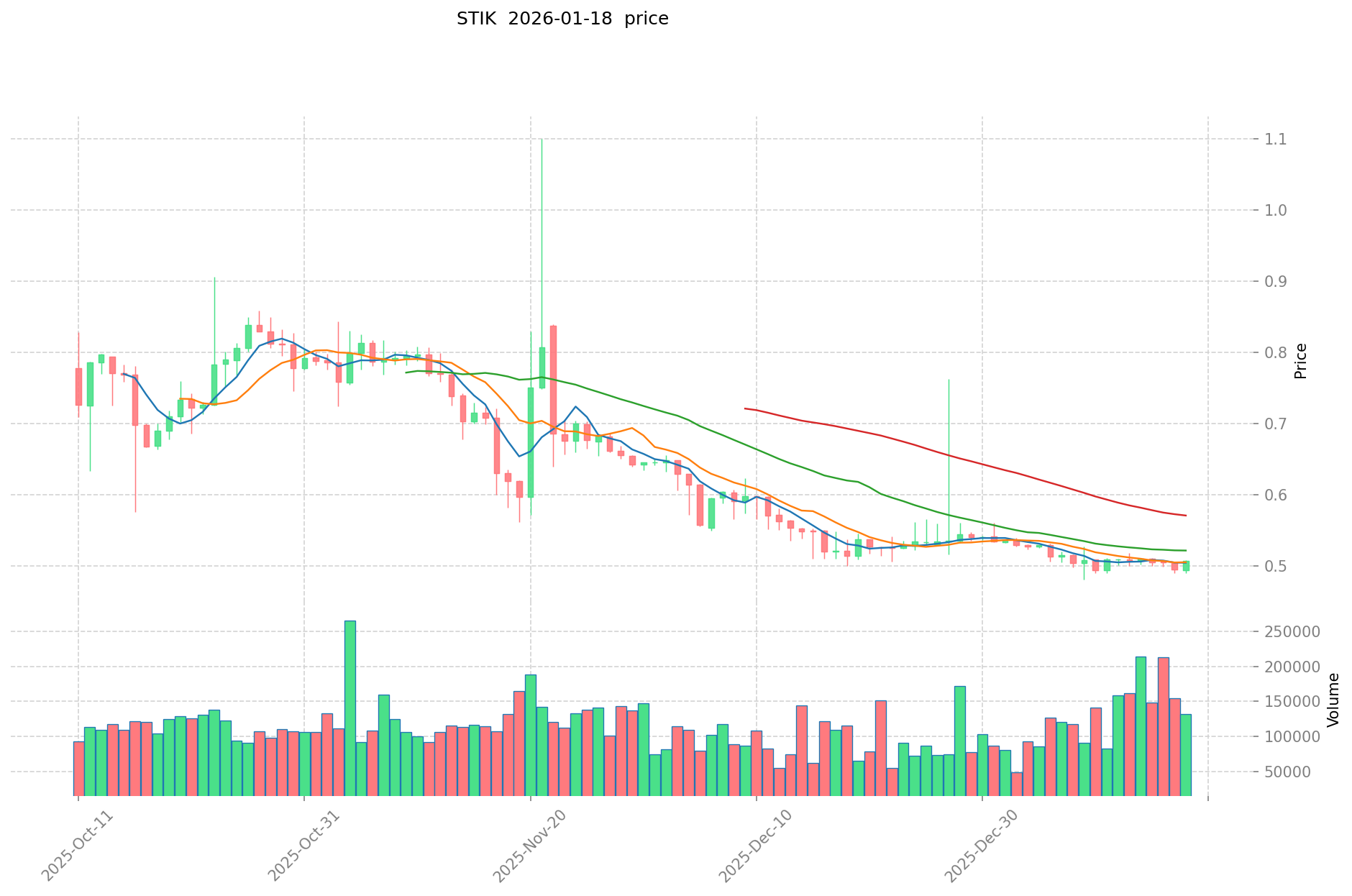
- January 2026: Market correction phase → Price declined to $0.474226, reflecting broader market volatility
- Current period (January 2026): Price stabilized around $0.4998 → One-year performance shows -68.23% change
Current STIK Investment Market Status (January 2026)
- STIK current price: $0.4998
- Market sentiment (Fear & Greed Index): Data not available in provided materials
- 24-hour trading volume: $81,196.23
- Institutional investor holdings: Data regarding institutional positions not provided in reference materials
- Token holders: 27,919 addresses
- Market capitalization: $67.11 million
- Circulating supply: 134.28 million STIK (53.71% of total supply)
- Listed on 4 exchanges
Click to view real-time STIK market price
II. Core Factors Influencing Whether STIK is a Good Investment
Supply Mechanism and Scarcity (STIK Investment Scarcity)
-
Token Supply Structure → Impacts Price and Investment Value
Staika has a maximum supply of 250,000,000 STIK tokens, with approximately 134,280,267 tokens (53.71%) currently in circulation as of January 18, 2026. The circulating supply increased from 27.5 million in January 2024 to 36.7 million by June 2024 through monthly unlocks of approximately 0.65%, introducing 1.6 million STIK tokens into the market each month. With 51% of the maximum supply still locked, sustained sell pressure may persist as vested tokens continue entering circulation.
-
Historical Supply Impact on Price
Reference materials indicate that STIK experienced price movements correlated with supply changes. The token reached a notable price level of $5.58 on February 28, 2025, before declining to $0.474226 on January 9, 2026. As of January 18, 2026, STIK trades at $0.4998, reflecting price volatility influenced by token unlock schedules and market absorption capacity.
-
Investment Significance of Scarcity Dynamics
The controlled supply mechanism through scheduled unlocks presents both opportunities and risks. New supply entering circulation (1.6 million STIK monthly) risks outpacing demand, particularly given that STIK's 24-hour trading volume ($81,196.23) represents approximately 10% of its market capitalization. The interplay between locked token releases and market demand absorption capacity remains a key factor for long-term investment consideration.
Technology and Ecosystem Development (Technology & Ecosystem for STIK Investment)
-
Multi-List Cryptocurrency Wallet
Staika provides a multi-list cryptocurrency wallet as part of its platform infrastructure, aiming to enhance user experience and facilitate digital asset management.
-
Move To Earn and Play To Earn Services
The project offers Move To Earn and Play To Earn services designed to generate user engagement and create utility for STIK tokens. The effectiveness of these earning mechanisms in driving ecosystem adoption and token demand represents a factor in the project's long-term investment potential. Regulatory considerations surrounding earning mechanisms may also influence future development.
-
NFT Marketplace
Staika operates an NFT marketplace within its ecosystem, providing additional use cases for STIK tokens. The marketplace aims to support digital asset trading and expand the platform's application scope.
-
ESG Management Approach
The project promotes ESG (Environmental, Social, and Governance) management by allocating portions of profits toward donations to non-governmental organizations and social enterprises. This approach may influence the project's positioning within broader sustainability-focused investment considerations.
-
Solana Blockchain Infrastructure
STIK operates as a token on the Solana blockchain (contract address: 8BMzMi2XxZn9afRaMx5Z6fauk9foHXqV5cLTCYWRcVje). The project's performance may be influenced by Solana ecosystem developments, including Total Value Locked (TVL) growth and network activity trends.
III. STIK Future Investment Forecast and Price Outlook (Is Staika(STIK) worth investing in 2026-2031)
Short-term Investment Forecast (2026, short-term STIK investment outlook)
- Conservative forecast: $0.31 - $0.50
- Neutral forecast: $0.50 - $0.60
- Optimistic forecast: $0.60 - $0.65
Mid-term Investment Outlook (2027-2029, mid-term Staika(STIK) investment forecast)
- Market stage expectation: STIK may enter a gradual growth phase, with price movements influenced by platform development and market adoption trends.
- Investment return forecast:
- 2027: $0.34 - $0.72
- 2028: $0.50 - $0.77
- 2029: $0.40 - $1.03
- Key catalysts: Potential expansion of Move To Earn and Play To Earn services, NFT marketplace development, and broader cryptocurrency market conditions.
Long-term Investment Outlook (Is STIK a good long-term investment?)
- Base scenario: $0.45 - $0.87 (assuming steady platform growth and moderate user adoption)
- Optimistic scenario: $0.95 - $1.50 (assuming accelerated ecosystem expansion and favorable market environment)
- Risk scenario: Below $0.40 (under adverse market conditions or platform development setbacks)
Click to view STIK long-term investment and price forecast: Price Prediction
2026-01-18 - 2031 Long-term Outlook
- Base scenario: $0.45 - $0.87 (corresponding to steady progress and gradual mainstream application improvement)
- Optimistic scenario: $0.95 - $1.50 (corresponding to large-scale adoption and favorable market environment)
- Transformative scenario: Above $1.50 (such as ecosystem breakthrough progress and mainstream popularization)
- 2031-12-31 forecast high: $1.50 (based on optimistic development assumptions)
Disclaimer: The above forecasts are based on historical data analysis and market trend projections. Cryptocurrency markets are highly volatile and unpredictable. These forecasts should not be considered as financial advice. Investors should conduct thorough research and consider their risk tolerance before making investment decisions.
| Year |
Predicted High Price |
Predicted Average Price |
Predicted Low Price |
Price Change |
| 2026 |
0.604758 |
0.4998 |
0.314874 |
0 |
| 2027 |
0.7179627 |
0.552279 |
0.33689019 |
10 |
| 2028 |
0.7684962285 |
0.63512085 |
0.5017454715 |
27 |
| 2029 |
1.0316585526975 |
0.70180853925 |
0.4000308673725 |
40 |
| 2030 |
1.196092293443775 |
0.86673354597375 |
0.45070144390635 |
73 |
| 2031 |
1.495548733577705 |
1.031412919708762 |
0.948899886132061 |
106 |
IV. Staika Investment Strategy and Risk Management (How to invest in Staika)
Investment Methodology (Staika investment strategy)
Long-term Holding (HODL Staika): This approach may suit conservative investors who believe in the project's long-term vision of developing a trusted blockchain platform with multi-list cryptocurrency wallet functionality, Move To Earn and Play To Earn services, and an NFT marketplace. Given the project's focus on continuous technological development based on user experience and ESG management principles through profit donations to NGOs and social enterprises, investors with extended time horizons might consider accumulation strategies.
Active Trading: Traders relying on technical analysis and swing trading strategies should note Staika's 24-hour price volatility range between $0.4934 and $0.5101. With a 24-hour trading volume of approximately $81,196, liquidity conditions should be evaluated before executing larger position sizes. The token has demonstrated varied performance across different timeframes: +1.27% (24H), -0.69% (7D), and -2.83% (30D).
Risk Management (Risk management for Staika investment)
Asset Allocation Ratios:
- Conservative investors: Consider limiting Staika exposure to 1-3% of total crypto portfolio
- Moderate investors: May allocate 3-7% depending on risk tolerance and market conviction
- Experienced investors: Could allocate 5-10% with appropriate hedging mechanisms
Risk Hedging Solutions: Diversification across multiple blockchain projects, stablecoins, and traditional assets can help mitigate concentration risk. Position sizing should account for Staika's historical volatility, including its year-over-year decline of 68.23%.
Secure Storage:
- Cold Wallets: Hardware wallet solutions recommended for long-term holdings
- Hot Wallets: Limited amounts for active trading on exchanges
- Contract Address Verification: Always verify the official Solana contract address (8BMzMi2XxZn9afRaMx5Z6fauk9foHXqV5cLTCYWRcVje) before transactions
V. Staika Investment Risks and Challenges (Risks of investing in Staika)
Market Risks: Staika exhibits significant price volatility, with the token currently trading at $0.4998, substantially below its previous peak of $5.58 recorded on February 28, 2025. The circulating supply represents approximately 53.71% of the maximum supply of 250 million tokens, with 134,280,267 tokens currently in circulation. The relatively modest 24-hour trading volume of $81,196 across 4 exchanges may present liquidity challenges during large transactions.
Regulatory Risks: As a blockchain project operating in the cryptocurrency wallet, NFT marketplace, and earn-to-play sectors, Staika faces evolving regulatory frameworks across different jurisdictions. The project's tax provisions for future virtual asset-based income indicate awareness of compliance requirements, though regulatory clarity remains uncertain in many markets.
Technical Risks: The platform's reliance on continuous technological development introduces execution risks. The integration of multiple services—cryptocurrency wallet, Move To Earn, Play To Earn, and NFT marketplace—creates technical complexity that requires robust infrastructure and security measures. Network security vulnerabilities or implementation issues could impact user experience and token value.
Project-Specific Risks: With a current market capitalization of approximately $67.11 million and a ranking of #450, Staika occupies a mid-tier position in the cryptocurrency market. The project's hybrid commercialization model and customized advertising services require successful business development and user adoption to achieve stated objectives.
VI. Conclusion: Is Staika a Good Investment?
Investment Value Summary: Staika presents a multi-faceted blockchain project combining cryptocurrency wallet functionality, earn mechanisms, and NFT marketplace services. The project's emphasis on user experience, ESG principles, and scalability demonstrates a comprehensive approach to blockchain adoption. However, the token's performance shows considerable volatility, with a 68.23% decline over the past year and current trading levels near its recorded low of $0.474226 from January 9, 2026.
Investor Recommendations:
✅ Beginners: Consider dollar-cost averaging strategies with small, regular purchases. Prioritize secure storage using hardware wallets and thoroughly research the project's roadmap and development progress. Limit initial exposure to a small percentage of overall portfolio.
✅ Experienced Investors: Evaluate swing trading opportunities based on technical indicators and support/resistance levels. Monitor the project's development milestones, partnership announcements, and user adoption metrics. Consider portfolio allocation within a diversified cryptocurrency strategy.
✅ Institutional Investors: Assess Staika's long-term positioning within the broader blockchain ecosystem, particularly its approach to combining multiple services and ESG considerations. Conduct thorough due diligence on the team, technology infrastructure, and competitive landscape before strategic allocation decisions.
⚠️ Disclaimer: Cryptocurrency investments carry substantial risk due to market volatility, regulatory uncertainty, and technological factors. This content is for informational purposes only and does not constitute investment advice. Investors should conduct independent research and consult with qualified financial advisors before making investment decisions.
VII. FAQ
Q1: What makes Staika (STIK) different from other cryptocurrency projects?
Staika distinguishes itself through a multi-faceted ecosystem combining cryptocurrency wallet services, Move To Earn and Play To Earn functionalities, and an NFT marketplace built on the Solana blockchain. The project emphasizes ESG (Environmental, Social, and Governance) management by allocating portions of profits toward donations to non-governmental organizations and social enterprises, setting it apart from purely profit-driven platforms. Additionally, its focus on user experience and continuous technological development based on community feedback creates a distinctive positioning in the blockchain space.
Q2: How does the token unlock schedule affect STIK's investment value?
The token unlock schedule introduces sustained selling pressure, as approximately 1.6 million STIK tokens enter circulation monthly (0.65% of supply). With 51% of the maximum supply (250 million tokens) still locked and only 134.28 million tokens currently circulating, new supply entering the market may outpace demand absorption. This dynamic is particularly relevant given STIK's 24-hour trading volume of $81,196, which represents approximately 10% of its market capitalization. Investors should monitor how the market absorbs these monthly unlocks and whether demand growth can offset the increased supply.
Q3: Is Staika suitable for long-term holding or active trading?
The investment approach depends on individual risk tolerance and investment objectives. Long-term holding (HODL) may suit conservative investors who believe in the project's vision of developing a comprehensive blockchain platform with earning mechanisms and NFT marketplace functionality. However, STIK's historical volatility—including a 68.23% year-over-year decline and daily price fluctuations between $0.4934 and $0.5101—suggests opportunities for active traders employing technical analysis and swing trading strategies. Conservative investors should limit exposure to 1-3% of total crypto portfolio, while experienced traders might allocate 5-10% with appropriate risk management measures.
Q4: What are the main risks associated with investing in STIK?
Key risks include significant price volatility (current price $0.4998 vs. historical peak of $5.58), limited liquidity with 24-hour trading volume of $81,196 across 4 exchanges, regulatory uncertainty affecting cryptocurrency wallet and earn-to-play sectors, and execution risks related to the integration of multiple services. The project's mid-tier market position (ranking #450 with $67.11 million market cap) and reliance on successful business development and user adoption also present project-specific challenges. Additionally, ongoing token unlocks may create persistent selling pressure without corresponding demand growth.
Q5: What price range can investors expect for STIK in 2026-2027?
Based on market analysis and historical trends, short-term forecasts for 2026 range from $0.31-$0.50 (conservative), $0.50-$0.60 (neutral), to $0.60-$0.65 (optimistic). For 2027, projections suggest a range of $0.34-$0.72, with potential catalysts including expansion of Move To Earn and Play To Earn services, NFT marketplace development, and broader cryptocurrency market conditions. However, these forecasts are subject to significant uncertainty due to market volatility, regulatory developments, and the project's execution capability. Investors should note that historical performance shows substantial variability and not rely solely on price predictions for investment decisions.
Q6: How should investors securely store their STIK tokens?
Long-term holders should prioritize cold wallet solutions using hardware wallets for maximum security. Active traders may keep limited amounts in hot wallets on exchanges for trading purposes. Before any transaction, investors must verify the official Solana contract address (8BMzMi2XxZn9afRaMx5Z6fauk9foHXqV5cLTCYWRcVje) to prevent scams. The project operates on the Solana blockchain, so investors should use Solana-compatible wallets and maintain backup recovery phrases in secure, offline locations. Never share private keys or recovery phrases with anyone.
Q7: What factors should institutional investors evaluate before allocating to STIK?
Institutional investors should conduct comprehensive due diligence covering several key areas: (1) technical infrastructure and security measures supporting the multi-service platform, (2) competitive positioning within the Solana ecosystem and broader blockchain space, (3) team background and track record in delivering development milestones, (4) regulatory compliance framework and exposure to different jurisdictions, (5) user adoption metrics and partnership ecosystem, (6) liquidity profile considering the limited trading volume relative to market capitalization, and (7) the project's ESG approach and its alignment with institutional investment mandates. Strategic allocation decisions should consider Staika's mid-tier market position and the scalability of its hybrid commercialization model.
Q8: Can beginners invest in Staika, and what approach should they take?
Beginners can consider investing in Staika using a cautious, measured approach. Dollar-cost averaging strategies with small, regular purchases help mitigate timing risk and reduce exposure to volatility. New investors should limit initial exposure to a small percentage of their overall portfolio (1-3% or less), prioritize secure storage using hardware wallets, and thoroughly research the project's roadmap, development progress, and fundamentals before investing. Understanding the token's supply mechanics, including the monthly unlock schedule, is essential. Beginners should also familiarize themselves with the Solana blockchain ecosystem and verify all transaction details carefully to avoid common security pitfalls.
* The information is not intended to be and does not constitute financial advice or any other recommendation of any sort offered or endorsed by Gate.