This comprehensive analysis evaluates whether StakeStone (STO) represents a viable investment opportunity in the decentralized omnichain liquidity infrastructure sector. As of January 2026, STO trades at $0.08295 with a market capitalization of $18.69 million, having demonstrated both significant volatility and 34.31% annual growth. The article examines critical investment factors including token supply dynamics, ecosystem positioning, and technological infrastructure across Ethereum and BSC networks. Price projections range from conservative scenarios of $0.0513-$0.0827 through 2026 to optimistic long-term forecasts reaching $0.2546 by 2031, contingent upon protocol adoption and market conditions. Investment strategies are tailored for different investor profiles, from conservative dollar-cost averaging approaches to active trading methodologies, with emphasis on robust risk management including position sizing, secure custody solutions via Gate, and portfolio diversification. Significant risks include marke
Introduction: StakeStone (STO) Investment Position and Market Outlook
STO is an important asset in the cryptocurrency field. As of 2026, StakeStone has established itself within the decentralized finance infrastructure sector. As of January 23, 2026, STO maintains a market capitalization of approximately $18.69 million, with a circulating supply of around 225.33 million tokens, and the current price stands at approximately $0.08295. With its positioning as a decentralized omnichain liquidity infrastructure protocol, STO has gradually become a focal point for investors discussing "Is StakeStone (STO) a good investment?" This article will comprehensively analyze STO's investment value, historical trends, future price predictions, and investment risks to provide reference for investors.
I. Cryptocurrency (STO) Price History Review and Current Investment Value Status
- April 2025: Token launched on exchanges → Price established initial trading range between $0.0526 and higher levels
- May 2025: Price reached $0.2365 during early trading period → Market showed volatility in early stage
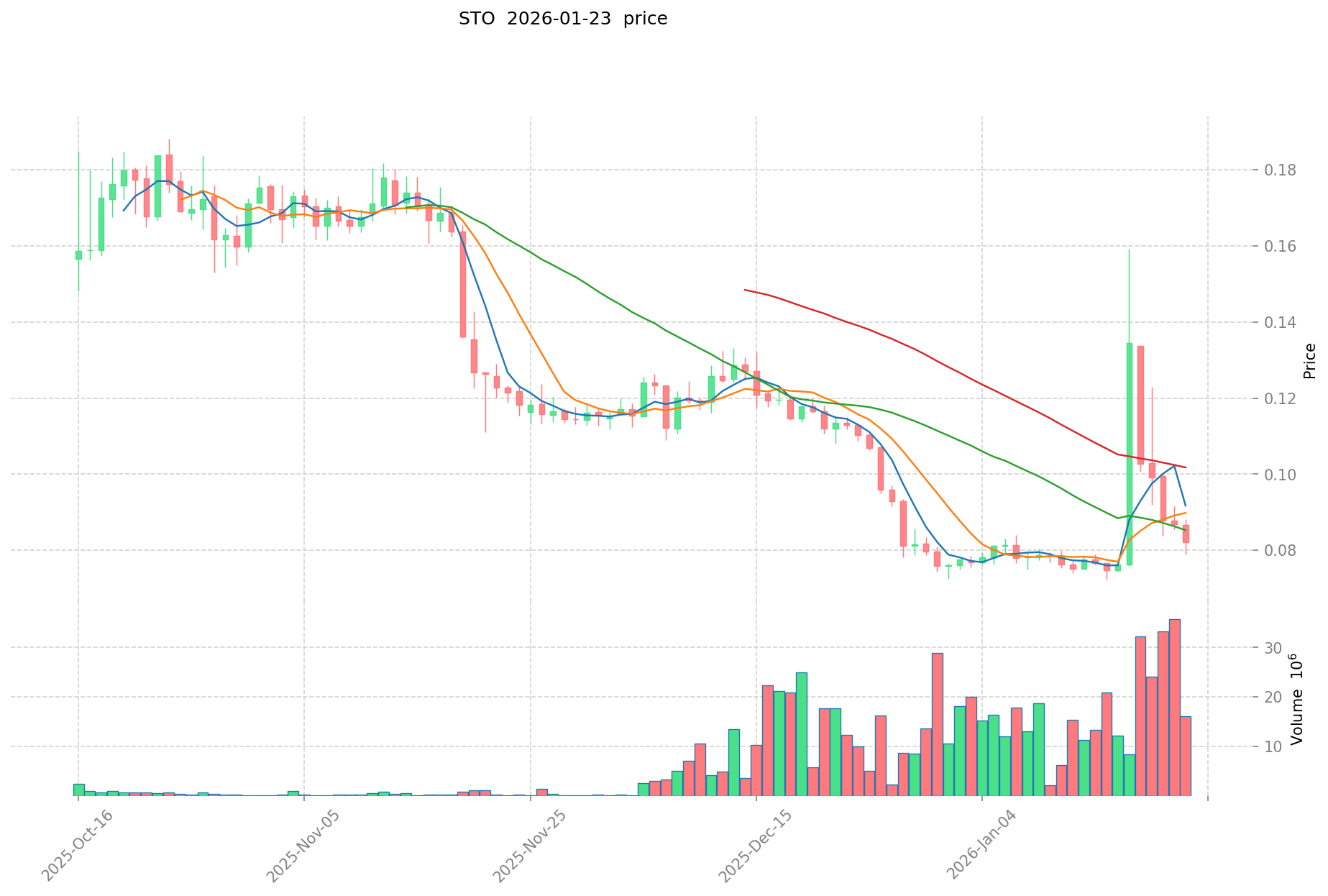
- January 2026: Market experienced correction phase → Price adjusted from higher levels to current $0.08295
Current STO Investment Market Status (January 2026)
- STO current price: $0.08295
- 24-hour trading volume: $1,438,534.88
- Market capitalization: $18,691,399.97
- Circulating supply: 225,333,333 STO (22.53% of total supply)
- Price changes: +0.33% (1H), +1.74% (24H), +9.49% (7D), -25.53% (30D), +34.31% (1Y)
Click to view real-time STO market price
II. Core Factors Affecting Whether STO is a Good Investment (Is StakeStone(STO) a Good Investment)
Supply Mechanism and Scarcity (STO investment scarcity)
- Supply mechanism influences price and investment value: StakeStone (STO) has a maximum supply of 1,000,000,000 tokens, with a current circulating supply of 225,333,333 tokens, representing approximately 22.53% of the total supply. The controlled token release may create supply-side constraints that could potentially support price stability over time.
- Historical price movements and supply dynamics: STO has experienced price fluctuations since its launch in April 2025, with recorded prices reaching $0.2365 at one point and declining to $0.0526 at another. These variations reflect market responses to supply distribution and trading dynamics.
- Investment significance of scarcity: The ratio of circulating supply to maximum supply indicates that a substantial portion of tokens remains undistributed. The rate and manner of future token releases may play a role in long-term investment considerations, though this depends on the project's tokenomics implementation.
Institutional Investment and Mainstream Adoption (Institutional investment in STO)
- Market presence and exchange availability: STO is currently listed on 25 exchanges, providing accessibility to both retail and institutional participants. The token maintains a market capitalization of approximately $18.69 million as of January 23, 2026.
- Ecosystem positioning: As a decentralized omnichain liquidity infrastructure protocol, StakeStone aims to serve the evolving needs of modular and multi-chain DeFi landscapes. Its positioning in the liquidity infrastructure sector may influence its adoption trajectory among DeFi protocols and platforms.
- Holder base: The token currently has 407 recorded holders, indicating an emerging but relatively limited community distribution at this stage.
Macroeconomic Environment's Impact on STO Investment
- Broader crypto market correlation: As an ERC20 and BEP20 token operating within the Ethereum and BSC ecosystems, STO's investment performance may be influenced by overall cryptocurrency market conditions, regulatory developments, and shifts in investor sentiment toward DeFi infrastructure projects.
- Liquidity sector dynamics: The decentralized liquidity infrastructure sector faces competition from various protocols. Macroeconomic factors affecting DeFi adoption, including institutional participation rates and cross-chain interoperability trends, may impact STO's investment outlook.
- Market volatility considerations: STO has demonstrated notable price volatility, with a 30-day price change of -25.53% and a 1-year change of 34.31%, reflecting the dynamic nature of emerging DeFi infrastructure investments.
Technology and Ecosystem Development (Technology & Ecosystem for STO investment)
- Omnichain infrastructure approach: StakeStone's protocol is designed to facilitate efficient, sustainable liquidity flows across multiple blockchain ecosystems. This cross-chain positioning addresses the growing demand for interoperable DeFi solutions in an increasingly fragmented blockchain landscape.
- Liquidity infrastructure value proposition: The project focuses on transforming how liquidity is acquired, distributed, and utilized across blockchain ecosystems. The success of this infrastructure-level approach may influence its long-term investment value as DeFi protocols seek reliable liquidity solutions.
- Ecosystem integration potential: As a liquidity infrastructure protocol, StakeStone's potential for integration with DeFi applications, cross-chain bridges, and staking platforms may contribute to its utility and adoption. However, the competitive landscape in liquidity infrastructure remains dynamic, with multiple protocols pursuing similar objectives.
III. STO Future Investment Prediction and Price Outlook (Is StakeStone(STO) worth investing in 2026-2031)
Short-term Investment Prediction (2026, short-term STO investment outlook)
- Conservative Prediction: $0.0513 - $0.0827
- Neutral Prediction: $0.0827 - $0.0950
- Optimistic Prediction: $0.0950 - $0.1067
Mid-term Investment Outlook (2027-2029, mid-term StakeStone(STO) investment forecast)
-
Market Stage Expectation: StakeStone may enter a growth phase as the protocol continues to develop its omnichain liquidity infrastructure, potentially benefiting from increased adoption in the modular and multi-chain DeFi landscape.
-
Investment Return Prediction:
- 2027: $0.0559 - $0.1307
- 2028: $0.0597 - $0.1488
- 2029: $0.1137 - $0.1922
-
Key Catalysts: Expansion of cross-chain liquidity solutions, potential partnerships within the DeFi ecosystem, and broader adoption of decentralized liquidity infrastructure protocols.
Long-term Investment Outlook (Is StakeStone a good long-term investment?)
- Baseline Scenario: $0.0994 - $0.1744 (assuming steady protocol development and moderate market conditions)
- Optimistic Scenario: $0.1744 - $0.2546 (assuming accelerated adoption of omnichain solutions and favorable market environment)
- Risk Scenario: Below $0.0594 (under adverse market conditions or significant competitive pressure)
View STO long-term investment and price prediction: Price Prediction
2026-01-23 - 2031 Long-term Outlook
- Base Scenario: $0.0994 - $0.1744 (corresponding to steady progress and gradual mainstream application growth)
- Optimistic Scenario: $0.1744 - $0.2546 (corresponding to large-scale adoption and favorable market environment)
- Transformative Scenario: Above $0.2546 (such as breakthrough developments in the ecosystem and mainstream adoption)
- 2031-12-31 Predicted High: $0.2546 (based on optimistic development assumptions)
Disclaimer: The above predictions are based on historical data analysis and market trend projections. Cryptocurrency markets are highly volatile and unpredictable. This content does not constitute investment advice. Investors should conduct their own research and assess risks before making any investment decisions.
| Year |
Predicted High Price |
Predicted Average Price |
Predicted Low Price |
Price Change |
| 2026 |
0.1066959 |
0.08271 |
0.0512802 |
0 |
| 2027 |
0.130690071 |
0.09470295 |
0.0558747405 |
14 |
| 2028 |
0.14875939386 |
0.1126965105 |
0.059729150565 |
35 |
| 2029 |
0.1921700897046 |
0.13072795218 |
0.1137333183966 |
57 |
| 2030 |
0.187280864293068 |
0.1614490209423 |
0.121086765706725 |
94 |
| 2031 |
0.254572816221818 |
0.174364942617684 |
0.099388017292079 |
110 |
IV. STO Investment Strategy and Risk Management (How to invest in StakeStone)
Investment Methodology (STO investment strategy)
Long-term Holding (HODL STO)
Long-term holding represents a strategy suited for conservative investors who believe in StakeStone's fundamental value proposition as a decentralized omnichain liquidity infrastructure. This approach involves:
- Accumulation during market corrections: Given STO's 30-day price decline of 25.53%, investors may consider strategic entry points during market downturns
- Focus on protocol development: Monitoring StakeStone's progress in delivering sustainable liquidity solutions across multi-chain DeFi ecosystems
- Patience through volatility: Acknowledging the 1-year price appreciation of 34.31% while recognizing that cryptocurrency markets experience significant fluctuations
This strategy minimizes transaction costs and reduces the impact of short-term market noise, allowing investors to benefit from potential long-term growth in the decentralized liquidity infrastructure sector.
Active Trading
Active trading strategies rely on technical analysis and swing trading techniques, suitable for investors with experience in cryptocurrency markets:
- Technical indicators monitoring: Tracking STO's 24-hour price range between $0.07893 and $0.08427 to identify potential entry and exit points
- Volume analysis: Observing the 24-hour trading volume of $1,438,534.88 to assess market liquidity and trading opportunities
- Multi-timeframe approach: Analyzing 1-hour (0.33%), 24-hour (1.74%), and 7-day (9.49%) price movements to identify short-term trends
Risk Management (Risk management for STO investment)
Asset Allocation Ratio
Different investor profiles should consider varying allocation strategies:
- Conservative investors: Limit STO exposure to 1-3% of total cryptocurrency portfolio, prioritizing established assets while maintaining limited exposure to emerging liquidity infrastructure protocols
- Aggressive investors: May allocate 5-10% to STO, accepting higher volatility in exchange for potential growth opportunities in the decentralized liquidity sector
- Professional investors: Consider 3-8% allocation based on thorough due diligence, portfolio diversification objectives, and risk tolerance parameters
Risk Hedging Solutions
Implementing risk mitigation strategies is essential for STO investments:
- Multi-asset portfolio composition: Combining STO with established cryptocurrencies, stablecoins, and traditional assets to reduce concentration risk
- Hedging instruments: Utilizing derivatives or inverse positions where available to protect against adverse price movements
- Rebalancing protocols: Establishing predetermined thresholds to maintain target allocation percentages and capture profits during price appreciation
Secure Storage
Protecting STO holdings requires appropriate custody solutions:
- Cold wallet storage: For long-term holdings, transferring STO tokens to hardware wallets or air-gapped devices minimizes exposure to online threats
- Hot wallet management: Maintaining only necessary trading amounts on exchanges or software wallets for active trading purposes
- Hardware wallet recommendations: Research devices that support ERC20 and BEP20 token standards, as STO operates on both Ethereum and BSC networks
- Security best practices: Implementing multi-signature wallets, secure backup procedures, and avoiding sharing private keys or seed phrases
V. STO Investment Risks and Challenges (Risks of investing in StakeStone)
Market Risk
STO faces significant market-related challenges common to cryptocurrency investments:
- High volatility: The token has experienced substantial price fluctuations, with a 30-day decline of 25.53% contrasting with a 7-day gain of 9.49%, demonstrating the unpredictable nature of short-term price movements
- Price range fluctuations: Historical data shows STO traded between an all-time low of $0.0526 and an all-time high of $0.2365, representing potential price swings of several hundred percent
- Limited market capitalization: With a circulating market cap of approximately $18.69 million and ranking at #908, STO has lower liquidity compared to major cryptocurrencies, potentially increasing susceptibility to price manipulation
- Low market dominance: Representing only 0.0026% of the total cryptocurrency market, STO remains vulnerable to broader market trends and sentiment shifts
Regulatory Risk
Policy uncertainty across jurisdictions presents challenges for STO investors:
- Evolving regulatory frameworks: Different countries continue developing and modifying cryptocurrency regulations, which may impact token classification, trading availability, or operational requirements for liquidity infrastructure protocols
- Compliance requirements: Changes in securities laws, anti-money laundering regulations, or cross-border transaction policies could affect StakeStone's protocol operations and token utility
- Geographic restrictions: Potential limitations on token access or trading in certain jurisdictions may reduce market liquidity or create compliance challenges for the protocol
- Tax implications: Varying tax treatments of cryptocurrency transactions across jurisdictions require investors to understand local reporting obligations and potential tax liabilities
Technical Risk
Technological challenges inherent to blockchain protocols and STO specifically:
- Network security vulnerabilities: As with any blockchain-based protocol, potential smart contract exploits, code vulnerabilities, or bridge security issues could impact token value and investor holdings
- Multi-chain complexity: Operating across multiple blockchain networks (evidenced by ERC20 and BEP20 implementations) introduces additional technical risks related to cross-chain infrastructure and interoperability
- Protocol upgrade challenges: Technical implementations, consensus changes, or liquidity mechanism updates could encounter unexpected issues affecting protocol functionality
- Dependency risks: StakeStone's reliance on underlying blockchain networks means that issues affecting Ethereum, BSC, or other integrated chains could impact protocol operations
- Custody risks: Token holders face potential security threats including exchange hacks, wallet compromises, or private key loss, particularly given the distributed nature of liquidity infrastructure protocols
VI. Conclusion: Is StakeStone a Good Investment?
Investment Value Summary
StakeStone (STO) represents a project focused on decentralized omnichain liquidity infrastructure within the evolving multi-chain DeFi ecosystem. The token has demonstrated notable price movements, including a 34.31% increase over a 1-year period, though accompanied by substantial short-term volatility, including a 25.53% decline over 30 days. With a current price of $0.08295, market capitalization of approximately $18.69 million, and circulating supply representing 22.53% of total supply, STO maintains a relatively early-stage market position.
The protocol's focus on providing efficient liquidity solutions across blockchain ecosystems addresses infrastructure needs in the modular and multi-chain DeFi landscape. However, investors should recognize that STO experiences significant price fluctuations characteristic of emerging cryptocurrency projects, with potential for both substantial gains and losses.
Investor Recommendations
✅ Beginners
- Dollar-cost averaging approach: Consider periodic small investments rather than lump-sum purchases to mitigate timing risk and reduce exposure to price volatility
- Secure storage priority: Transfer tokens to hardware wallets or secure software wallets that support ERC20 and BEP20 standards, avoiding prolonged storage on exchanges
- Education first: Understand StakeStone's protocol mechanics, liquidity infrastructure concepts, and multi-chain DeFi fundamentals before investing
- Limited allocation: Restrict STO investments to a small percentage of overall portfolio, recognizing the high-risk nature of emerging liquidity infrastructure tokens
✅ Experienced Investors
- Swing trading opportunities: Leverage technical analysis and market indicators to capitalize on STO's price movements, monitoring 24-hour volume and price ranges
- Portfolio composition: Integrate STO within a diversified cryptocurrency portfolio, balancing exposure across different sectors including established assets, DeFi protocols, and infrastructure projects
- Risk-adjusted positioning: Adjust STO allocation based on broader market conditions, protocol development milestones, and risk tolerance parameters
- Active monitoring: Track protocol updates, liquidity metrics, and multi-chain integration progress to inform trading decisions
✅ Institutional Investors
- Strategic infrastructure exposure: Consider STO as part of a broader thesis on decentralized liquidity infrastructure and multi-chain DeFi development
- Due diligence requirements: Conduct comprehensive analysis of protocol mechanics, team credentials, competitive positioning, and technical architecture before establishing positions
- Long-term allocation strategy: Evaluate STO within the context of portfolio diversification across DeFi infrastructure sectors, acknowledging early-stage risks and potential growth opportunities
- Risk management frameworks: Implement institutional-grade custody solutions, position sizing protocols, and regular portfolio rebalancing procedures
⚠️ Disclaimer
Cryptocurrency investments carry substantial risk, including the potential for complete loss of capital. This content provides informational analysis only and does not constitute investment advice, financial guidance, or recommendations to buy, sell, or hold any cryptocurrency. Market conditions, token prices, and project circumstances change rapidly and unpredictably. Investors should conduct independent research, consult qualified financial advisors, and carefully assess their risk tolerance before making investment decisions. Past performance does not indicate future results, and all cryptocurrency investments should be considered high-risk.
VII. FAQ
Q1: What is StakeStone (STO) and what problem does it solve?
StakeStone (STO) is a decentralized omnichain liquidity infrastructure protocol designed to facilitate efficient, sustainable liquidity flows across multiple blockchain ecosystems. The project addresses the challenge of fragmented liquidity in the multi-chain DeFi landscape by providing infrastructure-level solutions for acquiring, distributing, and utilizing liquidity across different blockchain networks. As an ERC20 and BEP20 token operating on both Ethereum and BSC networks, STO aims to serve the evolving needs of modular DeFi applications that require cross-chain liquidity access.
Q2: Is StakeStone (STO) a good short-term investment in 2026?
Short-term investment in STO presents both opportunities and significant risks. The token has shown recent positive momentum with a 7-day gain of 9.49% and 24-hour increase of 1.74%, but also experienced a 30-day decline of 25.53%, demonstrating substantial volatility. Conservative predictions for 2026 suggest a price range between $0.0513 and $0.0827, while optimistic scenarios project potential highs of $0.1067. Short-term investors should recognize that STO's relatively low market capitalization of $18.69 million and limited liquidity increase susceptibility to price swings. Active traders may find opportunities through swing trading strategies, but should implement strict risk management protocols including stop-loss orders and position sizing based on volatility metrics.
Q3: What are the major risks of investing in StakeStone (STO)?
Investing in STO carries multiple risk categories. Market risk includes high volatility evidenced by historical price fluctuations between $0.0526 and $0.2365, low market dominance at 0.0026% of total cryptocurrency market cap, and limited liquidity with only 407 current holders. Technical risks involve potential smart contract vulnerabilities, multi-chain operational complexity across Ethereum and BSC networks, and dependency on underlying blockchain infrastructure security. Regulatory risk encompasses evolving cryptocurrency regulations across jurisdictions, potential compliance requirements, and varying tax treatments. Additionally, custody risks include exchange security threats and private key management challenges. Investors should allocate only capital they can afford to lose and maintain strict risk management protocols.
Q4: How should different investor types approach STO investment?
Investment strategies should align with investor experience and risk tolerance. Conservative investors should limit STO exposure to 1-3% of their total cryptocurrency portfolio, focusing on long-term holding and accumulating during market corrections. Aggressive investors may allocate 5-10% to STO, accepting higher volatility for potential growth opportunities in decentralized liquidity infrastructure. Professional and institutional investors might consider 3-8% allocation after conducting comprehensive due diligence on protocol mechanics, competitive positioning, and technical architecture. All investor types should implement secure storage solutions using hardware wallets for long-term holdings and maintain only necessary trading amounts on exchanges. Dollar-cost averaging approaches can mitigate timing risk, particularly for beginners entering the market.
Q5: What is the long-term investment outlook for StakeStone (STO) through 2031?
Long-term predictions for STO suggest potential growth contingent on protocol adoption and market conditions. Base scenarios project price ranges between $0.0994 and $0.1744 by 2031, assuming steady protocol development and moderate market environment. Optimistic scenarios estimate potential highs of $0.2546, corresponding to accelerated adoption of omnichain solutions and favorable DeFi market conditions. Mid-term forecasts suggest progressive growth: 2027 ($0.0559-$0.1307), 2028 ($0.0597-$0.1488), and 2029 ($0.1137-$0.1922). Key factors influencing long-term value include expansion of cross-chain liquidity solutions, partnerships within the DeFi ecosystem, broader adoption of decentralized liquidity infrastructure protocols, and successful navigation of competitive pressures. However, risk scenarios acknowledge potential for prices below $0.0594 under adverse market conditions or significant competitive challenges.
Q6: How does StakeStone's tokenomics affect investment value?
StakeStone's tokenomics feature a maximum supply of 1,000,000,000 tokens with a current circulating supply of 225,333,333 tokens (22.53% of total supply). This controlled token release structure creates supply-side constraints that may support price stability over time, though approximately 77.47% of tokens remain undistributed. The rate and manner of future token releases will significantly impact long-term investment considerations and price dynamics. With current trading volume of $1,438,534.88 over 24 hours and availability on 25 exchanges, STO maintains reasonable liquidity for an emerging project. However, the relatively small holder base of 407 participants indicates limited community distribution at this stage, which may affect trading depth and price stability during volatile market periods.
Q7: What storage and security measures should STO investors implement?
Secure storage of STO tokens requires implementing appropriate custody solutions based on investment timeframe and holdings size. For long-term holdings, investors should transfer tokens to hardware wallets or air-gapped devices that support both ERC20 and BEP20 token standards, minimizing exposure to online threats. Hot wallet management should be limited to necessary trading amounts on exchanges or software wallets for active trading purposes only. Security best practices include implementing multi-signature wallets where applicable, maintaining secure backup procedures for recovery phrases, and never sharing private keys or seed phrases. Investors should research hardware wallet compatibility with both Ethereum and BSC networks, as STO operates across both chains. Regular security audits of wallet software and firmware updates further enhance protection against emerging threats.
Q8: How does StakeStone compare to other liquidity infrastructure protocols?
StakeStone positions itself within the competitive decentralized liquidity infrastructure sector, focusing on omnichain solutions for the multi-chain DeFi landscape. With a market capitalization of approximately $18.69 million and ranking at #908, STO represents a smaller-scale project compared to established liquidity protocols. The protocol's cross-chain approach addresses interoperability challenges as DeFi fragments across multiple blockchain ecosystems. However, the liquidity infrastructure sector faces competition from various established and emerging protocols pursuing similar objectives. StakeStone's success depends on achieving meaningful integration with DeFi applications, cross-chain bridges, and staking platforms while demonstrating technical reliability and sustainable liquidity provision mechanisms. Investors evaluating STO should compare its value proposition, adoption metrics, and technical architecture against competing protocols to assess competitive positioning and differentiation strategies.
* The information is not intended to be and does not constitute financial advice or any other recommendation of any sort offered or endorsed by Gate.