This comprehensive guide analyzes whether Star Atlas (ATLAS) represents a viable investment opportunity within the blockchain gaming and metaverse sector. ATLAS, the native in-game currency of Star Atlas metaverse operating on Solana blockchain, currently trades at $0.000263 with a market capitalization of $6.18 million as of January 2026. The article examines ATLAS's historical price movements, tokenomics featuring 65% inflation through play-to-earn emissions, and institutional adoption metrics across 135,675 token holders. Investment analysis covers short-term predictions of $0.000175-$0.000371, mid-term outlooks through 2029, and long-term scenarios projecting potential ranges up to $0.000569 by 2031. Critical risk factors including market volatility with 88.23% annual decline, limited liquidity, regulatory uncertainties, and technology dependencies on Solana are thoroughly evaluated. The guide provides tailored investment strategies for beginners, experienced traders, and institutional investors, emphasiz
Introduction: Star Atlas (ATLAS) Investment Position and Market Outlook
ATLAS is a digital asset in the cryptocurrency sector that has been operational since 2021, leveraging blockchain technology, real-time graphics, multiplayer gaming, and decentralized finance to build a next-generation gaming metaverse. As of January 28, 2026, ATLAS maintains a market capitalization of approximately $6.18 million, with a circulating supply of around 23.49 billion tokens, and a current price hovering near $0.000263. Operating on the Solana blockchain and utilizing Unreal Engine 5 with Nanite technology, ATLAS serves as the native in-game currency within the Star Atlas metaverse, where players acquire digital assets including warships, crew members, components, land, and equipment. With its positioning in the blockchain gaming and metaverse sector, ATLAS has become a subject of discussion among investors exploring "Is Star Atlas (ATLAS) a good investment?" This article provides a comprehensive analysis of ATLAS's investment characteristics, historical price movements, future price considerations, and associated risks to serve as a reference for investors.
I. Star Atlas (ATLAS) Historical Price Review and Investment Value Status
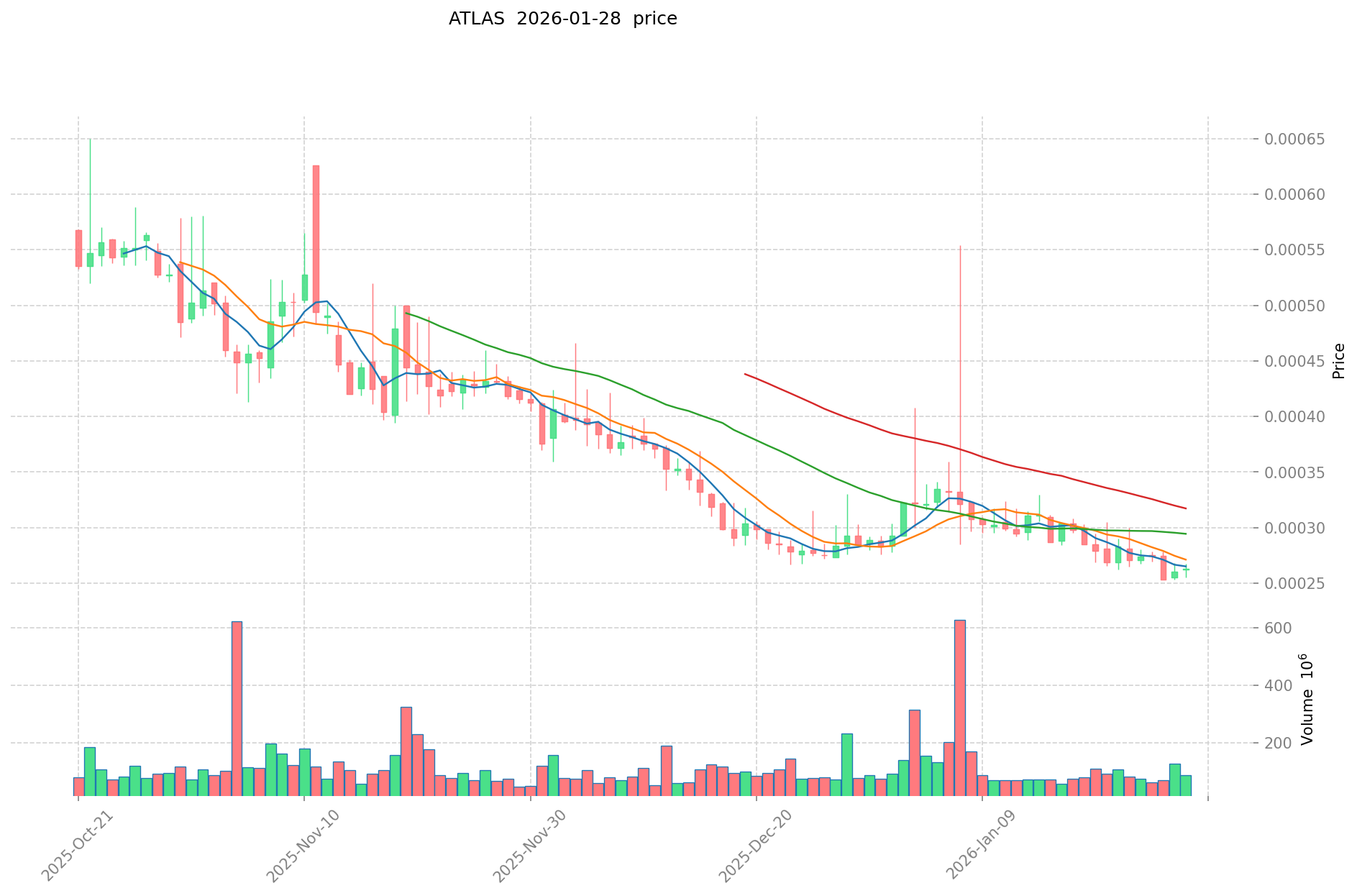
ATLAS Historical Price Trends and Investment Returns
- 2021: Token launch on September 4, with initial trading activity establishing early market presence
- 2021: Price experienced notable volatility during the initial launch phase, reflecting market discovery dynamics
- 2024-2026: Market adjustment period → Price declined from elevated levels to current trading ranges
Current ATLAS Investment Market Status (January 2026)
- ATLAS current price: $0.000263
- 24-hour trading volume: $23,220.35
- Market capitalization: $6,178,125.21
- Circulating supply: 23,490,970,388.83 ATLAS
Click to view real-time ATLAS market price
II. Core Factors Influencing Whether ATLAS Is a Good Investment
Supply Mechanism and Scarcity (ATLAS Investment Scarcity)
- Supply Parameters: Star Atlas (ATLAS) has a maximum supply of 36 billion tokens, with approximately 23.49 billion tokens currently in circulation, representing a circulating supply ratio of 65.25%. The circulating supply constitutes the tokens actively available in the market.
- Inflation Dynamics: According to referenced materials, ATLAS faces a 65% inflation rate through play-to-earn emissions, which may impact long-term scarcity and price stability. This high emission rate could influence the investment value proposition by increasing token availability in the market.
- Investment Implication: The substantial gap between circulating supply and maximum supply, combined with ongoing emissions, represents an important consideration for investors evaluating ATLAS's scarcity profile and potential value retention.
Institutional Investment and Mainstream Adoption (Institutional Investment in ATLAS)
- Holder Distribution: Current data indicates approximately 135,675 token holders, reflecting a level of community participation in the ATLAS ecosystem.
- Market Position: ATLAS maintains a market capitalization of approximately $6.18 million with a market dominance of 0.00029%, positioning it as a smaller-cap digital asset within the broader cryptocurrency landscape.
- Exchange Availability: The token is listed on 5 cryptocurrency exchanges, providing accessibility for investors seeking exposure to the Star Atlas gaming metaverse economy.
Macroeconomic Environment's Impact on ATLAS Investment
- Gaming Sector Performance: ATLAS operates within the blockchain gaming and metaverse sector, making its investment prospects sensitive to broader trends in gaming adoption and blockchain integration.
- Economic Indicators: The project experienced a 71% in-game GDP contraction in Q2 2025 despite record token locking activity, suggesting economic challenges within the game ecosystem that may influence investment considerations.
- Market Sentiment: Various prediction sources suggest ATLAS could reach approximately $0.00027 by the end of 2026, though such projections remain subject to market volatility and broader economic conditions affecting risk assets.
Technology and Ecosystem Development (Technology & Ecosystem for ATLAS Investment)
- Technical Foundation: Star Atlas operates on the Solana blockchain and utilizes Serum for transaction execution, leveraging established infrastructure for its gaming metaverse platform.
- Gaming Functionality: ATLAS serves as the native in-game currency within the Star Atlas metaverse, used for acquiring digital assets including warships, crew members, components, land, and equipment.
- Ecosystem Application: The token's utility is directly tied to in-game transactions and activities, with transaction volume potentially correlating to player engagement and ecosystem growth. The game's setting in the year 2620 features three competing factions, creating an economy driven by resource competition and territorial control.
III. ATLAS Future Investment Prediction and Price Outlook (Is Star Atlas(ATLAS) worth investing in 2026-2031)
Short-term Investment Prediction (2026, short-term ATLAS investment outlook)
- Conservative Prediction: $0.000175 - $0.000265
- Neutral Prediction: $0.000265 - $0.000318
- Optimistic Prediction: $0.000318 - $0.000371
Mid-term Investment Outlook (2027-2029, mid-term Star Atlas(ATLAS) investment forecast)
- Market Stage Expectation: The token may experience moderate fluctuations as the gaming metaverse ecosystem continues development, with potential price movements influenced by platform adoption rates and broader crypto market conditions.
- Investment Return Prediction:
- 2027: $0.000226 - $0.000350
- 2028: $0.000300 - $0.000401
- 2029: $0.000272 - $0.000481
- Key Catalysts: Ecosystem expansion on Solana blockchain, gaming platform user growth, NFT asset trading volume, and metaverse gaming sector developments.
Long-term Investment Outlook (Is ATLAS a good long-term investment?)
- Base Scenario: $0.000387 - $0.000479 (assuming steady ecosystem development and moderate market adoption)
- Optimistic Scenario: $0.000452 - $0.000569 (assuming enhanced platform engagement and favorable gaming sector trends)
- Risk Scenario: Below $0.000272 (under adverse market conditions or diminished project momentum)
Check ATLAS long-term investment and price prediction: Price Prediction
2026-01-28 - 2031 Long-term Outlook
- Base Scenario: $0.000387 - $0.000479 (corresponding to steady progress and gradual mainstream application improvement)
- Optimistic Scenario: $0.000452 - $0.000569 (corresponding to large-scale adoption and favorable market environment)
- Transformative Scenario: Above $0.000569 (if ecosystem achieves breakthrough progress and mainstream popularization)
- 2031-12-31 Predicted High: $0.000569 (based on optimistic development assumptions)
Disclaimer: The predictions presented are based on historical data analysis and market trend models. Cryptocurrency investments carry substantial risk, and actual prices may differ significantly from projections due to market volatility, regulatory changes, technological developments, and macroeconomic factors. This information is for reference purposes only and does not constitute investment advice.
| Year |
Predicted High Price |
Predicted Average Price |
Predicted Low Price |
Price Change |
| 2026 |
0.00037086 |
0.0002649 |
0.000174834 |
0 |
| 2027 |
0.000349668 |
0.00031788 |
0.0002256948 |
20 |
| 2028 |
0.0004005288 |
0.000333774 |
0.0003003966 |
26 |
| 2029 |
0.000480968334 |
0.0003671514 |
0.000271692036 |
39 |
| 2030 |
0.00047918764971 |
0.000424059867 |
0.00038589447897 |
61 |
| 2031 |
0.000569045935527 |
0.000451623758355 |
0.000410977620103 |
71 |
Investment Methodology (ATLAS investment strategy)
-
Long-term Holding (HODL ATLAS): Suitable for conservative investors who believe in the long-term development of blockchain gaming and metaverse ecosystems. This approach involves acquiring ATLAS tokens and holding them through market cycles, based on the premise that Star Atlas's technological foundation and gaming metaverse concept may gain traction over time.
-
Active Trading: Relies on technical analysis and swing trading strategies. Given ATLAS's price movements (with 24-hour changes of 1.68%, 7-day changes of -2%, and 30-day changes of -10.84%), traders may identify opportunities in short-term price fluctuations. This approach requires monitoring market sentiment, volume patterns, and key support/resistance levels.
Risk Management (Risk management for ATLAS investment)
-
Asset Allocation Ratio:
- Conservative investors: Allocate no more than 1-3% of portfolio to ATLAS
- Moderate investors: Consider 3-7% allocation as part of gaming/metaverse token exposure
- Experienced investors: May allocate 7-15% depending on risk tolerance and market analysis
-
Risk Hedging Strategies: Diversify across multiple asset classes including established cryptocurrencies, stablecoins, and traditional assets. Consider portfolio rebalancing during significant price movements.
-
Secure Storage:
- Hot wallets: Suitable for active trading portions with 2FA enabled
- Cold wallets: Recommended for long-term holdings
- Hardware wallets: Ledger and Trezor support Solana-based tokens like ATLAS
-
Market Risk: ATLAS exhibits significant price volatility, having declined approximately 88.23% over the past year from higher levels. The token's 24-hour trading volume of approximately $23,220 suggests relatively limited liquidity, which may amplify price movements. The market capitalization represents only 0.00029% of the total crypto market, indicating concentration risk.
-
Regulatory Risk: As a gaming token with financial elements, ATLAS may face evolving regulatory frameworks regarding virtual assets, gaming currencies, and decentralized finance across different jurisdictions. Changes in gaming regulations, securities laws, or crypto policies could impact the token's utility and trading accessibility.
-
Technology Risk: The project's reliance on Solana blockchain infrastructure means network congestion, outages, or technical issues on Solana could affect ATLAS functionality. Additionally, the integration of Unreal Engine 5 technology and complex gaming mechanics introduces development and execution risks. Smart contract vulnerabilities or security breaches could compromise token holders' assets.
-
Project-Specific Risk: As a gaming metaverse token, ATLAS's value proposition depends heavily on Star Atlas achieving user adoption, delivering on development roadmaps, and maintaining player engagement. Competition from other blockchain gaming projects and traditional gaming platforms presents additional challenges.
-
Investment Value Summary: ATLAS represents exposure to the intersection of blockchain technology, gaming, and metaverse concepts. While the token has experienced substantial price decline over the past year, it maintains trading presence across multiple exchanges and has a holder base of approximately 135,675 addresses. The project's technical foundation on Solana and utilization of advanced gaming engine technology provide a differentiated approach in the blockchain gaming space.
-
Investor Recommendations:
✅ Beginners: Consider dollar-cost averaging with very small allocations, prioritize learning about Solana wallet security, and store tokens in secure wallets rather than keeping significant amounts on exchanges.
✅ Experienced Investors: May employ swing trading strategies based on technical analysis, maintain strict position sizing relative to portfolio, and monitor project development milestones and gaming industry trends.
✅ Institutional Investors: Evaluate ATLAS as part of broader blockchain gaming and metaverse sector exposure, conduct thorough due diligence on project team and technology stack, and consider position sizing within alternative digital assets allocation.
⚠️ Notice: Cryptocurrency investment carries substantial risk, and gaming tokens exhibit particularly high volatility. This content is for informational purposes only and does not constitute investment advice. Conduct thorough research and consult financial advisors before making investment decisions.
VII. FAQ
Q1: What is ATLAS and how does it function within the Star Atlas ecosystem?
ATLAS is the native in-game currency of Star Atlas, a blockchain-based gaming metaverse operating on the Solana blockchain. Within the ecosystem, ATLAS serves as the primary medium of exchange for acquiring digital assets including warships, crew members, components, land, and equipment. The token facilitates all in-game transactions and economic activities within the Star Atlas universe set in the year 2620, where three competing factions drive resource competition and territorial control. Built using Unreal Engine 5 with Nanite technology, the platform combines real-time graphics, multiplayer gaming mechanics, and decentralized finance elements to create an immersive metaverse experience.
Q2: What are the current market metrics for ATLAS as of January 2026?
As of January 28, 2026, ATLAS trades at approximately $0.000263 with a market capitalization of $6.18 million. The token has a circulating supply of 23.49 billion tokens out of a maximum supply of 36 billion, representing a 65.25% circulation ratio. The 24-hour trading volume stands at $23,220.35, with the token listed on 5 cryptocurrency exchanges. ATLAS maintains approximately 135,675 token holders and holds a market dominance of 0.00029% within the broader cryptocurrency landscape. The token has experienced an 88.23% decline over the past year, with recent performance showing a 1.68% increase over 24 hours, a 2% decrease over 7 days, and a 10.84% decline over 30 days.
Q3: What are the primary investment risks associated with ATLAS?
ATLAS carries several significant investment risks. Market risk is substantial, evidenced by high volatility and limited liquidity with relatively low daily trading volumes. The token's small market capitalization magnifies price movement sensitivity. Regulatory risk exists as gaming tokens with financial elements may face evolving frameworks across jurisdictions. Technology risk includes dependence on Solana blockchain infrastructure, where network issues could affect functionality, along with potential smart contract vulnerabilities. Project-specific risk centers on Star Atlas achieving user adoption and competing against other blockchain gaming platforms and traditional gaming alternatives. Additionally, ATLAS faces a 65% inflation rate through play-to-earn emissions, potentially impacting long-term value retention.
Q4: What price predictions exist for ATLAS through 2031?
Short-term predictions for 2026 range from conservative estimates of $0.000175-$0.000265 to optimistic scenarios of $0.000318-$0.000371. Mid-term forecasts suggest potential ranges of $0.000226-$0.000350 for 2027, $0.000300-$0.000401 for 2028, and $0.000272-$0.000481 for 2029. Long-term projections through 2031 present base scenarios of $0.000387-$0.000479, optimistic scenarios of $0.000452-$0.000569, and a potential 2031 predicted high of $0.000569. However, these projections remain subject to significant uncertainty due to market volatility, regulatory changes, technological developments, and macroeconomic factors. Such predictions should be viewed as reference points rather than guaranteed outcomes.
Q5: What investment strategies are suitable for different types of ATLAS investors?
For conservative beginners, a dollar-cost averaging approach with 1-3% portfolio allocation is recommended, focusing on secure wallet storage and learning Solana wallet security fundamentals. Experienced investors may employ active trading strategies utilizing technical analysis for swing trading opportunities, maintaining 3-7% allocation while monitoring market sentiment and volume patterns. Institutional investors could consider ATLAS as part of broader blockchain gaming sector exposure with 7-15% allocation depending on risk tolerance, conducting thorough due diligence on the project team and technology stack. All investors should implement proper risk management through diversification across multiple asset classes, regular portfolio rebalancing, and appropriate storage solutions including hardware wallets for long-term holdings and secure hot wallets with two-factor authentication for active trading portions.
Q6: How does ATLAS's tokenomics affect its investment potential?
ATLAS's tokenomics present both opportunities and challenges for investors. With a maximum supply of 36 billion tokens and 23.49 billion currently circulating, a substantial 10.51 billion tokens remain to enter the market. The project faces a 65% inflation rate through play-to-earn emissions, which significantly impacts token scarcity and potentially dilutes holder value over time. This high emission rate requires strong ecosystem growth and token utility to offset inflationary pressure. Additionally, the project experienced a 71% in-game GDP contraction in Q2 2025 despite record token locking activity, suggesting economic challenges within the ecosystem. Investors must weigh these tokenomic factors against the project's technological foundation and gaming metaverse positioning when evaluating long-term investment potential.
Q7: What factors could drive ATLAS price appreciation in the future?
Several catalysts could potentially drive ATLAS price appreciation. Ecosystem expansion on the Solana blockchain, particularly increased user adoption of the Star Atlas gaming platform, represents a primary driver. Growth in NFT asset trading volume within the game economy could increase token utility and demand. Broader metaverse gaming sector developments and increased mainstream adoption of blockchain gaming concepts may benefit ATLAS as a sector participant. Technical milestones such as successful platform launches, enhanced gameplay features, and improved graphics utilizing Unreal Engine 5 could attract more players. Additionally, favorable macroeconomic conditions for risk assets, positive cryptocurrency market sentiment, and potential strategic partnerships or integrations could contribute to upward price movement. However, these potential catalysts remain subject to execution risk and broader market conditions.
Q8: Where can investors purchase and securely store ATLAS tokens?
ATLAS tokens are available for purchase on 5 cryptocurrency exchanges, with Gate.com providing real-time market data and trading capabilities. Before purchasing, investors should establish secure storage solutions. For long-term holdings, hardware wallets such as Ledger and Trezor that support Solana-based tokens offer the highest security level. Cold storage solutions are recommended for significant holdings to protect against online threats. For active trading, secure hot wallets with two-factor authentication enabled provide necessary accessibility while maintaining reasonable security. Investors should avoid keeping substantial amounts on exchanges due to counterparty risk. When setting up wallets, proper backup of recovery phrases and implementation of strong passwords are essential security practices for protecting ATLAS holdings.
* The information is not intended to be and does not constitute financial advice or any other recommendation of any sort offered or endorsed by Gate.