This comprehensive POLIS investment analysis examines Star Atlas DAO's governance token across six critical dimensions: historical price trends revealing an 81.01% annual decline from its $18.55 peak to $0.02216, core ecosystem factors built on Solana blockchain with Unreal Engine 5 integration, and price predictions spanning 2026-2031 across conservative, neutral, and optimistic scenarios. The article addresses investment strategies including long-term holding and active trading approaches, with detailed risk management protocols covering asset allocation, portfolio diversification, and secure wallet storage practices. It identifies key risks including market volatility, regulatory uncertainty, technical dependencies, and adoption challenges while providing investor recommendations stratified by experience levels—from newcomers utilizing dollar-cost averaging to institutional investors evaluating sector positioning. Detailed FAQ sections clarify POLIS's differentiation within blockchain gaming, supply dynami
Introduction: Star Atlas DAO (POLIS) Investment Status and Market Outlook
POLIS is a notable asset in the cryptocurrency field, launched in September 2021 within the blockchain gaming and metaverse sector. As of January 27, 2026, POLIS holds a market capitalization of approximately 7.27 million USD, with a circulating supply of around 327.91 million tokens, and the current price is maintained at approximately 0.02216 USD. With its positioning as a governance token for the Star Atlas gaming metaverse, POLIS has gradually become a focal point when investors discuss "Is Star Atlas DAO (POLIS) a good investment?" This article will comprehensively analyze POLIS's investment value, historical trends, future price predictions, and investment risks to provide reference for investors.
Star Atlas DAO combines advanced technologies such as blockchain, real-time imaging, multiplayer gaming, and decentralized finance to build a next-generation gaming metaverse. The project operates on the Solana blockchain and utilizes Unreal Engine 5 with Nanite technology. Set in the year 2620, Star Atlas presents a virtual universe where three major factions compete for resources, territory, and political influence. POLIS serves as one of the native tokens within this ecosystem, enabling players to participate in governance decisions and earn rewards based on their contributions.
As of the current observation date, POLIS ranks 1353 in the cryptocurrency market with a market dominance of 0.00025%. The token has experienced notable price fluctuations, with a 24-hour change of 0.4%, a 7-day decline of 6.85%, and a 30-day decrease of 14.77%. Over the past year, the price has shown a significant decline of 81.01%. The circulating supply represents approximately 91.09% of the maximum supply of 360 million tokens. With 52,604 holders and trading availability on 4 exchanges, POLIS demonstrates a certain level of market participation within the blockchain gaming sector.
I. POLIS Price History Review and Current Investment Landscape
- 2021: POLIS launched on September 4, with the token reaching $18.55 during the initial trading period → Early investors experienced significant price appreciation
- 2021-2025: The token experienced a substantial price correction → Declining from peak levels to $0.02216
- Market Cycle 2024-2025: Price declined approximately 81.01% over the one-year period → Trading near multi-year support zones around $0.02184
Current Market Status (January 2026)
- Current POLIS price: $0.02216
- Market sentiment indicators: Trading volume of $14,766.80 reflects moderate liquidity conditions
- 24-hour trading metrics: Price fluctuation range between $0.02199 and $0.02397, showing approximately 0.4% daily change
- Circulating supply: 327,914,181.67 POLIS tokens, representing 91.09% of the maximum supply of 360,000,000
Access real-time POLIS market price data
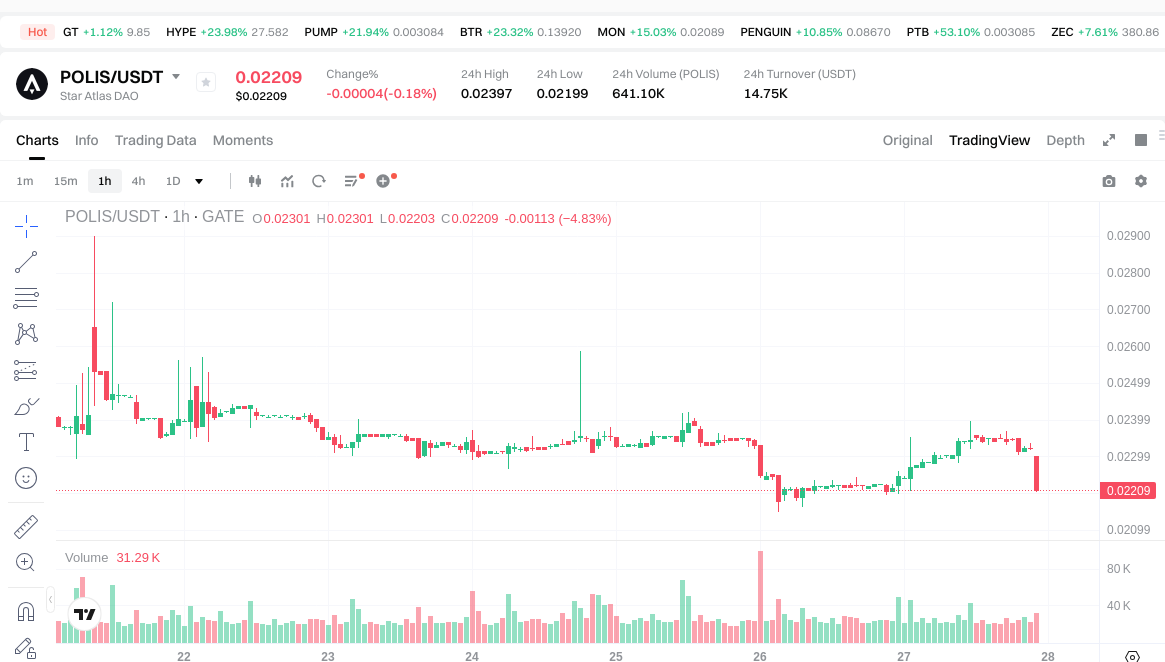
II. Core Factors Influencing Whether POLIS is a Good Investment
Supply Mechanism and Scarcity (POLIS Investment Scarcity)
- Maximum supply capped at 360,000,000 POLIS with a circulating supply of approximately 327,914,181 tokens (91.09% of total supply) → influences token scarcity dynamics and potential price appreciation
- Current circulating ratio suggests limited additional supply pressure in the near term, which may support price stability under favorable market conditions
- Investment significance: token scarcity combined with fixed maximum supply provides structural support for long-term value retention, though market demand remains the primary driver
Technical and Ecosystem Development (Technology & Ecosystem for POLIS Investment)
- Star Atlas operates on the Solana blockchain, leveraging its high-speed transaction processing and low-cost infrastructure → enhances scalability for gaming applications
- Integration with Serum decentralized exchange facilitates token liquidity and trading accessibility within the Solana ecosystem
- Utilization of Unreal Engine 5 with Nanite technology provides advanced graphics capabilities → strengthens the project's technical foundation for immersive metaverse gaming experiences
- Gaming metaverse narrative with three-faction gameplay system (MUD, ONI, Ustur) creates utility-driven token economics through player participation and reward mechanisms
- The project's positioning within blockchain gaming and metaverse sectors aligns with emerging trends in digital entertainment and NFT integration
III. POLIS Future Investment Predictions and Price Outlook (Is Star Atlas DAO (POLIS) worth investing in 2026-2031)
Short-term Investment Prediction (2026, short-term POLIS investment outlook)
- Conservative prediction: $0.0197 - $0.0221
- Neutral prediction: $0.0221 - $0.0273
- Optimistic prediction: $0.0273 - $0.0327
Mid-term Investment Outlook (2027-2029, mid-term Star Atlas DAO (POLIS) investment forecast)
- Market phase expectation: The mid-term period may witness moderate growth as the project continues developing its gaming metaverse ecosystem and potentially expands its user base.
- Investment return prediction:
- 2027: $0.0225 - $0.0403
- 2028: $0.0254 - $0.0375
- 2029: $0.0286 - $0.0389
- Key catalysts: Ecosystem development milestones, gaming platform adoption rates, Solana network performance, and broader blockchain gaming sector trends.
Long-term Investment Outlook (Is POLIS a good long-term investment?)
- Baseline scenario: $0.0194 - $0.0419 (assuming steady ecosystem development and moderate market conditions through 2030-2031)
- Optimistic scenario: $0.0355 - $0.0510 (assuming successful gaming platform launches, increased user engagement, and favorable blockchain gaming market dynamics)
- Risk scenario: Below $0.0194 (in case of significant technical challenges, reduced user adoption, or adverse market conditions)
Click to view POLIS long-term investment and price prediction: Price Prediction
2026-01-27 - 2031 Long-term Outlook
- Base scenario: $0.0194 - $0.0419 (corresponding to steady progress and gradual mainstream application growth)
- Optimistic scenario: $0.0355 - $0.0510 (corresponding to large-scale adoption and favorable market environment)
- Transformative scenario: Above $0.0510 (if the ecosystem achieves breakthrough progress and mainstream popularity)
- 2031-12-31 predicted high: $0.0510 (based on optimistic development assumptions)
Disclaimer: Price predictions are based on historical data analysis and market modeling. Cryptocurrency markets are highly volatile and subject to numerous unpredictable factors including technological developments, regulatory changes, and macroeconomic conditions. These projections should not be considered as financial advice, and actual prices may differ significantly from forecasts. Investors should conduct their own research and consider their risk tolerance before making investment decisions.
| Year |
Predicted High Price |
Predicted Average Price |
Predicted Low Price |
Price Change |
| 2026 |
0.0326932 |
0.02209 |
0.0196601 |
0 |
| 2027 |
0.040265652 |
0.0273916 |
0.022461112 |
23 |
| 2028 |
0.03754977486 |
0.033828626 |
0.0253714695 |
52 |
| 2029 |
0.0389012284687 |
0.03568920043 |
0.028551360344 |
61 |
| 2030 |
0.046246065917194 |
0.03729521444935 |
0.019393511513662 |
68 |
| 2031 |
0.050960181023591 |
0.041770640183272 |
0.035505044155781 |
88 |
IV. POLIS Investment Strategy and Risk Management (How to invest in Star Atlas DAO)
Investment Methodology (POLIS investment strategy)
Risk Management (Risk management for POLIS investment)
-
Asset Allocation Ratio: Conservative / Aggressive / Professional investors
- Conservative investors: Consider limiting POLIS exposure to a small percentage of overall crypto portfolio, given its market cap ranking of 1353 and market share of 0.00025%.
- Aggressive investors: May allocate a moderate portion while maintaining diversification across multiple blockchain gaming and metaverse projects.
- Professional investors: Could incorporate POLIS as part of a specialized gaming/metaverse sector allocation with appropriate risk parameters.
-
Risk Hedging Solutions: Multi-asset portfolio + hedging tools
- Diversification across different blockchain ecosystems beyond Solana-based assets may help mitigate platform-specific risks.
- Investors may consider balancing exposure between established cryptocurrencies and specialized gaming tokens to manage sector-specific volatility.
-
Secure Storage: Hot/cold wallets + hardware wallet recommendations
- POLIS tokens operate on the Solana blockchain (contract address: poLisWXnNRwC6oBu1vHiuKQzFjGL4XDSu4g9qjz9qVk). Investors should utilize Solana-compatible wallet solutions.
- Hardware wallets supporting Solana ecosystem provide enhanced security for long-term storage.
- For active traders, a combination of secure hot wallets for trading and cold storage for larger holdings offers a balanced approach.
V. POLIS Investment Risks and Challenges (Risks of investing in Star Atlas DAO)
-
Market Risk: High volatility, price manipulation concerns
- POLIS has experienced substantial price fluctuations, with the current price of $0.02216 representing a decline from its historical high of $18.55 recorded on September 4, 2021.
- The token's relatively modest market capitalization of approximately $7.27 million and limited exchange availability may contribute to price volatility.
- With a circulating supply of 327,914,181.67 tokens (91.09% of the 360 million maximum supply), the market structure presents characteristics associated with increased price sensitivity.
-
Regulatory Risk: Policy uncertainty across different jurisdictions
- As a gaming metaverse project incorporating decentralized finance elements and NFT components, POLIS may face evolving regulatory frameworks affecting blockchain gaming, digital assets, and virtual economies.
- Regulatory approaches to gaming tokens and in-game economies vary significantly across jurisdictions, creating potential compliance considerations.
-
Technical Risk: Network security vulnerabilities, upgrade failures
- POLIS operates on the Solana blockchain infrastructure. Any technical issues, network congestion, or security vulnerabilities affecting Solana could impact token functionality and user experience.
- The project's reliance on Serum for trading and integration with Unreal Engine 5 technology creates technical dependencies that require ongoing maintenance and development.
- Smart contract risks associated with the token contract (poLisWXnNRwC6oBu1vHiuKQzFjGL4XDSu4g9qjz9qVk) require careful consideration, as vulnerabilities could affect token security.
VI. Conclusion: Is Star Atlas DAO a Good Investment?
-
Investment Value Summary: POLIS presents characteristics associated with the emerging blockchain gaming and metaverse sector, though it has experienced considerable price volatility over extended periods.
-
Investor Recommendations:
- ✅ Newcomers: Consider dollar-cost averaging strategies + secure wallet storage practices. Begin with understanding Solana ecosystem fundamentals and blockchain gaming concepts before allocating capital.
- ✅ Experienced Investors: May explore swing trading approaches + portfolio diversification strategies. Monitor gaming metaverse sector developments and technical indicators for potential entry and exit points.
- ✅ Institutional Investors: Could evaluate strategic positioning within gaming/metaverse sector allocations, considering long-term technological trends and market evolution.
⚠️ Notice: Cryptocurrency investment involves substantial risk. This content is provided for informational purposes only and does not constitute investment advice. Investors should conduct thorough independent research and consider their financial situation and risk tolerance before making any investment decisions.
VII. FAQ
Q1: What makes POLIS different from other blockchain gaming tokens?
POLIS serves as the governance token for Star Atlas, a metaverse gaming platform built on Solana blockchain utilizing Unreal Engine 5 with Nanite technology. The token's uniqueness lies in its integration within a comprehensive gaming ecosystem set in 2620, where three major factions (MUD, ONI, Ustur) compete for resources and territory. Unlike many gaming tokens, POLIS combines real-time graphics capabilities, decentralized finance elements, and NFT integration within a scalable infrastructure. The project leverages Solana's high-speed transaction processing and integrates with Serum decentralized exchange, providing both gaming utility and DeFi functionality. Additionally, the fixed maximum supply of 360 million tokens with 91.09% already in circulation creates a relatively predictable supply structure compared to inflationary gaming token models.
Q2: How volatile has POLIS been historically, and what caused the significant price decline?
POLIS has demonstrated substantial volatility since its September 2021 launch. The token reached a historical high of $18.55 during initial trading but has since declined approximately 81.01% over the past year to the current price of $0.02216. This significant correction reflects broader cryptocurrency market cycles, the extended development timeline for the Star Atlas gaming platform, and sector-specific challenges in blockchain gaming adoption. Short-term volatility remains notable, with 24-hour fluctuations around 0.4%, 7-day changes of -6.85%, and 30-day declines of 14.77%. The relatively modest market capitalization of $7.27 million and limited exchange availability (4 exchanges) contribute to price sensitivity, making POLIS susceptible to both market sentiment shifts and trading volume variations.
Q3: What is the realistic price prediction range for POLIS through 2031?
Based on market modeling and historical data analysis, POLIS price projections suggest a gradual recovery trajectory under various scenarios. For 2026, conservative estimates range from $0.0197 to $0.0221, neutral predictions span $0.0221 to $0.0273, and optimistic scenarios reach $0.0273 to $0.0327. Mid-term outlooks for 2027-2029 anticipate potential ranges of $0.0225 to $0.0403 (2027), $0.0254 to $0.0375 (2028), and $0.0286 to $0.0389 (2029). Long-term projections through 2031 vary significantly based on ecosystem development, with baseline scenarios suggesting $0.0194 to $0.0419 and optimistic scenarios reaching $0.0355 to $0.0510. However, investors should recognize that these predictions carry substantial uncertainty given cryptocurrency market volatility, technological development risks, and evolving blockchain gaming sector dynamics.
Q4: How should investors approach risk management when investing in POLIS?
Risk management for POLIS investment requires careful portfolio allocation and diversification strategies. Conservative investors should consider limiting POLIS exposure to a small percentage of their overall cryptocurrency portfolio, reflecting its market cap ranking of 1353 and minimal market dominance of 0.00025%. Aggressive investors may allocate moderate positions while maintaining diversification across multiple blockchain gaming and metaverse projects. Asset allocation should account for POLIS's connection to Solana ecosystem performance, as network issues could impact token functionality. Secure storage practices are essential, utilizing Solana-compatible hardware wallets for long-term holdings and reputable hot wallets for active trading. Investors should also consider implementing dollar-cost averaging strategies to mitigate timing risk, monitor gaming metaverse sector developments, and establish clear entry and exit criteria based on technical indicators and project milestones.
Q5: What are the primary risks associated with POLIS investment?
POLIS investment involves multiple risk categories that require careful consideration. Market risks include high volatility demonstrated by the 81.01% annual decline and relatively low trading volume of $14,766.80, which may increase susceptibility to price manipulation. The modest market capitalization and limited exchange availability contribute to liquidity concerns. Technical risks stem from dependence on Solana blockchain infrastructure, where network congestion or security vulnerabilities could affect token functionality. The project's reliance on Serum integration and Unreal Engine 5 technology creates additional technical dependencies. Regulatory risks arise from evolving frameworks affecting blockchain gaming, digital assets, and virtual economies across different jurisdictions. Development risks include potential delays in gaming platform launches, user adoption challenges, and competitive pressures within the blockchain gaming sector. The high circulating supply ratio (91.09%) also limits scarcity-driven price appreciation potential in the near term.
Q6: Is POLIS suitable for long-term holding, or is it better for active trading?
The suitability of POLIS for long-term holding versus active trading depends on investor profile and market conditions. Long-term holding may appeal to investors who believe in the gaming metaverse sector's growth potential and Star Atlas's technological foundation, despite the token's significant historical decline from $18.55 to $0.02216. The project's integration with Solana blockchain, Unreal Engine 5 capabilities, and fixed maximum supply provide fundamental characteristics that some investors may view as supportive of long-term value creation. However, the extended development timeline and current early-stage adoption levels suggest considerable patience may be required. Active trading strategies may capitalize on POLIS's notable short-term volatility, with 1-hour changes reaching -4.89% and 24-hour fluctuations around 0.4%. Traders should monitor technical indicators, volume patterns, and gaming sector developments. A hybrid approach combining core long-term positions with tactical trading allocations may suit experienced investors seeking to balance growth potential with volatility management.
Q7: How does POLIS's circulating supply impact its investment potential?
POLIS's circulating supply structure significantly influences its investment dynamics and scarcity characteristics. With approximately 327.91 million tokens circulating out of a maximum supply of 360 million (91.09%), the token demonstrates a high circulation ratio that limits near-term supply pressure from new token releases. This relatively mature supply distribution reduces potential dilution risks compared to projects with lower circulation percentages. However, the high circulation ratio also means limited scarcity-driven price appreciation from supply constraints alone, placing greater emphasis on demand-side factors such as gaming platform adoption, user engagement, and broader market sentiment. The fixed maximum supply cap provides structural support for long-term value retention, assuming sustained or growing demand. Investors evaluating POLIS should recognize that price movements will likely depend more heavily on ecosystem development milestones, user base expansion, and sector-wide blockchain gaming trends rather than supply mechanics. The current holder base of 52,604 addresses suggests moderate token distribution, though concentration risks should be assessed through on-chain analysis.
Q8: What technological advantages does Star Atlas offer that could benefit POLIS investors?
Star Atlas incorporates several technological elements that differentiate it within the blockchain gaming sector and potentially support POLIS value proposition. The project utilizes Unreal Engine 5 with Nanite technology, providing advanced graphics capabilities that enable highly detailed virtual environments and immersive gaming experiences comparable to traditional AAA gaming standards. This technical foundation addresses a common criticism of blockchain games regarding visual quality and user experience. The Solana blockchain infrastructure offers high-speed transaction processing and low-cost operations, addressing scalability challenges that have limited other blockchain gaming platforms. Integration with Serum decentralized exchange facilitates token liquidity and trading accessibility within the broader Solana ecosystem. The three-faction gameplay system (MUD, ONI, Ustur) creates dynamic competitive elements that may enhance player engagement and token utility through governance participation and reward mechanisms. These technological components position Star Atlas to potentially compete more effectively with traditional gaming platforms while maintaining blockchain-based ownership and economic benefits. However, investors should recognize that technological capabilities alone do not guarantee market success, as user adoption, content development, and competitive dynamics remain critical determinants of long-term value creation.
* The information is not intended to be and does not constitute financial advice or any other recommendation of any sort offered or endorsed by Gate.