This comprehensive analysis examines whether Status (SNT) represents a viable investment opportunity in the decentralized application and Web3 communication space. The article evaluates SNT's market position, current trading at $0.01502 with a $59.49 million market capitalization, alongside historical price volatility that has seen 69.89% decline over one year. Key investment factors discussed include the token's unlimited supply model, ecosystem technology built on Ethereum's Whisper protocol, and utility functions within the Status platform for messaging and DApp browsing. The analysis presents short-term and long-term price predictions ranging from $0.0079659 to $0.0327122142408 through 2031, while emphasizing significant risks including market volatility, regulatory uncertainties, and adoption challenges against established competitors. Detailed investment strategies, secure storage recommendations on Gate, and risk management approaches are provided for different investor profiles, from beginners to inst
Introduction: Status (SNT) Investment Position and Market Outlook
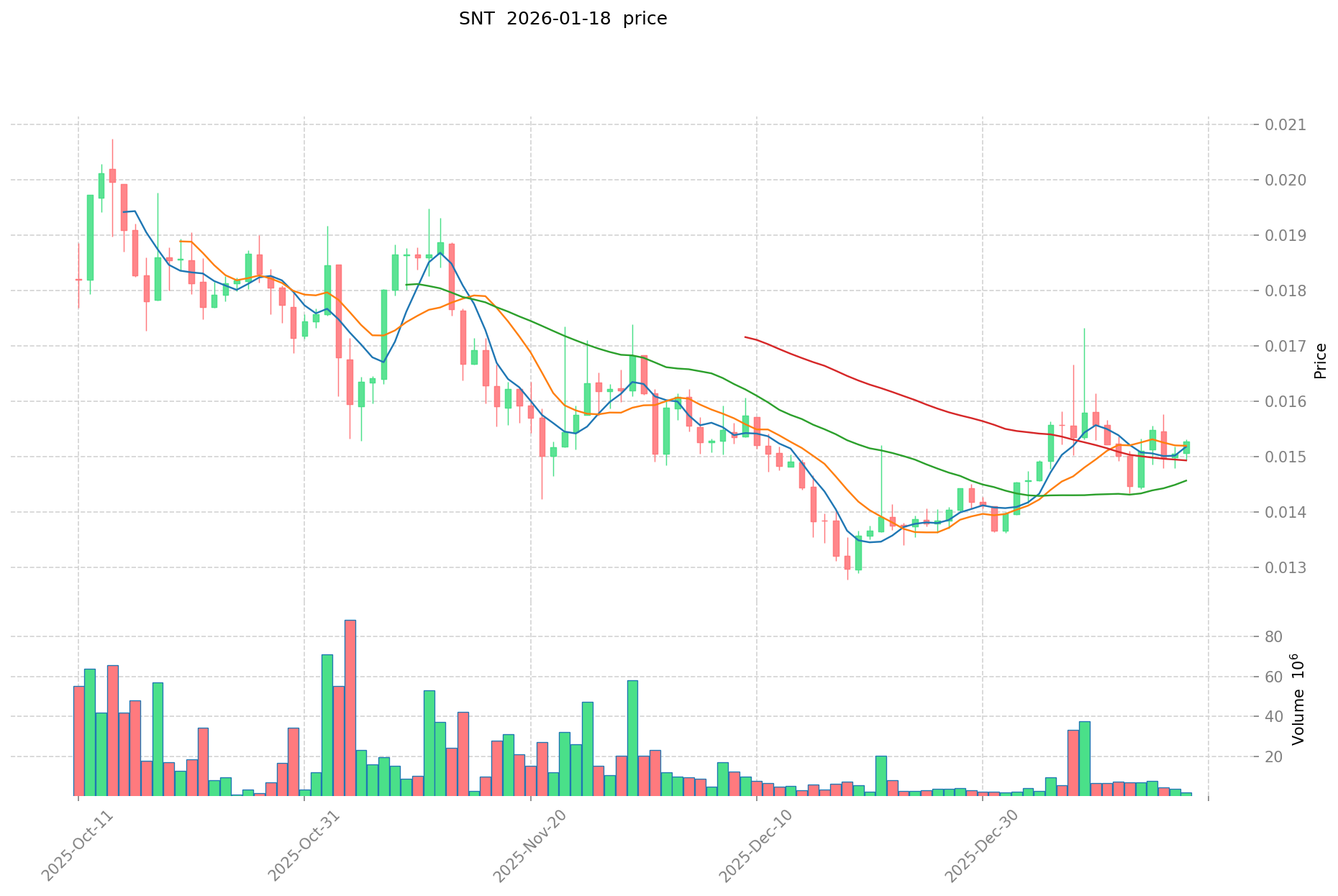
Status (SNT) represents a distinctive crypto asset in the decentralized application ecosystem, having launched in June 2017 through an Initial Coin Offering that raised approximately 300,000 ETH. As of January 19, 2026, SNT maintains a market capitalization of approximately $59.49 million, with a circulating supply of around 3.96 billion tokens out of a total supply of 6.80 billion tokens. The current price stands at approximately $0.01502, reflecting the asset's position in the mid-tier cryptocurrency market with a ranking of 493.
Positioned as an open-source messaging platform and mobile browser supporting decentralized applications on Ethereum, Status integrates instant messaging, DApp browsing, and lightweight wallet functionality. The platform's architecture, built upon the Whisper protocol, provides chat APIs and development tools for decentralized applications, enabling users to access DApp services within the software environment. With approximately 76,376 holders and trading availability on 11 exchanges, SNT has established a measurable presence in the crypto market.
The token serves multiple utility functions within the Status ecosystem, including supporting message transmission fees, DApp service calls, and platform advertising expenses. Current market data shows a 24-hour trading volume of approximately $30,489, with the token's price experiencing a 10.6% increase over the past 30 days, though showing a decline of 69.89% over the one-year period. This article examines Status (SNT)'s investment characteristics, historical price movements, future price projections, and associated investment risks to provide analytical reference for market participants considering "Is Status (SNT) a good investment?"
I. Status (SNT) Price Historical Review and Current Investment Value
- 2017: Status launched its ICO in June 2017, experiencing significant market enthusiasm during the ICO boom period → The token saw substantial initial trading activity
- 2018: SNT reached a notable price level of $0.684918 on January 3, 2018 → The token subsequently experienced considerable market volatility amid broader cryptocurrency market corrections
- 2020: On March 13, 2020, SNT recorded a price of $0.00592935 during market-wide downturns → The token demonstrated resilience through subsequent recovery phases
- 2025-2026: Market participants maintain cautious positioning → SNT trading within a range, with price standing at $0.01502 as of January 19, 2026
Current SNT Investment Market Status (January 2026)
- SNT Current Price: $0.01502
- Market Sentiment (Fear & Greed Index): Data indicates measured market positioning
- 24-Hour Trading Volume: $30,489.30
- Market Capitalization: $59.49 million
- Circulating Supply: 3.96 billion SNT tokens
- Total Supply: 6.80 billion SNT tokens
- Market Cap to Fully Diluted Valuation Ratio: 58.2%
- Exchange Availability: Listed on 11 cryptocurrency exchanges
- Token Holder Base: 76,376 addresses
Click to view real-time SNT market price
II. Core Factors Affecting Whether Status (SNT) is a Good Investment
Supply Mechanism and Scarcity (SNT Investment Scarcity)
- Total supply of 6,804,870,174 SNT tokens with infinite maximum supply → impacts long-term scarcity dynamics
- Circulating supply represents 58.20% of total supply (3,960,483,788 SNT) → current token distribution affects market liquidity
- Historical price range from $0.00592935 to $0.684918 → reflects market volatility and supply-demand dynamics
- Investment significance: unlimited supply model may influence long-term value propositions compared to capped-supply assets
Institutional Investment and Mainstream Adoption (Institutional Investment in SNT)
- Current holder count: 76,376 addresses → indicates retail and institutional participation levels
- Market capitalization ranking: 493rd position with $59.49 million market cap → reflects current institutional interest scale
- Platform availability: listed on 11 exchanges → provides institutional access channels
- Market dominance: 0.0030% of total crypto market → represents niche positioning within broader institutional portfolios
Macroeconomic Environment Impact on SNT Investment
- 24-hour trading volume: $30,489.30 → reflects current market liquidity conditions
- 30-day performance: +10.6% price increase → demonstrates recent market response to macroeconomic factors
- 1-year performance: -69.89% decline → indicates sensitivity to broader market cycles and economic conditions
- Price volatility: 24-hour range between $0.01484 and $0.0153 → shows active market price discovery
Technology and Ecosystem Development (Technology & Ecosystem for SNT Investment)
- Core functionality: decentralized messaging platform and DApp browser on Ethereum → provides fundamental utility value
- Built on Ethereum blockchain using Whisper protocol → leverages established network infrastructure
- Integrated wallet supporting ETH and SNT transfers → facilitates ecosystem participation
- Five DApp categories: exchanges, marketplace, games, social networks, and utility tools → demonstrates ecosystem diversity
- Developer tools and chat APIs → supports third-party application development and network effects
III. SNT Future Investment Prediction and Price Outlook (Is Status(SNT) worth investing in 2026-2031)
Short-term Investment Prediction (2026, short-term SNT investment outlook)
Based on available market analysis, short-term predictions for SNT in 2026 present varied scenarios:
- Conservative prediction: $0.0079659 - $0.01503
- Neutral prediction: $0.01503 - $0.0174348
- Optimistic prediction: $0.0174348 and above
The 2026 outlook suggests potential price movements influenced by broader market conditions and the project's ongoing development activities.
Mid-term Investment Outlook (2027-2029, mid-term Status(SNT) investment forecast)
- Market stage expectation: The mid-term period may witness gradual adoption of decentralized applications and messaging platforms, potentially supporting SNT's utility value.
- Investment return prediction:
- 2027: $0.011525004 - $0.020452824
- 2028: $0.01687520304 - $0.02586308292
- 2029: $0.0194505057648 - $0.0327122142408
- Key catalysts: Development progress in Status ecosystem, integration of decentralized communication tools, and overall growth in Ethereum-based dApp adoption.
Long-term Investment Outlook (Is SNT a good long-term investment?)
- Base scenario: $0.017540819744256 - $0.028503832084416 (assuming steady development and moderate market conditions through 2030)
- Optimistic scenario: $0.027955681467408 - $0.029633022355452 (assuming enhanced platform adoption and favorable regulatory environment through 2031)
- Risk scenario: Below $0.0079659 (under adverse market conditions or significant project setbacks)
Check SNT long-term investment and price prediction: Price Prediction
2026-2031 Long-term Outlook
- Base scenario: $0.0079659 - $0.028503832084416 (corresponding to steady progress and gradual mainstream application adoption)
- Optimistic scenario: $0.027955681467408 - $0.0327122142408 (corresponding to large-scale adoption and favorable market environment)
- Transformational scenario: Above $0.0327122142408 (if ecosystem achieves breakthrough developments and mainstream adoption)
- 2031-12-31 predicted high: $0.029633022355452 (based on optimistic development assumptions)
Disclaimer: The predictions presented are based on analytical models and historical data patterns. Cryptocurrency markets are highly volatile and subject to numerous unpredictable factors. These projections should not be construed as investment advice, and actual outcomes may differ materially from forecasts. Investors should conduct independent research and consider their risk tolerance before making investment decisions.
| Year |
Predicted High Price |
Predicted Average Price |
Predicted Low Price |
Price Change |
| 2026 |
0.0174348 |
0.01503 |
0.0079659 |
0 |
| 2027 |
0.020452824 |
0.0162324 |
0.011525004 |
8 |
| 2028 |
0.02586308292 |
0.018342612 |
0.01687520304 |
22 |
| 2029 |
0.0327122142408 |
0.02210284746 |
0.0194505057648 |
47 |
| 2030 |
0.028503832084416 |
0.0274075308504 |
0.017540819744256 |
82 |
| 2031 |
0.029633022355452 |
0.027955681467408 |
0.018450749768489 |
86 |
IV. Status (SNT) Investment Strategy and Risk Management (How to invest in Status)
Investment Methodology (Status investment strategy)
Long-term Holding (HODL Status)
Long-term holding may be suitable for investors who believe in Status's vision of becoming a decentralized application entry point. This strategy involves purchasing SNT tokens and holding them through market fluctuations, focusing on the platform's fundamental development rather than short-term price movements. Given Status's goal to serve as a blockchain traffic gateway and decentralized operating system for Ethereum-based applications, long-term holders would be betting on increased adoption of the platform's messaging, DApp browsing, and wallet functionalities.
Active Trading
Active trading strategies for SNT would rely on technical analysis and swing trading approaches. With a 24-hour trading volume of approximately $30,489 and price volatility evidenced by recent percentage changes (-1.5% in 24 hours, -0.53% over 7 days, +10.6% over 30 days), traders may identify opportunities through chart patterns, support and resistance levels, and momentum indicators. The token's historical price range between $0.00592935 and $0.684918 demonstrates significant volatility that active traders might attempt to capitalize on.
Risk Management (Risk management for Status investment)
Asset Allocation Ratios
- Conservative Investors: May consider limiting SNT exposure to 1-3% of their crypto portfolio, given the token's volatility and the project's competitive landscape in the messaging and DApp browser space.
- Aggressive Investors: Might allocate 5-10% of their portfolio to SNT, accepting higher volatility in exchange for potential upside if Status achieves mainstream adoption.
- Professional Investors: Could employ dynamic allocation strategies, adjusting positions based on development milestones, user growth metrics, and competitive analysis within the decentralized social and DApp ecosystem.
Risk Hedging Solutions
Multi-asset portfolio construction may help mitigate SNT-specific risks. Investors might combine SNT with other Ethereum ecosystem tokens, stablecoins, and established cryptocurrencies. Diversification across different blockchain infrastructure projects, DeFi protocols, and Web3 applications can reduce concentration risk. Some investors may also consider hedging strategies, though the availability of such instruments for SNT may be limited compared to larger cap assets.
Secure Storage
Status tokens are deployed on the Ethereum blockchain at contract address 0x744d70FDBE2Ba4CF95131626614a1763DF805B9E. For secure storage:
- Cold Wallets: Hardware wallets compatible with ERC-20 tokens provide offline storage, significantly reducing exposure to online threats.
- Hot Wallets: For active traders or those frequently interacting with DApps, reputable software wallets with strong security features may be appropriate, though they carry higher security risks than cold storage.
- Hardware Wallet Recommendations: Devices that support Ethereum and ERC-20 tokens can be used for long-term SNT storage, offering a balance between security and accessibility.
V. Status (SNT) Investment Risks and Challenges (Risks of investing in Status)
Market Risks
High Volatility: SNT has demonstrated substantial price volatility, with a decline of approximately 69.89% over one year, indicating significant downside risk. The token's current price of $0.01502 remains far below its historical peak of $0.684918 reached in January 2018. With a market capitalization of approximately $59.49 million and ranking at position 493, SNT's relatively small market size may contribute to increased price sensitivity to trading activity.
Price Manipulation Concerns: Lower market cap tokens like SNT, with a 24-hour trading volume of around $30,489, may face increased susceptibility to market manipulation compared to higher liquidity assets. Limited trading volume across 11 exchanges could potentially result in larger price swings from concentrated trading activity.
Regulatory Risks
Cryptocurrency regulations vary significantly across jurisdictions and continue to evolve. Status, as a platform combining messaging, DApp browsing, and wallet functionalities, may face regulatory scrutiny in multiple areas:
- Different countries may classify SNT tokens differently for tax and securities purposes
- Privacy-focused messaging features could attract regulatory attention in jurisdictions with strict data and communication laws
- The platform's wallet and payment functionalities may be subject to financial services regulations
- Regulatory uncertainty could impact user adoption, exchange listings, and overall project development
Technical Risks
Network Security Vulnerabilities: As an Ethereum-based application and token, Status inherits both the security benefits and potential vulnerabilities of the Ethereum network. Smart contract bugs, either in Ethereum itself or in Status's implementation, could pose security risks. The platform's reliance on multiple technologies (Whisper protocol for messaging, wallet infrastructure, DApp integration) creates multiple potential attack surfaces.
Development and Adoption Challenges: Status faces competition from established messaging platforms, other blockchain-based communication tools, and alternative DApp browsers. Technical challenges in achieving scalability, user experience parity with traditional applications, and developer adoption of the platform's chat API could impact the project's long-term viability. Network effects in messaging applications create high barriers to entry, and Status's decentralized approach may face trade-offs in performance and user experience compared to centralized alternatives.
VI. Conclusion: Is Status (SNT) a Good Investment?
Investment Value Summary
Status (SNT) presents a speculative investment opportunity within the decentralized application and Web3 communication space. The project's vision of becoming a blockchain traffic gateway and operating system for Ethereum-based applications addresses a potential need in the decentralized ecosystem. However, SNT has experienced significant price decline over the past year, and the token's market position reflects challenges in achieving widespread adoption. The circulating supply represents approximately 58.2% of total supply, with 76,376 holders, indicating a moderate user base.
Investor Recommendations
✅ Beginners: If considering SNT investment, newcomers should approach with caution, potentially using dollar-cost averaging strategies to mitigate timing risk. Secure storage in hardware wallets supporting ERC-20 tokens is essential. Education about the Ethereum ecosystem and Status platform functionality should precede any investment decision.
✅ Experienced Investors: Those familiar with cryptocurrency markets might consider SNT as a speculative position within a broader Web3 or Ethereum ecosystem allocation. Swing trading opportunities may arise from volatility, though limited liquidity requires careful position sizing. Monitoring development progress, user growth metrics, and competitive dynamics is important for managing positions.
✅ Institutional Investors: Professional investors evaluating SNT should conduct thorough due diligence on the project's technology stack, team execution capability, competitive positioning, and addressable market size. Strategic allocation would likely represent a small portion of a diversified Web3 infrastructure portfolio, with clear risk parameters and exit criteria.
⚠️ Disclaimer: Cryptocurrency investment carries substantial risk, including the potential for complete loss of invested capital. This analysis is provided for informational purposes only and does not constitute financial advice, investment recommendations, or an endorsement to buy, sell, or hold Status (SNT) tokens. Prospective investors should conduct their own research, consider their risk tolerance and financial situation, and consult with qualified financial advisors before making investment decisions.
VII. FAQ
Q1: What is Status (SNT) and what makes it different from other cryptocurrency projects?
Status (SNT) is an open-source messaging platform and mobile browser that supports decentralized applications on the Ethereum blockchain. It distinguishes itself by integrating three core functionalities: instant messaging built on the Whisper protocol, a DApp browser for accessing Ethereum-based applications, and a lightweight cryptocurrency wallet. Unlike standalone messaging apps or DApp browsers, Status combines these features into a unified platform, positioning itself as a potential gateway for blockchain services and a decentralized operating system for Web3 applications. The SNT token serves multiple utility purposes within the ecosystem, including supporting message transmission fees, DApp service calls, and platform advertising expenses.
Q2: Has Status (SNT) been a profitable investment historically?
Historical performance data indicates significant volatility in SNT's investment returns. The token reached its peak price of $0.684918 on January 3, 2018, during the cryptocurrency market boom following its June 2017 ICO. However, as of January 19, 2026, SNT trades at approximately $0.01502, representing a decline of approximately 69.89% over the one-year period. While the token has shown a 10.6% increase over the past 30 days, long-term holders have experienced substantial value erosion. The token's historical price range between $0.00592935 and $0.684918 demonstrates the extreme volatility characteristic of this asset.
Q3: What are the primary risks associated with investing in Status (SNT)?
SNT investment carries several significant risks: (1) Market risk - the token has demonstrated high volatility with a 69.89% decline over one year and relatively low liquidity with a 24-hour trading volume of only $30,489; (2) Regulatory risk - the platform's combination of messaging, wallet, and DApp functionalities may face scrutiny in multiple regulatory areas across different jurisdictions; (3) Technical risk - dependencies on Ethereum infrastructure and multiple technology components create various potential security vulnerabilities; (4) Adoption risk - Status faces intense competition from established messaging platforms and other blockchain communication tools, with network effects creating high barriers to achieving mainstream adoption. The token's unlimited maximum supply also differs from scarcity models employed by other cryptocurrencies.
Q4: What is the price prediction for Status (SNT) in 2026 and beyond?
Price projections for SNT vary based on different scenarios. For 2026, conservative estimates range from $0.0079659 to $0.01503, while optimistic predictions suggest potential prices above $0.0174348. Mid-term forecasts project 2027 prices between $0.011525004 and $0.020452824, with 2029 estimates ranging from $0.0194505057648 to $0.0327122142408. Long-term projections for 2031 suggest a potential high of $0.029633022355452 under favorable conditions. However, these predictions are based on analytical models and historical patterns, and actual outcomes may differ significantly due to market volatility, adoption rates, development progress, and macroeconomic factors. These projections should not be construed as investment advice.
Q5: How should investors store Status (SNT) tokens securely?
Status tokens are ERC-20 tokens deployed on the Ethereum blockchain at contract address 0x744d70FDBE2Ba4CF95131626614a1763DF805B9E. For optimal security, long-term investors should utilize hardware wallets compatible with ERC-20 tokens, which provide offline cold storage and significantly reduce exposure to online threats such as hacking or phishing attacks. For active traders or users frequently interacting with DApps, reputable software wallets with strong security features may be appropriate, though they carry higher security risks than cold storage solutions. Investors should never store significant amounts of SNT on exchanges for extended periods, as exchange-held assets remain vulnerable to platform security breaches or operational failures.
Q6: Is Status (SNT) suitable for beginner cryptocurrency investors?
For beginners, SNT represents a high-risk, speculative investment that requires careful consideration. The token's significant price volatility, relatively low market capitalization ranking (493rd position), and limited liquidity present challenges for inexperienced investors. If beginners choose to invest in SNT, they should limit exposure to a small percentage of their overall portfolio (1-3%), employ dollar-cost averaging strategies to mitigate timing risk, and prioritize secure storage in hardware wallets. More importantly, beginners should thoroughly educate themselves about the Ethereum ecosystem, Status platform functionality, and cryptocurrency fundamentals before making any investment decisions. Alternative options with greater liquidity and established track records may be more appropriate for those new to cryptocurrency investing.
Q7: What factors could drive Status (SNT) price appreciation in the future?
Several potential catalysts could positively impact SNT's value: (1) Increased adoption of decentralized applications and Web3 services, which would drive demand for Status as a DApp gateway; (2) Growth in privacy-conscious messaging alternatives to centralized platforms, potentially benefiting Status's decentralized communication features; (3) Successful development and implementation of new platform features that enhance user experience and attract developers; (4) Integration of Status's chat APIs and development tools by third-party applications, expanding the ecosystem; (5) Favorable regulatory developments for decentralized communication platforms; (6) Broader Ethereum ecosystem growth, which could increase overall interest in Ethereum-based applications. However, these potential positive factors must be weighed against competitive pressures, adoption challenges, and overall cryptocurrency market conditions.
Q8: How does Status (SNT) compare to other cryptocurrency investments in terms of market position?
Status occupies a mid-to-lower tier position in the cryptocurrency market with a ranking of 493rd and a market capitalization of approximately $59.49 million as of January 19, 2026. This represents just 0.0030% of the total cryptocurrency market, indicating limited institutional presence compared to top-tier assets. The token's 24-hour trading volume of $30,489 suggests relatively low liquidity compared to major cryptocurrencies. With 76,376 token holders and availability on 11 exchanges, SNT has established measurable but limited market presence. The token's circulating supply represents 58.2% of total supply, with an unlimited maximum supply that differs from fixed-supply models like Bitcoin. Compared to larger market cap projects, SNT carries higher volatility risk and potentially greater return potential, though with correspondingly increased probability of significant losses.
* The information is not intended to be and does not constitute financial advice or any other recommendation of any sort offered or endorsed by Gate.