This comprehensive analysis examines whether STEEM represents a viable investment opportunity in the cryptocurrency market. As of January 2026, STEEM trades at $0.06494 with a market capitalization of $34.88 million, operating as a blockchain protocol for decentralized social media with fee-free transactions and three-second block times. The article evaluates STEEM's investment characteristics through multiple dimensions: historical price performance showing notable volatility, market positioning with unlimited supply affecting scarcity dynamics, and ecosystem development supporting applications like steemit.com and busy.org. Price forecasts for 2026-2031 range from conservative estimates of $0.0378 to optimistic scenarios reaching $0.1556, contingent upon platform adoption and market conditions. Investment strategies encompass long-term holding and active trading approaches with corresponding risk management protocols. Critical risks include market volatility, regulatory uncertainty, and technical developmen
Introduction: Steem (STEEM)'s Investment Position and Market Prospects
STEEM is a notable asset in the cryptocurrency sector, having been launched in March 2016 and establishing a presence in the blockchain-based social media and content distribution space. As of January 21, 2026, Steem holds a market capitalization of approximately $34.88 million, with a circulating supply of around 537.13 million tokens and a current trading price near $0.06494. Operating as an open-source blockchain protocol that stores social information and distributes tokens based on the Proof-of-Brain algorithm, Steem supports various user-facing applications including busy.org, d.tube, dlive.io, steemit.com, and dsound.audio. With its three-second transaction capability and fee-free transfers enabled by the Delegated Proof-of-Stake algorithm, STEEM has positioned itself within the decentralized social media ecosystem. As investors examine whether Steem (STEEM) represents a suitable investment opportunity, understanding its value proposition, historical performance patterns, future price dynamics, and associated risks becomes essential. This analysis provides a comprehensive examination of STEEM's investment characteristics, price trends, forward-looking projections, and risk factors to inform investment considerations.
I. Cryptocurrency (STEEM) Price History Review and Investment Value Status
- 2018: In early January, STEEM experienced significant price movement, reaching elevated levels during the cryptocurrency market expansion period
- 2025: During December, STEEM price demonstrated volatility in market conditions, with fluctuations observed throughout the month
- Recent period: Market conditions have shown varied performance across different timeframes, with price movements reflecting broader cryptocurrency market dynamics
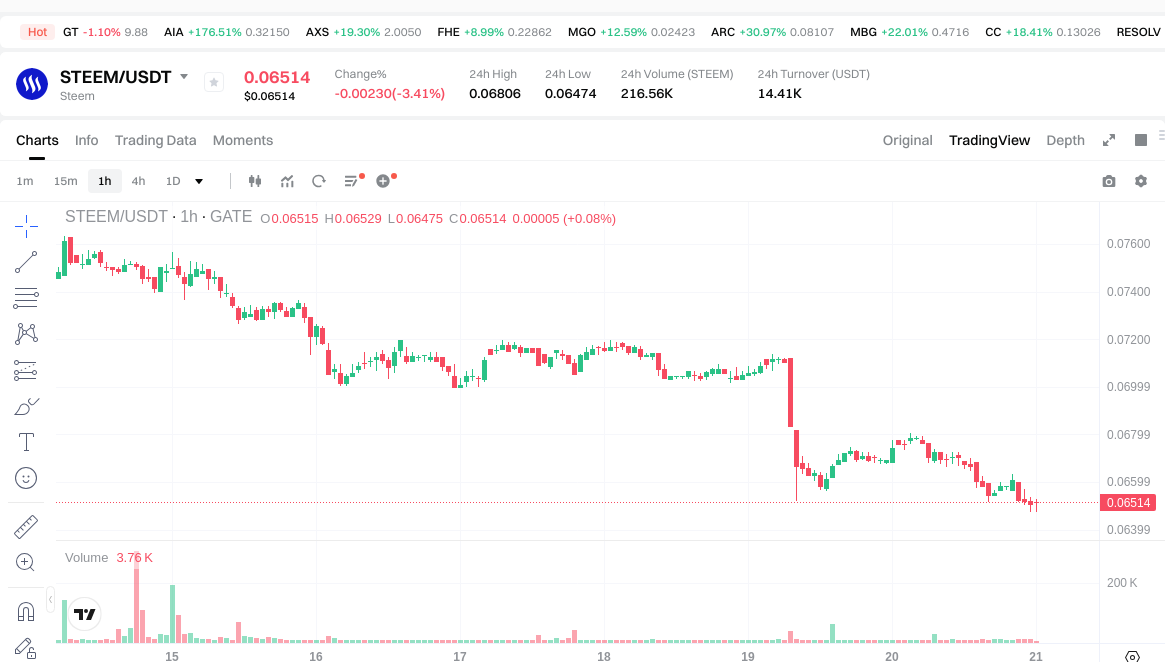
Current STEEM Investment Market Status (January 2026)
- STEEM current price: $0.06494
- 24-hour trading volume: $14,371.46
- Market capitalization: $34,881,011.40
- Circulating supply: 537,126,753.956 STEEM
- Price performance: 1H (+0.65%), 24H (-3.21%), 7D (-11.89%), 30D (+3.13%)
Click to view real-time STEEM market price
II. Core Factors Affecting Whether STEEM is a Good Investment (Is Steem(STEEM) a Good Investment)
Supply Mechanism and Scarcity (STEEM investment scarcity)
- Unlimited maximum supply mechanism → Influences price dynamics and investment value assessment
- Historical context: STEEM experienced notable price movements, with recorded pricing ranging from $0.060275 to $8.19 across its trading history
- Investment consideration: The absence of a supply cap may impact traditional scarcity-driven value propositions compared to fixed-supply digital assets
Institutional Investment and Mainstream Adoption (Institutional investment in STEEM)
- Exchange availability: STEEM is currently listed on 10 exchanges, indicating a certain level of market accessibility
- Trading activity: 24-hour trading volume of approximately $14,371.46 reflects current market participation levels
- Adoption applications: The protocol supports multiple user-oriented platforms including busy.org, d.tube, dlive.io, steemit.com, and dsound.audio, demonstrating diverse ecosystem applications
Macroeconomic Environment's Impact on STEEM Investment
- Market performance context: STEEM showed a 1-year price change of -69.6%, reflecting sensitivity to broader market conditions
- Short-term volatility: Recent price movements include -3.21% (24H), -11.89% (7D), and +3.13% (30D), indicating responsiveness to market sentiment shifts
- Market positioning: With a market cap of approximately $34.88 million and 0.0010% market dominance, STEEM represents a smaller-cap digital asset that may exhibit different risk-return characteristics compared to larger assets
Technology and Ecosystem Development (Technology & Ecosystem for STEEM investment)
- Core protocol features: Steem operates as an open-source blockchain utilizing Proof-of-Brain algorithm with three-second block times and Delegated-Proof-of-Stake consensus mechanism
- Transaction efficiency: The protocol enables fee-free transactions with rapid confirmation times, potentially supporting user adoption
- Smart Media Token (SMT) protocol: Planned functionality to allow entrepreneurs and developers to launch customizable STEEM-like tokens with features including ICO capabilities, automated market makers, and autonomous token distribution
- Ecosystem applications: The blockchain infrastructure supports storage of user content, social information, account data, and JSON metadata across multiple decentralized applications
- Token utility: STEEM can be utilized for Steem Power activation, internal market SBD exchanges, order cancellations, trading with other digital tokens, and purchases through third-party platforms
III. STEEM Future Investment Forecast and Price Outlook (Is Steem(STEEM) worth investing in 2026-2031)
Short-term Investment Forecast (2026, short-term STEEM investment outlook)
- Conservative Forecast: $0.0378 - $0.0515
- Neutral Forecast: $0.0515 - $0.0651
- Optimistic Forecast: $0.0651 - $0.0697
Mid-term Investment Outlook (2027-2029, mid-term Steem(STEEM) investment forecast)
-
Market Phase Expectation: The mid-term period may witness gradual ecosystem development and potential recovery from previous downturns, with growth contingent on platform adoption and broader blockchain market conditions.
-
Investment Return Forecast:
- 2027: $0.0499 - $0.0978
- 2028: $0.0628 - $0.0983
- 2029: $0.0561 - $0.1284
-
Key Catalysts: Platform user engagement, Smart Media Token protocol implementation progress, broader social blockchain adoption trends, and overall cryptocurrency market sentiment.
Long-term Investment Outlook (Is STEEM a good long-term investment?)
- Base Scenario: $0.0799 - $0.1357 (assuming steady platform development and moderate blockchain adoption)
- Optimistic Scenario: $0.1224 - $0.1556 (assuming enhanced ecosystem growth and favorable market conditions)
- Risk Scenario: Below $0.0561 (under conditions of reduced platform activity or adverse regulatory developments)
View STEEM long-term investment and price forecast: Price Prediction
2026-2031 Long-term Outlook
- Base Scenario: $0.0799 - $0.1357 (corresponding to steady progress and gradual mainstream application growth)
- Optimistic Scenario: $0.1224 - $0.1556 (corresponding to large-scale adoption and favorable market environment)
- Transformative Scenario: Above $0.1556 (in case of breakthrough ecosystem developments and mainstream prevalence)
- 2031-12-31 Predicted High: $0.1556 (based on optimistic development assumptions)
Disclaimer: The forecasts provided are based on historical data and market analysis models. Cryptocurrency markets are highly volatile and subject to numerous unpredictable factors. These predictions should not be considered as financial advice, and investors should conduct their own research and risk assessment before making investment decisions.
| Year |
Predicted High Price |
Predicted Average Price |
Predicted Low Price |
Price Change |
| 2026 |
0.0696998 |
0.06514 |
0.0377812 |
0 |
| 2027 |
0.097758855 |
0.0674199 |
0.049890726 |
3 |
| 2028 |
0.098281359225 |
0.0825893775 |
0.0627679269 |
27 |
| 2029 |
0.12841822307475 |
0.0904353683625 |
0.05606992838475 |
39 |
| 2030 |
0.135689226691095 |
0.109426795718625 |
0.079881560874596 |
68 |
| 2031 |
0.155648674230172 |
0.12255801120486 |
0.093144088515693 |
88 |
IV. Steem Investment Strategy and Risk Management (How to invest in Steem)
Investment Methodology (Steem investment strategy)
Long-term Holding (HODL Steem): Suitable for Conservative Investors
Long-term holding represents a fundamental approach for investors seeking exposure to Steem's blockchain infrastructure. This strategy involves acquiring STEEM tokens and maintaining positions through market cycles, with particular attention to the protocol's utility in supporting decentralized social media applications. The approach aligns with participants who prioritize the platform's technological development over short-term price movements.
Active Trading: Technical Analysis and Swing Operations
Active trading strategies for STEEM involve analyzing price patterns and market momentum. Given the token's observed price fluctuations, with recent data showing movements ranging from hourly changes of 0.65% to seven-day variations of -11.89%, traders may identify entry and exit points based on technical indicators. This methodology requires continuous market monitoring and familiarity with cryptocurrency trading dynamics.
Risk Management (Risk management for Steem investment)
Asset Allocation Ratio: Conservative / Aggressive / Professional Investors
- Conservative approach: Limiting STEEM exposure to a small percentage of overall portfolio, typically 1-3%, focusing on established cryptocurrencies with larger market capitalizations
- Aggressive approach: Allocating 5-10% to STEEM, accepting higher volatility in exchange for potential growth tied to the platform's ecosystem development
- Professional approach: Dynamic allocation based on market conditions, protocol updates, and ecosystem metrics, with systematic rebalancing protocols
Risk Hedging Solutions: Multi-asset Portfolio + Hedging Instruments
Diversification across multiple blockchain protocols and traditional assets can help mitigate concentration risk. STEEM's current market capitalization of approximately $34.88 million and ranking position suggest consideration of portfolio balance with more established digital assets. Hedging instruments may include stablecoin positions or derivatives where available.
Secure Storage: Hot and Cold Wallets + Hardware Wallet Recommendations
STEEM storage requires attention to security infrastructure:
- Cold storage solutions: Hardware wallets supporting STEEM provide offline security for long-term holdings
- Hot wallet considerations: For active participants engaging with Steem-based applications (steemit.com, busy.org), maintaining operational balances in secure hot wallets while transferring larger amounts to cold storage
- Key management: Secure backup of private keys and recovery phrases through redundant, physically separated storage locations
V. Steem Investment Risks and Challenges (Risks of investing in Steem)
Market Risk: High Volatility and Price Dynamics
STEEM exhibits characteristics common to mid-cap cryptocurrencies. The token's 24-hour trading volume of approximately $14,371 relative to its market capitalization indicates liquidity considerations. Recent price performance shows notable fluctuations, with seven-day changes of -11.89% and one-year movements of -69.6%. The current price of $0.06494 represents a substantial difference from historical levels, which investors should consider when evaluating entry points.
Regulatory Risk: Policy Uncertainty Across Jurisdictions
As a blockchain protocol facilitating social content and token distribution, Steem operates within an evolving regulatory landscape. Different jurisdictions maintain varying approaches to cryptocurrency classification, taxation, and compliance requirements. Investors should monitor regulatory developments in their respective regions and assess potential impacts on protocol operations and token utility.
Technical Risk: Network Security and Development Challenges
Blockchain protocols face ongoing technical considerations:
- Network security: Maintaining consensus mechanism integrity and preventing potential vulnerabilities
- Development execution: Successful implementation of protocol upgrades and ecosystem features, including the Smart Media Token (SMT) protocol referenced in project documentation
- Competition: Evolution of alternative social blockchain platforms and their potential impact on Steem's user base and application ecosystem
VI. Conclusion: Is Steem a Good Investment?
Investment Value Summary
Steem presents characteristics of an established blockchain protocol with specific utility in decentralized social media applications. The platform's claimed transaction speed capabilities and existing application ecosystem (steemit.com, busy.org, d.tube) represent developed infrastructure. However, market performance indicators suggest challenges in maintaining price levels, with the token trading substantially below historical peaks.
The protocol's approach to content monetization through the Proof-of-Brain algorithm and planned SMT functionality represents differentiated features within the blockchain space. Long-term potential depends on factors including adoption rates for Steem-based applications, successful protocol development execution, and broader cryptocurrency market conditions.
Investor Recommendations
✅ Beginners: Consider dollar-cost averaging strategies combined with secure wallet storage practices. New participants should thoroughly research the Steem ecosystem and understand the protocol's specific use cases before allocation.
✅ Experienced Investors: May explore swing trading opportunities based on technical analysis while maintaining diversified cryptocurrency portfolios. Attention to trading volume patterns and ecosystem development metrics can inform positioning decisions.
✅ Institutional Investors: Strategic allocation decisions should incorporate comprehensive due diligence regarding protocol governance, development roadmap execution, and competitive positioning within decentralized social media infrastructure.
⚠️ Notice: Cryptocurrency investments carry substantial risk, including potential loss of principal. This analysis serves informational purposes and does not constitute investment advice. Prospective investors should conduct independent research and consider consulting financial professionals before making investment decisions.
VII. FAQ
Q1: What makes Steem different from other cryptocurrencies in terms of its core use case?
Steem distinguishes itself as a blockchain protocol specifically designed for social media and content distribution, utilizing a Proof-of-Brain algorithm to reward content creators and curators. Unlike general-purpose cryptocurrencies, Steem's infrastructure supports multiple decentralized social applications (steemit.com, busy.org, d.tube, dlive.io, dsound.audio) with three-second transaction times and fee-free transfers enabled by its Delegated Proof-of-Stake consensus mechanism. The platform stores social information, user content, and JSON metadata on-chain, positioning itself as infrastructure for decentralized social interaction rather than primarily functioning as a store of value or payment system.
Q2: How does Steem's unlimited supply mechanism affect its investment value proposition?
Steem operates without a maximum supply cap, which fundamentally differentiates it from fixed-supply assets like Bitcoin. This unlimited supply mechanism influences traditional scarcity-driven value propositions, as new tokens can be continuously created through the protocol's reward distribution system. The current circulating supply stands at approximately 537.13 million STEEM, with ongoing token generation tied to platform activity and consensus rewards. Investors should recognize that this inflationary model may create different long-term price dynamics compared to deflationary or fixed-supply cryptocurrencies, potentially requiring sustained demand growth from ecosystem adoption to offset continuous supply expansion.
Q3: What are the primary risks associated with investing in STEEM at its current market position?
STEEM faces multiple risk categories that investors should evaluate: Market Risk includes high volatility, demonstrated by recent seven-day price declines of -11.89% and one-year drops of -69.6%, coupled with relatively low trading volume of approximately $14,371 per 24 hours. Technical Risk encompasses network security maintenance, successful execution of planned protocol upgrades (including Smart Media Token implementation), and competition from alternative social blockchain platforms. Regulatory Risk involves evolving cryptocurrency regulations across different jurisdictions that may impact protocol operations and token utility. The token's current market capitalization of approximately $34.88 million positions it as a smaller-cap asset, which typically correlates with higher volatility and liquidity considerations compared to larger cryptocurrencies.
Q4: How should investors interpret Steem's price forecasts for 2026-2031?
Price forecasts for STEEM ranging from $0.0378 to $0.1556 across different scenarios should be viewed as analytical projections rather than guaranteed outcomes. The conservative 2026 forecast of $0.0378-$0.0515 reflects current market positioning, while optimistic long-term scenarios reaching $0.1556 by 2031 assume successful ecosystem development and favorable market conditions. These predictions incorporate historical data patterns, market analysis models, and technological development assumptions. However, cryptocurrency markets remain highly volatile and subject to numerous unpredictable factors including regulatory changes, technological disruptions, and macroeconomic conditions. Investors should recognize these forecasts as one analytical input among many considerations, conducting independent research and risk assessment before making allocation decisions.
Q5: What storage solutions are recommended for securing STEEM tokens?
STEEM security requires a multi-layered approach combining cold and hot storage solutions. For long-term holdings, hardware wallets supporting STEEM provide offline security protection against online threats, with recommended practices including secure backup of private keys and recovery phrases through redundant, physically separated storage locations. Active participants engaging with Steem-based applications (steemit.com, busy.org, d.tube) may maintain operational balances in secure hot wallets for platform interaction while transferring larger amounts to cold storage for enhanced security. The choice between storage methods should balance security requirements with functional needs, recognizing that cold storage offers maximum protection while hot wallets enable active ecosystem participation.
Q6: How does Steem's Delegated Proof-of-Stake mechanism affect network security and token value?
Steem's Delegated Proof-of-Stake (DPoS) consensus mechanism enables rapid three-second block times and fee-free transactions while maintaining network security through elected validators. This system differs from traditional Proof-of-Work protocols by prioritizing transaction efficiency and scalability over energy-intensive mining. The DPoS structure influences token value through staking incentives, where STEEM can be converted to Steem Power for network participation and voting rights. Network security depends on the integrity of elected validators and the economic alignment of stakeholders, creating governance dynamics that may affect protocol development decisions and ecosystem evolution. Investors should understand that DPoS systems concentrate decision-making power among active participants, which may influence protocol direction and token economics.
Q7: What allocation percentage should different investor types consider for STEEM?
Allocation recommendations vary significantly based on investor profiles and risk tolerance. Conservative investors typically limit STEEM exposure to 1-3% of overall portfolio value, prioritizing established cryptocurrencies with larger market capitalizations while maintaining modest exposure to mid-cap assets like STEEM. Aggressive investors may allocate 5-10% to STEEM, accepting higher volatility in exchange for potential growth tied to ecosystem development and platform adoption. Professional investors often implement dynamic allocation strategies based on market conditions, protocol updates, and ecosystem metrics, with systematic rebalancing protocols responsive to technical developments and competitive positioning. Regardless of investor type, diversification across multiple blockchain protocols and traditional assets remains essential for mitigating concentration risk associated with any single cryptocurrency investment.
Q8: What are the key catalysts that could drive STEEM's future price performance?
Multiple factors could influence STEEM's price trajectory over the coming years. Platform user engagement and adoption rates for Steem-based applications represent fundamental drivers, as increased utilization of steemit.com, busy.org, d.tube, and other ecosystem applications could generate organic demand for STEEM tokens. Successful implementation of the Smart Media Token (SMT) protocol, enabling entrepreneurs to launch customizable tokens with ICO capabilities and automated market makers, could expand ecosystem utility and attract developers. Broader trends in social blockchain adoption and decentralized content monetization may create favorable market conditions. Overall cryptocurrency market sentiment and macroeconomic factors affecting digital asset valuations will likely continue influencing STEEM's price performance, with correlation to broader market cycles remaining a significant consideration for investment timing decisions.
* The information is not intended to be and does not constitute financial advice or any other recommendation of any sort offered or endorsed by Gate.