This comprehensive analysis examines whether Stella (ALPHA) represents a viable investment opportunity within the DeFi leverage protocol sector. Trading at $0.005816 with a market capitalization of $5.59 million, ALPHA offers zero-cost borrowing mechanics on both Ethereum and BSC networks, attracting investors seeking leveraged yield strategies. The article evaluates ALPHA's significant 90.72% annual decline alongside recent 20.07% monthly recovery, providing price forecasts ranging from conservative to optimistic scenarios through 2031. Beyond price projections, it details investment strategies for beginners through institutional investors, outlines critical risk factors including market volatility and regulatory uncertainty, and offers secure storage recommendations on Gate and other exchanges. Whether ALPHA suits your portfolio depends on risk tolerance, DeFi expertise, and allocation strategy within a diversified cryptocurrency portfolio.
Introduction: Stella (ALPHA) Investment Position and Market Outlook
Stella (ALPHA) represents a notable asset in the cryptocurrency sector, having launched in October 2020 with a distinctive focus on leveraged DeFi strategies. As of January 2026, ALPHA maintains a market capitalization of approximately $5.59 million, with a circulating supply of around 961 million tokens, and a current trading price near $0.005816. Positioned as a leveraged strategies protocol with zero-cost borrowing features, Stella aims to redefine how leveraged DeFi operates by driving enhanced usage of decentralized exchanges and money markets. This introductory analysis examines ALPHA's investment characteristics, historical performance patterns, future price dynamics, and associated risk factors to provide investors with informational context when evaluating "Is Stella (ALPHA) a good investment?"
I. Stella (ALPHA) Price History Review and Current Investment Value
- 2021: ALPHA reached a notable price level of $2.93 on February 6, 2021 → Early investors experienced significant price appreciation during this period
- 2025: Market adjustment phase → ALPHA price declined to $0.00464056 on December 31, 2025, reflecting broader market volatility
- 2025-2026: Recovery trajectory → Price climbed from lower levels to $0.005816, showing signs of stabilization
Current ALPHA Investment Market Status (January 2026)
- ALPHA current price: $0.005816
- 24-hour trading volume: $12,846.62
- Market capitalization: $5,589,176
- Circulating supply: 961,000,000 ALPHA (96.10% of total supply)
- 24-hour price change: +2.43%
- 7-day price change: -0.91%
- 30-day price change: +20.07%
- 1-year price change: -90.72%
Click to view real-time ALPHA market price
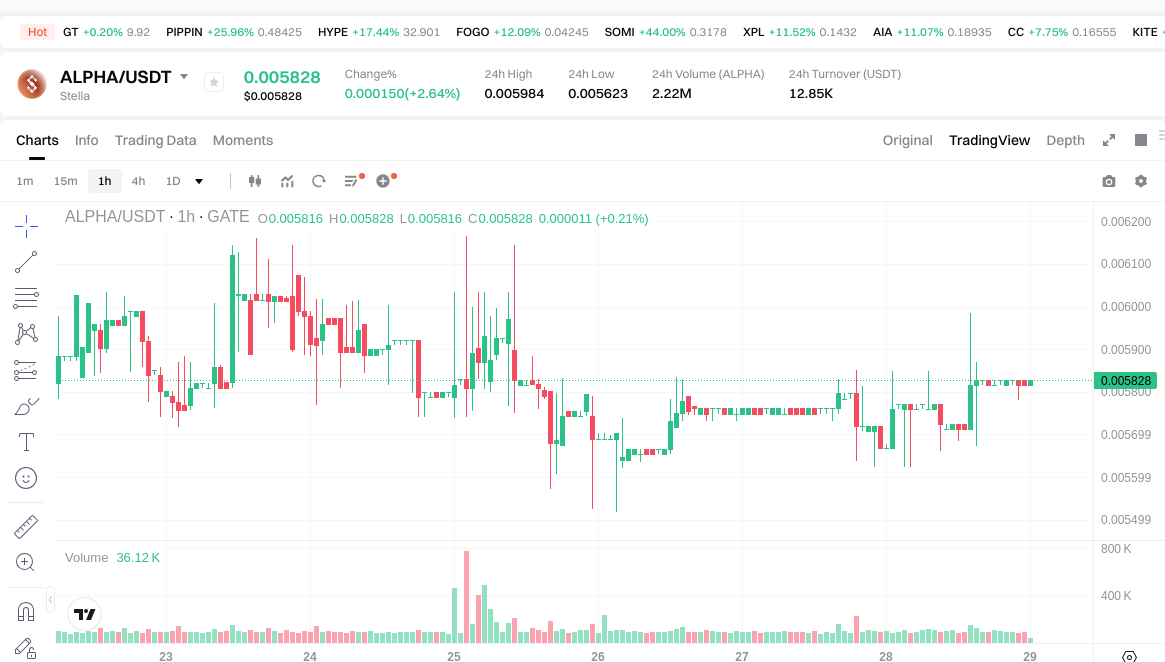
II. Core Factors Influencing Whether ALPHA is a Good Investment (Is Stella(ALPHA) a Good Investment)
Supply Mechanism and Scarcity (ALPHA Investment Scarcity)
- Fixed Supply Structure → Influences Price and Investment Value
Stella operates with a defined supply framework, featuring a maximum supply of 1,000,000,000 ALPHA tokens and a circulating supply of 961,000,000 tokens as of January 29, 2026. This represents a circulating ratio of approximately 96.1%, indicating that most tokens have already entered circulation. The high circulating percentage suggests limited future supply expansion, which may contribute to scarcity dynamics in the market.
- Investment Significance: Scarcity Serves as a Key Support for Long-Term Investment
The near-complete token distribution reduces the risk of significant supply-side dilution, potentially supporting price stability for investors with extended time horizons. However, the absence of aggressive supply control mechanisms means scarcity alone may not guarantee value appreciation without corresponding demand growth.
Institutional Investment and Mainstream Adoption (Institutional Investment in ALPHA)
- Holder Distribution Trends: As of the latest data, ALPHA has 11,601 holders
The holder count provides insight into the token's distribution across market participants. While the number suggests a moderately distributed ownership base, the relatively limited trading volume of $12,846.62 over 24 hours indicates modest liquidity compared to more established crypto assets.
- Trading Venue Accessibility → Impacts Investment Accessibility
ALPHA is currently listed on 8 exchanges and is available for trading on Gate.com, providing retail and institutional investors with multiple access points. The multi-chain deployment on Ethereum (ETH) and Binance Smart Chain (BSC) enhances interoperability and potential adoption across different blockchain ecosystems.
Macroeconomic Environment's Impact on ALPHA Investment
- Market Sentiment and Risk Appetite → Alter Investment Attractiveness
Broader cryptocurrency market conditions significantly influence ALPHA's investment appeal. As a DeFi-focused protocol, ALPHA's performance is tied to overall decentralized finance adoption trends and investor confidence in alternative financial systems. Market downturns or regulatory uncertainties can impact DeFi tokens more acutely than mainstream cryptocurrencies.
- Competitive Landscape in Leveraged DeFi → Affects Long-Term Positioning
Stella's mission to redefine leveraged DeFi with 0% borrowing costs positions it in a competitive segment. The protocol's value proposition depends on sustained demand for leveraged yield strategies and its ability to maintain competitive advantages as the DeFi ecosystem evolves.
Technology and Ecosystem Development (Technology & Ecosystem for ALPHA Investment)
- Leveraged Strategy Protocol Innovation: Zero-Cost Borrowing Mechanism → Differentiates Investment Value
Stella's core technology focuses on enabling leveraged strategies without borrowing costs, which represents a notable value proposition in the DeFi lending and liquidity provision space. The protocol aims to drive increased usage of decentralized exchanges and money markets, positioning itself as infrastructure for DeFi's fundamental building blocks.
- Multi-Chain Deployment: Ethereum and BSC Integration → Expands Ecosystem Accessibility
The protocol's presence on both Ethereum and Binance Smart Chain broadens its potential user base and reduces barriers to entry by offering alternatives to Ethereum's higher transaction costs. This multi-chain approach may support ecosystem growth by accommodating different user preferences and capital flows.
- DeFi Application Expansion → Supports Long-Term Value
Stella's focus on enhancing DEX and money market utilization creates potential for compounding network effects as DeFi adoption grows. The protocol's success depends on its ability to attract liquidity providers and users seeking leveraged yield opportunities, which in turn relies on sustained innovation and competitive positioning within the rapidly evolving DeFi landscape.
III. ALPHA Future Investment Forecast and Price Outlook (Is Stella(ALPHA) worth investing in 2026-2031)
Short-term ALPHA Investment Outlook (2026)
- Conservative forecast: $0.004371 - $0.005828
- Neutral forecast: $0.005000 - $0.005828
- Optimistic forecast: $0.005828 - $0.0064108
Mid-term Stella(ALPHA) Investment Forecast (2027-2028)
-
Market stage expectation: ALPHA is anticipated to enter a gradual recovery phase during 2027-2028, with moderate price appreciation driven by evolving DeFi market dynamics and potential protocol developments.
-
Investment return forecast:
- 2027: $0.00520149 - $0.007220892
- 2028: $0.00593642994 - $0.00813757812
-
Key catalysts: Enhanced adoption of leveraged DeFi strategies, improvements in protocol functionality, broader integration with DEXes and money markets, and overall market sentiment toward DeFi infrastructure.
Long-term Investment Outlook (Is Stella a good long-term investment?)
-
Base scenario: $0.007080801942873 - $0.009066880536606 (assuming steady protocol development and moderate DeFi sector growth through 2031)
-
Optimistic scenario: $0.008635124320578 - $0.009348116236956 (assuming increased institutional participation, significant protocol upgrades, and favorable regulatory environment for DeFi)
-
Risk scenario: $0.00435717282231 - $0.006670146 (under conditions of prolonged market downturns, regulatory headwinds, or competitive pressure from alternative DeFi protocols)
For detailed ALPHA long-term investment and price predictions, visit: Price Prediction
2026-01-29 to 2031 Long-term Outlook
-
Base scenario: $0.004371 - $0.009066880536606 (corresponding to stable progress and steady growth in mainstream DeFi adoption)
-
Optimistic scenario: $0.008635124320578 - $0.009348116236956 (corresponding to large-scale adoption and favorable market conditions)
-
Transformative scenario: Above $0.01 (contingent upon breakthrough ecosystem developments and widespread mainstream integration)
-
2031-12-31 projected high: $0.009348116236956 (based on optimistic development assumptions)
Disclaimer: The forecasts presented are for informational purposes only and should not be construed as investment advice. Cryptocurrency markets are highly volatile and subject to significant risks. Past performance does not guarantee future results. Investors should conduct thorough research and consider their risk tolerance before making investment decisions.
| Year |
Predicted High Price |
Predicted Average Price |
Predicted Low Price |
Price Change |
| 2026 |
0.0064108 |
0.005828 |
0.004371 |
0 |
| 2027 |
0.007220892 |
0.0061194 |
0.00520149 |
5 |
| 2028 |
0.00813757812 |
0.006670146 |
0.00593642994 |
14 |
| 2029 |
0.0084404027484 |
0.00740386206 |
0.0063673213716 |
27 |
| 2030 |
0.009348116236956 |
0.0079221324042 |
0.00435717282231 |
36 |
| 2031 |
0.009066880536606 |
0.008635124320578 |
0.007080801942873 |
48 |
IV. Stella Investment Strategy and Risk Management (How to invest in Stella)
Investment Methodology (Stella investment strategy)
Long-term Holding (HODL Stella): Suitable for Conservative Investors
For investors with a conservative approach, long-term holding of Stella (ALPHA) may be considered as part of a diversified DeFi portfolio. This strategy involves acquiring ALPHA tokens and maintaining positions through market cycles, potentially benefiting from the protocol's development of leveraged strategies with 0% borrowing costs. Given the token's significant price decline of 90.72% over the past year and current trading price of $0.005816, investors should carefully evaluate entry points and position sizing relative to their overall portfolio allocation.
Active Trading: Relying on Technical Analysis and Swing Operations
Active traders may approach Stella through technical analysis and swing trading strategies. With a 24-hour price range between $0.005623 and $0.005984, the token exhibits intraday volatility that may present short-term trading opportunities. The recent 30-day price increase of 20.07% suggests potential momentum patterns, though the 7-day decline of 0.91% indicates periods of consolidation. Traders should monitor the $12,846.62 in 24-hour trading volume and utilize appropriate technical indicators while setting strict stop-loss parameters.
Risk Management (Risk management for Stella investment)
Asset Allocation Ratio: Conservative / Aggressive / Professional Investors
Conservative Investors: May consider allocating 1-3% of their cryptocurrency portfolio to Stella, with the majority held in established assets. Given ALPHA's ranking at #1474 and market capitalization of approximately $5.59 million, conservative positioning is advisable.
Aggressive Investors: Could allocate 5-10% of their DeFi-focused portfolio to Stella, accepting higher volatility in exchange for potential upside from protocol development and adoption of leveraged DeFi strategies.
Professional Investors: May deploy strategic positions ranging from 3-8% within specialized DeFi portfolios, implementing dynamic rebalancing based on protocol metrics, on-chain data from the 11,601 holders, and market conditions across the 8 exchanges where ALPHA is listed.
Investors should consider diversifying Stella holdings within a broader DeFi ecosystem allocation, including established protocols and stablecoins. Risk mitigation strategies may include:
- Pairing ALPHA positions with stablecoin holdings to manage volatility exposure
- Diversifying across different DeFi sectors beyond leveraged strategies
- Monitoring the protocol's development on both Ethereum (ETH) and Binance Smart Chain (BSC) networks
- Setting predetermined exit points based on technical levels or fundamental changes
Secure Storage: Hot and Cold Wallets + Hardware Wallet Recommendations
Given that Stella operates on Ethereum and BSC networks, investors should implement appropriate security measures:
Hot Wallets: MetaMask, Trust Wallet, or other Web3-enabled wallets for active trading and DeFi interactions, maintaining only necessary amounts for immediate transactions.
Cold Storage: Hardware wallets such as Ledger or Trezor for long-term holdings, providing offline security for the majority of ALPHA token positions.
Best Practices: Verify contract addresses (0xa1faa113cbe53436df28ff0aee54275c13b40975 on both ETH and BSC) before transactions, enable two-factor authentication, and maintain secure backup of recovery phrases.
V. Stella Investment Risks and Challenges (Risks of investing in Stella)
Market Risk: High Volatility and Price Manipulation
Stella exhibits significant price volatility, evidenced by a 90.72% decline over the past year from higher levels. The token's historical range spans from an all-time high of $2.93 on February 6, 2021, to an all-time low of $0.00464056 on December 31, 2025. With relatively modest 24-hour trading volume of $12,846.62 and a market capitalization of approximately $5.59 million, the token may be susceptible to price fluctuations driven by limited liquidity. The small market dominance of 0.00018% suggests that broader market movements and sector-specific developments in DeFi leverage protocols could significantly impact ALPHA's price action.
Regulatory Risk: Policy Uncertainty Across Different Countries
As a leveraged DeFi protocol, Stella operates in a regulatory environment that continues to evolve globally. DeFi leverage mechanisms face scrutiny from financial regulators in various jurisdictions who are developing frameworks for decentralized lending and borrowing protocols. Investors should be aware that regulatory developments targeting leveraged crypto products, DeFi protocols, or specific blockchain networks (Ethereum and BSC) could impact Stella's operations and token utility. The cross-chain deployment on both Ethereum and BSC networks may subject the protocol to different regulatory interpretations across jurisdictions.
Technical Risk: Network Security Vulnerabilities and Upgrade Failures
Stella's operation as a leveraged strategies protocol with 0% borrowing costs involves complex smart contract interactions that carry inherent technical risks. Potential vulnerabilities in the protocol's smart contracts could result in loss of funds or exploitation. The protocol's dependency on underlying blockchain infrastructure (Ethereum and BSC) means that network congestion, high gas fees, or technical issues on these chains could affect user experience and protocol functionality. Additionally, as DeFi protocols evolve and upgrade their systems to maintain competitiveness, there exists risk that technical implementations may not perform as intended or could introduce unexpected issues.
VI. Conclusion: Is Stella a Good Investment?
Investment Value Summary
Stella (ALPHA) presents as a specialized DeFi protocol focused on leveraged strategies with distinctive 0% borrowing cost mechanics. The token's long-term investment potential depends on the protocol's ability to drive increased usage of DEXes and money markets within the DeFi ecosystem. However, investors should carefully consider the significant price volatility, with the token experiencing a 90.72% decline over the past year while showing a 20.07% increase over the past 30 days. The relatively small market capitalization of approximately $5.59 million and modest trading volume suggest that ALPHA remains a higher-risk asset within the broader cryptocurrency landscape.
Investor Recommendations
✅ Beginners: Consider dollar-cost averaging (DCA) into small positions rather than lump-sum investments, and prioritize secure wallet storage using hardware wallets or reputable software wallets. Beginners should thoroughly research DeFi leverage mechanisms before investing and limit exposure to a minimal percentage of their overall crypto portfolio.
✅ Experienced Investors: May employ swing trading strategies based on technical analysis while maintaining core positions for longer-term protocol development. Experienced investors can leverage the token's volatility through active portfolio rebalancing and consider monitoring on-chain metrics from the 11,601 holders and protocol usage data across both Ethereum and BSC networks.
✅ Institutional Investors: Could consider strategic long-term allocation within diversified DeFi portfolios, focusing on protocol fundamentals, competitive positioning within the leveraged DeFi sector, and governance participation. Institutional approaches should include comprehensive due diligence on smart contract security, liquidity analysis across the 8 listing exchanges, and ongoing monitoring of regulatory developments.
⚠️ Notice: Cryptocurrency investment carries high risk. This content is provided for informational purposes only and does not constitute investment advice. Investors should conduct independent research and consider their financial situation and risk tolerance before making investment decisions.
VII. FAQ
Q1: What is Stella (ALPHA) and what makes it unique in the DeFi space?
Stella (ALPHA) is a leveraged strategies protocol that offers zero-cost borrowing features, distinguishing itself by aiming to drive enhanced usage of decentralized exchanges and money markets. The protocol operates on both Ethereum (ETH) and Binance Smart Chain (BSC) networks, providing users with leveraged DeFi strategies without traditional borrowing costs. Launched in October 2020, Stella's core innovation lies in its approach to eliminating borrowing fees while enabling leveraged positions, which represents a notable value proposition in the competitive DeFi lending and liquidity provision sector.
Q2: Has Stella (ALPHA) experienced significant price volatility?
Yes, ALPHA has exhibited substantial price volatility throughout its market history. The token reached an all-time high of $2.93 on February 6, 2021, before declining to an all-time low of $0.00464056 on December 31, 2025—representing a decline of over 99% from peak levels. Over the past year alone, the token has experienced a 90.72% price decrease, though it has shown a 20.07% recovery over the past 30 days as of January 2026. This volatility pattern reflects both broader cryptocurrency market dynamics and the specific challenges facing smaller-cap DeFi protocols.
Q3: What is the current supply structure of Stella (ALPHA) tokens?
Stella operates with a maximum supply of 1,000,000,000 ALPHA tokens, with approximately 961,000,000 tokens currently in circulation as of January 29, 2026. This represents a circulating ratio of 96.1%, indicating that the vast majority of tokens have already been distributed. The high circulating percentage suggests limited future supply expansion, which reduces the risk of significant supply-side dilution for existing holders. However, the token's value appreciation depends primarily on demand growth rather than supply contraction mechanisms.
Q4: Is Stella (ALPHA) suitable for long-term investment?
The suitability of Stella for long-term investment depends on individual risk tolerance and portfolio objectives. Conservative investors might consider allocating only 1-3% of their cryptocurrency portfolio to ALPHA given its small market capitalization of approximately $5.59 million and higher risk profile. The protocol's long-term value proposition rests on the successful adoption of its leveraged DeFi strategies and its ability to maintain competitive advantages in an evolving ecosystem. Price forecasts suggest potential gradual recovery through 2026-2031 under base scenarios, with projected ranges from $0.004371 to $0.009348116236956 by 2031, though such forecasts carry significant uncertainty.
Q5: What are the primary risks associated with investing in Stella (ALPHA)?
Investing in Stella carries multiple risk categories: Market Risk includes high volatility and limited liquidity, with modest 24-hour trading volume of $12,846.62 making the token susceptible to price swings; Regulatory Risk stems from evolving DeFi regulations globally that could impact leveraged protocols; Technical Risk involves potential smart contract vulnerabilities and dependencies on underlying blockchain infrastructure (Ethereum and BSC networks). Additionally, the token's small market dominance of 0.00018% and ranking at #1474 suggest it remains a speculative asset within the broader cryptocurrency landscape.
Q6: Where can investors trade and securely store Stella (ALPHA) tokens?
ALPHA is currently listed on 8 exchanges, with Gate.com being a notable trading venue providing retail and institutional access. For secure storage, investors should implement a multi-layered approach: Hot Wallets such as MetaMask or Trust Wallet for active trading and DeFi interactions (maintaining only necessary transaction amounts); Cold Storage through hardware wallets like Ledger or Trezor for long-term holdings (storing the majority of tokens offline). Best practices include verifying the official contract address (0xa1faa113cbe53436df28ff0aee54275c13b40975 on both ETH and BSC networks), enabling two-factor authentication, and securely backing up recovery phrases.
Q7: What technical indicators should traders monitor when actively trading ALPHA?
Active traders should focus on several key metrics when trading Stella: the 24-hour price range ($0.005623 to $0.005984 as of latest data) provides insight into intraday volatility; the 24-hour trading volume of $12,846.62 indicates liquidity depth; recent performance metrics including the 30-day gain of 20.07% versus the 7-day decline of 0.91% suggest momentum patterns and consolidation phases. Additionally, monitoring on-chain data such as the holder count (11,601 holders) and protocol usage across Ethereum and BSC networks can provide fundamental context for technical trading strategies. Traders should implement strict stop-loss parameters given the token's volatility profile.
Q8: What is the future price outlook for Stella (ALPHA) through 2031?
Price projections for Stella through 2031 vary significantly based on different scenarios: Short-term (2026) forecasts range from $0.004371 to $0.0064108 under conservative to optimistic conditions; Mid-term (2027-2028) projections anticipate gradual recovery with ranges of $0.00520149 to $0.00813757812; Long-term (2031) base scenarios project $0.007080801942873 to $0.009066880536606, while optimistic scenarios suggest potential prices between $0.008635124320578 and $0.009348116236956. These forecasts assume various degrees of DeFi adoption, protocol development success, and favorable market conditions. However, investors should note that cryptocurrency price predictions carry substantial uncertainty and should not be relied upon as investment guarantees.
* The information is not intended to be and does not constitute financial advice or any other recommendation of any sort offered or endorsed by Gate.