This comprehensive analysis examines whether Stellar (XLM) represents a viable investment opportunity in 2026. The article evaluates XLM's current market position with a circulating supply of 32.41 billion tokens and market capitalization of approximately $7.21 billion at $0.22235 per token. Key investment considerations include Stellar's core utility as a decentralized gateway enabling low-cost cross-border transfers between digital and fiat currencies, supported by over 10.2 million holders across 67 exchanges including Gate. The analysis addresses critical factors influencing investment decisions: fixed supply mechanisms capping at 50 billion XLM, institutional adoption trends, technological ecosystem development, and macroeconomic impacts. Price forecasts span conservative ($0.1159-$0.2228), neutral ($0.1700-$0.2350), and optimistic ($0.2228-$0.2473) scenarios through 2031. Investment strategies accommodate diverse profiles through long-term holding and active trading approaches, alongside comprehensive r
Introduction: Stellar (XLM)'s Investment Position and Market Outlook
XLM is a significant asset in the cryptocurrency space. Since its launch in 2014, it has achieved notable progress in cross-border payments and digital asset transfer sectors. As of 2026, Stellar holds a market capitalization of approximately $7.21 billion, with a circulating supply of around 32.41 billion tokens, and the current price maintains at approximately $0.22235. With its positioning as a decentralized gateway facilitating rapid and low-cost transfers between digital currencies and fiat currencies among banks, payment institutions, and individuals, Stellar has gradually become a focal point when investors discuss "Is Stellar (XLM) a good investment?" This article will comprehensively analyze Stellar's investment value, historical trends, future price predictions, and investment risks to provide reference for investors.
I. Stellar (XLM) Price History Review and Current Investment Value
- 2018: XLM reached a significant price level of $0.875563 on January 3 → representing a notable peak during the broader crypto market rally of that period
- 2015: Early development phase → XLM traded near $0.00047612 in March, reflecting its nascent stage as a payment-focused blockchain project
- 2024: Market correction period → price declined from elevated levels to approximately $0.42 range, reflecting broader market adjustments
- 2014: Project launch at $0.002 → Stellar initiated its mission to build decentralized payment infrastructure connecting banks, payment institutions, and individuals
Current XLM Investment Market Status (January 2026)
- XLM current price: $0.22235
- 24-hour trading volume: $1,563,487,455.24
- Market capitalization: $7,207,272,788.39
- Circulating supply: 32,414,089,446.31 XLM (64.83% of max supply)
- Price changes: -0.23% (24h), -9.27% (7d), -47.12% (1y)
- Trading availability: Listed on 67 exchanges
- Holder base: 10,214,383 addresses
Click to view real-time XLM market price
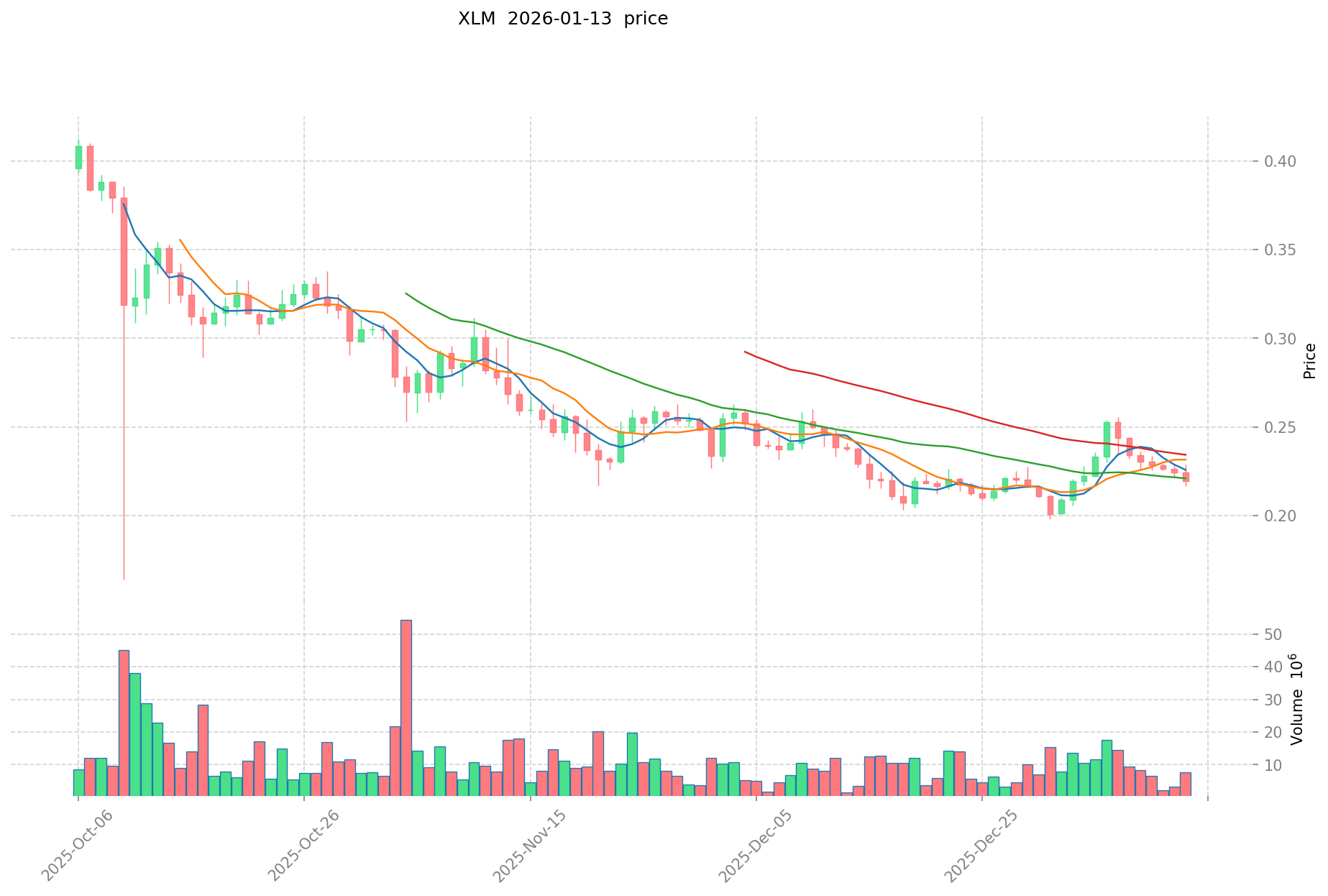
II. Core Factors Influencing Whether XLM is a Good Investment
Supply Mechanism and Scarcity (XLM Investment Scarcity)
- Fixed supply cap of 50,001,786,892 XLM → Influences price dynamics and investment considerations
- Current circulating supply of approximately 32.41 billion XLM represents 64.83% of total supply → Limited additional supply pressure
- Investment significance: The predetermined supply ceiling provides a framework for assessing potential scarcity characteristics over time
Institutional Investment and Mainstream Adoption (Institutional Investment in XLM)
- Network adoption metrics: Over 10.2 million holders as of January 2026 → Indicates broad user base distribution
- Growing recognition among financial institutions: Banks and payment organizations exploring blockchain capabilities may consider Stellar's infrastructure for cross-border transactions
- Institutional interest trend: Financial organizations increasingly evaluating blockchain advantages for global remittance operations, which may influence demand for network capabilities
Macroeconomic Environment's Impact on XLM Investment
- Monetary policy and interest rate fluctuations → May alter risk appetite for digital assets and affect investment attractiveness
- Market volatility considerations: The cryptocurrency market experiences significant price fluctuations, which presents both opportunities and risks for investors
- Global financial infrastructure evolution → Digital transaction adoption trends may influence demand for efficient cross-border payment solutions
Technology and Ecosystem Development (Technology & Ecosystem for XLM Investment)
- Network efficiency: Strong throughput capacity and low-cost transaction characteristics → Attracts projects to issue assets on the Stellar network
- Cross-border payment infrastructure: Decentralized gateway enabling transfers between digital and fiat currencies → Facilitates movement of digital assets among banks, payment institutions, and individuals
- Real-world asset integration: Consistent development and partnerships aimed at increasing network utilization for asset transfer applications
- Application expansion: Growing reliance on digital transactions and financial inclusion initiatives may support broader ecosystem adoption over time
III. XLM Future Investment Forecast and Price Outlook (Is Stellar (XLM) Worth Investing in 2026-2031)
Short-term Investment Outlook (2026, Short-term XLM Investment Outlook)
- Conservative Forecast: $0.1159 - $0.2228
- Neutral Forecast: $0.1700 - $0.2350
- Optimistic Forecast: $0.2228 - $0.2473
Mid-term Investment Outlook (2027-2029, Mid-term Stellar (XLM) Investment Forecast)
-
Market Stage Expectation: Following initial consolidation in 2026, XLM may enter a gradual recovery phase during 2027-2029, with price movements influenced by network adoption trends and cross-border payment integration progress.
-
Investment Return Forecast:
- 2027: $0.1481 - $0.3385
- 2028: $0.2380 - $0.3327
- 2029: $0.1858 - $0.4398
-
Key Catalysts: Expansion of institutional partnerships in cross-border payment networks, increased transaction volume on the Stellar network, and broader fintech adoption could serve as potential growth drivers.
Long-term Investment Outlook (Is XLM a Good Long-term Investment?)
- Base Scenario: $0.2286 - $0.4347 (assuming steady network development and moderate adoption growth)
- Optimistic Scenario: $0.3828 - $0.4949 (assuming accelerated institutional adoption and favorable market conditions)
- Risk Scenario: Below $0.1858 (under conditions of intensified competition from alternative payment networks or regulatory challenges)
Click to view XLM long-term investment and price forecast: Price Prediction
2026-01-13 to 2031 Long-term Outlook
- Base Scenario: $0.23 - $0.43 (corresponding to steady progress and gradual mainstream application expansion)
- Optimistic Scenario: $0.38 - $0.49 (corresponding to large-scale adoption and favorable market environment)
- Transformative Scenario: Above $0.50 (in case of breakthrough ecosystem developments and mainstream widespread adoption)
- 2031-12-31 Projected High: $0.47 (based on optimistic development assumptions)
Disclaimer: These forecasts are provided for informational purposes only and should not be construed as investment advice. Cryptocurrency markets are highly volatile and unpredictable. Price projections are based on historical data analysis and various assumptions about future market conditions, which may not materialize. Past performance does not guarantee future results. Investors should conduct thorough independent research and consider their own risk tolerance before making any investment decisions. The actual price performance of XLM may differ significantly from these projections due to numerous factors including market sentiment, regulatory changes, technological developments, and macroeconomic conditions.
| Year |
Predicted High Price |
Predicted Average Price |
Predicted Low Price |
Price Change |
| 2026 |
0.2473302 |
0.22282 |
0.1158664 |
0 |
| 2027 |
0.338508144 |
0.2350751 |
0.148097313 |
5 |
| 2028 |
0.33267828152 |
0.286791622 |
0.23803704626 |
28 |
| 2029 |
0.4398236314992 |
0.30973495176 |
0.185840971056 |
39 |
| 2030 |
0.494708664951072 |
0.3747792916296 |
0.228615367894056 |
68 |
| 2031 |
0.473870936336466 |
0.434743978290336 |
0.382574700895495 |
95 |
IV. Stellar Investment Strategy and Risk Management (How to invest in Stellar)
Investment Methodology (Stellar investment strategy)
Long-term Holding (HODL Stellar)
For conservative investors seeking to benefit from Stellar's role in the cross-border payment infrastructure, a long-term holding strategy may be considered. This approach involves acquiring XLM tokens and maintaining positions through market cycles, with the expectation that the network's utility in facilitating low-cost transfers between digital and fiat currencies could support value over extended periods.
Active Trading
Traders utilizing technical analysis may engage with Stellar's price movements through various timeframes. Recent data shows price fluctuations with a 24-hour range between $0.21635 and $0.2246. Active trading strategies typically involve monitoring support and resistance levels, volume patterns, and broader market sentiment to identify potential entry and exit points.
Risk Management (Risk management for Stellar investment)
Asset Allocation Guidelines
- Conservative investors: Consider limiting crypto exposure to a small percentage of overall portfolio (typically 1-5%), with Stellar representing only a portion of that allocation
- Moderate investors: May allocate 5-15% to cryptocurrency holdings, with diversification across multiple assets including Stellar
- Experienced investors: Could consider higher allocations while maintaining diversification across blockchain networks and use cases
Risk Mitigation Approaches
- Portfolio diversification: Combining Stellar with other asset classes and cryptocurrencies to reduce concentration risk
- Position sizing: Limiting individual investment amounts to levels that align with personal risk tolerance
- Regular rebalancing: Periodically adjusting holdings to maintain target allocation percentages
Secure Storage Solutions
- Cold wallets: Offline storage solutions for long-term holdings, reducing exposure to online security threats
- Hot wallets: For active trading and immediate access, while maintaining awareness of security considerations
- Hardware wallets: Physical devices that store private keys offline, recommended for significant holdings
- Multi-signature solutions: For institutional or high-value storage requiring multiple authorization steps
V. Stellar Investment Risks and Challenges (Risks of investing in Stellar)
Market Risks
Stellar demonstrates notable price volatility, with recent data showing a 1-year decline of 47.12% and 7-day decline of 9.27%. The current price of $0.22235 remains substantially below its historical high of $0.875563 recorded on January 3, 2018. Market participants should be aware that cryptocurrency markets can experience rapid price movements influenced by various factors including trading volume, market sentiment, and broader economic conditions.
Regulatory Uncertainties
The regulatory landscape for cryptocurrencies varies significantly across jurisdictions and continues to evolve. Changes in regulatory frameworks, compliance requirements, or government policies in major markets could impact the adoption and trading of XLM tokens. Investors should monitor regulatory developments in their respective jurisdictions.
Technical Considerations
- Network security: While blockchain technology offers certain security features, all networks face potential vulnerabilities that require ongoing development and maintenance
- Protocol upgrades: Changes to the Stellar network may introduce technical risks during implementation periods
- Dependency on network adoption: The value proposition of Stellar relates to its utility in facilitating transactions, which depends on continued and expanding adoption by payment institutions and other participants
Liquidity Considerations
With a 24-hour trading volume of approximately $1.56 billion and listings on 67 exchanges, Stellar maintains reasonable liquidity levels. However, market conditions can change, potentially affecting the ability to execute large transactions at desired price points.
VI. Conclusion: Is Stellar a Good Investment?
Investment Value Assessment
Stellar presents a use case focused on enabling low-cost, rapid transfers of digital and fiat assets across borders. With a circulating supply of approximately 32.41 billion XLM tokens (64.83% of maximum supply) and a market capitalization exceeding $7.2 billion, the network maintains a presence in the cryptocurrency ecosystem. The current price represents a substantial decline from historical peaks, which may reflect various market factors and competitive dynamics.
Considerations for Different Investor Profiles
✅ Newcomers to cryptocurrency
- Consider starting with small position sizes to understand market dynamics
- Utilize secure storage solutions from the outset
- Implement regular investment approaches (dollar-cost averaging) to mitigate timing risk
- Dedicate time to understanding Stellar's technology and use cases
✅ Experienced cryptocurrency investors
- May integrate Stellar as part of a diversified cryptocurrency portfolio
- Can apply technical analysis for potential trading opportunities within established risk parameters
- Should evaluate Stellar's positioning relative to other payment-focused blockchain networks
✅ Institutional participants
- May consider Stellar for its specific utility in cross-border payment infrastructure
- Should conduct comprehensive due diligence on network security, adoption metrics, and regulatory compliance
- Can implement sophisticated custody and risk management frameworks
⚠️ Important Notice: Cryptocurrency investments carry substantial risk, including the potential for complete loss of capital. Market volatility can be extreme, and past performance does not indicate future results. This content provides informational perspectives only and does not constitute investment advice, financial guidance, or recommendations to buy or sell any asset. Individuals should conduct independent research, consult with qualified financial advisors, and carefully assess their risk tolerance and financial situation before making any investment decisions.
VII. FAQ
Q1: Is Stellar (XLM) a good investment for beginners in 2026?
Stellar can be considered for beginners, but with careful risk management. As a payment-focused blockchain with over 10.2 million holders and listings on 67 exchanges, XLM offers reasonable accessibility and liquidity. However, beginners should start with small position sizes (1-5% of portfolio) and utilize dollar-cost averaging to mitigate timing risk. The current price of $0.22235 represents a 47.12% decline over one year, demonstrating the significant volatility inherent in cryptocurrency markets. New investors should prioritize secure storage solutions, conduct thorough research on Stellar's cross-border payment technology, and understand that cryptocurrency investments carry substantial risk including potential complete loss of capital.
Q2: What is the long-term price forecast for XLM through 2031?
Price projections for XLM through 2031 vary significantly based on adoption scenarios. The base scenario estimates a range of $0.23-$0.43, assuming steady network development and moderate adoption growth. An optimistic scenario projects $0.38-$0.49, contingent upon accelerated institutional adoption and favorable market conditions. By 2031, the projected high reaches $0.47 under optimistic development assumptions. However, these forecasts are based on historical data analysis and various assumptions that may not materialize. Cryptocurrency markets are highly volatile and unpredictable, and actual performance may differ significantly due to factors including market sentiment, regulatory changes, technological developments, and macroeconomic conditions.
Q3: How does Stellar's supply mechanism affect its investment value?
Stellar has a fixed maximum supply cap of 50,001,786,892 XLM, with a current circulating supply of approximately 32.41 billion tokens (64.83% of total supply). This predetermined supply ceiling provides a framework for assessing potential scarcity characteristics over time, limiting additional supply pressure compared to cryptocurrencies with unlimited issuance. The controlled supply mechanism is significant for investment considerations as it establishes predictable token economics. However, scarcity alone does not guarantee price appreciation - investment value ultimately depends on network adoption, utility in cross-border payment applications, and broader market demand for Stellar's infrastructure capabilities.
Q4: What are the main risks of investing in Stellar (XLM)?
Stellar investment carries multiple risk categories. Market risk is substantial, with recent data showing a 47.12% decline over one year and notable volatility - the price trades far below its historical high of $0.875563 from January 2018. Regulatory uncertainties exist as cryptocurrency frameworks continue evolving across jurisdictions, potentially impacting adoption and trading. Technical considerations include network security dependencies, protocol upgrade risks, and reliance on continued adoption by payment institutions for utility value. Additionally, while current liquidity is reasonable with $1.56 billion in 24-hour volume across 67 exchanges, market conditions can change, affecting transaction execution. Investors face potential complete loss of capital and should carefully assess their risk tolerance.
Q5: What investment strategies work best for Stellar (XLM)?
Two primary strategies suit different investor profiles. Long-term holding (HODL) appeals to conservative investors seeking to benefit from Stellar's role in cross-border payment infrastructure, involving acquiring and maintaining XLM positions through market cycles with expectations that network utility could support value over extended periods. Active trading suits experienced participants utilizing technical analysis to engage with price movements - recent 24-hour ranges between $0.21635 and $0.2246 provide opportunities for those monitoring support/resistance levels and volume patterns. Regardless of strategy, effective risk management is essential: conservative investors should limit crypto exposure to 1-5% of portfolios, moderate investors to 5-15%, while maintaining diversification across multiple assets and implementing secure storage solutions including hardware wallets for significant holdings.
Q6: How does Stellar compare to other payment-focused cryptocurrencies?
Stellar distinguishes itself through its decentralized gateway infrastructure specifically designed for rapid, low-cost transfers between digital currencies and fiat currencies among banks, payment institutions, and individuals. With a market capitalization of approximately $7.21 billion and strong network throughput capacity, Stellar maintains a significant presence in the payment blockchain sector. The network's efficiency characteristics attract projects to issue assets on its infrastructure, while consistent development efforts focus on real-world asset integration and cross-border payment applications. However, investors should evaluate Stellar's positioning relative to competing payment networks, considering factors such as adoption rates, institutional partnerships, transaction volume trends, and technological differentiation when assessing its competitive position within the evolving blockchain payment ecosystem.
Q7: What factors could drive Stellar's price growth in the coming years?
Several catalysts could potentially influence Stellar's price trajectory through 2031. Expansion of institutional partnerships in cross-border payment networks represents a primary growth driver, as financial organizations increasingly evaluate blockchain advantages for global remittance operations. Increased transaction volume on the Stellar network and broader fintech adoption may support demand for network capabilities. Growing reliance on digital transactions and financial inclusion initiatives could expand ecosystem adoption over time. Real-world asset integration developments and mainstream application expansion may enhance utility value. Additionally, the fixed supply cap of 50 billion XLM provides scarcity characteristics that could interact with demand dynamics. However, actual price performance depends on numerous unpredictable factors including market sentiment, regulatory developments, technological evolution, competitive dynamics, and macroeconomic conditions.
Q8: Should I hold XLM for the long term or trade it actively?
The optimal approach depends on individual investment objectives, risk tolerance, and experience level. Long-term holding may suit investors who believe in Stellar's fundamental value proposition for cross-border payments and prefer to avoid the complexity and risks of active trading. This strategy involves weathering market volatility with the expectation that network utility could support value over extended timeframes, typically requiring 1-5 year holding periods. Active trading appeals to experienced participants comfortable with technical analysis, market timing, and managing transaction costs, but requires significant time commitment and expertise. Many investors implement hybrid approaches, maintaining core long-term positions while allocating smaller portions for tactical trading. Regardless of approach, proper risk management is critical - position sizing should align with personal risk tolerance, diversification across assets is essential, and secure storage solutions must be implemented to protect holdings from security threats.
* The information is not intended to be and does not constitute financial advice or any other recommendation of any sort offered or endorsed by Gate.