This comprehensive analysis examines StepN (GMT), the governance token of a move-to-earn blockchain application built on Solana and BSC networks. As of January 2026, GMT trades at $0.01903 with a $59.21 million market capitalization and 51.86% circulating supply ratio. The article evaluates GMT's investment characteristics through multiple dimensions: historical price trends showing volatility between $4.11 (2022 peak) and $0.01320 (2025 low), tokenomics featuring burn mechanisms and governance utility, institutional backing with $5 million funding, and price scenarios through 2030. Key investment strategies include long-term holding for conservative investors and active trading for experienced traders, supported by detailed risk management frameworks. Critical risks encompass market volatility, regulatory uncertainty, and technical vulnerabilities. The analysis concludes GMT presents differentiated opportunities for various investor profiles on Gate exchange, requiring thorough due diligence and aligned risk
GMT is a significant asset in the cryptocurrency sector. Since its launch in 2022, it has gained attention within the move-to-earn and blockchain gaming sectors. As of January 2026, GMT maintains a market capitalization of approximately $59.21 million, with a circulating supply of about 3.11 billion tokens, and the current price hovers around $0.01903. Positioned as the governance token of the STEPN ecosystem, GMT has gradually become a focal point when investors discuss "Is StepN (GMT) a good investment?" This article will comprehensively analyze GMT's investment characteristics, historical trends, future price projections, and associated risks to provide reference for investors.
GMT serves as the native governance token within the STEPN platform, a move-to-earn application that combines NFT sneakers with outdoor physical activity. The token operates within a dual-token system alongside Green Satoshi Token (GST), with GMT specifically designed for governance participation, staking rewards distribution, and protocol revenue accumulation through token burning mechanisms. The platform has secured approximately $5 million in funding, with 16.30% of GMT's total supply distributed during its initial offering. Currently available on 43 exchanges and holding 78,463 token holders, GMT demonstrates measurable adoption within its target market segment.
The token's price history reflects notable volatility patterns common in the cryptocurrency market. Historical data shows GMT reached $4.11 on April 28, 2022, while experiencing a lower bound of $0.01320308 on December 19, 2025. Recent price movements indicate a 31.13% increase over the past 30 days, contrasting with an 86.22% decline over the one-year period. With a circulating supply representing 51.86% of its maximum supply of 6 billion tokens, GMT's market dynamics warrant examination of both short-term trends and long-term tokenomics structures.
This analysis examines GMT's investment profile through multiple dimensions, including its technological infrastructure across Solana and BSC networks, market performance metrics, and the sustainability factors affecting the move-to-earn sector. The following sections will explore historical price patterns, assess valuation methodologies for future price scenarios, and identify key risk factors that potential investors should consider when evaluating GMT's position in their portfolio allocation strategies.
I. StepN (GMT) Price History Review and Current Investment Value
GMT Historical Price Trends and Investment Returns
- 2022: Project launch and market enthusiasm surge → GMT price reached $4.11, delivering significant returns for early investors
- 2022-2023: Market adjustment period → GMT experienced substantial price corrections alongside broader cryptocurrency market volatility
- 2025: Market stabilization phase → Price declined to $0.01320308 in December 2025, representing an 86.22% decrease from previous year levels
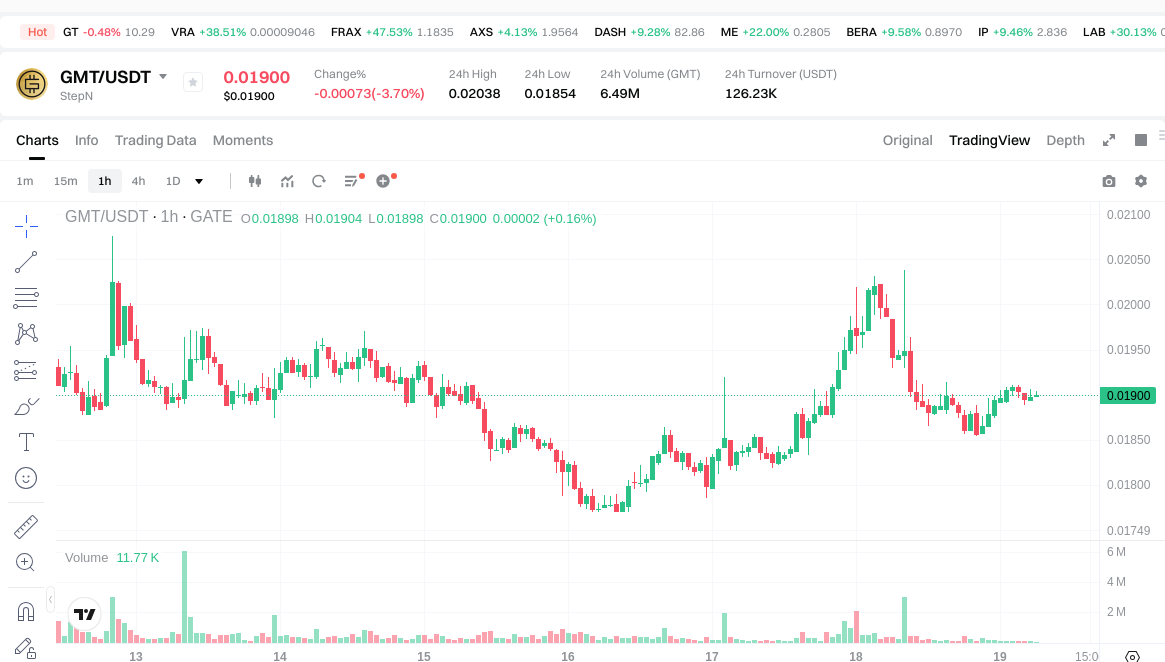
Current GMT Investment Market Status (January 2026)
- GMT current price: $0.01903
- Market sentiment: Data suggests cautious market positioning with 78,463 holders
- 24-hour trading volume: $127,024.90
- Circulating supply: 3.11 billion GMT tokens (51.86% of total supply)
- Market capitalization: $59.21 million
Click to view real-time GMT market price
II. Core Factors Influencing Whether GMT is a Good Investment
Supply Mechanism and Scarcity (GMT Investment Scarcity)
- Token supply structure → Influences price dynamics and investment value
- GMT operates with a dual-token system alongside GST, where GMT serves as the governance token with a maximum supply of 6,000,000,000 tokens. As of January 19, 2026, approximately 3,111,400,155 GMT tokens are in circulation, representing a circulating ratio of 51.86%.
- The token burn mechanism plays a role in the ecosystem, as GMT must be burned to access in-app features such as sneaker upgrades and minting new sneakers. This deflationary pressure through protocol revenue accumulation may contribute to scarcity dynamics over time.
- Investment consideration: The relationship between circulating supply, maximum supply, and burn mechanisms represents a key factor when evaluating long-term investment potential.
Institutional Investment and Mainstream Adoption (Institutional Investment in GMT)
- Funding background: STEPN raised approximately $5 million from investors, with 16.30% of the total GMT token supply sold at $0.005 per GMT during the funding round.
- Market positioning: GMT is listed on 43 exchanges as of the reference date, indicating a degree of market accessibility and liquidity for potential investors.
- The project's availability on mainstream platforms (iOS App Store and Google Play Store in certain regions) demonstrates efforts toward broader user adoption, though regional restrictions apply.
Macroeconomic Environment's Impact on GMT Investment
- Market cycle considerations: As a token within the Move-to-Earn sector, GMT's investment appeal may be influenced by broader cryptocurrency market cycles and sentiment shifts.
- The token experienced significant price volatility, with its price at $0.01903 as of January 19, 2026, representing an 86.22% decline over the one-year period, while showing a 31.13% increase over the 30-day period.
- External macroeconomic factors, including regulatory developments and overall risk appetite in digital asset markets, may affect GMT's investment characteristics, though specific correlations require careful analysis.
Technology and Ecosystem Development (Technology & Ecosystem for GMT Investment)
- Core application features: The STEPN mobile application integrates multiple functionalities including NFT sneakers with varying types, qualities, attributes, and gem slots. Users can upgrade and customize sneakers through token burning mechanisms.
- Anti-cheat infrastructure: The platform incorporates multi-layered anti-cheat mechanisms to maintain ecosystem integrity, which may support sustainable user engagement.
- Ecosystem components: STEPN provides an in-app NFT marketplace for trading, an in-app swap function for converting token earnings, and a decentralized wallet for managing cryptocurrency deposits and withdrawals.
- Rental system: The free sneaker rental system allows users to participate in move-to-earn activities and share earnings with sneaker owners, potentially expanding the user base without upfront investment barriers.
- Governance utility: GMT holders can stake tokens to participate in governance, with longer lock-up periods conferring higher voting power. Stakers can also vote on staking reward distribution, providing utility beyond speculative trading.
The investment value of GMT depends on multiple interconnected factors including tokenomics, ecosystem adoption, technological development, and broader market conditions. Potential investors should conduct comprehensive research and consider their individual risk tolerance before making investment decisions.
III. GMT Future Investment Prediction and Price Outlook (Is StepN(GMT) worth investing in 2026-2030)
Short-term GMT Investment Outlook (2026)
Based on available market analyses, GMT presents varied short-term price scenarios for 2026. Conservative estimates suggest GMT may trade between $0.01254 and $0.01903, reflecting cautious market sentiment. A neutral scenario anticipates prices ranging from $0.019 to $0.02223, while optimistic projections point toward potential highs near $0.11363 under favorable market conditions. Multiple technical indicators currently show sell signals, suggesting a measured approach may be prudent in the near term.
Mid-term StepN(GMT) Investment Forecast (2027-2028)
Market Phase Expectations
The mid-term outlook for GMT shows potential for gradual recovery and stabilization. Market analyses suggest the token may enter a consolidation phase as the project continues developing its move-to-earn ecosystem. Various forecasting models present divergent views, with some predicting modest growth while others anticipate continued price discovery.
Investment Return Predictions
- 2027: Price estimates range from $0.01278 to $0.7639, with average trading cost potentially around $0.02062 to $0.6662 depending on market conditions
- 2028: Projections suggest a range of $0.01592 to $0.03617, with some models indicating possible advancement to $0.02494
Key Catalysts
Potential factors that may influence GMT's mid-term trajectory include developments in the STEPN application ecosystem, NFT marketplace evolution, adoption rates of the move-to-earn model, and broader cryptocurrency market conditions. The dual-token system's effectiveness and governance participation levels may also play significant roles.
Long-term Investment Outlook (Is GMT a good long-term investment?)
Baseline Scenario
$0.01786 - $0.04405 (assuming steady ecosystem development and moderate user adoption growth through 2030)
Optimistic Scenario
$0.108276 - $0.4406 (conditional upon widespread adoption of move-to-earn concepts and favorable regulatory environment)
Risk Scenario
$0.01320 - $0.02566 (reflecting potential challenges such as reduced user engagement or adverse market conditions)
For detailed GMT long-term investment analysis and price predictions, visit: Price Prediction
2026-2030 Long-term Outlook
- Base Case: $0.01254 - $0.04405 USD (corresponding to steady progress and gradual mainstream application enhancement)
- Optimistic Case: $0.108276 - $0.4406 USD (aligned with large-scale adoption and favorable market environment)
- Transformative Case: Above $0.140657 USD (contingent upon breakthrough ecosystem developments and mainstream popularization)
- December 31, 2030 Projected High: $0.044854 USD (based on optimistic development assumptions)
Disclaimer: These predictions are based on technical analyses and historical data patterns and should not be construed as investment advice. Cryptocurrency markets exhibit high volatility, and actual prices may differ substantially from projections. Multiple factors including technological developments, regulatory changes, market sentiment, and macroeconomic conditions can significantly impact price movements. Investors should conduct thorough research and consider their risk tolerance before making investment decisions.
| Year |
Predicted High Price |
Predicted Average Price |
Predicted Low Price |
Price Change |
| 2026 |
0.02223 |
0.019 |
0.01254 |
0 |
| 2027 |
0.0292733 |
0.020615 |
0.0127813 |
8 |
| 2028 |
0.0361690175 |
0.02494415 |
0.0202047615 |
31 |
| 2029 |
0.0406402563875 |
0.03055658375 |
0.02566753035 |
60 |
| 2030 |
0.044854009286625 |
0.03559842006875 |
0.030614641259125 |
87 |
| 2031 |
0.058730273429423 |
0.040226214677687 |
0.028158350274381 |
111 |
IV. GMT Investment Strategy and Risk Management (How to invest in GMT)
Investment Methodology (GMT investment strategy)
Long-term Holding (HODL GMT): Suitable for Conservative Investors
Long-term holding represents a passive investment approach for GMT token holders. This strategy involves acquiring GMT tokens and maintaining positions through market cycles, regardless of short-term price fluctuations. Given GMT's utility within the STEPN ecosystem—including governance participation, staking rewards, and protocol fee burning mechanisms—long-term holders may benefit from the platform's sustained development and user adoption. Conservative investors should consider GMT's circulating supply ratio of approximately 51.86% and evaluate the token's fundamental role in the move-to-earn application before committing to extended holding periods.
Active Trading: Relying on Technical Analysis and Swing Operations
Active trading strategies for GMT involve frequent position adjustments based on technical indicators and market momentum. Traders may utilize price movement patterns, volume analysis, and key support/resistance levels to execute swing trades. With GMT demonstrating price volatility—including a 24-hour change of -3.35% and 30-day performance of +31.13%—experienced traders might identify opportunities within these fluctuations. This approach requires continuous market monitoring, risk assessment, and disciplined execution of entry and exit strategies.
Risk Management (Risk management for GMT investment)
Asset Allocation Ratios: Conservative / Aggressive / Professional Investors
- Conservative investors: May allocate 1-3% of their crypto portfolio to GMT, prioritizing capital preservation while maintaining limited exposure to move-to-earn sector opportunities.
- Aggressive investors: Could consider 5-10% allocation to GMT, accepting higher volatility in pursuit of potential returns from the application's growth trajectory.
- Professional investors: Might implement dynamic allocation models (3-15%) based on market conditions, technical indicators, and ecosystem development metrics.
Risk Hedging Solutions: Multi-asset Portfolio + Risk Mitigation Tools
Diversification across multiple digital assets can reduce concentration risk associated with GMT holdings. Investors may consider:
- Combining GMT with established cryptocurrencies to balance portfolio volatility
- Utilizing stablecoin positions to maintain liquidity and reduce overall portfolio fluctuation
- Monitoring correlation patterns between GMT and broader crypto market movements
- Implementing position sizing rules to limit exposure to any single asset
Secure Storage: Hot and Cold Wallets + Hardware Wallet Recommendations
GMT tokens exist on multiple blockchain networks, including Solana (contract address: 7i5KKsX2weiTkry7jA4ZwSuXGhs5eJBEjY8vVxR4pfRx) and BSC (contract address: 0x3019BF2a2eF8040C242C9a4c5c4BD4C81678b2A1). Storage considerations include:
- Cold storage solutions (hardware wallets) for long-term holdings and larger amounts
- Hot wallets (mobile/web wallets) for active trading and smaller operational balances
- Multi-signature wallets for institutional holdings
- Regular security audits and backup procedures for wallet recovery phrases
V. GMT Investment Risks and Challenges (Risks of investing in GMT)
Market Risk: High Volatility and Price Manipulation Concerns
GMT exhibits substantial price volatility, with recorded fluctuations including a 7-day change of -4.75% and 1-year change of -86.22%. The token's 24-hour trading volume of approximately $127,024 and market capitalization of around $59.2 million suggest moderate liquidity levels. Price movements may be influenced by:
- Broader cryptocurrency market sentiment shifts
- STEPN application user activity and engagement metrics
- Trading volume concentration across 43 exchanges
- Market depth and order book dynamics
Regulatory Risk: Policy Uncertainty Across Different Countries
The regulatory landscape for move-to-earn applications and associated tokens remains evolving across jurisdictions. Potential regulatory considerations include:
- Classification of GMT tokens under securities, utility tokens, or other regulatory frameworks
- Geographic restrictions on STEPN application availability (currently limited to certain countries/regions)
- Compliance requirements for NFT marketplaces and in-app exchange functions
- Tax treatment of token earnings from move-to-earn activities
- Potential changes in cryptocurrency regulations affecting token trading and custody
Technical Risk: Network Security Vulnerabilities and Upgrade Failures
Technical considerations for GMT investment include:
- Smart contract security on deployed blockchains (Solana and BSC)
- Network congestion or performance issues affecting token transactions
- Integration risks between STEPN application components (wallet, marketplace, exchange functions)
- Anti-cheat mechanism effectiveness and potential exploitation
- Dependency on underlying blockchain infrastructure reliability
- Potential vulnerabilities in NFT minting and upgrade functions
VI. Conclusion: Is GMT a Good Investment?
Investment Value Summary
GMT serves as the governance token within the STEPN move-to-earn ecosystem, offering utility through staking, governance participation, and protocol fee mechanisms. The token's performance reflects both broader cryptocurrency market conditions and specific factors related to STEPN application adoption. With a circulating supply of approximately 3.11 billion tokens (51.86% of maximum supply) and presence on multiple blockchain networks, GMT demonstrates established infrastructure. However, price performance over extended periods shows significant fluctuation, requiring careful consideration of individual risk tolerance and investment objectives.
Investor Recommendations
✅ Beginners: Consider dollar-cost averaging (DCA) strategies to mitigate timing risk, combined with secure cold wallet storage for token holdings. Focus on understanding STEPN ecosystem fundamentals before establishing positions.
✅ Experienced Investors: May explore swing trading opportunities based on technical analysis while maintaining core holdings. Implement portfolio diversification and position sizing disciplines aligned with personal risk parameters.
✅ Institutional Investors: Evaluate GMT as a strategic allocation within move-to-earn or gaming token categories. Consider ecosystem development metrics, user retention data, and competitive positioning when determining allocation weights.
⚠️ Notice: Cryptocurrency investments involve substantial risk and price volatility. This content is provided for informational purposes only and does not constitute investment advice. Conduct thorough research and consider consulting financial professionals before making investment decisions.
VII. FAQ
Q1: What is GMT and how does it function within the STEPN ecosystem?
GMT (Green Metaverse Token) is the governance token of STEPN, a move-to-earn application that combines NFT sneakers with physical activity. GMT operates within a dual-token system alongside GST (Green Satoshi Token), serving three primary functions: governance participation where holders can stake tokens to vote on protocol decisions, staking rewards distribution with longer lock-up periods conferring higher voting power, and protocol revenue accumulation through token burning mechanisms. The token must be burned to access specific in-app features such as sneaker upgrades and minting new NFTs. With a maximum supply of 6 billion tokens and approximately 3.11 billion currently in circulation (51.86%), GMT is deployed on multiple blockchain networks including Solana and BSC, available on 43 exchanges, and held by 78,463 token holders as of January 2026.
Q2: What are the main risks associated with investing in GMT?
GMT investment carries three primary risk categories: market risk, regulatory risk, and technical risk. Market risk manifests through substantial price volatility, with GMT experiencing an 86.22% decline over one year and a current 24-hour trading volume of approximately $127,024, which may indicate liquidity constraints and potential price manipulation concerns. Regulatory risk stems from evolving global policies regarding move-to-earn applications and token classifications, with STEPN currently facing geographic restrictions in certain jurisdictions and uncertain tax treatment of token earnings. Technical risk involves smart contract security vulnerabilities on deployed blockchains (Solana and BSC), potential network congestion affecting transactions, integration risks between application components, anti-cheat mechanism effectiveness, and dependency on underlying blockchain infrastructure reliability. Investors should assess these risk factors against their individual risk tolerance before establishing positions.
Q3: How has GMT's price performed historically and what factors influence its value?
GMT launched in 2022 with significant early momentum, reaching a peak of $4.11 on April 28, 2022. Following this peak, the token experienced substantial corrections aligned with broader cryptocurrency market volatility, declining to $0.01320308 on December 19, 2025. As of January 19, 2026, GMT trades at $0.01903 with a market capitalization of approximately $59.21 million. Key factors influencing GMT's value include: supply mechanism and scarcity through its burn mechanism and circulating ratio of 51.86%; institutional investment background with approximately $5 million raised and 16.30% sold during initial offering; macroeconomic conditions affecting broader cryptocurrency market sentiment; and technology ecosystem development including STEPN application features, anti-cheat infrastructure, NFT marketplace functionality, and governance utility. Recent performance shows a 31.13% increase over 30 days contrasted with the 86.22% annual decline, reflecting the token's sensitivity to both short-term market dynamics and long-term adoption trends.
Q4: What are the price predictions for GMT through 2030?
Price projections for GMT vary significantly based on different scenarios and market conditions. For 2026, conservative estimates suggest GMT may trade between $0.01254 and $0.01903, with neutral scenarios anticipating $0.019 to $0.02223, and optimistic projections reaching approximately $0.11363. Mid-term forecasts for 2027-2028 show price ranges of $0.01278 to $0.7639 for 2027 and $0.01592 to $0.03617 for 2028, depending on ecosystem development and adoption rates. Long-term outlook through 2030 presents three scenarios: baseline scenario of $0.01786 to $0.04405 assuming steady development; optimistic scenario of $0.108276 to $0.4406 conditional upon widespread adoption; and risk scenario of $0.01320 to $0.02566 reflecting potential challenges. By December 31, 2030, the projected high reaches $0.044854 under optimistic assumptions. These predictions are based on technical analyses and historical patterns but should not be construed as investment advice, as actual prices may differ substantially due to technological developments, regulatory changes, market sentiment, and macroeconomic conditions.
Q5: What investment strategies are suitable for different types of GMT investors?
Investment strategies for GMT vary based on investor profile and risk tolerance. Conservative investors may adopt a long-term holding (HODL) strategy, allocating 1-3% of their crypto portfolio to GMT while utilizing cold storage solutions for security, focusing on GMT's fundamental utility within the STEPN ecosystem including governance participation and staking rewards. Aggressive investors could consider 5-10% allocation with active trading approaches based on technical analysis and swing operations, capitalizing on GMT's demonstrated volatility (31.13% increase over 30 days). Professional investors might implement dynamic allocation models ranging from 3-15% based on market conditions, ecosystem development metrics, and technical indicators. All investor types should implement risk management through multi-asset portfolio diversification, position sizing disciplines, and secure storage practices using hardware wallets for long-term holdings and hot wallets for active trading. Dollar-cost averaging (DCA) strategies are recommended for beginners to mitigate timing risk, while experienced investors may explore swing trading opportunities while maintaining core holdings.
Q6: How does GMT's tokenomics and supply mechanism affect its investment potential?
GMT's tokenomics structure significantly influences its investment characteristics through several mechanisms. The token operates with a maximum supply of 6 billion tokens, with approximately 3.11 billion currently in circulation representing a 51.86% circulating ratio. This leaves approximately 48.14% of total supply yet to enter circulation, which may create future selling pressure depending on release schedules. However, GMT incorporates deflationary pressure through its burn mechanism, where tokens must be burned to access in-app features such as sneaker upgrades and minting new NFTs, creating protocol revenue accumulation. The dual-token system with GST provides functional separation where GMT serves governance and long-term utility while GST handles daily earning activities. The initial funding round distributed 16.30% of total supply at $0.005 per GMT, establishing early investor cost basis significantly below current market price. These tokenomics factors—circulating supply ratio, burn mechanism effectiveness, dual-token dynamics, and initial distribution—create complex supply-demand dynamics that investors should analyze when evaluating GMT's scarcity profile and long-term investment potential.
Q7: What role does the STEPN ecosystem development play in GMT's investment value?
STEPN ecosystem development directly impacts GMT's investment value through multiple channels. The core application features including NFT sneakers with varying types, qualities, attributes, and gem slots drive user engagement and token utility, as users must burn GMT to upgrade and customize their sneakers. The platform's multi-layered anti-cheat infrastructure supports ecosystem integrity and sustainable user participation, which is critical for long-term value retention. The in-app NFT marketplace facilitates trading activity, the swap function enables token conversion, and the decentralized wallet manages cryptocurrency operations—all contributing to ecosystem liquidity and user retention. The free sneaker rental system potentially expands the user base by allowing participation without upfront investment barriers, though this may also dilute token demand. Governance utility through staking mechanisms provides GMT holders with decision-making power, with longer lock-up periods conferring higher voting power, creating opportunity cost considerations for token holders. The ecosystem's availability on iOS App Store and Google Play Store in certain regions demonstrates mainstream accessibility efforts, though geographic restrictions limit total addressable market. These development factors collectively influence user adoption rates, token velocity, and long-term sustainability—key variables affecting GMT's investment valuation.
Q8: What security considerations should GMT investors prioritize?
GMT investors should implement comprehensive security measures across multiple dimensions. For token storage, cold storage solutions using hardware wallets are recommended for long-term holdings and larger amounts, while hot wallets (mobile/web wallets) may be appropriate for active trading and smaller operational balances. Since GMT exists on multiple blockchain networks including Solana (contract address: 7i5KKsX2weiTkry7jA4ZwSuXGhs5eJBEjY8vVxR4pfRx) and BSC (contract address: 0x3019BF2a2eF8040C242C9a4c5c4BD4C81678b2A1), investors must verify correct contract addresses before transactions to avoid scams. Multi-signature wallets are advisable for institutional holdings, providing additional security layers. Regular security audits of wallet software and secure backup procedures for recovery phrases are essential. When using STEPN's integrated wallet features, investors should understand the security architecture of in-app custody solutions versus external wallet control. Transaction security requires verification of network fees, confirmation of recipient addresses, and awareness of blockchain congestion that may affect transaction processing. Investors should also monitor smart contract security audits for GMT token contracts and stay informed about any discovered vulnerabilities or upgrade implementations that may affect token holdings.
* The information is not intended to be and does not constitute financial advice or any other recommendation of any sort offered or endorsed by Gate.