This comprehensive article examines whether GMT (Green Metaverse Token), the governance token of STEPN's move-to-earn fitness platform, represents a viable investment for 2024-2030. Starting from GMT's current market position (0.01734 USD, 53.95M market cap as of January 2026), the analysis explores critical investment factors including tokenomics with supply caps and burn mechanisms, institutional backing through Adidas and Asics partnerships, and ecosystem development across Solana and BSC networks via Gate and 41 other exchanges. The article provides tiered price forecasts ranging from conservative to optimistic scenarios through 2030, evaluates investment strategies for different investor profiles, and thoroughly examines market, regulatory, technical, and platform-specific risks. Designed for both beginners and experienced investors, this guide balances GMT's governance utility and Move-to-Earn narrative potential against substantial volatility and regulatory uncertainties.
GMT is a significant asset in the cryptocurrency sector, serving as the native governance token of STEPN, a move-to-earn fitness application launched in March 2022. As of January 19, 2026, GMT maintains a market capitalization of approximately 53.95 million USD, with a circulating supply of around 3.11 billion tokens, and the current price stands at approximately 0.01734 USD. Positioned as the governance token within STEPN's dual-token ecosystem alongside Green Satoshi Token (GST), GMT has established itself in the Web3 fitness and NFT gaming sectors. With deployment on both Solana and BSC networks, and availability across 42 exchanges, GMT has attracted attention from investors examining "Is StepN (GMT) a good investment?" This article provides a comprehensive analysis of GMT's investment attributes, historical performance, future price outlook, and associated risks to serve as a reference for market participants.
I. GMT Price History Review and Investment Value Status
- 2022: Project launch and market enthusiasm → GMT price reached 4.11 USD, demonstrating notable investor returns
- 2022-2023: Broader cryptocurrency market adjustment period → GMT experienced price fluctuations following initial growth driven by market enthusiasm and StepN user expansion
- 2025: Market volatility continues → Price movements reflect ongoing adjustments in the move-to-earn sector
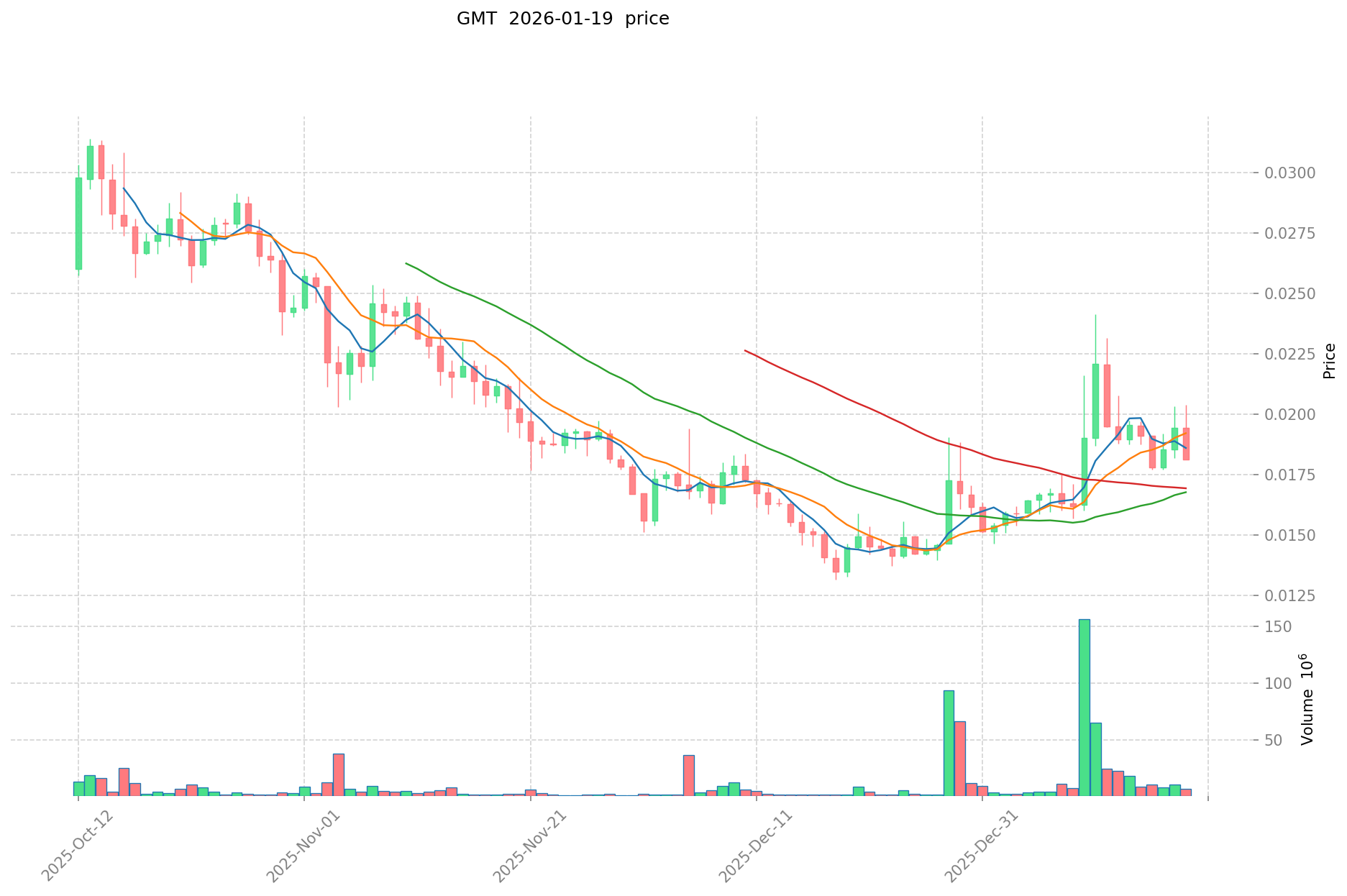
Current GMT Investment Market Status (January 2026)
- GMT current price: 0.01734 USD
- 24-hour trading volume: 175,660.703225 USD
- Market capitalization: 53,951,678.69 USD
- Circulating supply: 3,111,400,155.10 GMT
Click to view real-time GMT market price
II. Core Factors Influencing Whether GMT is a Good Investment
Supply Mechanism and Scarcity (GMT Investment Scarcity)
- Token Supply Structure → GMT operates under a dual-token system with a maximum supply of 6,000,000,000 tokens, of which approximately 51.86% (3,111,400,155 tokens) are currently in circulation. The predetermined supply cap may contribute to scarcity dynamics as adoption increases.
- Token Burn Mechanism → STEPN has implemented a token burn mechanism where GMT must be burned to access in-app features such as sneaker upgrades and minting new sneakers. This deflationary pressure through protocol revenue accumulation could influence long-term supply dynamics.
- Halving Events → GMT earnings are scheduled to be halved on January 1, 2026, which may impact token distribution rates and potentially affect price dynamics through reduced emission rates.
- Investment Significance → The combination of capped supply, burn mechanisms, and reduced emission schedules represents structural factors that may influence GMT's long-term investment profile.
Institutional Investment and Mainstream Adoption (Institutional Investment in GMT)
- Fundraising History → STEPN raised approximately $5 million from investors, with 16.30% of GMT token total supply sold at $0.005 per GMT during initial funding rounds.
- Brand Partnerships → STEPN has established partnerships with established brands including Adidas and Asics, featuring custom sneakers within its ecosystem. These collaborations may contribute to mainstream recognition and user acquisition.
- User Base → The platform has approximately 78,463 holders according to available data, indicating a distributed ownership structure.
- Exchange Listings → GMT is listed on 42 exchanges, providing liquidity access across multiple platforms.
Macroeconomic Environment Impact on GMT Investment
- Market Cycle Sensitivity → As a cryptocurrency asset, GMT may be influenced by broader crypto market cycles. Some analysis suggests that bullish crypto market conditions could potentially support price appreciation.
- Move-to-Earn Narrative → The move-to-earn sector, which emerged in 2021, may experience renewed interest during broader market upswings, potentially benefiting established projects like STEPN.
- Regulatory Considerations → The mobile application's availability is limited to certain countries/regions, indicating that regulatory factors and geographic restrictions may affect potential market reach.
Technology and Ecosystem Development (Technology & Ecosystem for GMT Investment)
- Multi-Platform Application → STEPN is available on iOS App Store and Google Play Store in select regions, providing accessibility through mainstream mobile platforms.
- NFT Sneaker System → The platform features NFT sneakers with varying types, qualities, attributes, and gem slots. Users can upgrade and customize sneakers through token burning mechanisms.
- Move-to-Earn Mechanism → Users equipped with sneaker NFTs can earn tokens through outdoor physical activity. The application incorporates multi-layered anti-cheating mechanisms to maintain system integrity.
- Rental System → A sneaker rental system allows users to borrow sneakers at no upfront cost and share earnings with sneaker owners, potentially lowering entry barriers.
- Integrated Infrastructure → The ecosystem includes built-in wallet functionality, an in-app NFT marketplace, swap functions for converting token earnings, and a decentralized wallet for cryptocurrency management.
- Dual-Token Architecture → The system utilizes both GMT (governance token) and GST (game token), with GMT serving governance functions including staking for voting rights, staking reward allocation, and protocol revenue accumulation through token burns.
III. GMT Future Investment Forecast and Price Outlook (Is StepN(GMT) worth investing in 2026-2030)
Short-term GMT Investment Outlook (2026)
- Conservative Forecast: $0.0117 - $0.0137
- Neutral Forecast: $0.0172 - $0.0189
- Optimistic Forecast: $0.0195 - $0.0206
Mid-term StepN(GMT) Investment Forecast (2027-2028)
-
Market Phase Expectation: GMT is anticipated to experience gradual price adjustments during this period, with technical indicators suggesting mixed sentiment. The token may face consolidation as market participants assess fundamental developments and broader cryptocurrency market conditions.
-
Investment Return Forecast:
- 2027: $0.0119 - $0.0259
- 2028: $0.0143 - $0.0294
-
Key Catalysts: Market performance during this period may be influenced by token unlock schedules, technical resistance levels, trading volume recovery, overall cryptocurrency market sentiment, and potential developments in STEPN's move-to-earn ecosystem.
Long-term Investment Outlook (Is GMT a good long-term investment?)
- Base Scenario: $0.0154 - $0.0285 (assuming steady ecosystem development and sustained user engagement in the move-to-earn sector)
- Optimistic Scenario: $0.0259 - $0.0336 (assuming enhanced platform features, increased adoption, and favorable market conditions)
- Risk Scenario: $0.0117 - $0.0154 (under conditions of reduced market interest or competitive pressures)
Click to view GMT long-term investment and price forecast: Price Prediction
2026-2030 Long-term Outlook
- Base Scenario: $0.0172 - $0.0274 USD (corresponding to steady progress and gradual mainstream application enhancement)
- Optimistic Scenario: $0.0259 - $0.0336 USD (corresponding to large-scale adoption and favorable market environment)
- Transformative Scenario: Above $0.0350 USD (contingent upon breakthrough developments in the ecosystem and mainstream popularization)
- 2030-12-31 Forecast High: $0.0285 USD (based on optimistic development assumptions)
Disclaimer: Cryptocurrency markets are highly volatile and unpredictable. Price forecasts are based on technical analysis and market projections, which may not reflect actual future performance. These projections should not be considered as investment advice. Investors should conduct thorough research and consider multiple factors including regulatory developments, market conditions, and technological progress before making investment decisions.
| Year |
Predicted High Price |
Predicted Average Price |
Predicted Low Price |
Price Change |
| 2026 |
0.02064 |
0.0172 |
0.011696 |
0 |
| 2027 |
0.0259204 |
0.01892 |
0.0119196 |
9 |
| 2028 |
0.029370462 |
0.0224202 |
0.014348928 |
29 |
| 2029 |
0.02900277072 |
0.025895331 |
0.02252893797 |
49 |
| 2030 |
0.0285470128944 |
0.02744905086 |
0.0153714684816 |
58 |
| 2031 |
0.03359763825264 |
0.0279980318772 |
0.026878110602112 |
61 |
IV. GMT Investment Strategy and Risk Management (How to invest in Move-to-Earn Tokens)
Investment Methodology (GMT investment strategy)
Long-term Holding (HODL GMT): This approach may be suitable for investors who believe in the long-term development of the Move-to-Earn model and the STEPN ecosystem. Holders can consider participating in governance through staking GMT tokens, with longer lock-up periods potentially providing higher voting rights. The staking mechanism also allows token holders to participate in determining the distribution of staking rewards.
Active Trading: For traders focusing on short-term opportunities, GMT's price movements can be analyzed through technical indicators and market trends. The token has shown notable volatility, with 24-hour fluctuations reaching double-digit percentages and significant price variations across different timeframes. Traders should monitor market liquidity, trading volume patterns, and key support and resistance levels.
Risk Management (Risk management for GMT investment)
Asset Allocation Ratios:
- Conservative investors: May consider limiting GMT exposure to a small percentage of their crypto portfolio, given the token's volatility characteristics
- Moderate investors: Could allocate a modest portion while maintaining diversification across different crypto asset categories
- Experienced investors: May implement more flexible allocation strategies based on market conditions and risk tolerance
Risk Hedging Approaches: Diversification across multiple crypto assets and traditional investment vehicles can help mitigate concentration risk. Investors may consider holding a mix of different token categories alongside GMT to balance portfolio exposure.
Secure Storage:
- Cold wallets: Hardware wallets provide enhanced security for long-term storage of GMT tokens
- Hot wallets: The STEPN application includes a built-in decentralized wallet for operational needs
- Multi-signature solutions: May be considered for larger holdings to add an additional security layer
V. GMT Investment Risks and Challenges (Risks of investing in Move-to-Earn Tokens)
Market Risks: GMT has demonstrated substantial price volatility, with recent data showing fluctuations ranging from -13.73% in 24 hours to +19.54% over 30 days. The token's price history includes periods of significant movement, and current trading patterns suggest continued volatility potential. Market liquidity and trading volume variations can impact price stability.
Regulatory Risks: The Move-to-Earn model and crypto gaming applications face evolving regulatory landscapes across different jurisdictions. STEPN's mobile application availability is limited to certain countries, reflecting the complexity of regional compliance requirements. Changes in regulatory frameworks could affect the platform's operations and token utility.
Technical Risks: The platform's functionality depends on multiple technical components including NFT infrastructure, anti-cheating mechanisms, and multi-chain operations. GMT operates on both Solana and BSC networks, creating potential cross-chain technical considerations. Security vulnerabilities in smart contracts, wallet systems, or the application itself could pose risks to users and token value.
Platform-Specific Risks: The token's utility is closely tied to the STEPN ecosystem and its user adoption. Changes in user engagement, competition from similar Move-to-Earn platforms, or modifications to the dual-token economic model (GMT and GST) could impact token demand and value proposition.
VI. Conclusion: Is Move-to-Earn Token a Good Investment?
Investment Value Summary: GMT represents exposure to the Move-to-Earn concept and the STEPN ecosystem, which combines NFT functionality, gaming mechanics, and fitness incentives. The token's governance utility and burn mechanism through in-app features provide potential value drivers. However, the asset has shown considerable price volatility and substantial drawdowns from previous price levels.
Investor Recommendations:
✅ Beginners: Consider starting with small allocations and using secure wallet storage solutions. The STEPN platform's built-in wallet and marketplace provide user-friendly features, but understanding the dual-token system and NFT mechanics requires research and learning.
✅ Experienced Investors: May evaluate GMT as part of a diversified crypto portfolio, considering both the token's governance features and its connection to Move-to-Earn trends. Technical analysis and monitoring of ecosystem developments can inform trading decisions.
✅ Institutional Investors: Should conduct thorough due diligence on the platform's user metrics, tokenomics structure, regulatory compliance status, and competitive positioning within the broader GameFi and lifestyle application sectors.
⚠️ Important Notice: Cryptocurrency investments involve substantial risks including potential loss of capital. GMT's price history shows significant volatility, and past performance does not indicate future results. This content is for informational purposes only and does not constitute investment advice. Investors should conduct independent research and consider their financial situation and risk tolerance before making investment decisions.
VII. FAQ
Q1: What is GMT and what role does it play in the STEPN ecosystem?
GMT (Green Metaverse Token) is the governance token of STEPN, a move-to-earn fitness application launched in March 2022. GMT operates within a dual-token ecosystem alongside Green Satoshi Token (GST), serving multiple functions: governance participation through staking with voting rights, protocol revenue accumulation through token burns when users access in-app features such as sneaker upgrades and minting new NFT sneakers, and staking reward distribution. The token is deployed on both Solana and BSC networks and is listed on 42 exchanges, providing widespread accessibility for holders.
Q2: How does GMT's token supply mechanism affect its investment potential?
GMT has a maximum supply of 6,000,000,000 tokens with approximately 51.86% (3,111,400,155 tokens) currently in circulation as of January 2026. The token incorporates three key supply dynamics: a predetermined supply cap that may contribute to scarcity as adoption increases, a deflationary burn mechanism where GMT must be burned to access various in-app features, and scheduled halving events (with the most recent on January 1, 2026) that reduce token emission rates. These structural factors collectively influence GMT's long-term supply dynamics and may impact its value proposition over time.
Q3: What are the primary risks associated with investing in GMT?
GMT investment involves several risk categories: Market risks include substantial price volatility, with recent fluctuations ranging from -13.73% in 24 hours to +19.54% over 30 days, and significant drawdowns from previous price levels. Regulatory risks stem from evolving compliance requirements across different jurisdictions, limiting the application's availability to certain countries. Technical risks involve dependencies on NFT infrastructure, anti-cheating mechanisms, and multi-chain operations across Solana and BSC networks. Platform-specific risks include the token's close connection to STEPN ecosystem adoption, competition from similar Move-to-Earn platforms, and potential changes to the dual-token economic model.
Q4: How has GMT's price performed historically and what is the current market status?
GMT reached a peak price of 4.11 USD in 2022 following its March launch, driven by market enthusiasm and user expansion. Subsequently, the token experienced significant price adjustments during the broader cryptocurrency market correction period of 2022-2023. As of January 19, 2026, GMT trades at approximately 0.01734 USD with a market capitalization of 53.95 million USD, 24-hour trading volume of 175,660.70 USD, and a circulating supply of around 3.11 billion tokens. This represents a substantial decrease from its historical high, reflecting both sector-specific challenges and broader market conditions.
Q5: What factors could influence GMT's future price performance?
Several factors may impact GMT's future trajectory: Supply-side dynamics including token burn mechanisms, halving schedules, and emission rates affect token scarcity. Demand drivers include STEPN's user adoption rates, brand partnerships with companies like Adidas and Asics, and the platform's competitive positioning within the Move-to-Earn sector. Ecosystem developments such as rental system adoption, marketplace activity, and governance participation may influence utility and demand. External factors include broader cryptocurrency market cycles, regulatory developments affecting mobile gaming applications, and macroeconomic conditions influencing risk asset appetite. Technical developments across Solana and BSC networks may also affect platform functionality and user experience.
Q6: What investment strategies are suitable for different types of GMT investors?
Different investor profiles may consider varying approaches: Conservative investors might limit GMT exposure to a small percentage of their crypto portfolio, utilize cold wallet storage for security, and focus on long-term holding with potential governance participation through staking. Moderate investors could allocate a modest portion while maintaining diversification, monitor ecosystem developments, and consider gradual position building. Experienced investors may implement active trading strategies based on technical analysis and market trends, given GMT's notable volatility with double-digit percentage fluctuations. All investors should implement proper risk management through asset allocation, secure storage solutions (hardware wallets for long-term holdings, multi-signature options for larger positions), and diversification across different crypto asset categories.
Q7: What is the long-term investment outlook for GMT through 2030?
Price forecasts for GMT through 2030 vary based on different scenarios: The base scenario projects prices ranging from 0.0172 USD to 0.0274 USD, assuming steady ecosystem development and sustained user engagement. The optimistic scenario forecasts 0.0259 USD to 0.0336 USD, contingent upon enhanced platform features, increased adoption, and favorable market conditions. The transformative scenario suggests potential prices above 0.0350 USD, dependent on breakthrough ecosystem developments and mainstream popularization. The 2030 year-end forecast high stands at 0.0285 USD under optimistic assumptions. However, these projections are subject to significant uncertainty given cryptocurrency market volatility, regulatory developments, technological progress, and competitive dynamics within the Move-to-Earn sector.
Q8: How does GMT's governance mechanism function and what benefits does it provide to token holders?
GMT serves as the governance token within the STEPN ecosystem, providing holders with several participation mechanisms: Token holders can stake GMT to obtain voting rights, with longer lock-up periods potentially providing higher voting power to influence platform decisions. Stakers participate in determining the distribution of staking rewards, aligning token holder interests with platform development. The governance framework allows community involvement in protocol decisions affecting the dual-token economy (GMT and GST), feature development, and ecosystem parameters. Additionally, GMT accumulates value through protocol revenue via the burn mechanism, where tokens must be burned for accessing various in-app features including sneaker upgrades, minting, and customization, creating a direct link between platform usage and token utility.
* The information is not intended to be and does not constitute financial advice or any other recommendation of any sort offered or endorsed by Gate.