This comprehensive analysis examines whether STO Chain (STOC) represents a viable investment opportunity for cryptocurrency market participants. Currently trading at $0.18305 with a market capitalization of $534.40 million, STOC positions itself as blockchain infrastructure for security tokens and Real-World Asset tokenization bridging traditional finance with decentralized systems. The article evaluates STOC's investment merit by examining historical price volatility ranging from $0.02718 to $2.39999, current market metrics, and institutional adoption potential. Long-term price forecasts through 2031 range from $0.19 to $0.52 under various scenarios, reflecting the platform's growth prospects alongside significant risks. Key considerations include limited liquidity, regulatory uncertainty, and competitive pressures in the emerging security token market. The analysis provides targeted investment strategies for different investor profiles, comprehensive risk management frameworks, and critical factors requirin
Introduction: STO Chain (STOC) Investment Position and Market Outlook
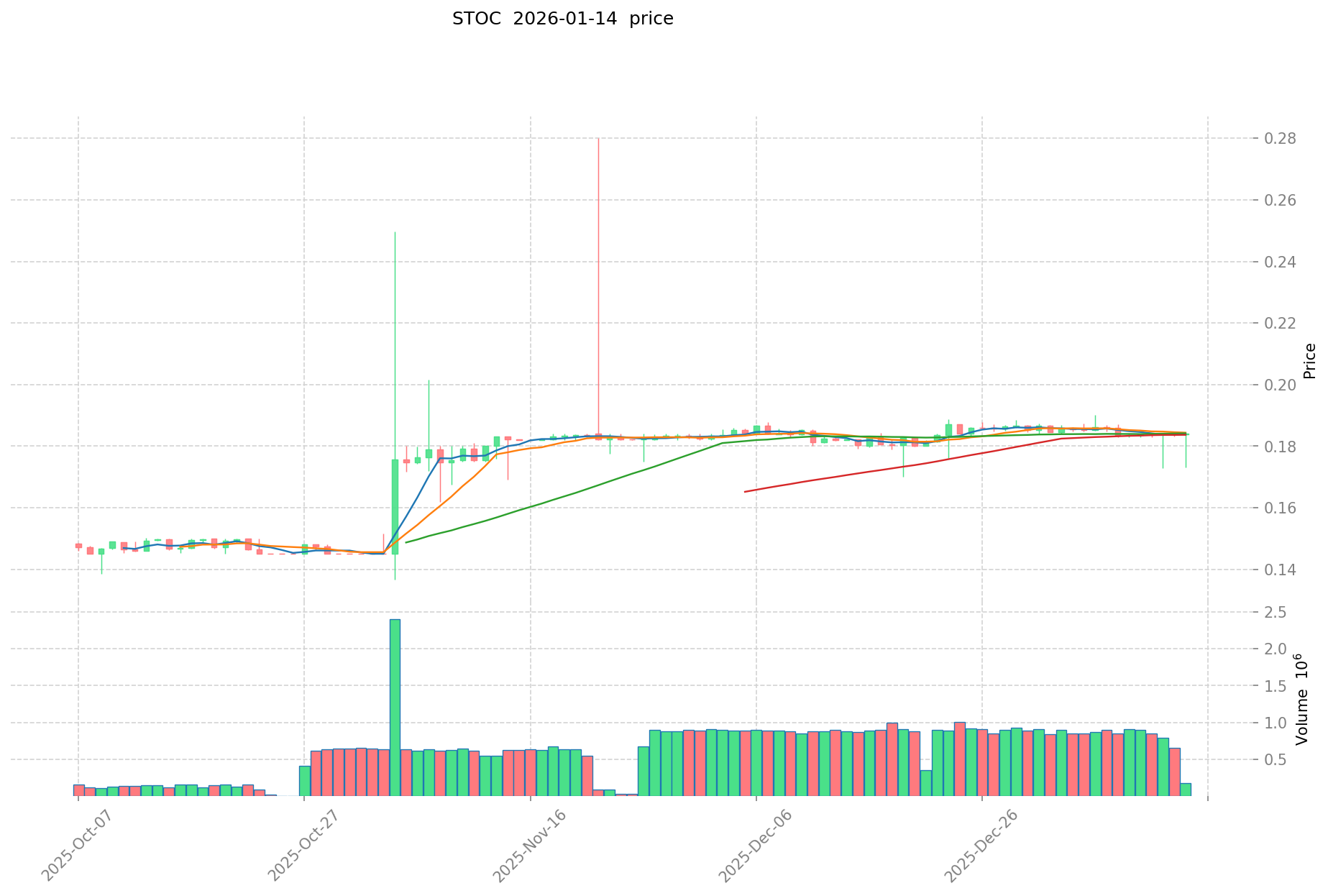
STO Chain (STOC) represents a notable asset in the cryptocurrency sector, positioning itself as a blockchain infrastructure designed specifically for regulated assets. As of January 15, 2026, STOC maintains a market capitalization of approximately $534.40 million, with a circulating supply of 2.92 billion tokens and a current price around $0.18305. The project ranks 129th in the overall cryptocurrency market, holding a 0.053% market dominance. With its focus on bridging traditional finance with decentralized finance through security token and Real-World Asset (RWA) capabilities, STOC has attracted attention from investors examining "Is STO Chain (STOC) a good investment?" Over the past year, the token has shown notable price movement, with various periods of volatility reflected in its 24-hour trading volume of approximately $29,637. This article provides a comprehensive analysis of STOC's investment characteristics, historical performance patterns, future price outlook considerations, and associated investment risks to serve as a reference for market participants.
I. STO Chain (STOC) Price History and Current Investment Value
- 2025: STOC reached a significant price milestone of $2.39999 on July 11, 2025 → Early investors experienced substantial returns during this period
- 2025: The token encountered a price correction, dropping to $0.02718 on August 1, 2025 → Market volatility presented potential entry opportunities for new investors
- 2025: Throughout the year, STOC demonstrated considerable price movement → The token fluctuated between different price levels, reflecting market dynamics and investor sentiment
Current STOC Investment Market Status (January 2026)
- STOC current price: $0.18305
- 24-hour trading volume: $29,637.34
- Market capitalization: $534.40 million
- Circulating supply: 2.919 billion STOC (29.19% of total supply)
- Fully diluted market cap: $1.831 billion
- Market dominance: 0.053%
Click to view real-time STOC market price
II. Core Factors Influencing Whether STOC is a Good Investment
Supply Mechanism and Scarcity (STOC Investment Scarcity)
- Supply Structure → Influences Price and Investment Value
- STOC has a maximum supply of 10 billion tokens, with approximately 2.92 billion currently in circulation, representing a circulation ratio of 29.19%.
- The defined supply cap creates potential scarcity dynamics, which may support price appreciation as adoption increases and circulating supply approaches the maximum limit.
- Historical price performance shows volatility, with the token experiencing significant price movements between $0.02718 and $2.39999 during its trading history.
- Investment Significance: Scarcity characteristics represent a key element in evaluating long-term investment potential, as limited supply combined with growing demand could create favorable conditions for price support.
Institutional Investment and Mainstream Adoption (Institutional Investment in STOC)
- Infrastructure Focus: STO Chain positions itself as blockchain infrastructure specifically designed for regulated assets, enabling issuance, trading, and settlement of security tokens and Real-World Assets (RWAs).
- Target Market: The platform aims to bridge traditional finance with decentralized finance (DeFi), providing infrastructure for institutional investors and projects seeking to unlock liquidity in regulated asset classes.
- Regulatory Compliance: By focusing on regulated assets and security tokens, STO Chain addresses institutional requirements for compliance, transparency, and security in blockchain-based financial operations.
- Adoption Potential: The platform's emphasis on institutional-grade infrastructure and RWA tokenization aligns with broader industry trends toward regulated digital asset adoption.
Macroeconomic Environment's Impact on STOC Investment
- Market Position: STOC maintains a market capitalization of approximately $534 million, representing 0.053% market share within the broader cryptocurrency ecosystem.
- Trading Activity: The token demonstrates modest trading volume of approximately $29,637 over 24 hours, indicating relatively limited liquidity compared to major cryptocurrency assets.
- Price Stability: Recent price performance shows limited volatility, with 24-hour changes of 0.05%, 7-day changes of -0.51%, and 30-day changes of 1.93%, suggesting relatively stable short-term price action.
- Broader Market Context: Cryptocurrency investment attractiveness remains influenced by macroeconomic factors including monetary policy adjustments, inflation trends, and regulatory developments affecting digital assets.
Technology and Ecosystem Development (Technology & Ecosystem for STOC Investment)
- Core Technology: STO Chain operates as a mainnet blockchain specifically designed for regulated asset tokenization, focusing on security token and RWA functionality.
- Infrastructure Capabilities: The platform provides infrastructure for seamless issuance, trading, and settlement of tokenized regulated assets, addressing specific needs in the security token sector.
- Ecosystem Position: STO Chain positions itself within the growing RWA tokenization sector, which represents an emerging area of blockchain application focused on bringing traditional financial assets onto distributed ledger technology.
- Value Proposition: The platform's specialized focus on regulated assets and institutional infrastructure represents a distinct positioning within the broader blockchain ecosystem, targeting specific use cases in tokenized finance.
III. STOC Future Investment Forecast and Price Outlook (Is STO Chain(STOC) worth investing in 2026-2030)
Short-term Investment Forecast (2026, short-term STOC investment outlook)
- Conservative estimate: $0.139 - $0.184
- Neutral estimate: $0.183 - $0.220
- Optimistic estimate: $0.220 - $0.242
Mid-term Investment Outlook (2027-2028, mid-term STO Chain(STOC) investment forecast)
-
Market stage expectations: The mid-term outlook suggests a gradual growth phase as STO Chain continues to develop its infrastructure for regulated assets and security token offerings. The platform's focus on bridging traditional finance with DeFi may attract increasing institutional interest, potentially supporting price appreciation during this period.
-
Investment return forecast:
- 2027: $0.153 - $0.289
- 2028: $0.206 - $0.311
-
Key catalysts: The expansion of RWA tokenization adoption, potential partnerships with institutional investors, regulatory clarity in security token markets, and the scalability improvements of the STO Chain infrastructure could serve as primary drivers for mid-term growth.
Long-term Investment Outlook (Is STOC a good long-term investment?)
- Base scenario: $0.189 - $0.477 (assuming steady development of the security token ecosystem and gradual institutional adoption)
- Optimistic scenario: $0.231 - $0.522 (assuming accelerated RWA tokenization trends and favorable regulatory developments for digital securities)
- Risk scenario: Below $0.139 (in case of significant regulatory challenges, competitive pressures, or reduced demand for security token platforms)
Click to view STOC long-term investment and price forecast: Price Prediction
2026-01-15 - 2031 Long-term Outlook
- Base scenario: $0.19 - $0.32 USD (corresponding to steady progress and gradual mainstream application advancement)
- Optimistic scenario: $0.23 - $0.52 USD (corresponding to large-scale adoption and favorable market conditions)
- Transformative scenario: Above $0.52 USD (in case of breakthrough ecosystem developments and mainstream popularization)
- 2031-12-31 forecast high: $0.522 USD (based on optimistic development assumptions)
Disclaimer: Price forecasts are based on historical data analysis and current market trends. Cryptocurrency markets are highly volatile and unpredictable. These projections should not be considered as financial advice or guarantees of future performance. Investors should conduct their own research and consider their risk tolerance before making investment decisions.
| Year |
Predicted High Price |
Predicted Average Price |
Predicted Low Price |
Price Change |
| 2026 |
0.241824 |
0.1832 |
0.139232 |
0 |
| 2027 |
0.28901632 |
0.212512 |
0.15300864 |
16 |
| 2028 |
0.3109475584 |
0.25076416 |
0.2056266112 |
36 |
| 2029 |
0.359495499776 |
0.2808558592 |
0.269621624832 |
53 |
| 2030 |
0.47706176243712 |
0.320175679488 |
0.18890365089792 |
74 |
| 2031 |
0.522190524460953 |
0.39861872096256 |
0.231198858158284 |
117 |
IV. STOC Investment Strategy and Risk Management (How to invest in STO Chain)
Investment Strategy (STOC investment strategy)
Long-term Holding (HODL STOC)
Long-term holding may be suitable for conservative investors who believe in the fundamental value proposition of blockchain infrastructure for regulated assets. This approach involves:
- Acquiring STOC tokens through regulated exchanges
- Holding positions through market cycles
- Monitoring project development milestones and ecosystem growth
- Evaluating the adoption rate of security token offerings and RWA tokenization
This strategy requires patience and tolerance for market volatility, as STOC has demonstrated significant price fluctuations since its launch.
Active Trading
Active trading strategies rely on technical analysis and market timing:
- Swing trading: Capitalizing on short to medium-term price movements
- Technical indicators: Using price charts, volume analysis, and momentum indicators
- Market timing: Entering and exiting positions based on technical signals
Traders should note that STOC experienced a 24-hour high of $0.18401 and low of $0.18302 as of January 15, 2026, indicating relatively tight intraday trading ranges that may present challenges for short-term strategies.
Risk Management (Risk management for STOC investment)
Asset Allocation Guidelines
Conservative Investors:
- Limit STOC exposure to 1-3% of total investment portfolio
- Focus on established cryptocurrencies with larger market capitalizations
- Maintain significant positions in traditional assets
Moderate Investors:
- Allocate 3-7% of portfolio to STOC and similar blockchain infrastructure projects
- Balance with major cryptocurrencies and traditional investments
- Regular portfolio rebalancing based on market conditions
Aggressive Investors:
- May allocate 7-15% to STOC and related crypto assets
- Accept higher volatility in pursuit of potential returns
- Maintain diversification across different blockchain sectors
Risk Mitigation Approaches
Portfolio Diversification:
- Combine STOC with assets from different sectors (DeFi, Layer-1 blockchains, stablecoins)
- Include both cryptocurrency and traditional financial instruments
- Consider geographic and regulatory diversification
Hedging Mechanisms:
- Utilize stablecoin allocations as safe-haven positions
- Consider options or futures contracts where available
- Implement stop-loss orders to limit potential losses
Secure Storage Solutions
Cold Wallet Storage:
- Hardware wallets for long-term holdings
- Paper wallets as backup solutions
- Offline storage for maximum security
Hot Wallet Solutions:
- Exchange wallets for active trading
- Mobile wallets for convenient access
- Web wallets with multi-factor authentication
Hardware Wallet Recommendations:
- Consider reputable hardware wallet manufacturers
- Implement multi-signature security where possible
- Maintain secure backup of recovery phrases
V. STOC Investment Risks and Challenges (Risks of investing in STO Chain)
Market Risk
High Volatility:
STOC has demonstrated substantial price volatility throughout its trading history. The token reached a high of $2.39999 in July 2025 and a low of $0.02718 in August 2025, representing significant price fluctuations. As of January 15, 2026, the token trades at $0.18305, showing the potential for rapid value changes.
Liquidity Concerns:
With a 24-hour trading volume of approximately $29,637 and listing on 2 exchanges, STOC may experience liquidity constraints compared to more established cryptocurrencies. Limited liquidity can lead to:
- Wider bid-ask spreads
- Difficulty executing large orders
- Increased susceptibility to price manipulation
Market Manipulation:
Smaller market cap tokens may be more vulnerable to:
- Pump and dump schemes
- Whale manipulation
- Coordinated trading activities
Regulatory Risk
Global Regulatory Uncertainty:
As a blockchain platform focused on security tokens and regulated assets, STOC operates in an evolving regulatory landscape:
- Different jurisdictions maintain varying approaches to security token regulation
- Changes in securities laws may impact the utility and adoption of the platform
- Compliance requirements may increase operational costs and complexity
Jurisdictional Variations:
- Some countries may restrict or prohibit security token offerings
- Cross-border transactions may face regulatory challenges
- KYC/AML requirements may affect platform accessibility
Compliance Burden:
- Regulatory compliance costs may impact project development resources
- Changes in regulatory frameworks may require platform modifications
- Licensing requirements may limit geographic expansion
Technical Risk
Network Security:
Blockchain platforms face various security considerations:
- Smart contract vulnerabilities that could be exploited
- Consensus mechanism attacks if network participation is insufficient
- Bridge security risks when connecting with other blockchain networks
Development Challenges:
- Technical implementation delays may affect adoption timelines
- Integration challenges with traditional financial systems
- Scalability limitations as transaction volume increases
Competitive Landscape:
- Other blockchain platforms are also targeting the security token and RWA markets
- Technological advancements by competitors may reduce STOC's competitive advantages
- Network effects favor platforms with larger existing user bases
VI. Conclusion: Is STO Chain a Good Investment?
Investment Value Assessment
STO Chain presents itself as infrastructure for regulated digital assets, specifically targeting security tokens and real-world asset tokenization. The project's positioning in the intersection of traditional finance and decentralized finance may offer opportunities as institutional adoption of blockchain technology evolves.
However, several factors warrant consideration:
- The token has experienced significant price volatility, trading at $0.18305 as of January 15, 2026, compared to its historical range of $0.02718 to $2.39999
- With a market capitalization of approximately $534 million and relatively low trading volume, liquidity remains limited
- The circulating supply represents 29.19% of the maximum supply, suggesting potential future dilution
- The project operates in a competitive and evolving regulatory environment
Investor Recommendations
For Beginners:
✅ Start with small allocations to understand market dynamics
✅ Use dollar-cost averaging to mitigate timing risk
✅ Store assets in secure hardware wallets
✅ Conduct thorough research before making investment decisions
✅ Only invest amounts you can afford to lose completely
For Experienced Investors:
✅ Consider STOC as part of a diversified blockchain infrastructure portfolio
✅ Monitor regulatory developments in security token markets
✅ Evaluate technical developments and ecosystem growth
✅ Implement risk management strategies including position sizing and stop-losses
✅ Assess liquidity constraints before entering positions
For Institutional Investors:
✅ Evaluate regulatory compliance frameworks in relevant jurisdictions
✅ Conduct comprehensive due diligence on technical architecture and team
✅ Consider strategic allocation timing based on project milestones
✅ Assess integration potential with existing financial infrastructure
✅ Monitor competitive landscape and market positioning
⚠️ Disclaimer: Cryptocurrency investments carry substantial risk. Market conditions can change rapidly, and past performance does not indicate future results. This analysis is for informational purposes only and does not constitute investment advice. Investors should conduct their own research and consult with qualified financial advisors before making investment decisions. The high volatility and regulatory uncertainty surrounding blockchain projects require careful consideration and appropriate risk management.
VII. FAQ
Q1: What is the current market position of STO Chain (STOC) as an investment?
As of January 15, 2026, STOC trades at $0.18305 with a market capitalization of approximately $534.40 million, ranking 129th in the overall cryptocurrency market with 0.053% market dominance. The token currently has a circulating supply of 2.92 billion tokens (29.19% of total supply) and a 24-hour trading volume of approximately $29,637. This market position indicates that STOC is a mid-cap cryptocurrency with relatively limited liquidity compared to major digital assets. The low trading volume and limited exchange listings (2 exchanges) suggest potential liquidity constraints for investors, particularly those seeking to execute large orders. Investors should consider these liquidity factors when evaluating position sizing and exit strategies.
Q2: How volatile has STOC's price been historically, and what does this mean for investors?
STOC has demonstrated substantial price volatility throughout its trading history. The token reached a significant high of $2.39999 on July 11, 2025, and subsequently dropped to a low of $0.02718 on August 1, 2025, representing a dramatic price swing of over 98%. This extreme volatility indicates high risk for investors, as the asset can experience rapid and substantial value fluctuations within short timeframes. For context, the current price of $0.18305 represents approximately 92% below the all-time high but still 573% above the recorded low. Such volatility patterns suggest that STOC is suitable primarily for investors with high risk tolerance who can withstand significant portfolio value fluctuations and should only allocate capital they can afford to lose completely.
Q3: What makes STO Chain different from other blockchain projects, and how does this affect its investment potential?
STO Chain distinguishes itself by focusing specifically on blockchain infrastructure for regulated assets, including security tokens and Real-World Asset (RWA) tokenization. Unlike general-purpose blockchain platforms, STOC targets the intersection of traditional finance and decentralized finance by providing infrastructure for compliant asset issuance, trading, and settlement. This specialized positioning addresses institutional requirements for regulatory compliance, transparency, and security in blockchain-based financial operations. The investment potential largely depends on the growth trajectory of the security token market and institutional adoption of RWA tokenization. While this niche focus reduces competition in some respects, it also limits the addressable market compared to broader blockchain platforms. The success of STOC as an investment correlates strongly with regulatory clarity in digital securities markets and institutional willingness to adopt blockchain-based asset tokenization solutions.
Q4: What are the recommended investment strategies for different investor types considering STOC?
Investment strategies should align with individual risk profiles and investment objectives. Conservative investors should limit STOC exposure to 1-3% of their total portfolio, focusing primarily on established cryptocurrencies and maintaining significant traditional asset positions. Moderate investors may allocate 3-7% to STOC and similar blockchain infrastructure projects while maintaining balance with major cryptocurrencies. Aggressive investors with higher risk tolerance might allocate 7-15% to STOC and related crypto assets, accepting greater volatility for potential returns. For long-term holders (HODLers), the strategy involves acquiring tokens through regulated exchanges and holding through market cycles while monitoring project milestones and ecosystem growth. Active traders may employ swing trading strategies using technical analysis, though the relatively tight intraday trading ranges may present challenges. Regardless of strategy, investors should implement proper risk management including portfolio diversification, position sizing limits, and secure storage solutions using hardware wallets for long-term holdings.
Q5: What are the primary risks associated with investing in STOC?
STOC investments face multiple risk categories that investors must carefully evaluate. Market risk includes high volatility (evidenced by the historical price range of $0.02718 to $2.39999), limited liquidity with 24-hour volume of only $29,637, and potential market manipulation due to its relatively small market cap. Regulatory risk represents a significant concern given STOC's focus on security tokens and regulated assets; changes in securities laws across different jurisdictions may substantially impact platform utility and adoption. The evolving regulatory landscape for digital securities creates uncertainty regarding compliance requirements and operational costs. Technical risks include potential smart contract vulnerabilities, network security concerns, scalability limitations, and competitive pressures from other platforms targeting the security token market. Additionally, with only 29.19% of maximum supply currently circulating, future token releases may create dilution pressure on prices. The combination of these risks means STOC is suitable only for investors who thoroughly understand blockchain technology, can tolerate substantial portfolio volatility, and are prepared for the possibility of partial or complete capital loss.
Q6: What is the long-term investment outlook for STOC through 2031?
Long-term projections for STOC through 2031 vary significantly based on adoption scenarios and market conditions. Under a base scenario assuming steady development of the security token ecosystem and gradual institutional adoption, price forecasts range from $0.19 to $0.32 by 2031. An optimistic scenario, which assumes accelerated RWA tokenization trends and favorable regulatory developments, projects prices between $0.23 and $0.52, with a potential high of $0.522 by December 31, 2031. Conversely, a risk scenario involving significant regulatory challenges, competitive pressures, or reduced demand for security token platforms could see prices fall below $0.139. These projections suggest potential returns ranging from approximately 4% to 185% from current levels by 2031 under various scenarios. However, cryptocurrency markets are highly unpredictable, and these forecasts are based on current trends and assumptions that may not materialize. Investors should view these projections as general guidance rather than guaranteed outcomes and recognize that actual results may differ substantially. The long-term success of STOC depends heavily on factors including mainstream adoption of security token offerings, regulatory clarity, competitive positioning, and overall cryptocurrency market conditions.
Q7: How should investors approach portfolio allocation and risk management when investing in STOC?
Proper portfolio allocation and risk management are critical when investing in volatile assets like STOC. Asset allocation should follow established guidelines based on risk tolerance: conservative investors should limit STOC to 1-3% of total portfolio value, moderate investors to 3-7%, and aggressive investors to a maximum of 7-15%. Diversification remains essential—STOC holdings should be balanced with exposure to different cryptocurrency sectors (DeFi, Layer-1 blockchains, stablecoins) as well as traditional financial instruments. Investors should implement hedging mechanisms such as maintaining stablecoin allocations for safe-haven positions and utilizing stop-loss orders to limit potential losses. For security, long-term holders should use cold storage solutions including hardware wallets, while active traders may use hot wallets with multi-factor authentication on reputable exchanges. Dollar-cost averaging can help mitigate timing risk for new investors, spreading purchases over time rather than making large lump-sum investments. Regular portfolio rebalancing ensures allocations remain aligned with target percentages as market values fluctuate. Regardless of strategy, investors should only allocate capital they can afford to lose completely, given the high-risk nature of STOC and cryptocurrency investments generally.
Q8: What key factors should investors monitor to evaluate STOC's ongoing investment potential?
Investors should monitor several critical factors to assess STOC's evolving investment case. Regulatory developments represent a primary consideration—changes in securities laws, licensing requirements, and compliance frameworks across major jurisdictions directly impact the platform's utility and adoption potential. Project milestones including technical developments, network upgrades, scalability improvements, and smart contract security audits provide insight into execution capability. Ecosystem growth metrics such as the number of security token offerings launched on the platform, total value of assets tokenized, and institutional partnerships indicate real-world adoption. Trading metrics including daily volume, exchange listings, liquidity depth, and price volatility help assess market conditions and investment accessibility. Competitive analysis is essential—monitoring alternative platforms targeting security tokens and RWA tokenization reveals market positioning strength. Broader market conditions including overall cryptocurrency market sentiment, Bitcoin dominance trends, and macroeconomic factors (monetary policy, inflation, regulatory environment) influence STOC's performance. Token supply dynamics matter as well; investors should track the release schedule of the remaining 70.81% of maximum supply not yet in circulation and its potential dilutive impact. By systematically monitoring these factors, investors can make informed decisions about maintaining, adjusting, or exiting STOC positions based on evolving conditions rather than relying solely on initial investment theses.
* The information is not intended to be and does not constitute financial advice or any other recommendation of any sort offered or endorsed by Gate.