This comprehensive analysis evaluates whether Stratis (STRAX), a Blockchain-as-a-Service platform token, represents a viable investment opportunity. As of January 2026, STRAX trades at $0.02086 with a market capitalization of $42.76 million, offering customizable blockchain solutions and sidechain technology for enterprise adoption. The article examines STRAX's price history, technological positioning, market dynamics, and investment potential through short, mid, and long-term price forecasts ranging from conservative to optimistic scenarios. Key investment considerations include unlimited supply mechanisms, limited market presence across 4 exchanges, substantial price volatility with a 71.76% annual decline, and regulatory uncertainties common to cryptocurrency assets. The guide provides tailored investment strategies for beginners through institutional investors, emphasizing risk management through portfolio allocation ratios and secure storage practices. Investors should conduct thorough due diligence befo
Introduction: Stratis (STRAX) Investment Status and Market Prospects
STRAX is a notable asset in the cryptocurrency field. As a Blockchain-as-a-Service (BaaS) platform token, Stratis has been designed to simplify blockchain deployment for enterprises and developers. As of January 20, 2026, STRAX holds a market capitalization of approximately $42.76 million, with a circulating supply of around 2.05 billion tokens, and the current price stands at approximately $0.02086. With a market share of 0.0013%, STRAX positions itself as a platform enabling companies to customize blockchain solutions, including sidechains, cryptographic algorithms, and decentralized application testing environments. As investors evaluate "Is Stratis (STRAX) a good investment?", understanding its historical performance, technological positioning, and market dynamics becomes essential. This article provides a comprehensive analysis of STRAX's investment value, historical price movements, future price projections, and associated investment risks to assist investors in making informed decisions.
I. Stratis (STRAX) Price History Review and Current Investment Value
- 2018: Market correction period → Price declined from elevated levels to lower price ranges
- 2020: Token swap implementation (STRAT to STRAX 1:1 conversion) → Platform restructuring phase with price stabilization around lower valuations
- 2025-2026: Market fluctuation cycle → Price movements between various support and resistance levels with notable volatility
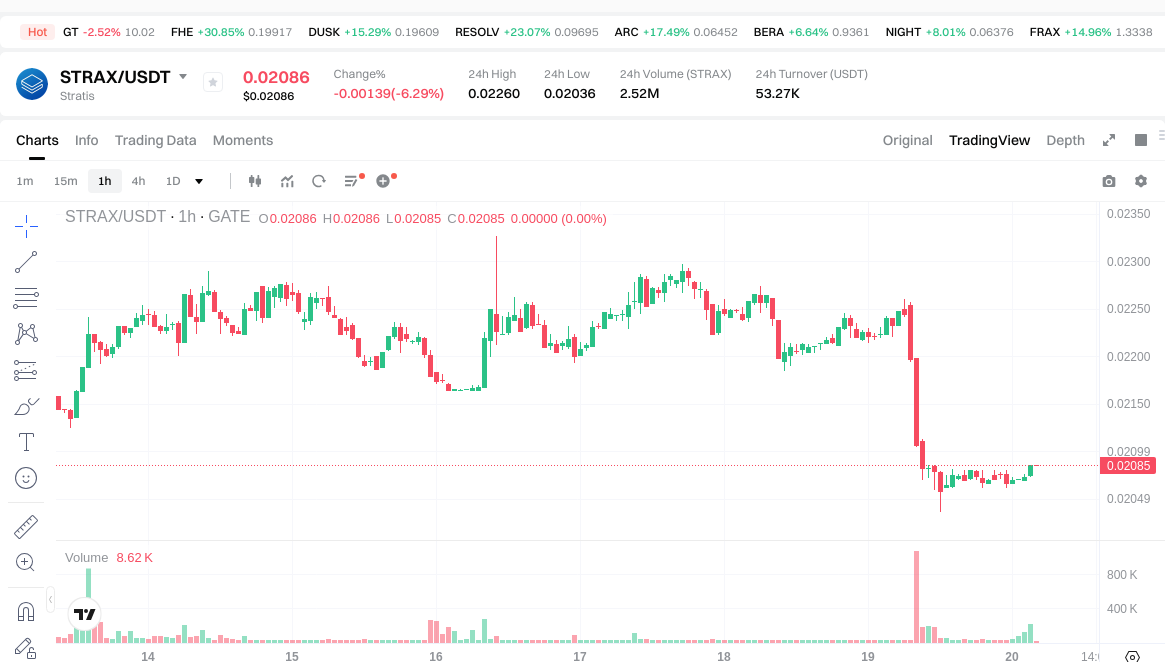
Current STRAX Investment Market Status (January 2026)
- STRAX current price: $0.02086 USD
- 24-hour price change: -6.54%
- 24-hour trading volume: $53,288.66
- Market capitalization: $42,762,023.76
- Circulating supply: 2,049,953,200.25 STRAX
- Market cap to fully diluted valuation ratio: 96.47%
Click to view real-time STRAX market price
II. Core Factors Influencing Whether STRAX is a Good Investment (Is Stratis(STRAX) a Good Investment)
Supply Mechanism and Scarcity (STRAX investment scarcity)
- Unlimited maximum supply mechanism → potential dilution effect on long-term price dynamics
- Current circulating supply represents approximately 96.47% of total supply → relatively mature distribution phase
- Investment significance: the unlimited supply model may present challenges for scarcity-driven value appreciation compared to fixed-supply assets
Institutional Investment and Mainstream Adoption (Institutional investment in STRAX)
- Holder base: approximately 90 recorded holders
- Exchange availability: trading accessible on 4 exchanges
- Market positioning: limited institutional presence as reflected in lower exchange coverage and holder concentration
Macroeconomic Environment's Impact on STRAX Investment
- Broader cryptocurrency market conditions influence STRAX's investment appeal
- Market capitalization represents approximately 0.0013% of total crypto market → positioning as a lower-cap asset with corresponding risk-return profile
- Economic uncertainty and risk appetite fluctuations may disproportionately affect smaller-cap digital assets
Technology and Ecosystem Development (Technology & Ecosystem for STRAX investment)
- Blockchain-as-a-Service (BaaS) platform architecture: enables customizable blockchain solutions with configurable parameters including cryptographic algorithms and issuance mechanisms
- Sidechain technology: provides businesses with flexible, tailored blockchain deployment options
- Developer-focused infrastructure: testing environments for decentralized applications and smart contract development support ecosystem expansion
- Platform utility: STRAX token functions as the native currency powering the Stratis platform and facilitating value transfer within its marketplace
III. STRAX Future Investment Prediction and Price Outlook (Is Stratis(STRAX) worth investing in 2026-2031)
Short-term Investment Prediction (2026, short-term STRAX investment outlook)
- Conservative Forecast: $0.0160545 - $0.02085
- Neutral Forecast: $0.02085 - $0.023352
- Optimistic Forecast: $0.02085 - $0.023352
Mid-term Investment Outlook (2027-2029, mid-term Stratis(STRAX) investment forecast)
- Market Phase Expectation: Based on available prediction models, STRAX may experience gradual growth during the mid-term period, with potential price movements influenced by market dynamics and platform development.
- Investment Return Prediction:
- 2027: $0.01458666 - $0.02563716
- 2028: $0.0231530076 - $0.0355649292
- 2029: $0.018721712898 - $0.041009466348
- Key Catalysts: Platform technological developments, market adoption trends, and broader cryptocurrency market conditions.
Long-term Investment Outlook (Is STRAX a good long-term investment?)
- Base Scenario: $0.02051067657492 - $0.04278951492354 (assuming steady platform development and moderate market growth)
- Optimistic Scenario: $0.035950265182868 - $0.041030193958708 (assuming increased adoption and favorable market conditions)
- Risk Scenario: Below $0.02 (under adverse market conditions or significant challenges)
Click to view STRAX long-term investment and price prediction: Price Prediction
2026-01-20 to 2031 Long-term Outlook
- Base Scenario: $0.02085 - $0.035363235474 (corresponding to steady progress and gradual mainstream application improvement)
- Optimistic Scenario: $0.035950265182868 - $0.041030193958708 (corresponding to large-scale adoption and favorable market environment)
- Transformative Scenario: Above $0.041030193958708 (such as breakthrough progress in ecosystem and mainstream popularization)
- 2031-12-31 Predicted High: $0.041030193958708 (based on optimistic development assumptions)
Disclaimer: The above predictions are based on analysis models and historical data, and actual market performance may differ significantly. Cryptocurrency investments involve substantial risk, and past performance does not guarantee future results. Investors should conduct their own research and consider their risk tolerance before making investment decisions.
| Year |
Predicted High Price |
Predicted Average Price |
Predicted Low Price |
Price Change |
| 2026 |
0.023352 |
0.02085 |
0.0160545 |
0 |
| 2027 |
0.02563716 |
0.022101 |
0.01458666 |
5 |
| 2028 |
0.0355649292 |
0.02386908 |
0.0231530076 |
14 |
| 2029 |
0.041009466348 |
0.0297170046 |
0.018721712898 |
42 |
| 2030 |
0.04278951492354 |
0.035363235474 |
0.02051067657492 |
69 |
| 2031 |
0.041030193958708 |
0.03907637519877 |
0.035950265182868 |
87 |
IV. Stratis Investment Strategy and Risk Management (How to invest in Stratis)
Investment Methodology (Stratis investment strategy)
Investors considering Stratis (STRAX) may adopt different approaches based on their risk tolerance and investment objectives:
-
Long-term Holding (HODL Stratis): This approach suits conservative investors who believe in the long-term potential of blockchain-as-a-service platforms. Given Stratis's focus on simplifying blockchain development and its customizable sidechain solutions, patient investors may benefit from holding STRAX over extended periods. However, investors should note that STRAX has experienced significant price fluctuations, with a 1-year decline of approximately 71.76%.
-
Active Trading: Experienced traders may utilize technical analysis and swing trading strategies to capitalize on STRAX's price volatility. With 24-hour price changes ranging from $0.02036 to $0.0226, short-term trading opportunities may present themselves. This approach requires continuous market monitoring and understanding of technical indicators.
Risk Management (Risk management for Stratis investment)
-
Asset Allocation Ratios:
- Conservative investors: Consider allocating 1-3% of crypto portfolio to STRAX
- Moderate investors: May allocate 3-7% depending on risk tolerance
- Aggressive investors: Could allocate higher percentages while maintaining diversification
-
Risk Hedging Solutions: Investors should consider diversifying across multiple blockchain platforms and asset classes. Given STRAX's market capitalization of approximately $42.76 million and market dominance of 0.0013%, combining it with more established cryptocurrencies may help balance portfolio risk.
-
Secure Storage:
- Cold wallets: Hardware wallets provide enhanced security for long-term STRAX holdings
- Hot wallets: Suitable for traders requiring frequent access, though with higher security considerations
- Hardware wallet options: Investors should research reputable hardware wallet providers supporting STRAX storage
V. Stratis Investment Risks and Challenges (Risks of investing in Stratis)
-
Market Risks: STRAX exhibits substantial price volatility, with historical price ranging from $0.0114071 to $22.77. Recent data shows a 24-hour decline of 6.54% and a 7-day decline of 3.16%. The relatively low 24-hour trading volume of approximately $53,288 may contribute to price instability and potential liquidity concerns.
-
Regulatory Risks: As with other cryptocurrencies, STRAX faces regulatory uncertainty across different jurisdictions. Changes in cryptocurrency regulations or blockchain-as-a-service platform oversight could impact STRAX's adoption and market value.
-
Technical Risks: While Stratis provides blockchain development tools and testing environments, the platform faces ongoing technical challenges common to blockchain projects, including potential network security vulnerabilities and the need for successful platform upgrades. The project's ability to maintain its development infrastructure and compete with other blockchain platforms represents an ongoing consideration.
-
Market Position: With a current ranking of 578 and limited exchange availability (4 exchanges), STRAX has relatively lower market visibility compared to leading cryptocurrencies, which may affect liquidity and adoption rates.
VI. Conclusion: Is Stratis a Good Investment?
-
Investment Value Summary: Stratis presents itself as a blockchain-as-a-service platform with customizable solutions for businesses and developers. While the project offers technical innovation in simplifying blockchain deployment, STRAX has experienced considerable price volatility, declining approximately 71.76% over the past year from its peak. The platform's market capitalization of approximately $42.76 million and limited exchange presence suggest a developing project with both opportunities and substantial risks.
-
Investor Recommendations:
✅ Beginners: Consider dollar-cost averaging (DCA) strategies with small allocations, combined with secure wallet storage practices. New investors should thoroughly research Stratis's technology and market position before investing.
✅ Experienced Investors: May explore swing trading opportunities given STRAX's price volatility, while maintaining diversified portfolio allocation. Technical analysis and market monitoring remain essential.
✅ Institutional Investors: Should conduct comprehensive due diligence on Stratis's technology roadmap, competitive positioning, and market adoption before considering strategic allocation.
⚠️ Disclaimer: Cryptocurrency investments carry high risk levels. STRAX's historical price performance, market volatility, and evolving competitive landscape require careful consideration. This content is for informational purposes only and does not constitute investment advice. Investors should conduct independent research and consult with financial advisors before making investment decisions.
VII. FAQ
Q1: What is Stratis (STRAX) and what makes it different from other blockchain platforms?
Stratis (STRAX) is a Blockchain-as-a-Service (BaaS) platform token designed to simplify blockchain deployment for enterprises and developers. The platform distinguishes itself through its customizable sidechain technology, which enables businesses to create tailored blockchain solutions with configurable parameters including cryptographic algorithms and issuance mechanisms. Unlike general-purpose blockchain platforms, Stratis focuses specifically on providing development-friendly infrastructure with testing environments for decentralized applications, making blockchain adoption more accessible for companies without requiring extensive technical expertise.
Q2: Is Stratis (STRAX) a good short-term investment in 2026?
Short-term investment in STRAX carries significant risk and volatility. As of January 2026, STRAX trades at approximately $0.02086 with a 24-hour decline of 6.54%. Short-term price forecasts suggest conservative movement between $0.0160545 - $0.02085, with optimistic scenarios reaching $0.023352. The limited trading volume of approximately $53,288 and availability on only 4 exchanges indicate potential liquidity challenges. Active traders with experience in technical analysis may find opportunities in STRAX's price volatility, but short-term investors should exercise caution and implement strict risk management strategies given the substantial price fluctuations and relatively low market liquidity.
Q3: What are the main risks of investing in Stratis (STRAX)?
STRAX investment involves multiple significant risks. Market risk remains substantial, with historical price ranging from $0.0114071 to $22.77 and a 71.76% decline over the past year. The platform's market capitalization of approximately $42.76 million and ranking at 578 suggest limited market presence compared to established cryptocurrencies. Liquidity concerns arise from low 24-hour trading volume and limited exchange availability. Additionally, STRAX faces regulatory uncertainty common to cryptocurrency projects, technical challenges in maintaining competitive blockchain infrastructure, and an unlimited supply mechanism that may present challenges for scarcity-driven value appreciation. The relatively small holder base of approximately 90 recorded holders indicates limited mainstream adoption.
Q4: How should investors approach long-term Stratis (STRAX) investment?
Long-term STRAX investment requires careful consideration of the platform's development trajectory and market positioning. Conservative investors should consider allocating only 1-3% of their crypto portfolio to STRAX, while moderate investors may allocate 3-7% based on risk tolerance. Long-term projections suggest potential growth, with base scenarios estimating prices between $0.02085 - $0.035363235474 by 2030, and optimistic scenarios reaching $0.035950265182868 - $0.041030193958708 by 2031. However, investors should recognize that these predictions depend on successful platform development, increased adoption, and favorable market conditions. The HODL strategy suits patient investors who believe in blockchain-as-a-service potential, but diversification across multiple blockchain platforms and asset classes remains essential for risk mitigation.
Q5: What factors could drive Stratis (STRAX) price growth in the future?
Several key factors could influence STRAX price appreciation. Platform technological developments, particularly successful implementation of sidechain solutions and developer tool enhancements, represent primary growth catalysts. Increased enterprise adoption of Stratis's blockchain-as-a-service offerings could expand the platform's user base and utility. Broader cryptocurrency market conditions and risk appetite for lower-cap digital assets will significantly impact STRAX performance. Enhanced exchange availability beyond the current 4 exchanges could improve liquidity and market access. Additionally, successful ecosystem expansion, including growth in decentralized application development and smart contract deployment on the platform, could strengthen STRAX's market position. However, investors should note that STRAX's unlimited supply mechanism and current limited mainstream adoption present ongoing challenges to value appreciation.
Q6: How does Stratis's market position compare to competing blockchain platforms?
Stratis occupies a niche position in the blockchain-as-a-service sector with a market capitalization of approximately $42.76 million and market dominance of 0.0013%. This positions STRAX as a lower-cap asset compared to established blockchain platforms. The platform's availability on only 4 exchanges and approximately 90 recorded holders indicate limited market penetration relative to major competitors. While Stratis offers specialized features like customizable sidechains and developer-friendly infrastructure, it faces intense competition from larger blockchain platforms with greater resources and market adoption. The platform's ranking at 578 suggests it operates outside the top-tier cryptocurrency ecosystem. Investors should assess whether Stratis's specialized focus on simplifying blockchain deployment can translate into competitive advantages that justify investment despite its current limited market presence.
Q7: What investment strategies work best for Stratis (STRAX)?
Investment strategies for STRAX should align with individual risk tolerance and market experience. Dollar-cost averaging (DCA) suits beginners, allowing systematic small allocations while minimizing timing risk and reducing exposure to STRAX's significant volatility. Long-term holders (HODL strategy) may benefit from patience if the blockchain-as-a-service platform achieves broader adoption, though they should prepare for extended periods of price stagnation or decline. Experienced traders can explore swing trading opportunities given STRAX's price volatility, with 24-hour price ranges between $0.02036 to $0.0226 creating potential entry and exit points. All strategies should incorporate secure storage practices using cold wallets for long-term holdings or reputable hot wallets for active trading. Regardless of approach, maintaining diversification across multiple blockchain platforms and limiting STRAX allocation to appropriate portfolio percentages remains essential for risk management.
Q8: What are the key technical features that support Stratis's investment value?
Stratis's technical infrastructure provides several features supporting its investment proposition. The Blockchain-as-a-Service architecture enables customizable blockchain solutions with configurable parameters, addressing enterprise needs for tailored deployment options. Sidechain technology offers businesses flexibility in creating independent blockchain networks while maintaining connection to the main Stratis platform. Developer-focused infrastructure includes testing environments for decentralized applications and smart contract development tools, potentially expanding the ecosystem. The STRAX token functions as the native currency powering platform operations and facilitating marketplace transactions. However, investors should balance these technical capabilities against market realities, including the platform's current limited adoption, competition from established blockchain providers, and the challenge of converting technological features into sustained demand and value appreciation. The platform's success depends on translating these technical offerings into meaningful commercial adoption.
* The information is not intended to be and does not constitute financial advice or any other recommendation of any sort offered or endorsed by Gate.