This comprehensive analysis examines whether Stratos (STOS) represents a viable investment opportunity for cryptocurrency investors. As a decentralized infrastructure token trading at $0.03685 (January 2026) with a $2.58 million market cap, STOS addresses Web 3.0 storage demands but faces significant challenges including a 99.3% decline from its $5.18 peak and limited liquidity across 2 exchanges. The article evaluates historical price trends, technological fundamentals, supply mechanics, and ecosystem positioning while providing forecasts ranging from conservative to optimistic scenarios through 2031. Key investment strategies vary by investor profile: conservative allocations (1-3%), active trading opportunities, and long-term HODL approaches, all requiring robust risk management. Critical risks include extreme volatility, regulatory uncertainty, technical dependencies, and liquidity constraints. The analysis concludes STOS suits risk-tolerant investors seeking exposure to decentralized storage infrastructu
Introduction: Stratos (STOS) Investment Position and Market Prospects
STOS is a cryptocurrency asset in the decentralized infrastructure sector. Launched in June 2021, Stratos has been developing its decentralized data grid for blockchain and Web 3.0 applications. As of January 31, 2026, STOS has a market capitalization of approximately $2.58 million, with a circulating supply of about 70.08 million tokens, and the current price is around $0.03685. With its positioning as a decentralized data storage solution provider, STOS has gradually become a subject of discussion among investors asking "Is Stratos (STOS) a good investment?" This article will comprehensively analyze the investment value, historical trends, future price predictions, and investment risks of STOS to provide reference for investors.
The project aims to address decentralized storage needs for NFT, DeFi, and DApp developers, as well as traditional enterprises requiring CDN services. Stratos features capabilities such as supporting various data types and sizes, scalable database infrastructure, and high-availability storage. The token ranks 1917 in the cryptocurrency market, with a market dominance of 0.00012%. With 6,217 holders and availability on 2 exchanges, STOS presents specific market characteristics that warrant detailed examination of its investment potential and associated risks.
I. Stratos (STOS) Historical Price Review and Current Investment Value
- 2021: STOS launched on exchanges in June 2021 with an initial trading price around $0.7108 → Early investors experienced significant volatility during the initial trading period
- 2021: November 2021 marked a notable price peak at approximately $5.18 → STOS witnessed substantial growth within its first six months of trading
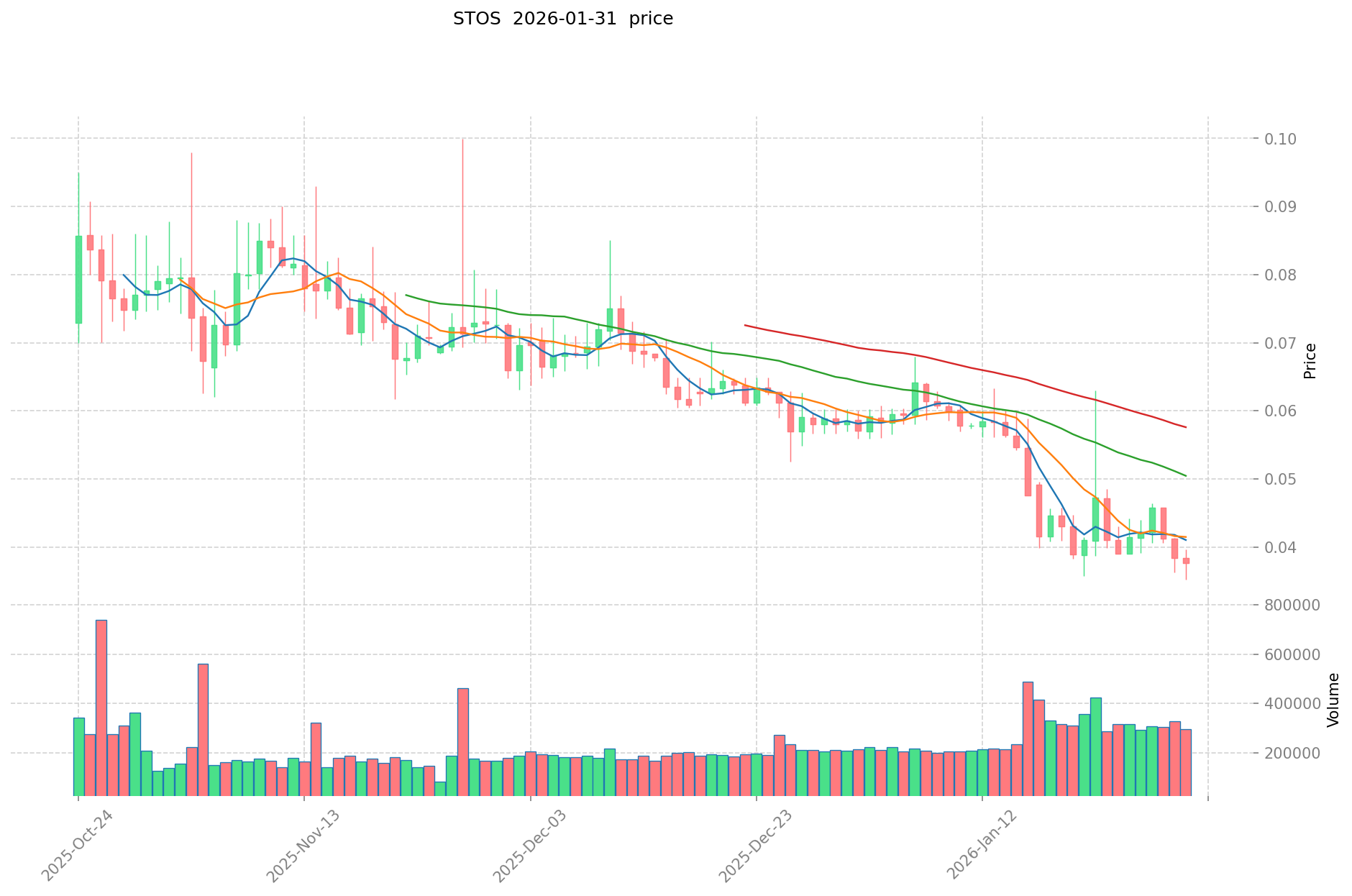
- 2025: Market correction phase → Price declined from approximately $0.0571 in early 2025 to around $0.0329 by October 2025
- 2026: Ongoing price stabilization → As of January 31, 2026, STOS trades at $0.03685, showing modest recovery from previous lows
Current STOS Investment Market Status (January 2026)
- Current STOS Price: $0.03685 (as of January 31, 2026)
- 24-Hour Price Change: -4.28% (-$0.001648)
- 24-Hour Trading Volume: Approximately $11,577.73
- 24-Hour Price Range: High $0.03913, Low $0.03521
- Market Capitalization: Approximately $2.58 million
- Circulating Supply: 70,084,080 STOS (70.08% of total supply)
- Fully Diluted Valuation: $3.685 million
- Market Cap to FDV Ratio: 70.08%
- Trading Activity: Available on 2 exchanges
- Token Holder Base: 6,217 holders
Click to view real-time STOS market price
II. Core Factors Influencing Whether STOS is a Good Investment
Supply Mechanism and Scarcity (STOS Investment Scarcity)
- Fixed maximum supply of 100,000,000 STOS tokens → influences price dynamics and investment valuation
- Current circulating supply represents approximately 70.08% of total supply, with 70,084,080 tokens in circulation
- Historical price volatility: STOS has experienced significant price fluctuations, with trading ranges between $0.03286932 and $5.18 during its market history
- Investment consideration: the defined supply cap and current circulation ratio may serve as factors in long-term value assessment
Institutional Investment and Mainstream Adoption (Institutional Investment in STOS)
- Current holder count stands at 6,217 addresses according to available data
- Trading availability limited to 2 exchanges, which may affect liquidity and institutional accessibility
- Market capitalization position at ranking 1917 with a market share of 0.00012%, indicating early-stage adoption levels
- Network activity and adoption metrics suggest STOS remains in development phase for broader institutional participation
Macroeconomic Environment's Impact on STOS Investment
- Cryptocurrency market conditions and monetary policy shifts → influence overall digital asset investment attractiveness
- Decentralized infrastructure positioning may offer differentiation during periods of centralized service concerns
- Market volatility patterns: recent performance shows -4.28% change over 24 hours, -10.67% over 7 days, and -35.53% over 30 days
- Broader market sentiment and regulatory developments continue to shape investment environment for decentralized storage solutions
Technology and Ecosystem Development (Technology & Ecosystem for STOS Investment)
- Decentralized data grid infrastructure: designed to support scalable, self-balancing storage solutions for blockchain and Web 3.0 applications
- Technical capabilities include support for various data types and sizes, rapid data upload and retrieval mechanisms, and adaptive database architecture
- Ecosystem positioning targets NFT, DeFi, and DApp developers, alongside enterprises requiring CDN services and edge computing solutions
- Platform integration features domain-specific language support for blockchain smart contracts and computing applications
- Community-driven growth model with focus on providing alternatives to centralized cloud services
III. STOS Future Investment Forecast and Price Outlook (Is Stratos(STOS) worth investing in 2026-2031)
Short-term Investment Forecast (2026, short-term STOS investment outlook)
- Conservative Forecast: $0.0307 - $0.0369
- Neutral Forecast: $0.0369 - $0.0450
- Optimistic Forecast: $0.0450 - $0.0532
Mid-term Investment Outlook (2027-2029, mid-term Stratos(STOS) investment forecast)
-
Market Phase Expectation: STOS may experience gradual recovery with price consolidation in the mid-term period, driven by potential adoption in decentralized storage infrastructure and Web 3.0 applications.
-
Investment Return Forecast:
- 2027: $0.0365 - $0.0658
- 2028: $0.0349 - $0.0637
- 2029: $0.0524 - $0.0661
-
Key Catalysts: Growth in decentralized storage demand, expansion of Web 3.0 ecosystem partnerships, technical upgrades to the Stratos data grid infrastructure, and increased adoption by DeFi, NFT, and DApp projects.
Long-term Investment Outlook (Is Stratos a good long-term investment?)
- Base Scenario: $0.0396 - $0.0628 (assuming steady development of decentralized storage market and moderate ecosystem expansion)
- Optimistic Scenario: $0.0628 - $0.0886 (assuming accelerated adoption of Web 3.0 infrastructure and favorable market conditions)
- Risk Scenario: Below $0.0329 (under extreme market downturns or project development setbacks)
Click to view STOS long-term investment and price forecast: Price Prediction
2026-01-31 - 2031 Long-term Outlook
- Base Scenario: $0.0396 - $0.0757 (corresponding to steady progress and mainstream application growth)
- Optimistic Scenario: $0.0757 - $0.1098 (corresponding to large-scale adoption and favorable market environment)
- Transformational Scenario: Above $0.1098 (such as breakthrough progress in ecosystem development and mainstream popularization)
- 2031-12-31 Forecast High: $0.1098 (based on optimistic development assumptions)
Disclaimer: This forecast is based on available market data and technical analysis models. Cryptocurrency markets are highly volatile and subject to numerous unpredictable factors. Historical performance does not guarantee future results. This analysis does not constitute investment advice, and investors should conduct their own due diligence and risk assessment before making any investment decisions.
| Year |
Predicted High Price |
Predicted Average Price |
Predicted Low Price |
Price Change |
| 2026 |
0.0531936 |
0.03694 |
0.0306602 |
0 |
| 2027 |
0.065797528 |
0.0450668 |
0.036504108 |
22 |
| 2028 |
0.0637469886 |
0.055432164 |
0.03492226332 |
50 |
| 2029 |
0.066144429693 |
0.0595895763 |
0.052438827144 |
61 |
| 2030 |
0.088642474225065 |
0.0628670029965 |
0.039606211887795 |
70 |
| 2031 |
0.109844370985634 |
0.075754738610782 |
0.052270769641439 |
105 |
IV. Stratos Investment Strategy and Risk Management (How to invest in Stratos)
Investment Methodology (Stratos investment strategy)
Long-term Holding (HODL Stratos)
Long-term holding may be suitable for investors who believe in the potential of decentralized infrastructure development. This approach involves purchasing STOS tokens and holding them through market cycles, based on the premise that the demand for decentralized data storage solutions could grow as Web 3.0 adoption expands. However, investors should note that STOS has experienced substantial price volatility, with a 1-year decline of approximately 85.42% as of January 31, 2026.
Active Trading
Active trading strategies rely on technical analysis and short-term price movements. Given STOS's price fluctuations (24-hour range between $0.03521 and $0.03913), traders may identify opportunities in intraday or swing trading patterns. However, the relatively low 24-hour trading volume of approximately $11,577 may present liquidity considerations for larger position sizes.
Risk Management (Risk management for Stratos investment)
Asset Allocation Ratios
- Conservative Investors: May consider allocating a minimal portion (1-3%) of their cryptocurrency portfolio to infrastructure tokens like STOS, given the sector's developmental stage and price volatility
- Aggressive Investors: Could allocate a moderate portion (5-10%) while maintaining diversification across multiple blockchain sectors
- Professional Investors: May take larger positions based on comprehensive due diligence of technical roadmaps and competitive positioning
Risk Hedging Approaches
Investors can consider:
- Multi-asset Portfolio Construction: Combining STOS with established cryptocurrencies and stablecoins to balance risk exposure
- Position Sizing: Limiting individual token exposure relative to total portfolio value
- Stop-loss Mechanisms: Setting predetermined exit points to manage downside risk
Secure Storage Solutions
- Cold Wallets: Hardware wallets (such as Ledger or Trezor devices) provide enhanced security for long-term holdings by keeping private keys offline
- Hot Wallets: Exchange wallets or software wallets may be used for active trading portions, though they carry higher security risks
- Custody Considerations: Since STOS is an ERC-20 token (contract address: 0x08c32b0726c5684024ea6e141c50ade9690bbdcc on Ethereum), it is compatible with Ethereum-supporting wallet infrastructure
V. Stratos Investment Risks and Challenges (Risks of investing in Stratos)
Market Risks
High Volatility: STOS has demonstrated significant price fluctuations, with a 30-day decline of approximately 35.53% and a distance from its historical peak of $5.18 (recorded on November 26, 2021) to the current price of $0.03685, representing a substantial drawdown. The relatively small market capitalization of approximately $2.58 million may contribute to price sensitivity.
Liquidity Considerations: With a 24-hour trading volume of approximately $11,577 and availability on 2 exchanges, liquidity constraints may affect the ability to execute large trades without significant price impact.
Regulatory Risks
Decentralized storage networks operate in an evolving regulatory environment. Different jurisdictions may develop varying approaches to classifying and regulating such infrastructure projects. Changes in cryptocurrency regulations, data storage laws, or cross-border data transfer rules could affect project operations and token utility.
Technical Risks
Network Security: Decentralized infrastructure projects face ongoing challenges in maintaining network security, preventing unauthorized access, and ensuring data integrity across distributed nodes.
Technology Development: The success of Stratos depends on continued development and adoption of its decentralized data grid technology. Delays in technical milestones, competition from alternative solutions, or challenges in achieving network effects could affect the project's long-term viability.
Smart Contract Risks: As an ERC-20 token operating on Ethereum, STOS is subject to smart contract vulnerabilities and potential exploits, though the specific security audit status is not provided in available materials.
VI. Conclusion: Is Stratos a Good Investment?
Investment Value Summary
Stratos represents an infrastructure-focused cryptocurrency project targeting the decentralized storage sector. While the concept of decentralized data grids addresses potential demand in the Web 3.0 ecosystem, the token has experienced substantial price volatility and a significant decline over the past year. The relatively small market capitalization and limited exchange availability present both opportunities and risks for different investor profiles.
Investor Recommendations
✅ Newcomers: Consider starting with small allocations through dollar-cost averaging strategies, and prioritize secure storage in hardware wallets. Thoroughly research the project's technical fundamentals and competitive positioning before investing.
✅ Experienced Investors: May explore tactical trading opportunities based on technical analysis while maintaining diversified portfolio allocations across multiple blockchain sectors and market capitalizations.
✅ Institutional Investors: Should conduct comprehensive due diligence on technology development progress, team credentials, competitive landscape analysis, and tokenomics before considering strategic positions.
⚠️ Important Notice: Cryptocurrency investments carry substantial risk, including the potential loss of principal. STOS has experienced significant price declines and exhibits high volatility. This content is provided for informational purposes only and does not constitute investment advice. Investors should conduct independent research and consider their own risk tolerance and financial circumstances before making investment decisions.
VII. FAQ
Q1: What is Stratos (STOS) and what problem does it solve?
Stratos is a decentralized infrastructure cryptocurrency that provides a decentralized data grid for blockchain and Web 3.0 applications. It addresses the need for scalable, self-balancing storage solutions by offering an alternative to centralized cloud services. The platform supports various data types and sizes, provides rapid data upload and retrieval mechanisms, and targets NFT, DeFi, and DApp developers, as well as traditional enterprises requiring CDN services and edge computing solutions.
Q2: What are the current market metrics for STOS as of January 31, 2026?
As of January 31, 2026, STOS trades at approximately $0.03685, with a market capitalization of $2.58 million and a 24-hour trading volume of around $11,577.73. The token has a circulating supply of 70,084,080 STOS (70.08% of the total 100 million supply), ranks 1917 in the cryptocurrency market, and is available on 2 exchanges with 6,217 token holders. The 24-hour price change shows a decline of 4.28%.
Q3: How has STOS performed historically since its launch?
STOS launched on exchanges in June 2021 with an initial trading price around $0.7108 and reached a historical peak of approximately $5.18 in November 2021. However, the token has experienced substantial volatility, declining to around $0.0571 in early 2025 and further correcting to approximately $0.0329 by October 2025. As of January 31, 2026, the current price of $0.03685 represents approximately a 99.3% decline from its all-time high and an 85.42% decline over the past year.
Q4: What are the price predictions for STOS in the coming years?
Based on technical analysis models, short-term forecasts for 2026 range from $0.0307 to $0.0532 depending on market scenarios. Mid-term projections suggest potential recovery phases: 2027 ($0.0365 - $0.0658), 2028 ($0.0349 - $0.0637), and 2029 ($0.0524 - $0.0661). Long-term forecasts through 2031 estimate a base scenario range of $0.0396 - $0.0757, with optimistic scenarios reaching up to $0.1098. These predictions assume varying levels of Web 3.0 adoption and decentralized storage market growth.
Q5: What are the main investment risks associated with STOS?
The primary risks include high price volatility, with STOS demonstrating significant fluctuations and a 35.53% decline over 30 days. Liquidity constraints exist due to limited exchange availability (2 exchanges) and relatively low trading volume ($11,577.73 per 24 hours). Additional concerns include regulatory uncertainty surrounding decentralized storage networks, technical risks related to network security and development progress, and smart contract vulnerabilities as an ERC-20 token on Ethereum.
Q6: What investment strategy is recommended for different types of investors?
Conservative investors may consider allocating 1-3% of their cryptocurrency portfolio to STOS, while aggressive investors could allocate 5-10% with proper diversification. Long-term holding (HODL) strategies suit those believing in Web 3.0 infrastructure growth, while active trading may exploit short-term price movements. Regardless of strategy, risk management through asset allocation, position sizing, stop-loss mechanisms, and secure storage (preferably cold wallets for long-term holdings) is essential.
Q7: What factors could positively influence STOS's future value?
Key catalysts include growth in decentralized storage demand driven by Web 3.0 adoption, expansion of ecosystem partnerships with DeFi, NFT, and DApp projects, successful technical upgrades to the Stratos data grid infrastructure, and increased mainstream adoption of decentralized alternatives to centralized cloud services. Additionally, broader cryptocurrency market recovery and favorable regulatory developments for decentralized infrastructure projects could support price appreciation.
Q8: How does STOS compare to other decentralized storage solutions in terms of market position?
With a market capitalization of approximately $2.58 million and a ranking of 1917 in the cryptocurrency market, STOS represents a relatively small-cap infrastructure project with a market dominance of 0.00012%. The limited exchange availability and holder base of 6,217 addresses suggest STOS is in an early adoption phase compared to more established decentralized storage competitors. This positioning presents both higher risk due to lower liquidity and potential upside opportunities if the project achieves broader adoption.
* The information is not intended to be and does not constitute financial advice or any other recommendation of any sort offered or endorsed by Gate.