This comprehensive analysis examines whether Streamr (DATA) represents a viable investment opportunity in the decentralized data streaming sector. As of January 31, 2026, DATA trades at $0.003691 with a $2.83 million market cap, offering exposure to peer-to-peer data infrastructure and machine-to-machine transactions. The article evaluates historical performance patterns, current market positioning across 20 exchanges including Gate, and detailed tokenomics revealing 38.36% circulating supply. Key sections address short-term price ranges ($0.00253-$0.00429 for 2026), mid-term forecasts through 2028, and long-term scenarios reaching $0.00848 by 2031. Investment strategies accommodate different risk profiles from conservative to aggressive allocations, while dedicated risk analysis covers market volatility, regulatory considerations, and technical challenges. The conclusion provides tailored recommendations for beginners, experienced investors, and institutional participants evaluating DATA's potential within d
Introduction: Streamr (DATA) Investment Position and Market Outlook
Streamr (DATA) represents a notable asset in the cryptocurrency sector, having launched in 2017 with a focus on decentralized peer-to-peer data streaming networks. As of January 31, 2026, DATA holds a market capitalization of approximately $2.83 million, with a circulating supply of 767.12 million tokens and a current trading price around $0.003691. The project has positioned itself within the data economy infrastructure space, enabling tokenized streaming data exchange across decentralized networks. With a maximum supply capped at 2 billion tokens and approximately 38.36% currently in circulation, DATA has attracted attention from investors examining opportunities in blockchain-based data solutions. The token is deployed on the Ethereum network and is available across 20 exchanges, with a holder base of 5,142 addresses. This analysis examines DATA's investment characteristics, historical performance patterns, future price considerations, and associated risk factors to provide a comprehensive reference for market participants evaluating "Is Streamr (DATA) a good investment?" The project's infrastructure combines blockchain technology with practical data streaming applications, creating a unique positioning within the broader cryptocurrency ecosystem.
I. Streamr (DATA) Historical Price Review and Current Investment Value Status
- 2021: DATA experienced notable growth during the broader cryptocurrency market expansion, with the token price reaching elevated levels during Q4 2021, reflecting increased investor interest in decentralized data streaming solutions.
- 2021-2022: Following the market cycle peak in December 2021, DATA underwent a significant correction phase, declining from higher valuation levels as part of the broader market downturn affecting most digital assets.
- 2024-2026: The token entered a period of substantial volatility, with prices adjusting to reflect changing market dynamics and evolving project fundamentals, experiencing fluctuations between different price ranges during this period.
Current DATA Investment Market Status (January 2026)
- DATA current price: $0.003691
- Market sentiment (Fear & Greed Index): Data indicates a relatively cautious market environment, with investor sentiment reflecting ongoing market uncertainty.
- 24-hour trading volume: $42,487.63, suggesting moderate trading activity within the current market context.
- Market capitalization: Approximately $2.83 million (circulating), representing a relatively modest market presence compared to larger digital asset projects.
Click to view real-time DATA market price
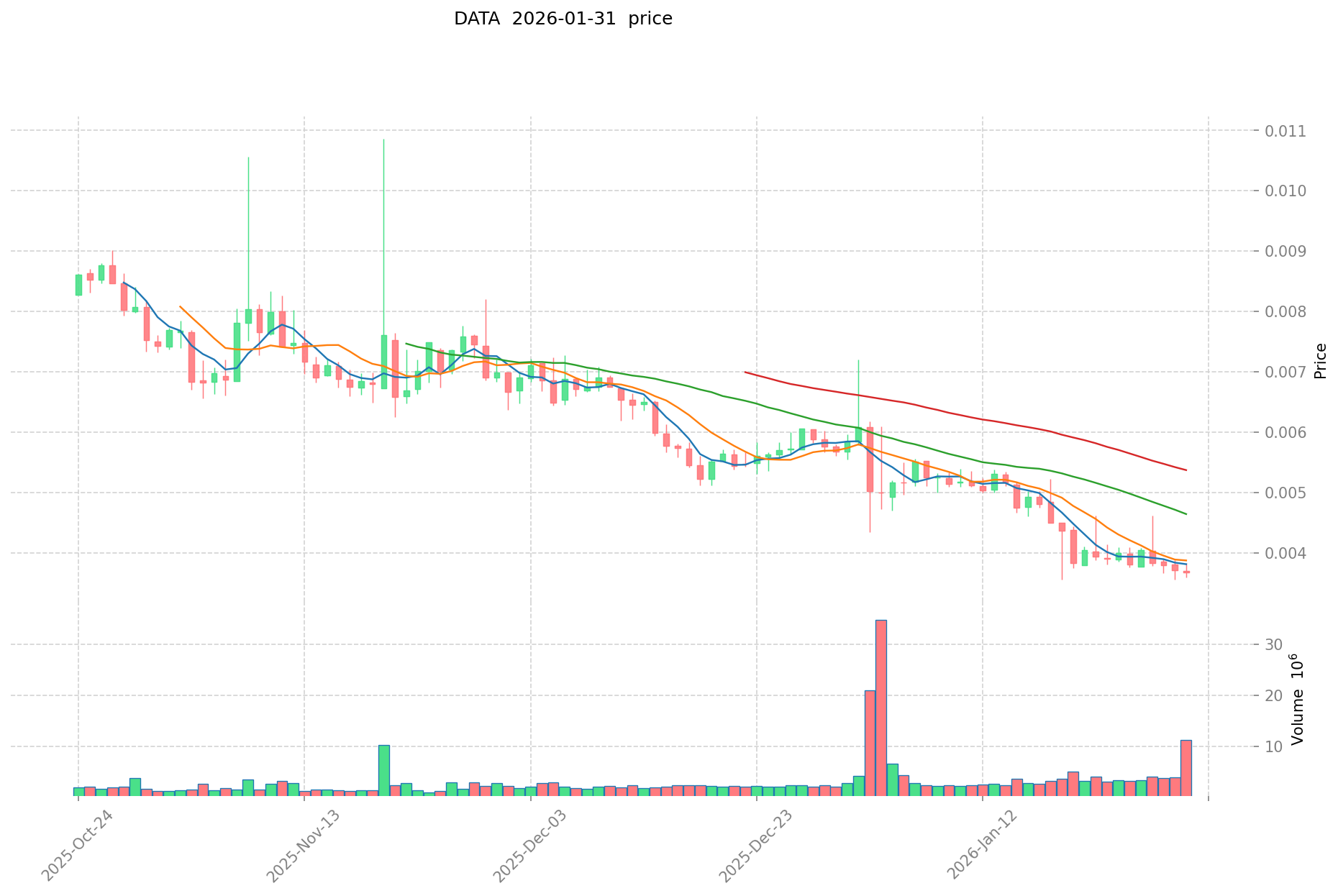
II. Core Factors Influencing Whether DATA is a Good Investment (Is Streamr(DATA) a Good Investment)
Supply Mechanism and Scarcity (DATA investment scarcity)
- Supply structure and tokenomics → Influence price and investment value
- Total supply: 1,000,541,714 DATA; Maximum supply: 2,000,000,000 DATA; Circulating supply: 767,121,867 DATA (38.36% of total supply)
- Market cap to fully diluted valuation ratio stands at 38.36%, indicating substantial uncirculated tokens that may affect future supply dynamics
- Investment significance: The relationship between circulating supply and maximum supply represents a key consideration for long-term investment evaluation
Institutional Investment and Mainstream Adoption (Institutional investment in DATA)
- Current holder count: 5,142 addresses, reflecting the scale of network participation
- Trading availability: Listed on 20 exchanges, providing liquidity across multiple platforms
- Decentralized P2P network structure allows participants to control, monetize, and trade data streams, potentially attracting institutional interest in data economy applications
Macroeconomic Environment's Impact on DATA Investment
- Monetary policy and interest rate changes → Alter investment attractiveness across crypto assets
- Market uncertainty and risk sentiment influence capital flows into alternative digital assets
- Regulatory developments in data privacy and decentralized networks may shape the investment environment for data-focused blockchain projects
Technology and Ecosystem Development (Technology & Ecosystem for DATA investment)
- Decentralized P2P network infrastructure: Data sources connect with network nodes to publish data, delivered instantly to subscribers through horizontal scalability via sharding
- Smart contract integration on Ethereum blockchain: Enables key operations including revenue models and access control mechanisms
- Dual ecosystem approach: (1) Data marketplace facilitating data stream trading with credit rating systems for reliability assessment; (2) Visual programming environment and real-time analytics engine for application development
- Use case expansion: Network designed to support machine-to-machine data transactions, exemplified by autonomous vehicle scenarios where vehicles can purchase traffic data, energy pricing information, and weather forecasts while monetizing their own generated data
- Decentralized architecture eliminates central control points, allowing broad participation in data ownership and monetization
III. DATA Future Investment Prediction and Price Outlook (Is Streamr(DATA) worth investing in 2026-2031)
Short-term DATA Investment Outlook (2026)
- Conservative Prediction: $0.00253 - $0.00305
- Neutral Prediction: $0.00305 - $0.00367
- Optimistic Prediction: $0.00367 - $0.00429
Mid-term Streamr(DATA) Investment Forecast (2027-2028)
- Market Stage Expectation: During this period, DATA may experience gradual recovery, with price fluctuations reflecting broader market sentiment and potential adoption of decentralized data streaming solutions.
- Investment Return Prediction:
- 2027: $0.00302 - $0.00497
- 2028: $0.00344 - $0.00604
- Key Catalysts: Market adoption of decentralized P2P data networks, integration with IoT and smart city applications, and expansion of the data marketplace ecosystem.
Long-term Investment Outlook (Is Streamr a good long-term investment?)
- Base Scenario: $0.00373 - $0.00559 (assuming steady progress in decentralized data infrastructure and moderate ecosystem growth)
- Optimistic Scenario: $0.00559 - $0.00688 (assuming increased adoption of real-time data trading and broader integration with autonomous systems)
- Risk Scenario: $0.00252 - $0.00373 (assuming limited market traction or unfavorable macroeconomic conditions)
Click to view DATA long-term investment and price prediction: Price Prediction
2026-01-31 to 2031 Long-term Outlook
- Base Scenario: $0.00373 - $0.00559 (corresponding to steady progress and gradual mainstream application enhancement)
- Optimistic Scenario: $0.00559 - $0.00688 (corresponding to large-scale adoption and favorable market environment)
- Transformative Scenario: Above $0.00848 (in case of breakthrough ecosystem developments and mainstream proliferation)
- 2031-12-31 Predicted High: $0.00848 (based on optimistic development assumptions)
Disclaimer: Price predictions are based on historical data analysis and modeling techniques. Cryptocurrency markets are highly volatile and unpredictable. These projections should not be considered as financial advice. Investors should conduct their own research and consider their risk tolerance before making any investment decisions.
| Year |
Predicted High Price |
Predicted Average Price |
Predicted Low Price |
Price Change |
| 2026 |
0.00428571 |
0.003663 |
0.00252747 |
-1 |
| 2027 |
0.00496794375 |
0.003974355 |
0.0030205098 |
7 |
| 2028 |
0.00603605165625 |
0.004471149375 |
0.00344278501875 |
20 |
| 2029 |
0.005936568582656 |
0.005253600515625 |
0.004728240464062 |
41 |
| 2030 |
0.006881953995442 |
0.00559508454914 |
0.003748706647924 |
50 |
| 2031 |
0.008484386210316 |
0.006238519272291 |
0.003618341177929 |
68 |
IV. Streamr (DATA) Investment Strategy and Risk Management (How to invest in DATA)
Investment Methodology (DATA investment strategy)
Long-term Holding (HODL DATA)
For conservative investors seeking to participate in the decentralized data economy, a long-term holding strategy may be appropriate. This approach involves acquiring DATA tokens and maintaining positions through market cycles, with the expectation that the underlying technology and network adoption will drive value over time. Given DATA's focus on decentralized peer-to-peer data streaming networks, long-term holders should monitor network growth metrics, partnership developments, and ecosystem expansion.
Active Trading
Active traders may employ technical analysis and swing trading strategies to capitalize on DATA's price movements. With a 24-hour trading volume of approximately $42,487 and price volatility evidenced by recent performance (-0.70% in 1H, +0.46% in 24H, -4.8% in 7D), short-term trading opportunities may present themselves. Traders should utilize support and resistance levels, volume indicators, and market sentiment analysis when executing trades.
Risk Management (Risk management for DATA investment)
Asset Allocation Guidelines
- Conservative investors: Consider allocating 1-3% of crypto portfolio to DATA, maintaining majority holdings in established assets
- Moderate investors: May allocate 3-7% of crypto portfolio, balancing between growth potential and stability
- Aggressive investors: Could allocate 7-15% of crypto portfolio, accepting higher volatility for potential returns
Risk Hedging Strategies
Implementing a diversified portfolio approach can help mitigate concentration risk. Investors might consider:
- Combining DATA holdings with established cryptocurrencies and stablecoins
- Utilizing stop-loss orders to limit downside exposure
- Regular portfolio rebalancing based on market conditions and personal risk tolerance
Secure Storage Solutions
Given that DATA is an ERC-20 token on the Ethereum blockchain (contract address: 0x8f693ca8d21b157107184d29d398a8d082b38b76), investors should prioritize security:
- Hot wallets: Suitable for active trading amounts, such as MetaMask or Trust Wallet
- Cold storage: Recommended for long-term holdings, including hardware wallets like Ledger or Trezor
- Multi-signature wallets: For institutional or high-value holdings requiring enhanced security
V. Streamr (DATA) Investment Risks and Challenges (Risks of investing in DATA)
Market Risks
DATA exhibits significant price volatility, with a 30-day decline of -36.65% and a 1-year decline of -88.75%. The token's current price of $0.003691 represents a substantial decrease from its all-time high of $0.209972 (reached on December 3, 2021). With a market capitalization of approximately $2.83 million and relatively modest 24-hour trading volume, the asset may be susceptible to:
- Sharp price fluctuations due to limited liquidity
- Potential impact from large buy or sell orders
- Market sentiment shifts affecting low-cap digital assets
Regulatory Risks
The regulatory landscape for cryptocurrencies continues to evolve across jurisdictions. DATA investors should be aware of:
- Varying legal frameworks for data-related tokens in different countries
- Potential classification changes that could affect trading or holding capabilities
- Compliance requirements that may impact network operations or token utility
Technical Risks
As a decentralized network combining peer-to-peer architecture with Ethereum smart contracts, DATA faces several technical considerations:
- Network security vulnerabilities that could affect data transmission or token operations
- Smart contract risks associated with the Ethereum platform
- Dependency on Ethereum network performance and gas fee fluctuations
- Technology adoption challenges in a competitive data streaming market
- Network upgrade implementations that may encounter technical difficulties
Project-Specific Risks
With a circulating supply of 767,121,867 DATA (38.36% of maximum supply) and approximately 5,142 holders, investors should consider:
- Relatively concentrated holder base compared to major cryptocurrencies
- Token unlock schedules that may affect future supply dynamics
- Competition from other decentralized data networks and traditional data infrastructure providers
VI. Conclusion: Is DATA a Good Investment?
Investment Value Summary
Streamr (DATA) presents a specialized investment opportunity in the decentralized data economy sector. The project's focus on peer-to-peer data streaming networks and tokenized data markets addresses emerging needs in machine-to-machine data exchange. However, the token has experienced substantial price declines, with current valuation significantly below historical peaks. The relatively modest market capitalization and trading volume indicate an early-stage project with corresponding risk-reward dynamics.
Investor Recommendations
✅ For Beginners: Consider dollar-cost averaging into small positions, allocating only funds you can afford to lose. Prioritize learning about the technology and storing tokens securely in hardware wallets. Avoid making DATA a significant portion of your initial crypto investments.
✅ For Experienced Investors: Evaluate DATA within a diversified portfolio strategy, utilizing technical analysis for entry and exit points. Monitor network development, partnership announcements, and adoption metrics. Consider position sizing based on overall portfolio risk tolerance and market conditions.
✅ For Institutional Investors: Assess DATA as a potential strategic allocation within thematic data economy or infrastructure investments. Conduct thorough due diligence on network metrics, tokenomics, and competitive positioning before establishing positions.
⚠️ Important Notice: Cryptocurrency investments carry substantial risk, including the possibility of total loss. This analysis is provided for informational purposes only and does not constitute investment advice. Investors should conduct independent research and consult with financial advisors before making investment decisions.
VII. FAQ
Q1: What is Streamr (DATA) and what makes it different from other cryptocurrency projects?
Streamr (DATA) is a decentralized peer-to-peer network designed for real-time data streaming and tokenized data exchange. Unlike traditional cryptocurrencies focused primarily on payments or store of value, DATA specifically targets the data economy infrastructure sector. The platform enables data sources to connect with network nodes and publish data that gets instantly delivered to subscribers through horizontal scalability via sharding. What distinguishes Streamr is its dual ecosystem approach: a data marketplace that facilitates data stream trading with credit rating systems, and a visual programming environment with real-time analytics engine for application development. The network particularly focuses on machine-to-machine data transactions, exemplified by autonomous vehicle scenarios where vehicles can both purchase traffic data and monetize their own generated data.
Q2: How has DATA performed historically, and what is its current market position?
Historically, DATA experienced significant volatility typical of smaller-cap digital assets. The token reached its all-time high of $0.209972 on December 3, 2021, during the broader cryptocurrency market expansion. Since then, it has undergone substantial correction, with the current price of $0.003691 representing an approximately 98% decline from its peak. The 1-year performance shows a decline of -88.75%, while the 30-day decline stands at -36.65%. As of January 31, 2026, DATA holds a market capitalization of approximately $2.83 million with a circulating supply of 767.12 million tokens (38.36% of maximum supply). The token is listed on 20 exchanges with a 24-hour trading volume of $42,487.63, indicating moderate liquidity. With 5,142 holder addresses, DATA represents a relatively small-scale project within the cryptocurrency ecosystem.
Q3: What are the main risks associated with investing in DATA?
Investing in DATA involves several significant risk categories. Market risks include extreme price volatility, with recent performance showing a -36.65% decline over 30 days and limited liquidity that could amplify price swings during large transactions. Technical risks encompass potential network security vulnerabilities, smart contract risks on the Ethereum platform, dependency on Ethereum network performance and gas fees, and technology adoption challenges in a competitive market. Regulatory risks involve the evolving legal landscape for data-related tokens across different jurisdictions. Project-specific risks include a relatively concentrated holder base of approximately 5,142 addresses, substantial uncirculated token supply (61.64% of maximum supply not yet in circulation), and competition from both other decentralized data networks and traditional data infrastructure providers. The token's significant decline from its all-time high suggests high volatility that may result in substantial or total capital loss.
Q4: What is the price outlook for DATA in the coming years?
Price predictions for DATA vary based on different scenarios and timeframes. For 2026, conservative estimates range from $0.00253 to $0.00305, neutral predictions suggest $0.00305 to $0.00367, and optimistic scenarios project $0.00367 to $0.00429. Mid-term forecasts for 2027-2028 indicate potential ranges of $0.00302 to $0.00497 (2027) and $0.00344 to $0.00604 (2028), contingent on market adoption of decentralized data streaming solutions and IoT integration. Long-term outlook through 2031 presents a base scenario of $0.00373 to $0.00559, an optimistic scenario of $0.00559 to $0.00688, and a transformative scenario exceeding $0.00848, with the predicted 2031 high reaching $0.00848. However, it is crucial to note that these projections are based on modeling techniques and historical data analysis. Cryptocurrency markets remain highly volatile and unpredictable, and these forecasts should not be considered as financial advice or guarantees of future performance.
Q5: What investment strategies are suitable for DATA holders?
Investment strategies for DATA should be aligned with individual risk tolerance and investment goals. For long-term holding (HODL), conservative investors may acquire tokens and maintain positions through market cycles, monitoring network growth metrics, partnership developments, and ecosystem expansion. This approach is suitable for those believing in the long-term potential of decentralized data economy infrastructure. For active trading, traders can employ technical analysis and swing trading strategies to capitalize on price movements, utilizing support and resistance levels, volume indicators, and market sentiment analysis given the token's volatility (-0.70% in 1H, +0.46% in 24H, -4.8% in 7D). Recommended asset allocation varies by risk profile: conservative investors might allocate 1-3% of their crypto portfolio to DATA, moderate investors 3-7%, and aggressive investors 7-15%. Risk management should include portfolio diversification, stop-loss orders, regular rebalancing, and secure storage solutions such as hardware wallets (Ledger or Trezor) for long-term holdings or MetaMask for active trading amounts.
Q6: How does DATA's tokenomics affect its investment potential?
DATA's tokenomics structure significantly impacts its investment characteristics. The token has a maximum supply of 2,000,000,000 DATA, with a total supply of 1,000,541,714 DATA and a circulating supply of 767,121,867 DATA. This means only 38.36% of the maximum supply is currently in circulation, indicating substantial uncirculated tokens that could affect future supply dynamics and price pressure. The market capitalization to fully diluted valuation ratio of 38.36% suggests that if all tokens were released, the market cap would need to increase significantly to maintain current price levels. This supply structure presents both opportunities and risks: potential for scarcity-driven value appreciation as adoption increases, but also risk of dilution as more tokens enter circulation. The relationship between circulating supply and maximum supply represents a key consideration for long-term investment evaluation, particularly regarding token unlock schedules that may introduce additional supply to the market over time.
Q7: What are the key technological advantages of the Streamr network?
The Streamr network offers several technological advantages that differentiate it within the blockchain ecosystem. Its decentralized P2P architecture eliminates central control points, allowing broad participation in data ownership and monetization while providing horizontal scalability through sharding technology. The platform integrates smart contracts on the Ethereum blockchain to enable revenue models and access control mechanisms, creating a trustless environment for data transactions. The network's dual ecosystem includes a data marketplace with credit rating systems for reliability assessment and a visual programming environment with real-time analytics engine for simplified application development. A particularly innovative feature is the support for machine-to-machine data transactions, enabling autonomous systems to both purchase necessary data (traffic information, energy pricing, weather forecasts) and monetize their own generated data. This architecture positions Streamr to potentially capitalize on the growing Internet of Things (IoT) and smart city applications, where real-time data streaming and automated transactions become increasingly critical.
Q8: Is DATA suitable for institutional investors?
Institutional investment in DATA requires careful evaluation of several factors. The project offers potential strategic value within thematic data economy or infrastructure investment portfolios, particularly for institutions interested in emerging decentralized data solutions. The token's availability on 20 exchanges provides multiple entry points, though the relatively modest 24-hour trading volume of $42,487.63 may present liquidity challenges for large position sizes. The current market capitalization of approximately $2.83 million indicates an early-stage project with corresponding risk-reward characteristics that may not align with conservative institutional mandates. Institutions considering DATA should conduct thorough due diligence on network metrics including adoption rates, active nodes, data stream volumes, tokenomics including the 61.64% uncirculated supply, competitive positioning against both decentralized alternatives and traditional data infrastructure providers, and regulatory considerations across operational jurisdictions. Security implementation through multi-signature wallets and robust custody solutions would be essential. The high volatility (30-day decline of -36.65%, 1-year decline of -88.75%) suggests DATA is more appropriate as a small strategic allocation within a diversified portfolio rather than a core holding for institutional investors.
* The information is not intended to be and does not constitute financial advice or any other recommendation of any sort offered or endorsed by Gate.












