This comprehensive analysis evaluates Subsquid (SQD), an emerging blockchain indexing protocol serving the Web3 data infrastructure sector. Trading at $0.06944 with a $11.21 million market cap as of January 2026, SQD presents a volatile investment opportunity since its May 2024 launch, ranging from $0.02288 to $0.50. The article examines core investment factors including SQD's fixed supply mechanism (12.07% circulating), growing holder base of 16,621 across 18 exchanges, and role as a hyper-scalable data access layer operating on Arbitrum. Price forecasts suggest potential appreciation to $0.130-$0.167 by 2031 under optimistic scenarios, though substantial risks including market volatility, regulatory uncertainty, and technical challenges require careful risk management. The analysis provides tailored investment strategies for beginners through institutional investors, emphasizing dollar-cost averaging, portfolio allocation between 1-15%, and secure cold storage practices for this emerging infrastructure toke
Introduction: Subsquid (SQD) Investment Position and Market Outlook
SQD is a notable asset in the cryptocurrency space, having launched in 2024 as an indexing protocol serving the blockchain data infrastructure sector. As of January 26, 2026, Subsquid maintains a market capitalization of approximately $11.21 million with a circulating supply of 161.4 million tokens, and the current price stands at around $0.06944. Positioned as a hyper-scalable data access layer that powers decentralized applications, SQD has gradually become a focal point when investors consider "Is Subsquid (SQD) a good investment?" This article comprehensively analyzes SQD's investment value, historical performance, future price projections, and investment risks to provide reference for investors.
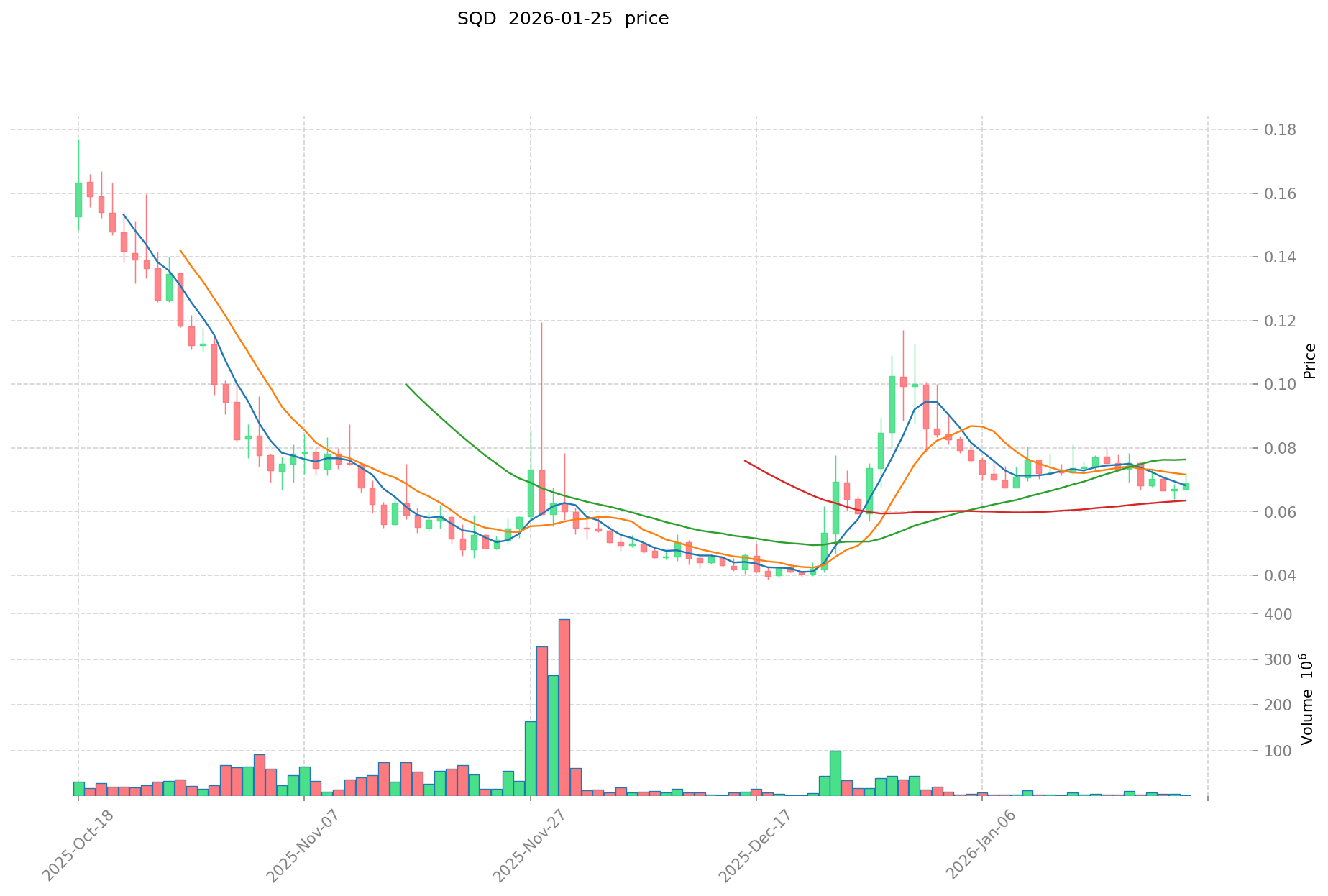
With an initial launch price of $0.176, SQD has experienced notable volatility, recording a price of $0.50 in May 2024 and $0.02288 in November 2024. Recent performance shows mixed momentum, with a 2.03% increase over 24 hours and a 13.69% gain over 30 days, while experiencing an 8.12% decline over the past week and a 9.84% decrease over the past year. The token is currently available on 18 exchanges and has attracted 16,621 holders. With a fully diluted market cap of approximately $92.84 million and a circulating supply ratio of 12.07%, SQD's market dynamics reflect the characteristics of emerging blockchain infrastructure projects in a competitive landscape.
I. Token (SQD) Price History Review and Investment Value Status
- 2024: Token Launch and Early Trading → The token was published on May 17, 2024, with an initial offering price of $0.176, experiencing significant volatility in its early trading period
- 2024: Market Adjustment Phase → SQD price experienced a decline from its early levels, reaching lower price points during market corrections in the latter half of the year
- 2024-2025: Price Discovery Period → The token traded within a range, with notable price movements as the market assessed the project's fundamentals and adoption metrics
Current SQD Investment Market Status (January 2026)
- SQD current price: $0.06944
- Market sentiment (Fear & Greed Index): Data not available in provided materials
- 24-hour trading volume: $192,905.18
- Institutional investor holdings: Data not available in provided materials
Click to view real-time SQD market price
II. Core Factors Affecting Whether SQD is a Good Investment (Is Subsquid(SQD) a Good Investment)
Supply Mechanism and Scarcity (SQD investment scarcity)
- Fixed Supply Model → Influences Price and Investment Value
- SQD has a maximum supply of 1,337,000,000 tokens with a current circulating supply of 161,400,000 tokens, representing approximately 12.07% of the total supply. This limited circulation relative to maximum supply may contribute to potential scarcity dynamics.
- Historical Pattern: SQD experienced price fluctuations with a recorded high of $0.50 in May 2024 and a low of $0.02288 in November 2024, demonstrating significant volatility in response to market conditions and supply dynamics.
- Investment Significance: The controlled token release schedule and relatively low circulating supply percentage could be factors in long-term investment considerations, though supply expansion plans may affect future scarcity.
Institutional Investment and Mainstream Adoption (Institutional investment in SQD)
- Holder Base: As of the latest data, SQD has approximately 16,621 token holders, indicating a growing but still developing community base.
- Exchange Presence: SQD is listed on 18 cryptocurrency exchanges, providing accessibility for investors across multiple platforms.
- Market Position: With a market capitalization of approximately $11.21 million and a market dominance of 0.0029%, SQD represents a smaller-cap project within the broader cryptocurrency ecosystem.
Macroeconomic Environment's Impact on SQD Investment
- Monetary Policy and Interest Rate Changes → Alter Investment Attractiveness
- As a data infrastructure token in the blockchain ecosystem, SQD's investment appeal may be influenced by broader liquidity conditions and risk appetite in cryptocurrency markets during varying macroeconomic cycles.
- Market Sentiment: Current market emotion indicators suggest neutral to cautious positioning, which may reflect broader uncertainty in crypto markets and their correlation with traditional financial market conditions.
Technology and Ecosystem Development (Technology & Ecosystem for SQD investment)
- Core Technology: Subsquid Network functions as a hyper-scalable data access layer and indexing protocol, providing infrastructure that blockchain applications utilize to deliver enhanced user experiences.
- Ecosystem Positioning: The protocol serves as foundational infrastructure for decentralized applications (dApps), potentially benefiting from growth in blockchain application development and data indexing requirements.
- Technical Infrastructure: SQD operates on the Arbitrum network, leveraging Layer 2 scaling solutions which may provide technical advantages in terms of transaction efficiency and cost-effectiveness.
- Long-term Value Proposition: The project's focus on solving data accessibility challenges for blockchain applications positions it within the growing infrastructure sector, though competitive dynamics and adoption rates remain important factors for investment consideration.
III. SQD Future Investment Forecast and Price Outlook (Is Subsquid(SQD) worth investing in 2026-2031)
Short-term Investment Forecast (2026, short-term SQD investment outlook)
- Conservative forecast: $0.066082 - $0.06956
- Neutral forecast: $0.06956 - $0.081733
- Optimistic forecast: $0.081733 - $0.093906
Mid-term Investment Outlook (2027-2029, mid-term Subsquid(SQD) investment forecast)
- Market stage expectation: The token may experience gradual growth as the indexing protocol continues to mature and expand its user base within the blockchain data access sector.
- Investment return forecast:
- 2027: $0.06375174 - $0.10952222
- 2028: $0.0870211251 - $0.1377037584
- 2029: $0.109665743148 - $0.136498850514
- Key catalysts: Expansion of dApp integrations, improvements in protocol scalability, and broader adoption of blockchain indexing solutions.
Long-term Investment Outlook (Is SQD a good long-term investment?)
- Base scenario: $0.06455695635207 - $0.126582267357 (assuming steady development and moderate market conditions)
- Optimistic scenario: $0.130430368284652 - $0.167291124539011 (assuming accelerated adoption and favorable market trends)
- Risk scenario: Below $0.06455695635207 (under challenging market conditions or slower-than-expected ecosystem growth)
View SQD long-term investment and price forecast: Price Prediction
2026-01-26 - 2031 Long-term Outlook
- Base scenario: $0.06455695635207 - $0.126582267357 (corresponding to steady progress and gradual mainstream application improvement)
- Optimistic scenario: $0.130430368284652 - $0.167291124539011 (corresponding to large-scale adoption and favorable market environment)
- Transformative scenario: Above $0.167291124539011 (if the ecosystem achieves breakthrough progress and mainstream penetration)
- 2031-12-31 forecast high: $0.167291124539011 (based on optimistic development assumptions)
Disclaimer: This forecast is for informational purposes only and should not be considered investment advice. Cryptocurrency markets are highly volatile and unpredictable.
| Year |
Predicted High Price |
Predicted Average Price |
Predicted Low Price |
Price Change |
| 2026 |
0.093906 |
0.06956 |
0.066082 |
0 |
| 2027 |
0.10952222 |
0.081733 |
0.06375174 |
17 |
| 2028 |
0.1377037584 |
0.09562761 |
0.0870211251 |
37 |
| 2029 |
0.136498850514 |
0.1166656842 |
0.109665743148 |
68 |
| 2030 |
0.15696201152268 |
0.126582267357 |
0.06455695635207 |
82 |
| 2031 |
0.167291124539011 |
0.14177213943984 |
0.130430368284652 |
104 |
IV. Subsquid (SQD) Investment Strategy and Risk Management (How to invest in blockchain indexing protocols)
Investment Methodology (SQD investment strategy)
-
Long-term Holding (HODL SQD): Suitable for conservative investors who believe in the long-term growth potential of blockchain data infrastructure. This approach focuses on accumulating SQD tokens during market corrections and holding through volatility cycles, with the expectation that increasing demand for efficient blockchain data access will drive token value appreciation over time.
-
Active Trading: Relies on technical analysis and swing trading strategies. Traders may monitor price movements between support levels (such as the 24-hour low of $0.06716) and resistance levels (such as the 24-hour high of $0.07098) to capitalize on short-term price fluctuations. This method requires close attention to market dynamics and technical indicators.
Risk Management (Risk management for SQD investment)
V. Subsquid (SQD) Investment Risks and Challenges (Risks of investing in blockchain indexing protocols)
-
Market Risks: SQD exhibits considerable volatility, with recent price changes showing fluctuations from -8.12% over 7 days to +13.69% over 30 days. The token's relatively low market capitalization of approximately $11.2 million makes it susceptible to significant price swings from large transactions. Trading volume of approximately $192,905 over 24 hours indicates moderate liquidity, which may result in slippage during larger trades.
-
Regulatory Risks: Blockchain infrastructure tokens face evolving regulatory frameworks across different jurisdictions. Changes in data privacy regulations, cross-border data transfer rules, or classification of utility tokens versus securities could impact the project's operational model and token utility. Policy uncertainty in major markets may affect adoption rates and token demand.
-
Technical Risks: As an indexing protocol, SQD faces technical challenges including potential network vulnerabilities, smart contract bugs, or protocol upgrade complications. The project's ability to maintain scalability while ensuring data accuracy and security remains critical. Competition from alternative indexing solutions or changes in blockchain architectures could affect the protocol's market position. With only 12.07% of total supply currently circulating (161.4 million out of 1.337 billion tokens), future token releases could create selling pressure.
VI. Conclusion: Is blockchain indexing infrastructure a Good Investment?
-
Investment Value Summary: Subsquid (SQD) represents an emerging infrastructure project in the blockchain data access sector, with potential tied to the growing demand for efficient blockchain indexing solutions. The token has experienced notable price movements, with a historical range from $0.02288 to $0.5. Current trading at $0.06944 reflects both recovery from lows and correction from historical peaks. The low circulating supply ratio of 12.07% suggests potential for future token distribution dynamics to influence price action.
-
Investor Recommendations:
✅ Beginners: Consider dollar-cost averaging (DCA) strategy with small, regular purchases to build positions gradually. Prioritize secure storage using hardware wallets and allocate only a minor portion of overall crypto portfolio to infrastructure tokens like SQD.
✅ Experienced Investors: Implement swing trading strategies during volatility periods while maintaining core holdings. Combine SQD with other blockchain infrastructure projects for diversified exposure to the data access sector.
✅ Institutional Investors: Evaluate strategic long-term allocation as part of broader blockchain infrastructure investment thesis. Consider the project's role in the expanding blockchain ecosystem and potential network effects from increased adoption.
⚠️ Disclaimer: Cryptocurrency investments carry substantial risks, including the possibility of complete loss of capital. This content is provided for informational purposes only and does not constitute financial, investment, or trading advice. Conduct thorough independent research and consult with qualified financial advisors before making investment decisions.
VII. FAQ
Q1: What is Subsquid (SQD) and what makes it different from other blockchain infrastructure projects?
Subsquid (SQD) is a hyper-scalable data access layer and indexing protocol that provides blockchain infrastructure for decentralized applications. Unlike general blockchain platforms, Subsquid specifically focuses on solving data accessibility and indexing challenges, enabling dApps to deliver enhanced user experiences through efficient blockchain data retrieval. Operating on the Arbitrum network, it leverages Layer 2 scaling solutions for improved transaction efficiency and cost-effectiveness, positioning itself within the specialized niche of blockchain data infrastructure.
Q2: How volatile has SQD's price been since its launch, and what does this mean for investors?
SQD exhibits significant volatility, having traded between $0.02288 (November 2024 low) and $0.50 (May 2024 high) since its May 2024 launch at $0.176. Recent performance shows mixed patterns: +13.69% over 30 days but -8.12% over 7 days and -9.84% over the past year. This volatility is typical for smaller-cap infrastructure tokens with a market capitalization of approximately $11.2 million. Investors should implement proper risk management, with conservative portfolios allocating only 1-3% to SQD, while understanding that such price fluctuations are characteristic of emerging blockchain projects.
Q3: Is SQD suitable for long-term investment, and what are the projected returns?
Long-term investment suitability depends on individual risk tolerance and belief in blockchain data infrastructure growth. Price forecasts suggest moderate appreciation potential, with 2031 projections ranging from $0.130430368284652 (optimistic scenario) to $0.06455695635207 (base scenario), representing potential returns of 88-104% from current levels of $0.06944. However, these projections assume continued protocol development, ecosystem expansion, and favorable market conditions. The low circulating supply ratio of 12.07% means future token releases could impact prices, making this more suitable for experienced investors who understand infrastructure token dynamics.
Q4: What are the main risks associated with investing in SQD?
Three primary risk categories affect SQD investments: Market risks include high volatility and relatively low liquidity (24-hour volume of approximately $192,905), making the token susceptible to significant price swings. Regulatory risks involve evolving frameworks for blockchain infrastructure and utility tokens, particularly regarding data privacy and cross-border data transfer regulations. Technical risks encompass potential smart contract vulnerabilities, protocol upgrade complications, competition from alternative indexing solutions, and the impact of future token releases from the remaining 87.93% of total supply not yet in circulation.
Q5: How should beginners approach investing in SQD?
Beginners should adopt a cautious, education-first approach when considering SQD investment. Start with dollar-cost averaging (DCA), making small, regular purchases rather than lump-sum investments to mitigate timing risk. Allocate only 1-3% of your overall crypto portfolio to SQD, ensuring this represents funds you can afford to lose entirely. Prioritize security by using hardware wallets (Ledger or Trezor) for storage, keeping 80%+ of holdings in cold storage. Before investing, thoroughly research blockchain indexing protocols, understand the project's technology and use cases, and consider consulting with financial advisors experienced in cryptocurrency investments.
Q6: What factors could drive SQD's price growth in the coming years?
Several catalysts could positively influence SQD's price trajectory: Increased adoption of the Subsquid protocol by decentralized applications requiring efficient blockchain data access could drive demand for the token. Expansion of integrations with major blockchain ecosystems and improvements in protocol scalability may enhance utility and network effects. Broader growth in the blockchain infrastructure sector, particularly as Web3 applications proliferate, could benefit specialized data indexing solutions. Additionally, favorable developments such as strategic partnerships, protocol upgrades enhancing performance, or successful expansion to additional blockchain networks could serve as positive catalysts.
Q7: How does SQD compare to other cryptocurrency investment options in terms of risk-reward?
SQD represents a higher-risk, potentially higher-reward investment compared to established cryptocurrencies like Bitcoin or Ethereum. With a market capitalization of only $11.21 million and market dominance of 0.0029%, SQD is significantly smaller and more volatile than major cryptocurrencies. This positioning offers potentially greater upside if the protocol achieves widespread adoption, but also carries substantially higher downside risk, including the possibility of total loss. The token occupies a specialized niche in blockchain infrastructure rather than competing as a general-purpose cryptocurrency, making it more suitable as a complementary holding within a diversified crypto portfolio rather than a core position.
Q8: Where can I buy SQD and what security measures should I take?
SQD is available on 18 cryptocurrency exchanges, providing multiple purchase options for investors. When buying SQD, implement robust security practices: Use reputable exchanges with strong security track records and enable two-factor authentication (2FA) on all accounts. For storage, utilize hardware wallets like Ledger or Trezor for long-term holdings (80%+ of your SQD), keeping only trading amounts in exchange hot wallets. Verify wallet addresses carefully before transactions to prevent sending to incorrect addresses. Consider diversifying exchange exposure rather than keeping all holdings on a single platform, and maintain secure backups of all wallet recovery phrases in offline, protected locations.
* The information is not intended to be and does not constitute financial advice or any other recommendation of any sort offered or endorsed by Gate.