Succinct (PROVE) is a decentralized proof generation infrastructure token for zero-knowledge proof services across blockchain applications. Trading at $0.4135 with $80.63 million market cap, PROVE powers a network processing proofs for 35+ protocols including Polygon and Celestia, securing over $4 billion in value. This analysis examines whether PROVE represents a sound investment by evaluating its technology fundamentals, market adoption potential, and associated risks. With only 19.5% circulating supply, PROVE offers scarcity dynamics and exposure to growing ZK-proof infrastructure adoption. Short-term forecasts suggest $0.399-$0.465 range, while long-term projections through 2031 indicate $0.361-$0.893 under various scenarios. Investment suitability depends on risk tolerance, with conservative allocations recommended at 1-3% of crypto portfolios. The token's success hinges on zero-knowledge proof adoption rates, ecosystem expansion, and competitive positioning within the rapidly evolving blockchain infrast
Introduction: Succinct (PROVE) Investment Position and Market Outlook
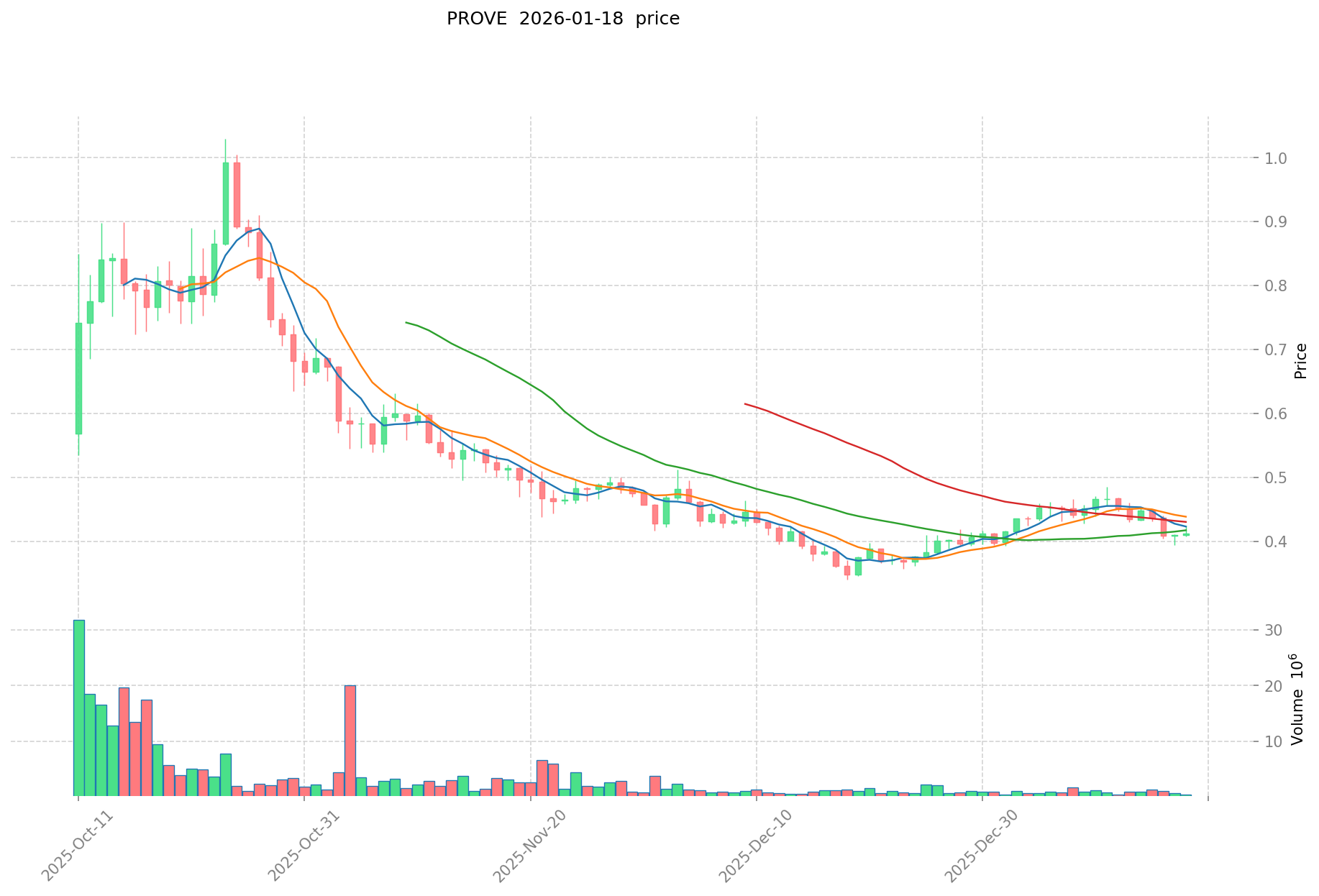
Succinct (PROVE) represents a notable asset in the cryptocurrency sector, focusing on decentralized proof generation infrastructure for blockchain applications. As of January 18, 2026, PROVE maintains a market capitalization of approximately $80.63 million with a circulating supply of 195 million tokens, trading at around $0.4135. The project positions itself within the zero-knowledge proof infrastructure space, providing proof generation services for rollups, coprocessors, and other blockchain applications. With a ranking of 416 in the cryptocurrency market and trading volume reaching $171,038 over the past 24 hours, PROVE has attracted attention from investors evaluating "Is Succinct (PROVE) a good investment?" This analysis examines PROVE's investment characteristics, historical performance, price projections, and associated risks to provide reference information for market participants.
I. Succinct (PROVE) Historical Price Review and Current Investment Value
- 2025 Q3: PROVE reached $1.8 during August 2025 → investors experienced notable price appreciation from the launch price
- 2025 Q4: Market correction phase → PROVE declined to $0.3403 in December 2025
- 2026 Q1: Price recovery observed → trading at $0.4135 as of January 18, 2026, representing an 18.9% gain over the past 30 days
Current PROVE Investment Market Status (January 2026)
- PROVE current price: $0.4135
- Market sentiment (Fear & Greed Index): data not available in provided materials
- 24-hour trading volume: $171,038.31
- Institutional investor holdings: data not available in provided materials
Click to view real-time PROVE market price
II. Core Factors Influencing Whether PROVE is a Good Investment
Supply Mechanism and Scarcity (PROVE Investment Scarcity)
- Supply Structure → Impacts price and investment value
- Total Supply: 1,000,000,000 PROVE
- Circulating Supply: 195,000,000 PROVE (19.5% of total supply)
- Max Supply: 1,000,000,000 PROVE (fixed cap)
- Scarcity Analysis: With only 19.5% of tokens currently in circulation, PROVE maintains a relatively controlled supply structure. The fixed maximum supply of 1 billion tokens provides a clear ceiling on potential dilution.
- Historical Performance: PROVE has experienced price fluctuations between $0.3403 and $1.8 since its launch in August 2025, demonstrating typical volatility patterns for infrastructure tokens in early circulation phases.
- Investment Significance: The controlled release schedule and fixed maximum supply contribute to scarcity dynamics that may support long-term value retention, though investors should note that 80.5% of tokens remain to be distributed.
Institutional Investment and Mainstream Adoption (Institutional Investment in PROVE)
- Network Adoption Metrics: Succinct's Prover Network, operational since August 2025, processes proofs for over 35 protocols including established platforms such as Polygon and Celestia, securing more than $4 billion in value.
- Enterprise Integration Potential: The reference materials suggest that large-scale financial institutions, supply chain networks, and government registries could potentially integrate Succinct's proof systems for verifiable data exchange between blockchain environments.
- Market Position: PROVE is listed on 39 exchanges and has 8,386 holders as of January 18, 2026, indicating growing but still developing mainstream adoption.
- Investment Value Enhancement: The integration with major blockchain protocols demonstrates practical utility beyond speculative trading, which may attract institutional interest in zero-knowledge proof infrastructure.
Macroeconomic Environment's Impact on PROVE Investment
- Market Sentiment Dependency: According to available analyses, PROVE's growth trajectory depends significantly on broader market sentiment toward cryptocurrency infrastructure projects.
- Zero-Knowledge Infrastructure Adoption: The token's performance correlates with the overall adoption rate of ZK (zero-knowledge) infrastructure in the blockchain industry, which serves as a macro-level factor affecting investment attractiveness.
- Sector-Specific Dynamics: As an infrastructure token focused on proof generation, PROVE's investment profile relates more directly to blockchain scalability trends rather than traditional macroeconomic indicators like inflation or interest rates.
Technology and Ecosystem Development (Technology & Ecosystem for PROVE Investment)
- Core Technology: Succinct operates a decentralized prover network enabling blockchain applications secured by cryptographic verification rather than trust-based systems.
- Zero-Knowledge Proof Integration: The platform unifies the proof supply chain, providing proof generation infrastructure for rollups, coprocessors, and various applications utilizing zero-knowledge proofs.
- Network Performance: The Prover Network demonstrates functional deployment by processing proofs for 35+ protocols, indicating operational maturity in its early phase.
- Ecosystem Expansion: Succinct's technology addresses critical blockchain infrastructure needs including:
- Cross-chain interoperability verification
- Scalability solutions for rollups
- Trustless data exchange between blockchain networks
- Long-Term Value Support: The platform's focus on becoming a standard verification provider across DeFi and enterprise applications suggests potential for sustained ecosystem growth, though actual adoption rates will determine investment outcomes.
- Developer Community Growth: The project's ability to build its developer community and integrate verification systems with leading blockchain networks represents a key factor in long-term investment value.
III. PROVE Future Investment Forecast and Price Outlook (Is Succinct(PROVE) worth investing in 2026-2031)
Short-term Investment Forecast (2026, short-term PROVE investment outlook)
- Conservative forecast: $0.399 - $0.416
- Neutral forecast: $0.416 - $0.440
- Optimistic forecast: $0.440 - $0.465
Mid-term Investment Outlook (2027-2029, mid-term Succinct(PROVE) investment forecast)
- Market stage expectations: PROVE may experience gradual growth during the mid-term period, with technical indicators suggesting potential consolidation phases followed by upward momentum as the decentralized prover network gains traction.
- Investment return forecast:
- 2027: $0.264 - $0.555
- 2028: $0.378 - $0.533
- 2029: $0.376 - $0.742
- Key catalysts: Adoption of zero-knowledge proof technology, expansion of rollup and coprocessor applications, development of the decentralized prover network infrastructure.
Long-term Investment Outlook (Is Succinct a good long-term investment?)
- Base scenario: $0.361 - $0.657 (assuming steady ecosystem development and moderate market conditions)
- Optimistic scenario: $0.597 - $0.893 (assuming accelerated adoption of ZK-proof infrastructure and favorable market environment)
- Risk scenario: Below $0.361 (under adverse market conditions or significant competitive pressure)
Click to view PROVE long-term investment and price prediction: Price Prediction
2026-01-18 - 2031 Long-term Outlook
- Base scenario: $0.361 - $0.657 (corresponding to steady progress and gradual mainstream application growth)
- Optimistic scenario: $0.597 - $0.893 (corresponding to large-scale adoption and favorable market conditions)
- Transformative scenario: Above $0.893 (if the ecosystem achieves breakthrough developments and mainstream adoption)
- 2031-12-31 forecast high: $0.893 (based on optimistic development assumptions)
Disclaimer: The forecasts presented are based on historical data analysis and market trends. Cryptocurrency markets are highly volatile and subject to numerous external factors. These projections should not be construed as financial advice, and investors should conduct their own research and risk assessment before making investment decisions.
| Year |
Predicted High Price |
Predicted Average Price |
Predicted Low Price |
Price Change |
| 2026 |
0.465472 |
0.4156 |
0.398976 |
0 |
| 2027 |
0.55507536 |
0.440536 |
0.2643216 |
6 |
| 2028 |
0.5326520776 |
0.49780568 |
0.3783323168 |
20 |
| 2029 |
0.741929585472 |
0.5152288788 |
0.376117081524 |
24 |
| 2030 |
0.68515136302824 |
0.628579232136 |
0.5971502705292 |
52 |
| 2031 |
0.893336804711683 |
0.65686529758212 |
0.361275913670166 |
58 |
IV. PROVE Investment Strategy and Risk Management (How to invest in Succinct)
Investment Strategy (PROVE investment strategy)
Long-term Holding (HODL PROVE): Suitable for Conservative Investors
Long-term holding strategies focus on the fundamental value proposition of Succinct's decentralized prover network infrastructure. Investors adopting this approach may consider accumulating positions during market corrections while maintaining conviction in the project's technological advancement in zero-knowledge proof generation. This strategy typically involves dollar-cost averaging to mitigate entry timing risks and requires patience through market cycles.
Active Trading: Relying on Technical Analysis and Swing Operations
Active traders may leverage PROVE's price volatility for short to medium-term opportunities. Key technical indicators to monitor include support levels around recent lows and resistance near previous highs. Given the 24-hour trading volume and price fluctuations, swing traders should establish clear entry and exit points, set stop-loss orders, and maintain disciplined position sizing to manage exposure.
Risk Management (Risk management for PROVE investment)
Asset Allocation Ratio: Conservative / Aggressive / Professional Investors
- Conservative investors: Allocate 1-3% of crypto portfolio to PROVE, focusing on established positions with limited exposure to newer projects
- Aggressive investors: May allocate 5-10% of crypto portfolio, accepting higher volatility for potential growth in the zero-knowledge proof infrastructure sector
- Professional investors: Can consider 10-15% allocation with active monitoring and rebalancing strategies based on project developments and market conditions
Risk Hedging Solutions: Multi-asset Portfolio + Risk Management Tools
Diversification across multiple blockchain infrastructure projects and different crypto sectors can help mitigate concentration risk. Investors may consider pairing PROVE holdings with more established cryptocurrencies to balance portfolio volatility. Position sizing should account for PROVE's current circulating supply ratio and market capitalization dynamics.
Secure Storage: Hot and Cold Wallets + Hardware Wallet Recommendations
Given that PROVE operates on the Ethereum network as an ERC-20 token, investors should prioritize secure storage solutions. Hardware wallets compatible with Ethereum and ERC-20 tokens provide enhanced security for long-term holdings. For active traders, a combination approach using hardware wallets for core holdings and secure software wallets for trading positions offers balanced accessibility and security.
V. PROVE Investment Risks and Challenges (Risks of investing in Succinct)
Market Risk: High Volatility and Price Manipulation
PROVE exhibits significant price volatility, with observable fluctuations across different timeframes. The relatively limited circulating supply compared to maximum supply may contribute to price sensitivity during periods of concentrated buying or selling. Market depth considerations are important, as lower liquidity assets can experience amplified price movements during market stress periods.
Regulatory Risk: Policy Uncertainty Across Different Jurisdictions
As a blockchain infrastructure project utilizing zero-knowledge proof technology, Succinct operates in an evolving regulatory landscape. Different jurisdictions maintain varying approaches to cryptocurrency regulation, which may impact project operations and token accessibility. Investors should monitor regulatory developments in key markets and understand how policy changes might affect the broader crypto infrastructure sector.
Technical Risk: Network Security Vulnerabilities and Upgrade Failures
As a decentralized prover network project, Succinct faces inherent technical risks associated with protocol development and network operations. Potential challenges include smart contract vulnerabilities, network congestion issues, and the successful implementation of technical upgrades. The project's reliance on zero-knowledge proof technology requires continuous innovation and maintenance to remain competitive in the evolving blockchain infrastructure landscape.
VI. Conclusion: Is Succinct a Good Investment?
Investment Value Summary
PROVE represents exposure to the growing zero-knowledge proof infrastructure sector, with the project positioning itself as a decentralized prover network for blockchain applications. The investment case centers on the increasing adoption of zero-knowledge proofs in rollups, coprocessors, and other blockchain applications. However, investors should recognize that the project operates in a competitive and rapidly evolving sector with significant price volatility.
Investor Recommendations
✅ Beginners: Consider dollar-cost averaging strategies with secure wallet storage. Start with small allocations while developing understanding of zero-knowledge proof technology and blockchain infrastructure fundamentals. Prioritize learning about secure storage practices before making significant commitments.
✅ Experienced Investors: May employ swing trading strategies combined with portfolio diversification across multiple blockchain infrastructure projects. Monitor technical developments, trading volumes, and market sentiment indicators while maintaining strict risk management protocols.
✅ Institutional Investors: Can evaluate strategic long-term allocation as part of broader blockchain infrastructure exposure. Conduct thorough due diligence on project technology, team capabilities, competitive positioning, and market dynamics before establishing positions.
⚠️ Disclaimer: Cryptocurrency investments carry substantial risk and high volatility. This content is for informational purposes only and does not constitute investment advice. Investors should conduct independent research and consider their risk tolerance before making investment decisions.
VII. FAQ
Q1: What is Succinct (PROVE) and what makes it different from other cryptocurrency investments?
Succinct (PROVE) is a decentralized proof generation infrastructure token that powers a network providing zero-knowledge proof services for blockchain applications. Unlike traditional cryptocurrencies focused on payments or value storage, PROVE operates in the blockchain infrastructure sector, specifically serving rollups, coprocessors, and applications requiring cryptographic verification. The project's Prover Network, operational since August 2025, processes proofs for over 35 protocols including Polygon and Celestia, securing more than $4 billion in value. This positions PROVE as an infrastructure investment rather than a direct transaction medium, with its value proposition tied to the adoption rate of zero-knowledge proof technology across the blockchain ecosystem.
Q2: Is PROVE a good short-term or long-term investment?
The investment timeframe suitability for PROVE depends significantly on risk tolerance and market objectives. For short-term trading (2026), forecasts suggest a range between $0.399 - $0.465, with notable volatility evidenced by the token's historical movement from $1.8 in August 2025 to $0.3403 in December 2025. Long-term projections (2026-2031) indicate potential growth to $0.361 - $0.893 under various scenarios, assuming continued adoption of zero-knowledge proof infrastructure. Conservative investors may find the long-term HODL strategy more appropriate given the project's early-stage development and the 80.5% of tokens yet to be circulated, while experienced traders might capitalize on price volatility through swing trading strategies with appropriate risk management.
Q3: What are the main risks associated with investing in PROVE?
PROVE investment carries three primary risk categories. First, market risk manifests through high volatility, with the token demonstrating significant price fluctuations and relatively limited liquidity ($171,038 24-hour trading volume) that may amplify price movements. Second, regulatory risk stems from evolving cryptocurrency policies across jurisdictions, particularly affecting blockchain infrastructure projects utilizing zero-knowledge proof technology. Third, technical risk involves potential smart contract vulnerabilities, network operational challenges, and the project's ability to successfully implement upgrades while maintaining competitive positioning in the rapidly evolving blockchain infrastructure sector. Investors should also consider that only 19.5% of the total supply currently circulates, with future token releases potentially affecting price dynamics.
Q4: How much of my portfolio should I allocate to PROVE?
Portfolio allocation for PROVE should align with individual risk profiles and investment experience. Conservative investors are advised to limit PROVE exposure to 1-3% of their cryptocurrency portfolio, focusing on established positions while maintaining limited exposure to newer infrastructure projects. Aggressive investors comfortable with higher volatility may allocate 5-10% to capture potential growth in the zero-knowledge proof sector. Professional investors with active monitoring capabilities could consider 10-15% allocation with regular rebalancing based on project developments and market conditions. All investor types should employ diversification across multiple blockchain infrastructure projects and different crypto sectors to mitigate concentration risk, while considering PROVE's current circulating supply ratio and market capitalization dynamics in position sizing decisions.
Q5: What factors will determine PROVE's future price performance?
PROVE's price trajectory depends on several interconnected factors. Technology adoption serves as the primary driver, with the token's value correlating directly to the integration rate of zero-knowledge proof infrastructure across blockchain applications, rollups, and coprocessors. Ecosystem expansion, measured by the number of protocols utilizing Succinct's Prover Network (currently 35+ protocols), directly impacts demand for proof generation services. Market sentiment toward cryptocurrency infrastructure projects influences price movements, as evidenced by the token's 18.9% gain over 30 days in early 2026. Competitive positioning against other zero-knowledge proof providers and the project's ability to expand its developer community will affect long-term viability. Additionally, the controlled release of the remaining 80.5% token supply and mainstream adoption by enterprise applications represent critical variables in determining whether PROVE achieves the optimistic forecast range of $0.597 - $0.893 by 2031.
Q6: Where can I buy PROVE and how should I store it?
PROVE is accessible on 39 cryptocurrency exchanges, with current trading volume reaching $171,038 over 24 hours. As an ERC-20 token operating on the Ethereum network, investors should prioritize secure storage solutions appropriate to their trading frequency. Hardware wallets compatible with Ethereum and ERC-20 tokens provide optimal security for long-term holdings, protecting against online vulnerabilities and unauthorized access. Active traders may employ a hybrid approach, utilizing hardware wallets for core holdings while maintaining secure software wallets for positions requiring frequent transactions. Before purchasing, investors should verify exchange legitimacy, understand withdrawal procedures, and establish secure wallet infrastructure. For beginners, starting with dollar-cost averaging strategies while developing understanding of wallet security practices reduces both timing risk and storage vulnerabilities.
Q7: How does PROVE compare to other blockchain infrastructure investments?
PROVE occupies a specialized niche within blockchain infrastructure as a decentralized prover network, distinguishing it from broader infrastructure categories such as layer-1 blockchains or general-purpose scaling solutions. With a market capitalization of approximately $80.63 million and ranking #416 in the cryptocurrency market, PROVE represents a smaller-cap infrastructure play compared to established projects. The token's focus on zero-knowledge proof generation positions it as a sector-specific investment tied to ZK-proof adoption rather than general blockchain growth. Unlike infrastructure tokens supporting entire blockchain networks, PROVE's value proposition centers on providing specialized proof generation services to multiple protocols. This creates a different risk-return profile: higher potential growth if zero-knowledge proof infrastructure becomes widely adopted, but also increased vulnerability to competitive pressure from alternative proof systems or integrated solutions within larger blockchain platforms.
Q8: What are the tax implications of investing in PROVE?
Tax treatment of PROVE investments varies significantly across jurisdictions and requires consultation with qualified tax professionals familiar with cryptocurrency regulations in specific regions. Generally, cryptocurrency transactions may trigger taxable events including capital gains or losses when selling, trading, or exchanging PROVE for other assets. In many jurisdictions, holding PROVE without transactions typically does not generate immediate tax liability, while active trading strategies may incur short-term capital gains taxes at higher rates than long-term holdings. Investors should maintain detailed records of all PROVE transactions, including purchase prices, dates, and amounts, to calculate cost basis and gains accurately. Some jurisdictions treat staking rewards or network participation incentives as taxable income at receipt, though specific applicability to PROVE's prover network participation requires jurisdiction-specific guidance. Cross-border investments add complexity, as tax obligations may arise in multiple countries depending on residency and exchange locations.
* The information is not intended to be and does not constitute financial advice or any other recommendation of any sort offered or endorsed by Gate.