Suilend (SEND) is the native governance token of a decentralized lending protocol on the Sui blockchain, launched in December 2024. Trading at $0.1469 with a $7.16 million market cap, SEND has experienced significant volatility, declining 91.67% from its $1.00 launch price. This comprehensive analysis examines SEND's investment potential across multiple dimensions: price history showing market consolidation phases, current fundamentals including 7,557 holders across 7 exchanges on Gate and other platforms, and price forecasts ranging from $0.171 to $0.329 through 2031 under various scenarios. The article evaluates core investment factors including fixed maximum supply of 100 million tokens, DeFi protocol utility, and Sui ecosystem integration. It provides actionable strategies for beginners using dollar-cost averaging, experienced traders employing technical analysis, and institutional investors conducting comprehensive due diligence. Critical risk assessment addresses market volatility, regulatory uncertaint
Introduction: Suilend (SEND) Investment Position and Market Prospects
Suilend (SEND) represents a notable asset within the crypto lending and borrowing sector, having launched in December 2024 as the native token of Suilend protocol on the Sui blockchain. As of January 28, 2026, SEND maintains a market capitalization of approximately $7.16 million with a circulating supply of 48.72 million tokens out of a maximum supply of 100 million tokens. The current trading price stands at around $0.1469, with a 24-hour trading volume of $15,935.12. Positioned as a governance and utility token for a decentralized lending platform, SEND has attracted attention from 7,557 token holders and is listed on 7 exchanges. This article provides a comprehensive analysis of SEND's investment characteristics, historical price movements, future price projections, and associated investment risks to offer reference for market participants evaluating "Is Suilend (SEND) a good investment?"
I. Price History and Current Investment Value of Suilend (SEND)
-
2024: Token Launch and Initial Market Entry → Suilend (SEND) was launched on December 11, 2024, with an initial offering price of $1.00. The token experienced significant volatility during its early trading phase, with prices fluctuating as the market established initial valuation benchmarks.
-
Late 2024 to Early 2025: Price Discovery Phase → Following the token generation event, SEND underwent a substantial price adjustment period. The token's value declined from its launch price as market participants evaluated the platform's fundamentals and trading dynamics stabilized across the seven exchanges where it became available.
-
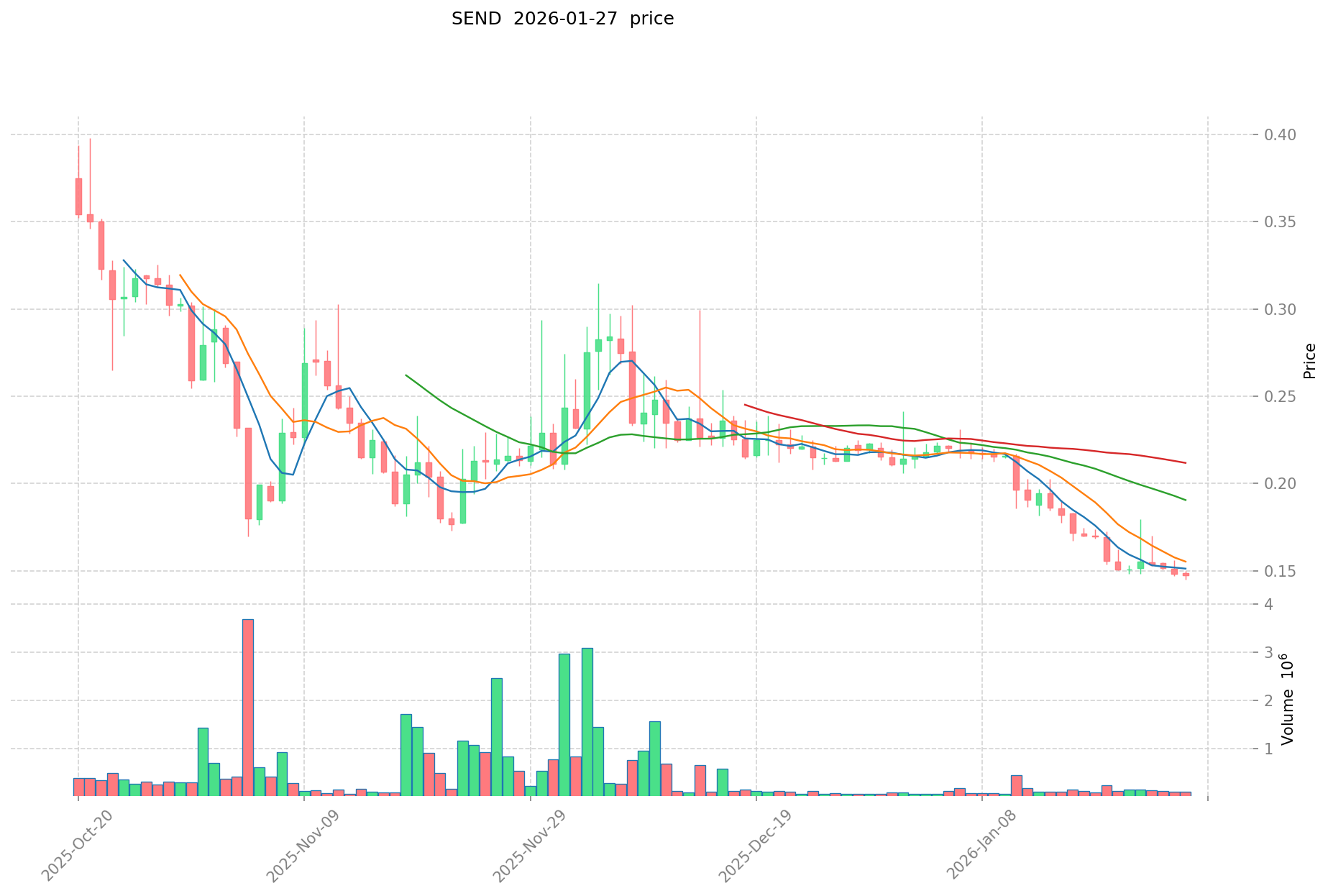
2025 to Early 2026: Market Consolidation Period → SEND price movements reflected broader trends in the DeFi lending sector on Sui blockchain. The token traded within a range as the platform's lending and borrowing activities developed, with price levels adjusting to reflect actual protocol usage and competitive positioning within the Sui ecosystem.
-
January 2026: Current Trading Phase → As of January 28, 2026, SEND has experienced notable price compression, with the token trading significantly below its initial distribution price. Recent price action shows mixed short-term movements, with a slight increase over the past hour contrasted against declines over longer timeframes.
Current SEND Investment Market Status (January 2026)
- Current SEND Price: $0.1469
- 24-Hour Trading Volume: $15,935.12
- Circulating Supply: 48,720,041 SEND (48.72% of total supply)
- Market Capitalization: $7,156,974
- Fully Diluted Valuation: $14,690,000
- Market Dominance: 0.00046%
- Exchange Listings: Available on 7 cryptocurrency exchanges
- Holder Count: 7,557 addresses
- Recent Price Trends:
- 1 Hour: +0.48%
- 24 Hours: -0.27%
- 7 Days: -3.81%
- 30 Days: -33.11%
- 1 Year: -91.67%
Click to view real-time SEND market price
II. Core Factors Influencing Whether SEND is a Good Investment (Is Suilend(SEND) a Good Investment)
Supply Mechanism and Scarcity (SEND investment scarcity)
- Fixed Maximum Supply → Influences Price and Investment Value
- Suilend has established a maximum supply of 100,000,000 SEND tokens, with a current circulating supply of 48,720,041 tokens, representing approximately 48.72% of the total supply. This limited supply structure creates a defined scarcity framework that may influence long-term valuation dynamics.
- Investment Significance: The token's scarcity model, with its capped supply, represents a structural element that could support investment considerations over extended timeframes, though market conditions and adoption rates remain variable factors.
Institutional Investment and Mainstream Adoption (Institutional investment in SEND)
- Current Holder Base: The platform has attracted 7,557 holders as of January 2026, indicating an expanding user community within the Sui ecosystem.
- Platform Adoption: Suilend operates as a lending and borrowing platform on the Sui blockchain, positioning itself within the growing DeFi sector. The platform's integration within the Sui ecosystem provides exposure to network effects as the blockchain infrastructure develops.
- Availability: SEND is listed on 7 exchanges, providing various access points for participants interested in the token.
Macroeconomic Environment Impact on SEND Investment
- Market Volatility: Recent price movements show fluctuations, with a 24-hour change of -0.27%, a 7-day decline of -3.81%, and a 30-day decrease of -33.11%, reflecting broader market sentiment and sector-specific dynamics.
- DeFi Sector Positioning: As a lending and borrowing protocol, Suilend's investment profile is influenced by interest rate environments, both in traditional finance and decentralized finance, which affect demand for lending services and yield-generating opportunities.
- Market Capitalization Context: With a market capitalization of approximately $7.16 million and a market dominance of 0.00046%, SEND represents a relatively small position within the broader cryptocurrency market, which may present both growth potential and liquidity considerations.
Technology and Ecosystem Development (Technology & Ecosystem for SEND investment)
- Sui Blockchain Infrastructure: Suilend's operations on the Sui blockchain provide access to the network's technological features and growing ecosystem. The platform's smart contract address (0xb45fcfcc2cc07ce0702cc2d229621e046c906ef14d9b25e8e4d25f6e8763fef7::send::SEND) demonstrates its integration within the Sui infrastructure.
- DeFi Protocol Functionality: As a lending and borrowing platform, Suilend contributes to the DeFi application layer on Sui, offering participants opportunities to engage with financial services built on blockchain technology.
- Ecosystem Participation: The platform's presence within the Sui ecosystem may benefit from broader network developments, developer activity, and cross-protocol integrations that expand utility and use cases for DeFi applications in this environment.
III. SEND Future Investment Forecast and Price Outlook (Is Suilend(SEND) worth investing in 2026-2031)
Short-term Investment Forecast (2026, short-term SEND investment outlook)
- Conservative Forecast: $0.080575 - $0.1465
- Neutral Forecast: $0.1465 - $0.16408
- Optimistic Forecast: $0.16408 - $0.18166
Mid-term Investment Outlook (2027-2029, mid-term Suilend(SEND) investment forecast)
-
Market Phase Expectation: During 2027-2029, SEND may experience gradual growth as the Sui ecosystem develops and lending protocols gain adoption. The token could benefit from increased DeFi activity and platform utility expansion.
-
Investment Return Forecast:
- 2027: $0.1525944 - $0.2444792 (potential increase of approximately 12% compared to 2026)
- 2028: $0.185894436 - $0.247178316 (potential increase of approximately 39% compared to 2026)
- 2029: $0.18961232472 - $0.27313203918 (potential increase of approximately 54% compared to 2026)
-
Key Catalysts: Growth in Sui blockchain adoption, expansion of lending and borrowing activities on the Suilend platform, and broader DeFi market recovery.
Long-term Investment Outlook (Is SEND a good long-term investment?)
- Base Scenario: $0.171046964408092 - $0.328936470015562 (assuming steady ecosystem development and moderate market conditions through 2031)
- Optimistic Scenario: $0.24943049859 - $0.328936470015562 (assuming accelerated DeFi adoption and favorable market environment)
- Risk Scenario: Below $0.171046964408092 (under adverse market conditions or competitive pressures)
View long-term SEND investment and price forecast: Price Prediction
2026-01-28 to 2031 Long-term Outlook
- Base Scenario: $0.1465 - $0.26314917601245 (corresponding to steady progress and gradual mainstream application growth)
- Optimistic Scenario: $0.24943049859 - $0.328936470015562 (corresponding to large-scale adoption and favorable market conditions)
- Transformative Scenario: Above $0.328936470015562 (if the ecosystem achieves breakthrough developments and mainstream popularization)
- 2031-12-31 Forecast High: $0.328936470015562 (based on optimistic development assumptions)
Disclaimer: These forecasts are based on historical data and market analysis models. Cryptocurrency markets are highly volatile and unpredictable. Past performance does not guarantee future results. These projections should not be considered as investment advice. Always conduct your own research and consult with financial advisors before making investment decisions.
| Year |
Predicted High Price |
Predicted Average Price |
Predicted Low Price |
Price Change |
| 2026 |
0.18166 |
0.1465 |
0.080575 |
0 |
| 2027 |
0.2444792 |
0.16408 |
0.1525944 |
12 |
| 2028 |
0.247178316 |
0.2042796 |
0.185894436 |
39 |
| 2029 |
0.27313203918 |
0.225728958 |
0.18961232472 |
54 |
| 2030 |
0.2768678534349 |
0.24943049859 |
0.2020387038579 |
70 |
| 2031 |
0.328936470015562 |
0.26314917601245 |
0.171046964408092 |
79 |
IV. SEND Investment Strategy and Risk Management (How to invest in lending protocols)
Investment Methodology (SEND investment strategy)
-
Long-term Holding (HODL SEND): Suitable for conservative investors seeking exposure to DeFi lending infrastructure on Sui blockchain. This approach involves acquiring SEND tokens and holding through market cycles, benefiting from potential platform growth and protocol development.
-
Active Trading: Relies on technical analysis and swing trading strategies. Given SEND's price volatility (24-hour range: $0.1446-$0.1489), traders may capitalize on short-term price movements. Active management requires monitoring trading volume ($15,935.12 in 24h) and price action across 7 exchanges.
Risk Management (Risk management for SEND investment)
V. SEND Investment Risks and Challenges (Risks of investing in lending protocols)
-
Market Risk: SEND exhibits substantial price volatility with 30-day decline of 33.11% and 1-year decline of 91.67%. The token's trading range from $0.1446 to historical levels demonstrates significant price fluctuation potential. With market capitalization of $7.16M and relatively low trading volume, the token may experience liquidity constraints and price manipulation susceptibility.
-
Regulatory Risk: Lending protocols face evolving regulatory frameworks across jurisdictions. Policy uncertainty regarding DeFi platforms may impact operational models and token utility. Different countries maintain varying stances on decentralized lending services, creating compliance complexities.
-
Technical Risk: Smart contract vulnerabilities pose security concerns for lending platforms. Protocol upgrades, network congestion on Sui blockchain, and potential integration issues may affect platform functionality. The circulating supply of 48.72M SEND (48.72% of max supply 100M) indicates ongoing token distribution which may influence market dynamics.
VI. Conclusion: Is Lending Protocol Investment a Good Investment?
-
Investment Value Summary: SEND represents participation in Sui's lending ecosystem infrastructure. The token has experienced substantial price corrections from its launch, with current market cap positioning at $7.16M and fully diluted valuation of $14.69M. The platform serves 7,557 holders with presence on 7 exchanges, indicating established but modest market adoption.
-
Investor Recommendations:
✅ Beginners: Employ dollar-cost averaging strategy combined with secure wallet storage. Start with minimal allocation to understand DeFi lending dynamics and token mechanics.
✅ Experienced Investors: Implement swing trading strategies leveraging technical analysis. Maintain diversified portfolio including multiple DeFi protocols and established cryptocurrencies.
✅ Institutional Investors: Strategic long-term positioning requires comprehensive due diligence on platform fundamentals, competitive landscape analysis, and risk-adjusted return assessment.
⚠️ Disclaimer: Cryptocurrency investment carries substantial risk. This content serves informational purposes only and does not constitute investment advice. Conduct thorough research and consider consulting financial professionals before making investment decisions.
VII. FAQ
Q1: What is Suilend (SEND) and what makes it unique in the DeFi lending space?
Suilend (SEND) is the native governance and utility token of the Suilend protocol, a decentralized lending and borrowing platform built on the Sui blockchain. Launched in December 2024, SEND operates on a fixed supply model with a maximum of 100 million tokens. The platform distinguishes itself through integration with Sui's high-performance blockchain infrastructure, offering participants access to DeFi lending services within the growing Sui ecosystem. With smart contract address 0xb45fcfcc2cc07ce0702cc2d229621e046c906ef14d9b25e8e4d25f6e8763fef7::send::SEND, the token serves dual purposes: platform governance and utility functions within the lending protocol. As of January 2026, SEND maintains a community of 7,557 holders and is accessible across 7 exchanges, positioning itself as a niche player in the Sui DeFi landscape.
Q2: How has SEND performed since its launch, and what are the key factors behind its price movements?
Since launching at $1.00 in December 2024, SEND has experienced significant price compression, currently trading at $0.1469 as of January 28, 2026, representing a 91.67% decline over approximately one year. The token's performance reflects several factors: initial price discovery volatility following the token generation event, broader DeFi market conditions, and the platform's developing adoption metrics. Recent performance shows a 33.11% decline over 30 days and a 3.81% decrease over 7 days, though short-term movements demonstrate a slight recovery with a 0.48% increase over the past hour. With only 48.72% of total supply currently circulating (48.72 million tokens), ongoing token distribution and market capitalization of $7.16 million contribute to price dynamics. The fully diluted valuation stands at $14.69 million, indicating potential supply-side pressure as additional tokens enter circulation.
Q3: What are the price projections for SEND through 2031?
Price forecasts for SEND suggest gradual growth potential under multiple scenarios. For 2026, conservative estimates range from $0.080575 to $0.1465, with optimistic projections reaching $0.18166. Mid-term outlook (2027-2029) anticipates potential increases of 12-54% compared to 2026 levels, with 2029 projections ranging from $0.18961 to $0.27313. Long-term forecasts through 2031 suggest a base scenario range of $0.171047 to $0.328936, with optimistic scenarios potentially reaching $0.328936 if adoption accelerates. These projections assume steady Sui ecosystem development, increased DeFi activity, and favorable market conditions. However, the risk scenario acknowledges potential for prices below $0.171047 under adverse conditions. These forecasts incorporate factors such as platform adoption growth, Sui blockchain infrastructure development, and broader DeFi market recovery potential.
Q4: What risks should investors consider before investing in SEND?
SEND investment carries multiple risk categories that require careful evaluation. Market risk is substantial, evidenced by 91.67% price decline since launch and 33.11% monthly decline, with market capitalization of only $7.16 million suggesting liquidity constraints and potential price manipulation vulnerability. Regulatory risk affects all DeFi lending protocols, as evolving compliance frameworks across jurisdictions may impact operational models and token utility. Technical risk encompasses smart contract vulnerabilities, potential protocol upgrade issues, and network congestion on Sui blockchain. Additionally, with 48.72% circulating supply, ongoing token distribution represents dilution risk as remaining 51.28% enters circulation. The platform's relatively modest holder base of 7,557 addresses and 24-hour trading volume of $15,935.12 indicate limited market depth, potentially resulting in increased volatility and execution challenges for larger positions.
Q5: What investment strategies are recommended for SEND tokens?
Investment approaches for SEND vary based on investor profile and risk tolerance. Conservative long-term holders (HODL strategy) should consider 1-3% portfolio allocation, focusing on exposure to Sui's DeFi lending infrastructure development with extended holding periods through market cycles. Aggressive investors may allocate 5-10% of their crypto portfolio, utilizing active trading strategies that capitalize on price volatility within the observed 24-hour range of $0.1446-$0.1489. Professional investors should implement strategic position sizing based on comprehensive portfolio analysis and correlation with broader Sui ecosystem tokens. All strategies require robust security measures including cold wallet storage for long-term holdings and hardware wallet utilization. Risk management should incorporate diversification across established cryptocurrencies and multiple DeFi protocols, while beginners should employ dollar-cost averaging to mitigate timing risk and gradually build positions while understanding platform mechanics.
Q6: How does SEND's tokenomics structure affect its investment potential?
SEND's tokenomics framework establishes a fixed maximum supply of 100 million tokens, creating a defined scarcity model that influences long-term valuation dynamics. Currently, 48,720,041 tokens (48.72%) are in circulation, with the remaining 51.28% yet to be released. This circulating supply ratio presents both opportunities and challenges: the capped total supply provides structural scarcity that could support valuation in favorable conditions, while the significant unreleased portion represents potential dilution pressure as tokens enter circulation. The market capitalization of $7.16 million contrasts with the fully diluted valuation of $14.69 million, indicating substantial difference between current and potential fully diluted values. Token distribution across 7,557 holders suggests moderate decentralization for a protocol of this size. The governance and utility dual-function design aligns holder interests with protocol development, though actual utility value depends on platform adoption metrics and lending/borrowing activity volumes within the Suilend ecosystem.
Q7: What role does the Sui blockchain play in SEND's investment thesis?
SEND's integration with the Sui blockchain represents a core component of its investment thesis. Sui provides the underlying infrastructure that enables Suilend's lending and borrowing operations, with the platform benefiting from Sui's technological features including high transaction throughput and low latency capabilities. The platform's smart contract deployment on Sui positions it within a growing ecosystem that has attracted developer activity and DeFi protocol development. Network effects from broader Sui adoption could positively impact Suilend's usage metrics and, by extension, SEND token demand. However, this dependency also introduces concentration risk, as SEND's performance correlates with Sui blockchain development trajectory, ecosystem growth, and competitive positioning against other lending protocols on alternative blockchains. The platform's market dominance of 0.00046% reflects its current niche positioning, suggesting significant potential for growth as the Sui ecosystem expands, though success depends on execution, competitive differentiation, and overall DeFi market conditions.
Q8: Is SEND suitable for different types of investors, and what are the recommended approaches?
SEND suitability varies significantly across investor profiles. Beginners should approach cautiously with minimal allocation, employing dollar-cost averaging to build positions gradually while learning DeFi lending mechanics and token dynamics. Secure storage through hardware wallets is essential, with emphasis on understanding platform fundamentals before committing capital. Experienced investors may utilize swing trading strategies leveraging technical analysis of SEND's price movements across its observed volatility ranges, maintaining diversified portfolios that include multiple DeFi protocols and established cryptocurrencies to manage correlation risk. These investors can allocate 5-10% of crypto portfolios based on risk tolerance and market conditions. Institutional investors require comprehensive due diligence examining platform fundamentals, competitive landscape analysis within Sui ecosystem and broader DeFi space, and risk-adjusted return assessments. Strategic long-term positioning demands evaluation of protocol revenue models, token utility mechanisms, and governance participation opportunities. All investor categories must acknowledge the substantial volatility evidenced by historical price performance and maintain strict risk management protocols.
* The information is not intended to be and does not constitute financial advice or any other recommendation of any sort offered or endorsed by Gate.