This comprehensive analysis evaluates whether SuiNS (NS) represents a viable investment opportunity within the Sui blockchain ecosystem. Launched in November 2024, NS currently trades at $0.0282 with a $4.38 million market cap and has experienced significant volatility, declining 86.77% from its peak. The article examines NS's investment fundamentals including supply mechanics—with only 31.06% of total tokens circulating and an 80% fee burn mechanism active since August 2025—institutional adoption across 68,340 holders on 8 exchanges, and macroeconomic factors affecting this micro-cap asset. Price projections through 2031 range from $0.0355-$0.0674 under optimistic scenarios, though substantial risks including limited liquidity ($76,216 daily volume), regulatory uncertainty, and competitive pressure from established naming services warrant careful consideration. The analysis provides tailored investment strategies for beginners, experienced traders, and institutions, emphasizing strict risk management and por
Introduction: SuiNS (NS) Investment Position and Market Outlook
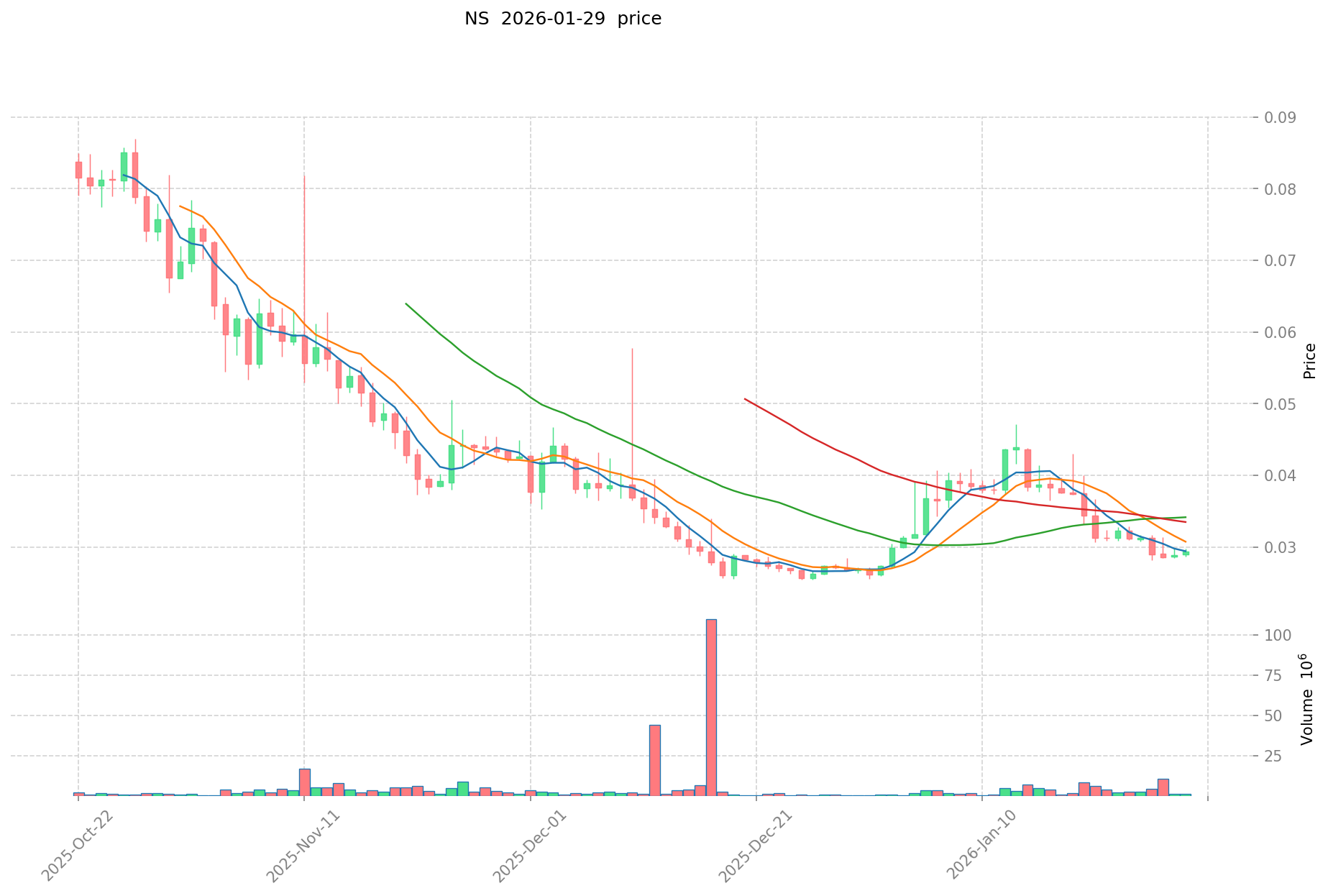
NS is a notable asset in the cryptocurrency sector, launched in 2024, and has demonstrated its role in the blockchain identity management domain. As of January 2026, SuiNS holds a market capitalization of approximately $4.38 million, with a circulating supply of around 155.30 million tokens, and the current price maintains at $0.0282. Positioned as a digital identity naming service within the Sui blockchain ecosystem, NS has gradually become a focal point for investors discussing "Is SuiNS (NS) a good investment?" The token facilitates user-friendly transfer, update, and security of digital identities while ensuring privacy and control. Its integration with various blockchain ecosystems promotes interoperability and innovation, making SuiNS a tool for developers, businesses, and individuals seeking simplified blockchain interactions. This article will comprehensively analyze NS's investment value, historical trends, future price projections, and investment risks to provide reference for investors.
I. NS Price History Review and Investment Value Status
- 2024: NS launched in November 2024 with an initial price of $0.09, reaching a peak of $1.1936 on November 14, 2024 → Early investors experienced significant gains during the initial launch period
- 2025: Market correction phase → Price declined from peak levels to $0.02544 in December 2025
- 2026: As of January 29, 2026 → NS trades at $0.0282, showing a -4.3% change over 24 hours and -8.97% decline over the past 7 days
Current NS Investment Market Status (January 2026)
- NS current price: $0.0282
- Market sentiment (Fear & Greed Index): Market emotion indicator shows neutral positioning
- 24-hour trading volume: $76,216.16
- Total market capitalization: $4,379,518.80
- Circulating supply: 155,302,085 NS (31.06% of total supply)
- Fully diluted valuation: $14,100,000
- Market dominance: 0.00045%
- Listed on 8 exchanges with 68,340 holders
Click to view real-time NS market price
II. Core Factors Affecting Whether NS is a Good Investment (Is SuiNS(NS) a Good Investment)
Supply Mechanism and Scarcity (NS investment scarcity)
- Total Supply of 500,000,000 NS tokens with a circulating supply of approximately 155,302,085 tokens (31.06% of total supply) → impacts price dynamics and investment considerations
- Token Burn Mechanism: SuiNS DAO enforces an 80% fee allocation to buy back and burn NS tokens, active since August 2025, with the burn address ranking among significant holders by November 2025 → enhances scarcity over time
- Investment significance: The combination of capped supply and active burn mechanism creates deflationary pressure that may support long-term value proposition
Institutional Investment and Mainstream Adoption (Institutional investment in NS)
- Market participation: NS is actively traded across 8 exchanges with 68,340 holders as of January 2026
- Ecosystem integration: SuiNS facilitates digital identity management with integration across various blockchain ecosystems, fostering interoperability for developers, businesses, and individuals
- Infrastructure positioning: Functions as an indispensable tool for simplifying blockchain interactions while maintaining security standards, potentially attracting enterprise-level adoption
Macroeconomic Environment Impact on NS Investment
- Broader market context: NS operates within the evolving digital asset sector where macroeconomic factors including monetary policy shifts and inflation concerns influence overall crypto investment sentiment
- Market positioning: With a market cap of approximately $4.38 million and market dominance of 0.00045%, NS represents a micro-cap investment subject to broader market volatility
- Risk-return profile: Price volatility evidenced by an 86.77% decline over one year (from launch price of $0.09 to current levels) reflects sensitivity to market conditions and risk tolerance requirements
Technology and Ecosystem Development (Technology & Ecosystem for NS investment)
- SUI Blockchain Infrastructure: NS token operates on the SUI blockchain, which has been positioned as offering base-layer scaling without fragmenting liquidity or user experience
- Name Service Utility: SuiNS enables users to transfer, update, and secure digital identities with privacy and control, providing fundamental utility within the SUI ecosystem
- Development momentum: Integration with various blockchain ecosystems and continuous protocol development supports potential for expanded use cases in DeFi, identity management, and Web3 applications
III. NS Future Investment Prediction and Price Outlook (Is SuiNS(NS) worth investing in 2026-2031)
Short-term Investment Prediction (2026, short-term NS investment outlook)
- Conservative prediction: $0.027072 - $0.02961
- Neutral prediction: $0.0282
- Optimistic prediction: Based on current market trends and the 24-hour trading volume of approximately $76,216, NS demonstrates moderate liquidity. The token's circulating supply represents approximately 31.06% of the total supply, suggesting controlled distribution.
Mid-term Investment Outlook (2027-2029, mid-term SuiNS(NS) investment forecast)
- Market stage expectation: The mid-term period shows potential growth as NS continues to serve its function within the Sui ecosystem for digital identity management. The project's focus on privacy, control, and blockchain interoperability positions it within the growing decentralized identity sector.
- Investment return prediction:
- 2027: $0.02283495 - $0.04306845 (potential increase of approximately 2% compared to 2026)
- 2028: $0.033107787 - $0.0496616805 (potential increase of approximately 27% compared to 2026)
- 2029: $0.0355440882825 - $0.0449654128875 (potential increase of approximately 51% compared to 2026)
- Key catalysts: Broader adoption of Sui blockchain ecosystem, increased demand for decentralized naming services, integration with additional blockchain platforms, and enhanced interoperability features may contribute to value appreciation.
Long-term Investment Outlook (Is NS a good long-term investment?)
- Base scenario: $0.035554794333187 - $0.051795873226125 (assuming steady ecosystem development and maintained utility within the Sui network)
- Optimistic scenario: $0.043060806470193 - $0.067461930136636 (assuming significant adoption of decentralized identity solutions and strong ecosystem expansion)
- Risk scenario: Below $0.027072 (under conditions of reduced blockchain adoption, competitive pressure from alternative naming services, or adverse market conditions)
Click to view NS long-term investment and price prediction: Price Prediction
2026-01-29 - 2031 Long-term Outlook
- Base scenario: $0.035554794333187 - $0.051795873226125 (corresponding to steady progress and stable mainstream application growth)
- Optimistic scenario: $0.043060806470193 - $0.067461930136636 (corresponding to large-scale adoption and favorable market environment)
- Transformative scenario: Above $0.067461930136636 (if ecosystem achieves breakthrough developments and mainstream popularization)
- 2031-12-31 predicted high: $0.067461930136636 (based on optimistic development assumptions)
Disclaimer: These predictions are based on historical data, current market trends, and ecosystem developments. Cryptocurrency investments carry substantial risk, and past performance does not guarantee future results. The digital asset market remains highly volatile and subject to regulatory, technological, and market uncertainties. Investors should conduct thorough research and consider their risk tolerance before making investment decisions. This analysis does not constitute financial advice.
| Year |
Predicted High Price |
Predicted Average Price |
Predicted Low Price |
Price Change |
| 2026 |
0.02961 |
0.0282 |
0.027072 |
0 |
| 2027 |
0.04306845 |
0.028905 |
0.02283495 |
2 |
| 2028 |
0.0496616805 |
0.035986725 |
0.033107787 |
27 |
| 2029 |
0.0449654128875 |
0.04282420275 |
0.0355440882825 |
51 |
| 2030 |
0.051795873226125 |
0.04389480781875 |
0.035554794333187 |
55 |
| 2031 |
0.067461930136636 |
0.047845340522437 |
0.043060806470193 |
69 |
IV. NS Investment Strategy and Risk Management (How to invest in SuiNS)
Investment Methodology (NS investment strategy)
-
Long-term Holding (HODL NS): This approach may suit conservative investors who believe in the long-term utility of decentralized naming services within the Sui ecosystem. Given the circulating supply represents approximately 31.06% of total supply, investors should consider potential dilution effects as more tokens enter circulation.
-
Active Trading: Traders may leverage technical analysis and price action patterns, particularly noting the 24-hour volatility range between $0.02807 and $0.02978. The token has shown significant historical volatility, with price movements ranging from an all-time low of $0.02544 (December 26, 2025) to an all-time high of $1.1936 (November 14, 2024).
Risk Management (Risk management for NS investment)
V. NS Investment Risks and Challenges (Risks of investing in SuiNS)
-
Market Risks: NS exhibits high volatility, with a 1-year performance showing -86.77% decline from peak levels. The current market capitalization of approximately $4.38 million and 24-hour trading volume of $76,216 suggest relatively limited liquidity, which may amplify price swings during periods of buying or selling pressure.
-
Regulatory Risks: Decentralized naming services operate in an evolving regulatory landscape. Changes in policies regarding digital identity solutions, blockchain domains, or cryptocurrency services across different jurisdictions may impact adoption and utility.
-
Technical Risks: As infrastructure built on the Sui blockchain, NS functionality depends on the underlying network's performance and security. Smart contract vulnerabilities, network congestion, or protocol upgrades on Sui could affect NS operations. The project's integration with various blockchain ecosystems introduces additional technical dependencies.
-
Adoption Risks: The token's utility is tied to adoption of the SuiNS naming service. Competition from established naming services and alternative identity solutions may limit growth potential.
VI. Conclusion: Is SuiNS a Good Investment?
-
Investment Value Summary: NS represents exposure to decentralized identity infrastructure within the Sui ecosystem. While the token has experienced significant volatility since launch, with current prices near historical lows, the project addresses practical needs in blockchain usability. The fully diluted market cap of $14.1 million and holder count of 68,340 indicate emerging community interest, though liquidity remains limited.
-
Investor Recommendations:
✅ Beginners: Consider dollar-cost averaging with small allocations, and prioritize secure wallet storage compatible with Sui blockchain. Avoid investing more than you can afford to lose given the token's volatility profile.
✅ Experienced Investors: May explore swing trading opportunities around technical levels, while maintaining diversified exposure across multiple infrastructure tokens. Monitor development updates and ecosystem adoption metrics.
✅ Institutional Investors: Could evaluate NS as part of a broader thesis on Sui ecosystem growth and decentralized identity solutions, with appropriate position sizing relative to liquidity constraints.
⚠️ Disclaimer: Cryptocurrency investments carry high risk due to market volatility, regulatory uncertainty, and technical factors. This content is for informational purposes only and does not constitute investment advice. Conduct thorough research and consider consulting financial professionals before making investment decisions.
VII. FAQ
Q1: Is SuiNS (NS) a good investment for beginners in 2026?
NS presents high-risk characteristics that require careful consideration for beginner investors. The token has experienced significant volatility, declining 86.77% from its all-time high of $1.1936 (November 2024) to current levels around $0.0282. With a relatively small market cap of $4.38 million and limited liquidity ($76,216 in 24-hour trading volume), price swings can be substantial. Beginners should limit exposure to 1-3% of their crypto portfolio, employ dollar-cost averaging strategies, and prioritize secure storage solutions compatible with the Sui blockchain. The project's utility in decentralized identity management offers long-term potential, but investors must be prepared for continued volatility and should only invest amounts they can afford to lose.
Q2: What factors could drive NS price appreciation in the future?
Several catalysts may support NS value growth through 2031. The active token burn mechanism, which allocates 80% of protocol fees to buy back and burn NS tokens, creates deflationary pressure with only 31.06% of total supply currently in circulation. Broader adoption of the Sui blockchain ecosystem and increased demand for decentralized naming services represent fundamental drivers. Technical integration with additional blockchain platforms could expand utility and user base. Price predictions suggest potential growth from current $0.0282 levels to $0.0449-$0.0674 by 2031 under optimistic scenarios, though investors should note these projections carry substantial uncertainty and depend on ecosystem development, competitive positioning, and overall market conditions.
Q3: How does NS compare to other blockchain naming services?
SuiNS operates within the Sui blockchain ecosystem, offering digital identity management with emphasis on privacy, control, and interoperability. Unlike established naming services such as Ethereum Name Service (ENS), NS benefits from Sui's base-layer scaling architecture that avoids liquidity fragmentation. However, NS faces significant competitive pressure from both established players and emerging alternatives. The token's market dominance stands at just 0.00045%, indicating limited market penetration. Key differentiators include integration across various blockchain ecosystems and focus on simplified user experience. Investors evaluating NS should assess the project's ability to capture market share within the growing decentralized identity sector, considering both technical capabilities and network effects that favor earlier-established competitors.
Q4: What are the primary risks associated with investing in NS?
NS investment carries multiple risk dimensions requiring thorough evaluation. Market risk remains substantial, evidenced by extreme volatility and 86.77% decline from peak pricing, with limited liquidity amplifying price movements. Technical risks stem from dependencies on Sui blockchain infrastructure, potential smart contract vulnerabilities, and integration complexities across multiple ecosystems. Regulatory uncertainty surrounding decentralized identity solutions and blockchain domain services may impact adoption trajectories. Adoption risk reflects competition from established naming services and alternative identity solutions that could limit growth potential. The token's concentrated holder base (68,340 holders) and low market dominance (0.00045%) suggest early-stage development with execution risks. Investors should implement strict position sizing, maintain diversification, and regularly reassess risk-reward profiles as market conditions evolve.
Q5: What is the optimal investment strategy for NS tokens?
Investment strategy should align with individual risk tolerance and investment objectives. For long-term holders (HODL strategy), NS offers exposure to decentralized identity infrastructure within the Sui ecosystem, though investors must account for potential token dilution as circulating supply increases from current 31.06% toward full distribution. Conservative allocations of 1-3% of total crypto portfolio help manage concentration risk. Active traders may leverage technical analysis around established support ($0.02544 historical low) and resistance levels, monitoring 24-hour volatility ranges. Dollar-cost averaging mitigates timing risk in volatile markets. Risk management requires secure cold wallet storage for long-term positions, diversification across multiple infrastructure tokens, and regular portfolio rebalancing. Regardless of strategy, investors should establish clear entry/exit criteria, position sizing limits, and loss thresholds before committing capital to NS investments.
* The information is not intended to be and does not constitute financial advice or any other recommendation of any sort offered or endorsed by Gate.