This comprehensive analysis examines whether Supra (SUPRA) represents a viable investment opportunity in the Layer 1 blockchain space. As of January 2026, SUPRA trades at $0.0007742 with a $5.3 million market capitalization, having experienced significant volatility since its November 2024 launch. The article evaluates SUPRA's MultiVM Layer 1 architecture offering 500,000 TPS throughput across 300 globally distributed nodes, alongside critical factors including tokenomics showing only 6.85% circulating supply, market performance with a 96.17% annual decline, and limited liquidity across 6 exchanges. Investment considerations span multiple risk categories—market volatility, regulatory uncertainty, technical complexity, and supply dilution—alongside price forecasts ranging from $0.00063427 to $0.001761 through 2031 depending on adoption scenarios. Strategic guidance addresses different investor profiles through portfolio allocation frameworks (1-15% allocation recommendations), trading methodologies, and secure
Introduction: Supra (SUPRA)'s Investment Position and Market Prospects
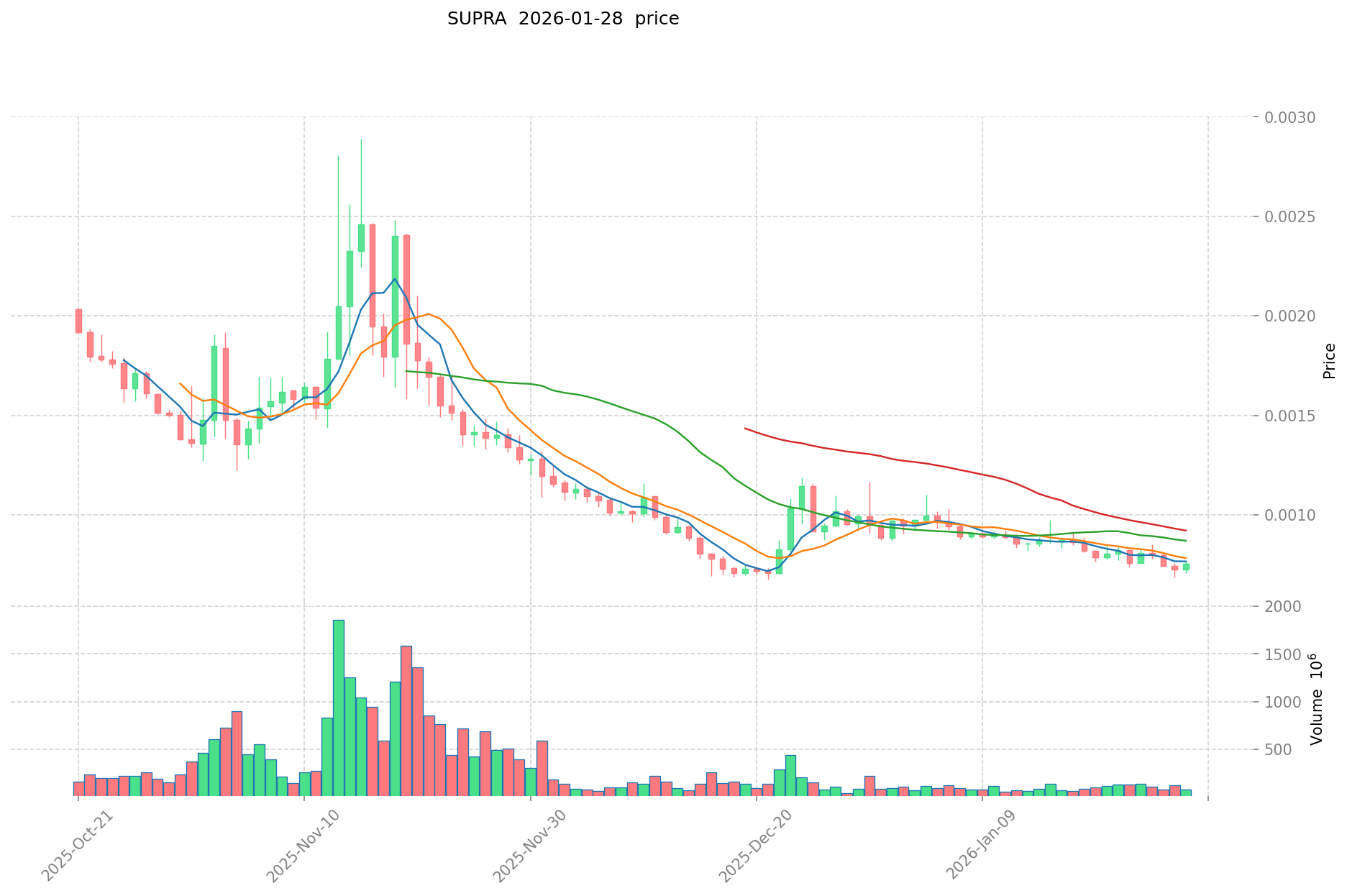
SUPRA is an asset in the cryptocurrency field. As of January 2026, Supra holds a market capitalization of approximately $5.3 million, with a circulating supply of about 6.85 billion tokens, and the current price is maintained around $0.0007742. With its positioning as a MultiVM Layer 1 blockchain starting with MoveVM, operating on 300 globally distributed nodes with sub-second consensus latency and 500,000 TPS throughput, Supra has gradually become a focal point for investors discussing "Is Supra (SUPRA) a good investment?". This article will comprehensively analyze Supra's investment value, historical trends, future price predictions, and investment risks to provide reference for investors.
I. Supra (SUPRA) Price History Review and Current Investment Value
- 2024: Initial token launch in November → Market debut with opening price of $0.007
- December 2024: Early trading phase → Price reached $0.0798 during initial market activity
- 2025-2026: Market adjustment period → Price declined from peak levels to $0.0007742, representing a significant correction phase
Current SUPRA Investment Market Status (January 2026)
- Current SUPRA price: $0.0007742
- 24-hour trading volume: $80,629.79
- Market capitalization: $5,303,270
- Circulating supply: 6.85 billion SUPRA (6.85% of total supply)
- Total supply: 100 billion SUPRA
- Recent price movements: +7.16% (24h), -3.96% (7d), -18.62% (30d)
Click to view real-time SUPRA market price
II. Core Factors Influencing Whether SUPRA is a Good Investment
Supply Mechanism and Scarcity (SUPRA Investment Scarcity)
- Total supply: 100,000,000,000 SUPRA tokens with a maximum supply of 100,000,000,000
- Current circulating supply: 6,850,000,000 tokens, representing approximately 6.85% of total supply
- The relatively low circulating ratio suggests significant token reserves remain locked or unvested, which may influence future supply dynamics and price behavior
- Market cap to fully diluted valuation ratio stands at 6.85%, indicating substantial supply yet to enter circulation
- Investment consideration: The large gap between circulating and total supply creates uncertainty regarding future dilution effects on token value
Technology and Ecosystem Development (Technology & Ecosystem for SUPRA Investment)
- Multi-VM Layer 1 blockchain architecture starting with MoveVM
- Technical capabilities include 500,000 TPS throughput across 300 globally distributed nodes with sub-second consensus latency
- Native oracle price feeds, on-chain randomness, cross-chain communication, and automation functionality
- Planned EVM and SolanaVM support aims to expand ecosystem compatibility
- Vertically integrated platform designed to provide unified infrastructure for decentralized application development
- Investment consideration: Technical specifications and ecosystem features may support long-term utility and adoption potential
Market Performance Context
- Current trading price: $0.0007742
- 24-hour price change: +7.16%
- 7-day price change: -3.96%
- 30-day price change: -18.62%
- 1-year price change: -96.17%
- Price range: Historical high of $0.0798 (December 8, 2024) and historical low of $0.0006735 (December 21, 2025)
- Market cap: $5,303,270 with market dominance of 0.0024%
- Investment consideration: Significant volatility and substantial decline from historical high levels reflect market uncertainty
Exchange Availability and Liquidity
- Listed on 6 exchanges
- 24-hour trading volume: $80,629.79
- Investment consideration: Limited exchange presence and relatively modest trading volume may affect liquidity and execution for larger transactions
III. SUPRA Future Investment Forecast and Price Outlook (Is Supra (SUPRA) worth investing in 2026-2031)
Short-term Investment Forecast (2026, short-term SUPRA investment outlook)
- Conservative forecast: $0.00063427 - $0.0007735
- Neutral forecast: $0.0007735 - $0.000821
- Optimistic forecast: $0.000821 - $0.000966875
Mid-term Investment Outlook (2027-2029, mid-term Supra (SUPRA) investment forecast)
- Market stage expectations: Price volatility may continue as the project develops its MultiVM Layer 1 infrastructure and expands its ecosystem capabilities
- Investment return forecast:
- 2027: $0.00060913125 - $0.00125307
- 2028: $0.000785605275 - $0.0012739545
- 2029: $0.00084080997 - $0.00134296036875
- Key catalysts: Platform development progress, oracle service adoption, cross-chain communication implementation, and potential EVM and SolanaVM support integration
Long-term Investment Outlook (Is SUPRA a good long-term investment?)
- Baseline scenario: $0.00070301055825 - $0.001255375996875 (assuming steady ecosystem growth and gradual adoption)
- Optimistic scenario: $0.001342624628657 - $0.001761292523615 (assuming accelerated adoption and favorable market conditions)
- Risk scenario: Below $0.0006735 (under adverse market conditions or implementation challenges)
Click to view SUPRA long-term investment and price prediction: Price Prediction
2026-01-29 to 2031 Long-term Outlook
- Baseline scenario: $0.00070301055825 - $0.001255375996875 (corresponding to steady progress and gradual mainstream application improvement)
- Optimistic scenario: $0.001342624628657 - $0.001761292523615 (corresponding to large-scale adoption and favorable market environment)
- Transformative scenario: Above $0.001761292523615 (if ecosystem achieves breakthrough progress and mainstream adoption)
- 2031-12-31 forecast high: $0.001761292523615 (based on optimistic development assumptions)
Disclaimer: The above forecasts are based on current market data and historical trends. Cryptocurrency investments carry significant risks, and past performance does not guarantee future results. Investors should conduct thorough research and consider their risk tolerance before making investment decisions.
| Year |
Predicted High Price |
Predicted Average Price |
Predicted Low Price |
Price Change |
| 2026 |
0.000966875 |
0.0007735 |
0.00063427 |
0 |
| 2027 |
0.00125307 |
0.0008701875 |
0.00060913125 |
12 |
| 2028 |
0.0012739545 |
0.00106162875 |
0.000785605275 |
37 |
| 2029 |
0.00134296036875 |
0.001167791625 |
0.00084080997 |
50 |
| 2030 |
0.001631988795937 |
0.001255375996875 |
0.00070301055825 |
62 |
| 2031 |
0.001761292523615 |
0.001443682396406 |
0.001342624628657 |
86 |
IV. SUPRA Investment Strategy and Risk Management (How to invest in Layer 1 blockchain)
Investment Methodology (SUPRA investment strategy)
-
Long-term Holding (HODL SUPRA): Suitable for conservative investors who believe in the long-term potential of vertically integrated blockchain infrastructure. This approach involves acquiring SUPRA tokens and holding them through market cycles, focusing on the project's technological development and ecosystem expansion rather than short-term price movements.
-
Active Trading: Relies on technical analysis and swing trading strategies. Traders may utilize price indicators, volume patterns, and market sentiment to identify entry and exit points. Given SUPRA's historical price range between $0.0006735 and $0.0798, active traders could capitalize on price fluctuations while managing position sizes carefully.
Risk Management (Risk management for SUPRA investment)
V. SUPRA Investment Risks and Challenges (Risks of investing in Layer 1 blockchain)
-
Market Risks: SUPRA has demonstrated considerable price volatility, with a 96.17% decrease over one year and trading significantly below its historical high. The relatively low market capitalization of approximately $5.3 million suggests susceptibility to price manipulation and limited liquidity in certain trading conditions.
-
Regulatory Risks: As a Layer 1 blockchain project with oracle services and cross-chain capabilities, SUPRA may face varying regulatory frameworks across different jurisdictions. Policy changes regarding blockchain infrastructure, data oracles, and cross-chain communications could impact the project's operations and token utility.
-
Technical Risks: Despite claims of high throughput capacity, the project involves complex technical components including MultiVM support, oracle integration, and cross-chain communication protocols. Network security vulnerabilities, consensus mechanism issues, or failed upgrades could affect network stability and token value.
-
Competition Risk: The Layer 1 blockchain space remains highly competitive, with established networks and emerging projects competing for developer adoption and market share.
-
Liquidity Risk: With a circulating supply representing only 6.85% of the total supply and relatively low trading volume, investors may face challenges executing large orders without significant price impact.
VI. Conclusion: Is Layer 1 blockchain a Good Investment?
-
Investment Value Summary: SUPRA presents itself as a comprehensive blockchain infrastructure project with multiple integrated services. However, the token has experienced substantial price decline since its historical high, and the project's actual adoption and ecosystem development remain key factors to monitor. The low circulating supply ratio indicates potential future supply increases that could affect token economics.
-
Investor Recommendations:
✅ Beginners: Consider dollar-cost averaging with small allocations and prioritize secure wallet storage. Focus on understanding the project's fundamentals before committing significant capital.
✅ Experienced Investors: May explore swing trading opportunities based on technical analysis while maintaining strict risk management protocols. Consider portfolio diversification across multiple Layer 1 projects.
✅ Institutional Investors: Conduct thorough due diligence on technical architecture, team background, and competitive positioning before considering strategic allocation.
⚠️ Disclaimer: Cryptocurrency investments carry substantial risks, including potential loss of principal. This content is for informational purposes only and does not constitute investment advice. Investors should conduct independent research and consult with financial advisors before making investment decisions.
VII. FAQ
Q1: What is Supra (SUPRA) and what makes it different from other Layer 1 blockchains?
Supra is a MultiVM Layer 1 blockchain that starts with MoveVM and aims to provide vertically integrated infrastructure for decentralized applications. What distinguishes Supra from competitors is its comprehensive approach: it operates 300 globally distributed nodes with sub-second consensus latency and claims 500,000 TPS throughput, while integrating native oracle price feeds, on-chain randomness, cross-chain communication, and automation functionality. The project also plans to support EVM and SolanaVM, creating a unified platform that combines blockchain infrastructure with oracle services and cross-chain capabilities—reducing the need for developers to integrate multiple third-party solutions.
Q2: What is the current price of SUPRA and what has been its price performance?
As of January 2026, SUPRA trades at approximately $0.0007742 with a market capitalization of $5.3 million. The token's price history shows significant volatility: it launched in November 2024 at $0.007, reached a historical high of $0.0798 in December 2024, but has since declined substantially—showing a 96.17% decrease over one year. Recent performance includes a +7.16% gain in 24 hours, -3.96% over 7 days, and -18.62% over 30 days. The substantial decline from peak levels reflects market adjustment and uncertainty surrounding the project's early stage of development.
Q3: What are the main risks associated with investing in SUPRA?
The primary investment risks include: (1) Market Risk - significant price volatility with a 96% decline from historical highs and low market capitalization that increases susceptibility to manipulation; (2) Liquidity Risk - only 6.85% of total supply currently circulates, with modest trading volume of approximately $80,000 daily across 6 exchanges; (3) Dilution Risk - the large gap between circulating and total supply (6.85 billion vs. 100 billion tokens) suggests future supply increases may pressure prices; (4) Technical Risk - complex architecture involving MultiVM support, oracles, and cross-chain protocols creates implementation challenges; and (5) Competition Risk - intense competition from established Layer 1 networks and emerging projects in the blockchain infrastructure space.
Q4: What is the long-term price forecast for SUPRA from 2026 to 2031?
Based on current market data and development assumptions, price forecasts vary by scenario: In the baseline scenario (steady ecosystem growth), SUPRA could range from $0.00070301 to $0.001255 by 2030-2031. The optimistic scenario (accelerated adoption and favorable conditions) projects $0.001342 to $0.001761 by 2031. The transformative scenario (breakthrough adoption) could see prices exceed $0.001761. However, a risk scenario under adverse conditions could push prices below the historical low of $0.0006735. These projections assume various levels of ecosystem development, technological implementation success, and market conditions—but cryptocurrency investments remain highly speculative and past performance does not guarantee future results.
Q5: How should different types of investors approach SUPRA investment?
Investment approaches should align with experience level and risk tolerance: Beginners should consider dollar-cost averaging with small allocations (1-3% of crypto portfolio), prioritize secure cold wallet storage, and focus on understanding project fundamentals before significant investment. Experienced investors may explore swing trading opportunities based on technical analysis while maintaining strict risk management (3-7% allocation), diversifying across multiple Layer 1 projects, and utilizing both hot and cold wallet solutions. Institutional investors should conduct comprehensive due diligence on technical architecture, team credentials, competitive positioning, and regulatory implications before considering strategic allocation (up to 7-15% for aggressive strategies). All investors should implement multi-asset portfolio strategies and never invest more than they can afford to lose.
Q6: What factors could positively influence SUPRA's investment value in the future?
Several catalysts could drive SUPRA's value appreciation: (1) Technical milestones - successful implementation of EVM and SolanaVM support expanding ecosystem compatibility; (2) Ecosystem growth - increased developer adoption and deployment of decentralized applications on the platform; (3) Oracle adoption - widespread use of Supra's native oracle services by DeFi protocols and blockchain applications; (4) Network performance - demonstrated achievement of claimed 500,000 TPS throughput in real-world conditions; (5) Strategic partnerships - collaborations with established blockchain projects or enterprise clients; and (6) Market conditions - favorable broader cryptocurrency market sentiment and increased institutional interest in Layer 1 infrastructure projects. However, these positive factors must materialize through actual execution rather than remaining speculative projections.
Q7: Where can investors buy SUPRA and what are the liquidity considerations?
SUPRA is currently listed on 6 cryptocurrency exchanges with a 24-hour trading volume of approximately $80,630. While this provides access for investors, the relatively modest trading volume and limited exchange presence create important liquidity considerations: larger transactions may experience significant price slippage, and the ability to execute quick exits during market volatility could be constrained. Investors should consider spreading purchases across multiple time intervals (dollar-cost averaging) to minimize price impact, use limit orders rather than market orders for better execution, and maintain realistic expectations about position sizes. The low circulating supply (6.85% of total) combined with limited liquidity makes SUPRA more suitable for patient, long-term investors rather than those requiring immediate liquidity or executing large-volume trades.
Q8: How does SUPRA's tokenomics and supply structure affect investment decisions?
SUPRA's tokenomics present both opportunities and concerns for investors. With a total supply of 100 billion tokens but only 6.85 billion (6.85%) currently circulating, the market cap to fully diluted valuation ratio stands at 6.85%—indicating substantial supply remains locked or unvested. This structure means the current $5.3 million market capitalization could theoretically expand to approximately $77 million at current prices if all tokens entered circulation, creating significant dilution risk. The large gap between circulating and total supply creates uncertainty regarding: (1) vesting schedules for team, investor, and ecosystem tokens; (2) future selling pressure as locked tokens become available; and (3) long-term price sustainability. Investors should research the token release schedule, vesting terms, and allocation distribution before investing, as future supply increases could substantially impact token value regardless of project development progress.
* The information is not intended to be and does not constitute financial advice or any other recommendation of any sort offered or endorsed by Gate.