This comprehensive guide examines whether Swarm (BZZ) represents a viable investment in the decentralized storage sector. BZZ, trading at $0.1893 with a market cap of $11.95 million, serves as the functional token for Swarm's distributed storage and content distribution protocol within Ethereum's Web3.0 ecosystem. The article analyzes BZZ's price history from its $21.11 peak in June 2021 to current levels, evaluates the fixed 63.15 million token supply supporting long-term scarcity, and explores Swarm's fundamental role in Web3.0 infrastructure. Mid-term price forecasts suggest potential ranges of $0.188-$0.394 through 2029, while addressing substantial risks including market volatility, regulatory uncertainty, and technical challenges. The guide provides investor recommendations across experience levels, risk management strategies for positions on Gate exchange, and detailed risk assessments. Ultimately, BZZ remains a speculative high-risk asset requiring careful due diligence and appropriate portfolio alloc
Introduction: Swarm (BZZ) Investment Position and Market Prospects
BZZ is a notable asset in the cryptocurrency sector, serving as the functional token for the Swarm network since its launch in 2021. As a distributed storage platform and content distribution service protocol within the Ethereum Web3.0 ecosystem, Swarm operates alongside smart contracts and Whisper to form one of Ethereum's foundational pillars. As of January 25, 2026, BZZ holds a market capitalization of approximately $11.95 million, with a circulating supply of around 63.15 million tokens and a current price near $0.1893. With its role as the fuel for decentralized storage and bandwidth services on the Swarm network, BZZ has become a subject of interest among investors exploring "Is Swarm (BZZ) a good investment?" This article comprehensively examines BZZ's investment characteristics, historical price movements, future price considerations, and associated risks to provide reference insights for investors.
I. Swarm (BZZ) Price History Review and Current Investment Value
- 2021: Token launch and initial market entry → BZZ was published at $1.92 on June 14, 2021, and reached a notable price level of $21.11 on June 22, 2021
- 2025: Market adjustment period → BZZ price experienced downward movement, recording $0.110009 on November 14, 2025
- 2021-2026: Multi-year price development → From June 2021 pricing levels to current trading range around $0.1893
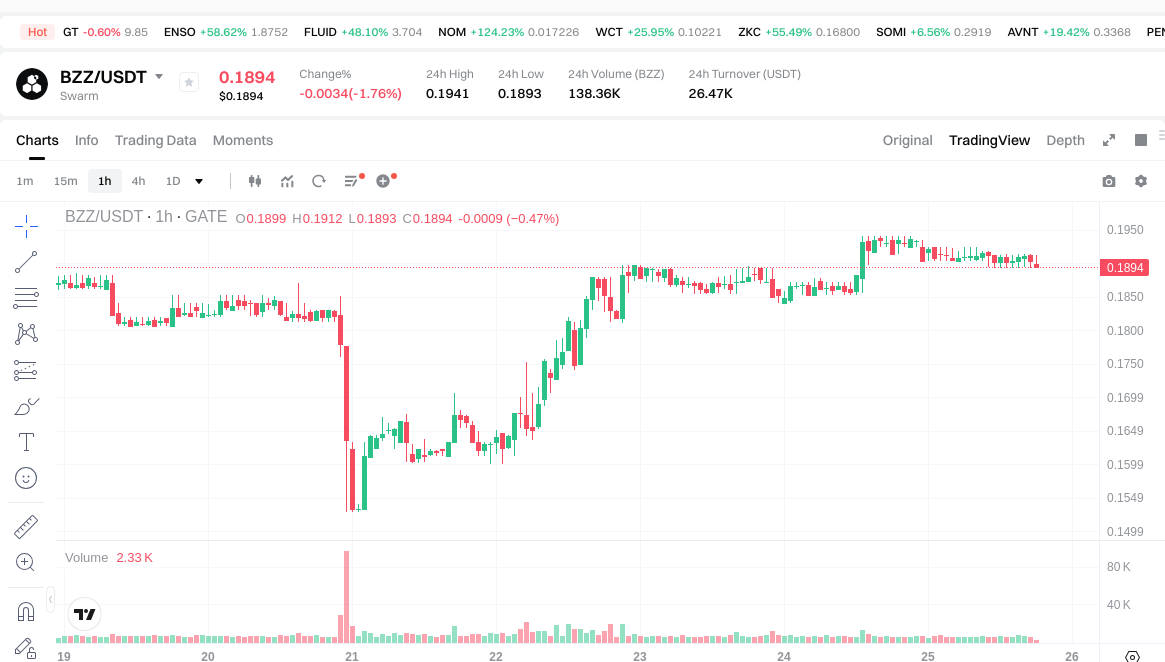
Current BZZ Investment Market Status (January 2026)
- BZZ current price: $0.1893
- 24-hour trading volume: $26,415.31
- Market capitalization: $11,954,188.58
- Circulating supply: 63,149,437.84 BZZ (100% of total supply)
- Market share: 0.00038%
- 24-hour price range: $0.1893 - $0.1941
Click to view real-time BZZ market price
II. Core Factors Affecting Whether BZZ is a Good Investment (Is Swarm(BZZ) a Good Investment)
Supply Mechanism and Scarcity (BZZ investment scarcity)
- Fixed Supply Model → Influences Price and Investment Value
Swarm (BZZ) operates with a capped total supply of 63,149,437 tokens, with 100% of tokens currently in circulation. This fixed supply mechanism creates a deflationary model where no additional tokens can be minted, potentially supporting long-term price stability. As of January 25, 2026, BZZ trades at $0.1893 with a market capitalization of approximately $11.95 million.
- Historical Price Patterns: Supply Dynamics Previously Contributed to Price Movements
Historical data shows BZZ reached a notable price level of $21.11 in June 2021, while experiencing a lower price point of $0.110009 in November 2025. These fluctuations reflect how market perception of the fixed supply interacts with demand cycles. The complete circulation of all tokens eliminates concerns about future dilution from token unlocks or emissions.
- Investment Significance: Scarcity as a Foundation for Long-Term Investment
The fully circulated supply with no additional issuance creates inherent scarcity that may support investment value over extended periods. With a market cap to fully diluted valuation ratio of 100%, investors face no uncertainty regarding future token releases. However, the current market dominance of 0.00038% suggests BZZ remains a smaller-cap asset within the broader cryptocurrency ecosystem.
Technology and Ecosystem Development (Technology & Ecosystem for BZZ investment)
- Decentralized Storage Infrastructure: Enhancing Network Utility → Supporting Investment Appeal
Swarm functions as a distributed storage platform and content distribution service protocol, serving as a native service layer for Ethereum Web3.0. The project focuses on providing decentralized data storage and bandwidth services for the Ethereum network. BZZ tokens serve as the fuel for accessing Swarm's decentralized storage and bandwidth resources.
- Ethereum Web3.0 Integration: Expanding Ecosystem Applications → Long-Term Value Support
Swarm positions itself as one of the three pillars of Ethereum Web3.0, alongside smart contracts and Whisper (encrypted data communication). This integration with Ethereum's infrastructure provides potential utility as decentralized applications require distributed storage solutions. The project maintains active development with presence on GitHub and ongoing technical documentation.
- Application Ecosystem: DeFi, NFT, and Broader Use Cases
As a storage layer for Ethereum-based applications, Swarm's infrastructure potentially supports various decentralized applications including DeFi protocols requiring data availability, NFT projects needing content storage, and Web3 applications demanding censorship-resistant hosting. The practical adoption of these use cases may influence BZZ's long-term investment value, though specific adoption metrics require further monitoring.
III. BZZ Future Investment Forecast and Price Outlook (Is Swarm(BZZ) worth investing in 2026-2031)
Short-term Investment Forecast (2026, short-term BZZ investment outlook)
- Conservative forecast: $0.121216 - $0.1894
- Neutral forecast: $0.1894
- Optimistic forecast: $0.1894 - $0.206446
Mid-term Investment Outlook (2027-2029, mid-term Swarm(BZZ) investment forecast)
-
Market stage expectation: The mid-term period may witness gradual development in decentralized storage adoption and potential expansion of Web3.0 infrastructure applications. Market dynamics would likely be influenced by broader cryptocurrency market trends and technological advancement in distributed storage solutions.
-
Investment return forecast:
- 2027: $0.18802685 - $0.25532067
- 2028: $0.2084920882 - $0.32860166075
- 2029: $0.255402808045 - $0.3942086819825
-
Key catalysts: Factors may include Web3.0 ecosystem development, decentralized storage demand growth, Ethereum network evolution, and potential integration with broader blockchain infrastructure projects.
Long-term Investment Outlook (Is BZZ a good long-term investment?)
-
Baseline scenario: $0.203141702478161 - $0.382181847035185 (based on steady ecosystem development and moderate adoption of decentralized storage solutions)
-
Optimistic scenario: $0.344307970301968 - $0.3942086819825 (contingent upon accelerated Web3.0 adoption and favorable market conditions for distributed storage platforms)
-
Risk scenario: Below $0.203141702478161 (in cases of limited adoption growth or unfavorable market conditions for decentralized storage protocols)
Click to view BZZ long-term investment and price forecast: Price Prediction
2026-01-25 - 2031 Long-term Outlook
-
Base scenario: $0.203141702478161 - $0.344307970301968 (corresponding to steady progress and gradual mainstream application enhancement)
-
Optimistic scenario: $0.344307970301968 - $0.3942086819825 (corresponding to large-scale adoption and favorable market environment)
-
Transformative scenario: Above $0.3942086819825 (if ecosystem achieves breakthrough developments and mainstream popularization)
-
2031-12-31 forecast high: $0.382181847035185 (based on optimistic development assumptions)
Disclaimer: This forecast is for informational purposes only and does not constitute investment advice. Cryptocurrency markets involve substantial risks, and past performance does not guarantee future results. Investors should conduct independent research and consider their risk tolerance before making investment decisions.
| Year |
Predicted High Price |
Predicted Average Price |
Predicted Low Price |
Price Change |
| 2026 |
0.206446 |
0.1894 |
0.121216 |
0 |
| 2027 |
0.25532067 |
0.197923 |
0.18802685 |
4 |
| 2028 |
0.32860166075 |
0.226621835 |
0.2084920882 |
19 |
| 2029 |
0.3942086819825 |
0.277611747875 |
0.255402808045 |
46 |
| 2030 |
0.352705725675187 |
0.33591021492875 |
0.238496252599412 |
77 |
| 2031 |
0.382181847035185 |
0.344307970301968 |
0.203141702478161 |
81 |
IV. Swarm Investment Strategy and Risk Management (How to invest in Swarm)
Investment Methodology (Swarm investment strategy)
Investors considering BZZ tokens can adopt different strategies based on their risk tolerance and investment objectives:
-
Long-term Holding (HODL Swarm): This approach is suitable for conservative investors who believe in the fundamental value proposition of decentralized storage solutions within the Web3.0 ecosystem. Given Swarm's position as one of the three pillars of Ethereum's Web3.0 infrastructure alongside smart contracts and Whisper, long-term holders may focus on the protocol's utility in providing decentralized storage and bandwidth services. This strategy requires patience and conviction in the technology's eventual adoption.
-
Active Trading: Traders may utilize technical analysis and momentum strategies to capitalize on BZZ's price movements. With a 24-hour trading volume of approximately $26,415 and price fluctuations across different timeframes (-0.77% over 1 hour, -2.06% over 24 hours, +1.66% over 7 days), active traders can potentially identify entry and exit points through chart patterns, support and resistance levels, and volume analysis.
Risk Management (Risk management for Swarm investment)
-
Asset Allocation Ratios:
- Conservative investors: Consider allocating 1-3% of crypto portfolio to BZZ
- Moderate investors: May allocate 3-7% depending on conviction in decentralized storage sector
- Professional investors: Could consider higher allocations as part of a Web3.0 infrastructure thesis, while maintaining diversification
-
Risk Hedging Approaches: Investors should consider portfolio diversification across multiple asset classes and sectors within the crypto ecosystem. Combining BZZ with other infrastructure tokens, Layer 1 protocols, and potentially stablecoins can help mitigate concentration risk. Additionally, setting predetermined stop-loss levels and position sizing based on personal risk tolerance are essential risk management practices.
-
Secure Storage:
- Cold Storage: Hardware wallets such as Ledger or Trezor for long-term holdings
- Hot Wallets: For active trading, use reputable software wallets with strong security features
- Security Best Practices: Enable two-factor authentication, maintain backup seed phrases in secure locations, and verify contract addresses (BZZ contract: 0x19062190b1925b5b6689d7073fdfc8c2976ef8cb on Ethereum) before transactions
V. Swarm Investment Risks and Challenges (Risks of investing in Swarm)
-
Market Risks: BZZ has demonstrated substantial price volatility, with the token experiencing a decline of approximately 45% over the past year. The current price of $0.1893 represents a considerable distance from its all-time high of $21.11 recorded on June 22, 2021. The token's market capitalization of approximately $11.95 million and relatively modest 24-hour trading volume suggest potential liquidity concerns and susceptibility to price swings. The fully diluted market cap represents 100% of the current market cap, indicating that all 63.15 million tokens are already in circulation.
-
Regulatory Risks: As with other crypto assets, BZZ faces uncertainty regarding regulatory treatment across different jurisdictions. Changes in regulatory frameworks governing decentralized storage networks, token classifications, or data sovereignty requirements could impact the protocol's operations and token value. The evolving global regulatory landscape for cryptocurrencies introduces compliance uncertainty that investors should monitor.
-
Technical Risks: The Swarm network's functionality as a decentralized storage and content distribution protocol introduces technical considerations. Potential risks include network security vulnerabilities, smart contract exploits, protocol upgrade complications, or challenges in achieving sustainable network adoption. Competition from other decentralized storage solutions may also impact Swarm's market position and token utility.
VI. Conclusion: Is Swarm a Good Investment?
-
Investment Value Summary: Swarm (BZZ) represents an infrastructure component within the Ethereum Web3.0 ecosystem, specifically focused on decentralized storage and bandwidth provision. While the protocol addresses a fundamental need in the decentralized web architecture, the token has experienced considerable price volatility and a substantial decline from its historical peak. The relatively small market capitalization and trading volume suggest that BZZ remains a speculative asset with potential for both growth and continued volatility.
-
Investor Recommendations:
✅ Beginners: Consider dollar-cost averaging with small allocations, prioritize secure hardware wallet storage, and thoroughly research the decentralized storage sector before investing
✅ Experienced Investors: May employ swing trading strategies while maintaining risk-appropriate position sizes, diversify across multiple Web3.0 infrastructure projects, and monitor protocol development milestones
✅ Institutional Investors: Could evaluate strategic long-term positions as part of a broader Web3.0 infrastructure thesis, while conducting comprehensive due diligence on protocol economics and competitive positioning
⚠️ Disclaimer: Cryptocurrency investments carry high risk due to market volatility, regulatory uncertainty, and technical complexities. This content is for informational purposes only and does not constitute investment advice. Investors should conduct independent research and consult financial professionals before making investment decisions.
VII. FAQ
Q1: Is Swarm (BZZ) a good investment for beginners in 2026?
BZZ presents high-risk characteristics that may not be suitable for beginners without proper risk management. The token has experienced significant volatility, declining approximately 45% over the past year and trading substantially below its historical peak of $21.11. For beginners considering BZZ, it's advisable to allocate no more than 1-3% of their crypto portfolio, utilize dollar-cost averaging strategies, and prioritize secure storage through hardware wallets. Understanding the decentralized storage sector and Swarm's role within the Ethereum Web3.0 ecosystem is essential before making investment decisions.
Q2: What is the BZZ price forecast for 2027-2029?
Mid-term forecasts suggest potential price ranges of $0.188 - $0.255 for 2027, expanding to $0.208 - $0.329 in 2028, and $0.255 - $0.394 by 2029. These projections assume gradual development in decentralized storage adoption and broader Web3.0 infrastructure expansion. However, these forecasts should be viewed as estimates based on current market conditions and technology trends, with actual performance dependent on multiple factors including ecosystem development, market sentiment, and competitive dynamics within the distributed storage sector.
Q3: How does BZZ's fixed supply affect its investment value?
BZZ operates with a capped supply of 63.15 million tokens, with 100% currently in circulation, creating a deflationary model that eliminates concerns about future token dilution. This fixed supply mechanism theoretically supports long-term price stability as increasing demand faces finite supply constraints. The fully diluted market cap matches the current market cap, providing transparency regarding total token availability. However, with a market dominance of only 0.00038%, scarcity alone does not guarantee price appreciation without corresponding utility adoption and demand growth.
Q4: What are the main risks of investing in Swarm (BZZ)?
BZZ investment carries three primary risk categories: Market risks include substantial volatility demonstrated by the 45% annual decline and relatively modest trading volume of approximately $26,415, suggesting potential liquidity challenges. Regulatory risks involve uncertainty regarding decentralized storage network treatment across jurisdictions and evolving global cryptocurrency frameworks. Technical risks encompass potential network security vulnerabilities, smart contract exploits, protocol upgrade complications, and competitive pressure from alternative decentralized storage solutions. The combination of these factors makes BZZ a highly speculative asset requiring comprehensive risk management.
Q5: How can investors securely store BZZ tokens?
BZZ token storage requires implementing security measures appropriate to investment timeframe and trading activity. For long-term holdings, cold storage through hardware wallets such as Ledger or Trezor provides optimal security by keeping private keys offline. Active traders may utilize reputable software wallets with strong security features while accepting marginally higher risk exposure. Critical security practices include enabling two-factor authentication, maintaining secure backup copies of seed phrases in multiple physical locations, and verifying the BZZ contract address (0x19062190b1925b5b6689d7073fdfc8c2976ef8cb on Ethereum) before executing transactions to prevent phishing attempts.
Q6: What role does Swarm play in the Ethereum Web3.0 ecosystem?
Swarm functions as one of three foundational pillars of Ethereum's Web3.0 infrastructure alongside smart contracts and Whisper encrypted communication. The protocol provides distributed storage and content distribution services, with BZZ tokens serving as the fuel for accessing decentralized storage and bandwidth resources. This positioning theoretically supports various use cases including DeFi protocols requiring data availability, NFT projects needing content storage, and Web3 applications demanding censorship-resistant hosting. The practical investment value depends on whether these theoretical applications translate into sustained network adoption and utility demand.
Q7: Should institutional investors consider BZZ as part of their portfolio?
Institutional investors may evaluate BZZ as a component of a broader Web3.0 infrastructure investment thesis, though with appropriate caution given the asset's characteristics. The token's small market capitalization of approximately $11.95 million and limited liquidity present considerations for position sizing and entry/exit execution. Institutions considering BZZ exposure should conduct comprehensive due diligence on protocol economics, competitive positioning within decentralized storage markets, and development roadmap milestones. Strategic long-term positions could be appropriate within diversified portfolios focused on emerging blockchain infrastructure, while maintaining risk-adjusted allocation levels consistent with the asset's speculative nature.
Q8: What factors could drive BZZ price appreciation in the future?
Potential positive catalysts include accelerated Web3.0 ecosystem adoption driving demand for decentralized storage solutions, Ethereum network evolution creating increased infrastructure requirements, successful protocol upgrades enhancing Swarm's technical capabilities, and partnerships integrating Swarm storage with prominent decentralized applications. The fixed supply of 63.15 million tokens could amplify price movements if utility demand increases substantially. However, price appreciation depends on translating these theoretical catalysts into measurable network usage, with actual outcomes subject to competitive dynamics, technological execution, and broader cryptocurrency market conditions.
* The information is not intended to be and does not constitute financial advice or any other recommendation of any sort offered or endorsed by Gate.