This comprehensive analysis examines whether Swash (SWASH) represents a viable investment opportunity in 2024-2031. As a data economy ecosystem token with a current market capitalization of $1.94 million, Swash enables users to monetize data while maintaining privacy. The article evaluates core investment factors including token supply dynamics (99.93% circulation), institutional adoption levels (2,320 holders), and ecosystem development potential. It presents detailed price projections across conservative, neutral, and optimistic scenarios, alongside multi-year forecasts through 2031. The analysis addresses critical investment considerations: high market volatility (62.76% annual decline), regulatory uncertainties surrounding data monetization, and limited liquidity challenges. Risk management strategies, investor segmentation recommendations, and technical infrastructure details for Ethereum and Polygon deployment are thoroughly examined. Ideal for investors seeking in-depth evaluation of emerging data econ
Introduction: Swash (SWASH) Investment Position and Market Outlook
Swash (SWASH) is an asset in the cryptocurrency field that has been operational since its launch in 2021. As of February 2026, Swash has a market capitalization of approximately $1.94 million, with a circulating supply of around 994.96 million tokens, and the current price is maintained at approximately $0.001952. Positioned as a data economy ecosystem, Swash focuses on enabling individuals, businesses, and developers to unlock data value through secure sharing and monetization mechanisms. With its market ranking at 2076 and a market dominance of 0.000070%, Swash represents a smaller-cap asset in the cryptocurrency landscape. This article will provide a comprehensive analysis of Swash's investment characteristics, historical price movements, future price projections, and associated investment risks to serve as a reference for investors considering the question "Is Swash (SWASH) a good investment?"
I. SWASH Price Historical Review and Current Investment Value Status
- 2021: Token launch in October witnessed significant market interest → Price reached $0.95025 in late October, representing a notable increase from the initial offering price of $0.24
- 2025: Market correction phase → Price experienced substantial downward pressure, declining to lower valuation levels
- Recent Period: Extended bear market conditions → Price stabilized around $0.00195, reflecting changed market dynamics from earlier trading periods
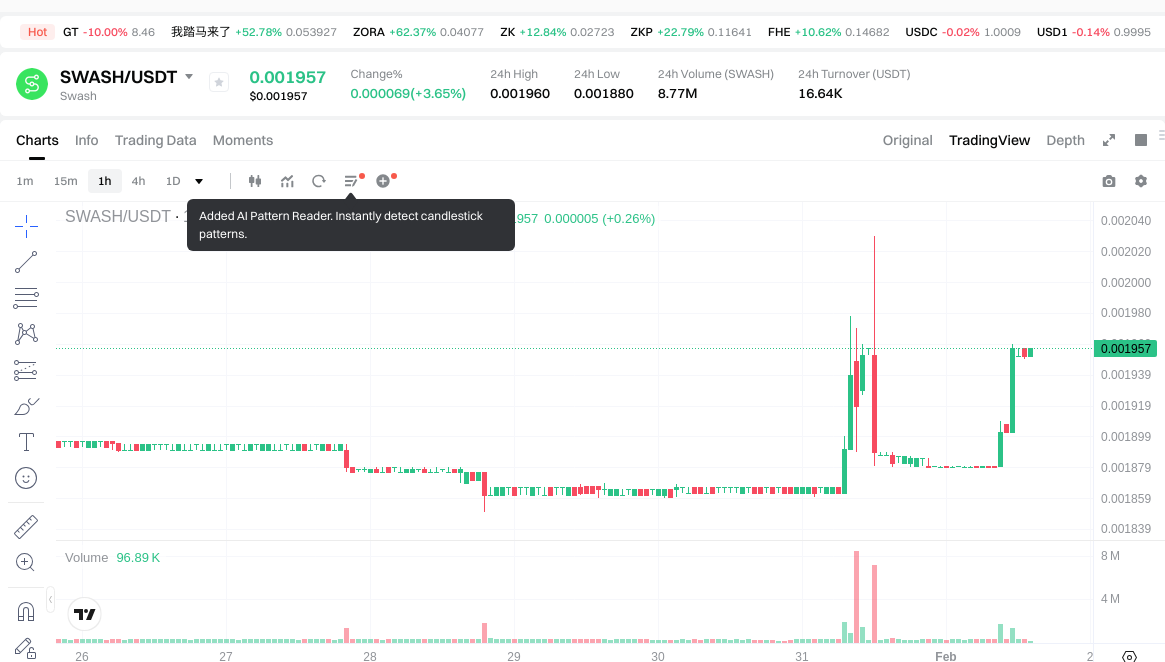
Current SWASH Investment Market Status (February 2026)
- SWASH current price: $0.001952
- Market sentiment (Fear & Greed Index): Data indicates neutral positioning among market participants
- 24-hour trading volume: $16,596.18
- Circulating supply: 994,960,022 SWASH tokens (representing 99.93% of total supply)
- Market capitalization: $1,942,161.96
- Holder distribution: 2,320 addresses currently holding SWASH tokens
Click to view real-time SWASH market price
II. Core Factors Affecting Whether SWASH is a Good Investment (Is Swash(SWASH) a Good Investment)
Supply Mechanism and Scarcity (SWASH investment scarcity)
- Total Supply and Circulation → Impact on Price and Investment Value
- SWASH has a total supply of 1,000,000,000 tokens, with a circulating supply of approximately 994,960,022 tokens, representing a circulation ratio of 99.93%. The max supply is recorded at 995,675,233.84 tokens. This high circulation ratio indicates that nearly all tokens are already in the market, which may limit scarcity-driven price appreciation compared to assets with lower circulation ratios.
- Investment Significance: The near-complete circulation of SWASH tokens means that supply-side scarcity is minimal. For investors, this suggests that price movements may be more dependent on demand dynamics, adoption rates, and ecosystem development rather than supply constraints. The lack of significant token unlock events may reduce potential dilution risks, but it also diminishes the scarcity factor that can support long-term investment value.
Institutional Investment and Mainstream Adoption (Institutional investment in SWASH)
- Holder Distribution Trends: As of the latest data, SWASH has 2,320 holders. This relatively modest holder count suggests limited widespread retail adoption and potentially minimal institutional participation compared to more established digital assets.
- Mainstream Adoption Status: The reference materials do not provide evidence of significant enterprise adoption or partnerships with well-known companies utilizing SWASH within its data economy ecosystem. The absence of such information indicates that mainstream adoption remains in early stages, which may affect its investment appeal.
- Policy and Regulatory Environment: No specific national policy impacts on SWASH investment prospects are mentioned in the available materials. Investors should monitor broader regulatory developments in the data economy and privacy sectors, as these could influence the project's operational environment and long-term viability.
Macroeconomic Environment's Impact on SWASH Investment
- Monetary Policy and Interest Rate Changes → Altering Investment Attractiveness
- During periods of tightening monetary policy and rising interest rates, risk assets including smaller-cap digital assets like SWASH may experience reduced investment appeal as capital flows toward higher-yielding, lower-risk instruments. Conversely, accommodative monetary conditions could support risk appetite for emerging digital assets.
- Inflation Environment and Hedging Role: While larger digital assets are sometimes positioned as inflation hedges, SWASH's modest market capitalization of approximately $1.94 million and limited liquidity (24-hour trading volume of $16,596.18) suggest it may not serve effectively as a macroeconomic hedge. Its investment case appears more closely tied to ecosystem-specific developments rather than broader macroeconomic trends.
- Geopolitical Uncertainty: Heightened geopolitical instability may drive interest in decentralized data economy solutions, potentially benefiting projects like SWASH. However, the lack of specific evidence in the reference materials regarding such dynamics means this factor remains speculative for SWASH investment considerations.
Technology and Ecosystem Development (Technology & Ecosystem for SWASH investment)
- Data Economy Ecosystem: SWASH operates as an ecosystem of tools and services enabling individuals, businesses, and developers to aggregate, securely share, and monetize data. Users can share data to earn income while preserving privacy; enterprises access quality data in sustainable and compliant ways; and developers can build data economy systems within a collaborative framework. This foundational value proposition represents the core technological and ecosystem foundation for potential investment value.
- Contract Deployments: SWASH has contract addresses on Ethereum (ETH) and Polygon (MATIC) networks. Multi-chain presence may enhance accessibility and interoperability within the broader digital asset ecosystem, though specific technical upgrades or performance enhancements are not detailed in the available materials.
- Ecosystem Growth Indicators: The reference materials do not provide specific information regarding DeFi integrations, NFT applications, or payment use cases directly involving SWASH. The absence of such details suggests that ecosystem expansion in these areas may be limited or under development. Long-term investment value will likely depend on the project's ability to expand partnerships, increase user adoption, and demonstrate tangible utility within the data economy sector.
- Trading Availability: SWASH is listed on one exchange according to the available data, which may constrain liquidity and accessibility for investors compared to assets with broader exchange coverage.
III. SWASH Future Investment Prediction and Price Outlook (Is Swash(SWASH) worth investing in 2026-2031)
Short-term Investment Prediction (2026, short-term SWASH investment outlook)
- Conservative prediction: $0.00182 - $0.00188
- Neutral prediction: $0.00195 - $0.00196
- Optimistic prediction: $0.00198 - $0.00202
Mid-term Investment Outlook (2027-2028, mid-term Swash(SWASH) investment forecast)
- Market stage expectation: The token may experience gradual volatility as the data monetization ecosystem develops and user adoption patterns evolve.
- Investment return prediction:
- 2027: $0.00169 - $0.00246
- 2028: $0.00127 - $0.00260
- Key catalysts: Platform user growth, data sharing partnerships expansion, and privacy technology implementation progress.
Long-term Investment Outlook (Is SWASH a good long-term investment?)
- Baseline scenario: $0.00143 - $0.00251 (assuming steady ecosystem development and moderate market conditions)
- Optimistic scenario: $0.00181 - $0.00296 (assuming increased adoption of data monetization models and favorable regulatory environment)
- Risk scenario: Below $0.00127 (under conditions of limited platform traction or adverse market sentiment)
View SWASH long-term investment and price prediction: Price Prediction
2026-02-01 - 2031 Long-term Outlook
- Baseline scenario: $0.00143 - $0.00251 USD (corresponding to steady progress and gradual mainstream application improvement)
- Optimistic scenario: $0.00181 - $0.00296 USD (corresponding to large-scale adoption and favorable market environment)
- Transformative scenario: Above $0.00339 USD (if the ecosystem achieves breakthrough progress and mainstream popularization)
- 2031-12-31 predicted high: $0.00339 USD (based on optimistic development assumptions)
Disclaimer: This analysis is for informational purposes only and does not constitute investment advice. Cryptocurrency markets are highly volatile and predictions involve uncertainty. Past performance does not guarantee future results.
| Year |
Predicted High Price |
Predicted Average Price |
Predicted Low Price |
Price Change |
| 2026 |
0.00201571 |
0.001957 |
0.00182001 |
0 |
| 2027 |
0.0024630802 |
0.001986355 |
0.00168840175 |
1 |
| 2028 |
0.002602919592 |
0.0022247176 |
0.001268089032 |
13 |
| 2029 |
0.00260692408368 |
0.002413818596 |
0.001810363947 |
23 |
| 2030 |
0.002962238181011 |
0.00251037133984 |
0.001430911663708 |
28 |
| 2031 |
0.003393017902927 |
0.002736304760425 |
0.001614419808651 |
40 |
IV. Swash Investment Strategy and Risk Management (How to invest in Swash)
Investment Strategy (Swash investment strategy)
Long-term Holding (HODL Swash)
This approach suits conservative investors who believe in Swash's long-term vision of building a data economy ecosystem. By holding SWASH tokens over an extended period, investors may benefit from potential ecosystem growth as more users, businesses, and developers participate in the data-sharing platform. This strategy requires patience and tolerance for short-term price fluctuations.
Active Trading
Active traders may leverage technical analysis and swing trading strategies based on SWASH's price movements. Given the token's historical volatility—ranging from an all-time high of $0.95025 (October 31, 2021) to an all-time low of $0.00159234 (December 2, 2025)—traders can potentially capitalize on price swings. Current 24-hour trading volume of approximately $16,596 suggests limited liquidity, which traders should consider when executing orders.
Risk Management (Risk management for Swash investment)
Asset Allocation Ratio
- Conservative Investors: Allocate no more than 1-3% of crypto portfolio to SWASH, given its lower market capitalization of approximately $1.94 million and ranking of 2076
- Aggressive Investors: May allocate 5-10% while maintaining diversification across multiple assets
- Professional Investors: Should conduct thorough due diligence on Swash's ecosystem development and data monetization model before determining allocation
Risk Hedging Solutions
Implement multi-asset portfolio strategies by combining SWASH with more established cryptocurrencies and traditional assets. Consider stablecoin positions to quickly exit during adverse market conditions. Due to SWASH's limited exchange availability (listed on 1 exchange according to available data), maintaining liquidity reserves is essential.
Secure Storage
- Cold Wallet Storage: Recommended for long-term holdings, using hardware wallets such as Ledger or Trezor
- Hot Wallet: Suitable for active trading amounts only; ensure using reputable wallets with strong security features
- Contract Addresses: SWASH is deployed on Ethereum (0xa130e3a33a4d84b04c3918c4e5762223ae252f80) and Polygon (0xbA3CB8329D442E6F9Eb70fafe1E214251df3D275); verify addresses before transactions
V. Swash Investment Risks and Challenges (Risks of investing in Swash)
Market Risk
High Volatility: SWASH has experienced significant price fluctuations, with a 1-year decline of approximately 62.76%. The current price of $0.001952 represents a substantial decrease from its historical high. Limited trading volume ($16,596 in 24 hours) may amplify price volatility and create challenges for entering or exiting positions without impacting market price.
Market Manipulation Concerns: Lower market capitalization tokens with limited liquidity can be more susceptible to price manipulation through concentrated trading activities.
Regulatory Risk
Policy Uncertainty: Data privacy and monetization face varying regulatory frameworks across jurisdictions. Changes in data protection laws (such as GDPR in Europe or similar regulations elsewhere) could impact Swash's operational model. The regulatory status of data-sharing tokens remains unclear in many regions, potentially affecting adoption and legal compliance requirements.
Compliance Requirements: As Swash operates at the intersection of data privacy and blockchain technology, evolving regulations regarding data ownership, sharing, and monetization may require significant platform adjustments.
Technical Risk
Network Security: Smart contract vulnerabilities on Ethereum and Polygon networks could expose user funds to potential exploits. With approximately 2,320 holders, the relatively small user base suggests the platform is still in early adoption stages.
Platform Development: The success of Swash depends on continuous development of its ecosystem tools and services for data aggregation, sharing, and monetization. Failure to attract sufficient users, businesses, and developers could limit network effects and token utility.
Multi-chain Complexity: Operating on both Ethereum and Polygon networks introduces cross-chain risks and potential interoperability challenges.
VI. Conclusion: Is Swash a Good Investment?
Investment Value Summary
Swash presents an innovative approach to data monetization through blockchain technology, allowing individuals to earn income from their data while preserving privacy. However, the token faces significant challenges, including a substantial price decline over the past year, limited market capitalization (approximately $1.94 million), and relatively low trading volume. With a circulating supply of approximately 994.96 million tokens (99.93% of total supply), the token economics show high circulation but limited market demand at current levels.
The project's long-term potential depends on successful ecosystem development, increased adoption by users and businesses, and effective execution of its data economy vision. Short-term price movements remain highly volatile and influenced by limited liquidity conditions.
Investor Recommendations
✅ Beginners: Consider dollar-cost averaging with very small allocations (no more than 1-2% of crypto portfolio). Prioritize secure storage using hardware wallets. Thoroughly research Swash's data-sharing model and ecosystem development before investing.
✅ Experienced Investors: May explore swing trading opportunities based on technical analysis, while maintaining strict risk management protocols. Consider ecosystem participation through the Swash platform to understand utility value. Diversify holdings across multiple assets to mitigate concentration risk.
✅ Institutional Investors: Conduct comprehensive due diligence on Swash's business model, team, technology infrastructure, and competitive landscape before any strategic allocation. Monitor regulatory developments in data privacy and blockchain sectors. Consider pilot participation in the data economy ecosystem to evaluate real-world utility.
⚠️ Disclaimer: Cryptocurrency investments carry high risk, including potential loss of principal. This content is for informational purposes only and does not constitute investment advice. Conduct thorough research and consult with qualified financial advisors before making investment decisions.
VII. FAQ
Q1: What makes Swash different from other data economy projects?
Swash distinguishes itself by creating a comprehensive ecosystem that enables individuals, businesses, and developers to participate in the data economy simultaneously. Unlike traditional data collection models, Swash allows users to monetize their data while maintaining privacy through secure sharing mechanisms. The platform operates on both Ethereum and Polygon networks, providing multi-chain accessibility. However, with a current market capitalization of approximately $1.94 million and 2,320 holders, the project remains in early adoption stages compared to more established competitors in the data monetization space.
Q2: Is Swash suitable for beginners looking to invest in cryptocurrency?
For beginners, Swash represents a high-risk investment opportunity that should only constitute a very small portion (1-2%) of a cryptocurrency portfolio. The token has experienced significant volatility, with a 62.76% decline over the past year and limited trading volume of approximately $16,596 in 24 hours. New investors should prioritize secure storage using hardware wallets, conduct thorough research on the data-sharing model, and consider dollar-cost averaging to manage risk. More established cryptocurrencies may be more appropriate for those new to digital asset investing.
Q3: What factors could drive Swash's price appreciation in the future?
Several catalysts could potentially support SWASH price growth: (1) Expansion of platform user base and increased adoption of data monetization services, (2) Strategic partnerships with businesses seeking compliant data acquisition solutions, (3) Implementation of advanced privacy technologies enhancing platform security, (4) Favorable regulatory developments supporting decentralized data economy models, and (5) Increased exchange listings improving liquidity and accessibility. However, investors should note that with near-complete token circulation (99.93%), price movements will primarily depend on demand dynamics rather than supply constraints.
Q4: How does the current macroeconomic environment affect Swash investment prospects?
Swash's investment appeal is influenced by broader macroeconomic conditions, though its small market capitalization limits its effectiveness as a macroeconomic hedge. During periods of rising interest rates and tightening monetary policy, smaller-cap digital assets like SWASH may face reduced investment demand as capital flows toward lower-risk instruments. Conversely, accommodative monetary conditions could support risk appetite for emerging projects. The token's modest 24-hour trading volume suggests its price movements are more closely tied to ecosystem-specific developments than macro trends. Geopolitical uncertainty might theoretically benefit decentralized data solutions, though concrete evidence of such correlation for Swash remains limited.
Q5: What are the primary risks investors should consider before buying Swash?
Key risks include: (1) Market Risk – high volatility with 62.76% decline over one year and limited liquidity that may amplify price swings, (2) Regulatory Risk – uncertain policy landscape regarding data privacy and monetization across different jurisdictions, particularly with evolving frameworks like GDPR, (3) Technical Risk – smart contract vulnerabilities on Ethereum and Polygon networks, and dependence on continuous platform development to attract users, (4) Adoption Risk – relatively small user base of 2,320 holders indicates early-stage adoption with uncertain network effects, and (5) Liquidity Risk – limited exchange availability (listed on 1 exchange) may create challenges for position entry and exit without market impact.
Q6: What is the long-term investment outlook for Swash through 2031?
Based on available projections, Swash presents three long-term scenarios through 2031: (1) Baseline Scenario ($0.00143 - $0.00251) assumes steady ecosystem development with moderate market conditions, (2) Optimistic Scenario ($0.00181 - $0.00296) reflects increased adoption of data monetization models and favorable regulatory environment, with a predicted high of $0.00339 by December 2031, and (3) Risk Scenario (below $0.00127) occurs under conditions of limited platform traction or adverse market sentiment. Long-term value creation depends critically on successful user acquisition, business partnerships, and demonstration of tangible utility within the data economy sector. Investors should note these predictions involve significant uncertainty given market volatility and early-stage project status.
Q7: How should investors implement proper risk management when holding Swash?
Effective risk management strategies include: (1) Asset Allocation – conservative investors should limit SWASH to 1-3% of crypto portfolio, while aggressive investors may allocate 5-10% with proper diversification, (2) Portfolio Hedging – combine SWASH with established cryptocurrencies and maintain stablecoin positions for quick exits during adverse conditions, (3) Secure Storage – use cold wallet storage (hardware wallets like Ledger or Trezor) for long-term holdings, keeping only trading amounts in hot wallets, (4) Verification – confirm official contract addresses on Ethereum (0xa130e3a33a4d84b04c3918c4e5762223ae252f80) and Polygon (0xbA3CB8329D442E6F9Eb70fafe1E214251df3D275) before transactions, and (5) Liquidity Planning – account for limited exchange availability and low trading volume when planning position sizes and exit strategies.
Q8: Can Swash serve as a long-term hold (HODL) investment strategy?
A long-term holding strategy for Swash suits conservative investors who believe in the project's data economy vision and can tolerate significant short-term volatility. This approach requires patience through price fluctuations while the ecosystem develops user adoption among individuals, businesses, and developers. However, several factors warrant careful consideration: the token has declined substantially from its all-time high of $0.95025 (October 2021) to current levels around $0.00195, near-complete circulation (99.93%) limits scarcity-driven appreciation, and the project remains in early adoption stages with 2,320 holders. Long-term success depends on Swash's ability to demonstrate tangible utility, expand partnerships, and achieve meaningful traction in the competitive data monetization space. Investors pursuing this strategy should maintain strict allocation limits and monitor ecosystem development milestones closely.
* The information is not intended to be and does not constitute financial advice or any other recommendation of any sort offered or endorsed by Gate.