This comprehensive analysis examines whether Symbol (XYM) represents a viable investment opportunity for cryptocurrency portfolios. The article evaluates XYM's current market position, currently trading at $0.003845 with a market cap of $24.4 million, alongside its historical performance and technological foundation. Key sections analyze price history from 2021's $0.726 peak through current recovery phases, core investment factors including supply mechanisms and ecosystem development, and multi-year price forecasts ranging from $0.0051 to $0.0093 by 2031. The guide provides investment methodologies, risk management strategies, and practical storage solutions while addressing regulatory and technical challenges. Comprehensive FAQ sections help beginners and experienced investors understand Symbol's differentiation, liquidity considerations on Gate, and position-sizing recommendations for this enterprise-focused blockchain platform.
Introduction: Symbol (XYM)'s Investment Position and Market Outlook
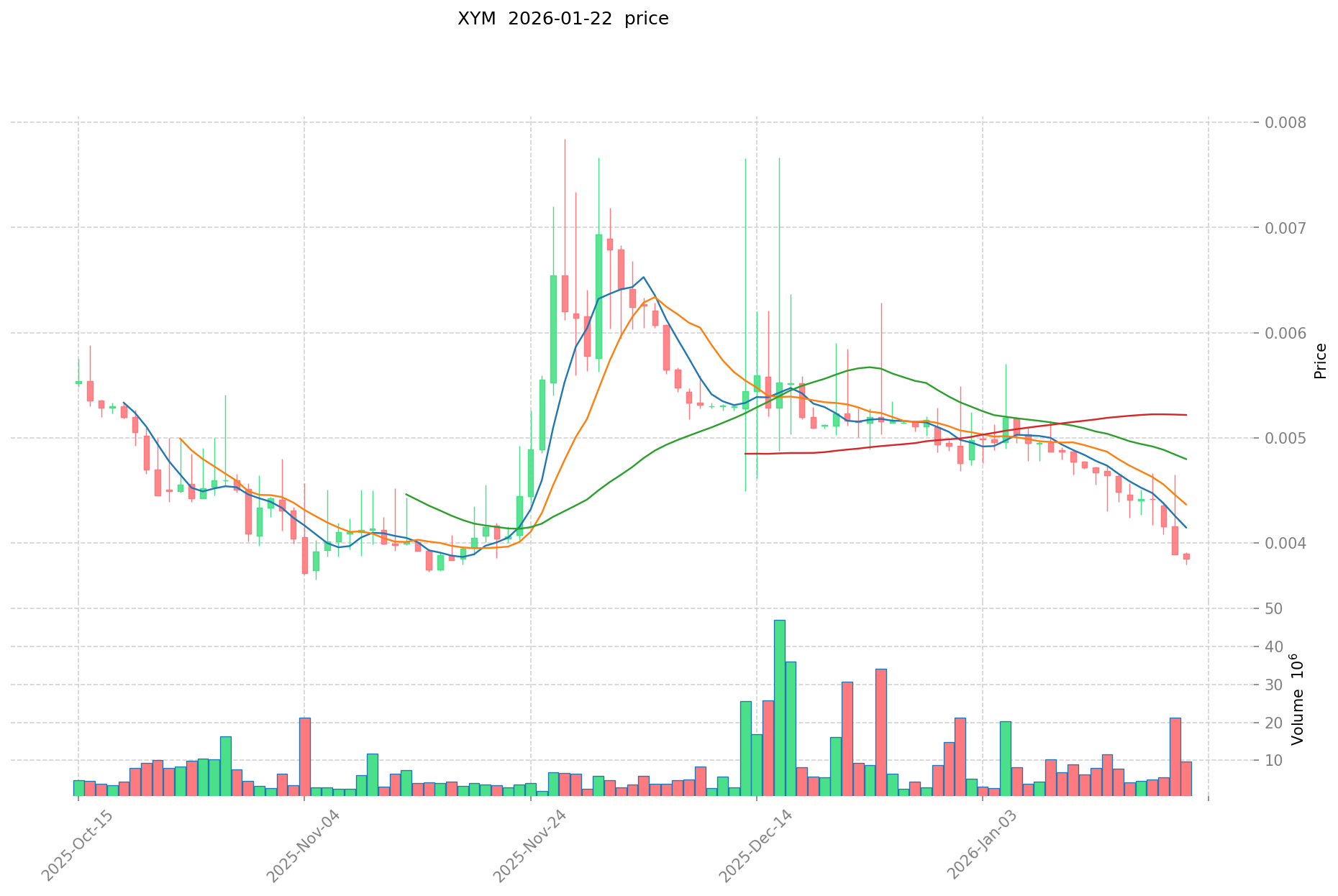
XYM is a notable asset in the cryptocurrency field. Since its launch in 2021, it has been developing within the blockchain infrastructure sector. As of January 2026, Symbol (XYM) has a market capitalization of approximately $24.40 million, with a circulating supply of about 6.35 billion tokens, and the current price is maintained around $0.003845. Positioned as a next-generation open-source decentralized platform built upon NEM's foundations, Symbol aims to facilitate secure value exchange for business applications. The platform inherits technical strengths while enhancing functionality, flexibility, and usability. As XYM serves as the native currency of the Symbol public blockchain, used for transaction fees and network incentives, it has gradually become a subject of discussion when investors consider "Is Symbol (XYM) a good investment?" This article will comprehensively analyze XYM's investment characteristics, historical price movements, future price outlook, and associated investment risks to provide reference for investors.
I. Symbol (XYM) Price History Review and Investment Value Status
- 2021: XYM reached a notable price level of $0.726222 on March 24, 2021 → Early investors experienced significant price appreciation during the initial launch period
- 2020-2021: Token launch and initial distribution → XYM was released as the native currency of Symbol public blockchain with an initial offering price of $0.06
- 2021-2025: Extended market correction cycle → Price declined from the March 2021 level to $0.00371324 recorded on November 5, 2025
- Current recovery phase: From the November 2025 low point, the price has shown modest recovery to current levels
Current XYM Investment Market Status (January 2026)
- XYM current price: $0.003845 (as of January 22, 2026)
- 24-hour trading volume: $32,760.15
- Market capitalization: $24,398,006.70
- Circulating supply: 6,345,385,356.97 XYM (representing 70.5% of maximum supply)
- Recent price performance: -0.33% (24H), -17.03% (7D), -25.6% (30D), -73.9% (1Y)
- Price range (24H): $0.003793 - $0.003912
- Market dominance: 0.0010%
- Available on 4 exchanges with Gate.com trading support
Click to view real-time XYM market price
II. Core Factors Affecting Whether XYM is a Good Investment (Is Symbol(XYM) a Good Investment)
Supply Mechanism and Scarcity (XYM investment scarcity)
- Fixed supply mechanism → impacts price and investment value
- Maximum supply capped at 8,999,999,999 XYM with current circulation of approximately 6,345,385,357 tokens, representing about 70.5% of total supply
- The controlled supply structure may provide support for long-term investment considerations
Institutional Investment and Mainstream Adoption (Institutional investment in XYM)
- XYM is listed on 4 exchanges, indicating limited mainstream market presence
- Current market capitalization stands at approximately $24.4 million with a market dominance of 0.0010%
- Limited institutional adoption data suggests the asset remains in early stages of mainstream recognition
Macroeconomic Environment's Impact on XYM Investment
- Changes in monetary policy and interest rates → may alter investment attractiveness
- Market volatility reflected in 24-hour trading volume of approximately $32,760
- Price movements show sensitivity to broader market conditions, with 7-day decline of 17.03% and 30-day decline of 25.6%
Technology and Ecosystem Development (Technology & Ecosystem for XYM investment)
- Symbol platform built as a next-generation open-source, decentralized system based on NEM's technological foundation
- Enhanced functionality, flexibility, speed, and usability compared to previous generation platforms
- XYM serves as the native currency for the Symbol public blockchain, functioning as payment for transactions and network incentivization
- Platform designed for secure value exchange and business-blockchain connectivity, supporting various asset transfers
III. XYM Future Investment Forecast and Price Outlook (Is Symbol(XYM) worth investing in 2026-2031)
Short-term Investment Forecast (2026, short-term XYM investment outlook)
- Conservative forecast: $0.0027 - $0.0039
- Neutral forecast: $0.0039 - $0.0048
- Optimistic forecast: $0.0048 - $0.0057
Mid-term Investment Outlook (2027-2029, mid-term Symbol(XYM) investment forecast)
- Market stage expectations: The mid-term outlook suggests a gradual recovery phase with potential price appreciation driven by technological developments and ecosystem expansion.
- Investment return forecast:
- 2027: $0.0039 - $0.0059
- 2028: $0.0031 - $0.0073
- 2029: $0.0045 - $0.0089
- Key catalysts: Platform adoption growth, enterprise integration developments, and broader blockchain technology acceptance.
Long-term Investment Outlook (Is Symbol a good long-term investment?)
- Baseline scenario: $0.0051 - $0.0076 (assuming steady ecosystem development and maintained market positioning)
- Optimistic scenario: $0.0076 - $0.0093 (assuming enhanced adoption rates and favorable market conditions)
- Risk scenario: $0.0027 - $0.0045 (considering potential market corrections and competitive pressures)
View XYM long-term investment and price prediction: Price Prediction
2026-01-22 to 2031 Long-term Outlook
- Baseline scenario: $0.0051 - $0.0076 USD (corresponding to steady progress and gradual mainstream application growth)
- Optimistic scenario: $0.0079 - $0.0093 USD (corresponding to large-scale adoption and favorable market environment)
- Transformative scenario: Above $0.0093 USD (in case of breakthrough ecosystem progress and mainstream popularization)
- 2031-12-31 predicted high: $0.0093 USD (based on optimistic development assumptions)
Disclaimer: These forecasts are based on historical data and market analysis models. Cryptocurrency investments carry substantial risks, and actual prices may differ materially from predictions due to market volatility, regulatory changes, technological developments, and other unforeseen factors. This information does not constitute investment advice.
| Year |
Predicted High Price |
Predicted Average Price |
Predicted Low Price |
Price Change |
| 2026 |
0.00566685 |
0.003855 |
0.0026985 |
0 |
| 2027 |
0.00585593775 |
0.004760925 |
0.0039039585 |
23 |
| 2028 |
0.0073256352975 |
0.005308431375 |
0.0030788901975 |
38 |
| 2029 |
0.008907017004112 |
0.00631703333625 |
0.0045482640021 |
64 |
| 2030 |
0.008220987183795 |
0.007612025170181 |
0.005100056864021 |
97 |
| 2031 |
0.009262312227076 |
0.007916506176988 |
0.005224894076812 |
105 |
Investment Methodology (Symbol investment strategy)
Long-term Holding (HODL Symbol): This approach may suit conservative investors who believe in the long-term potential of blockchain infrastructure projects. Symbol's technology foundation, inherited from NEM, provides a base for enterprise-level applications. However, investors should consider the token's performance trends before making decisions.
Active Trading: Traders utilizing technical analysis might consider Symbol's price movements for short-term opportunities. The 24-hour trading volume of approximately $32,760 suggests moderate liquidity levels. Price volatility is evident from recent performance data, with fluctuations observed across different timeframes.
Risk Management (Risk management for Symbol investment)
Asset Allocation Ratio:
- Conservative investors: Consider limiting exposure to a small percentage of overall portfolio
- Moderate investors: May allocate a measured portion alongside other blockchain assets
- Experienced investors: Could evaluate higher allocations based on technical analysis and market conditions
Risk Hedging Approaches: Diversification across multiple blockchain platforms and digital assets may help manage concentration risk. Combining Symbol with assets from different categories could provide portfolio balance.
Secure Storage:
- Cold wallet solutions for long-term holdings
- Hot wallets for active trading needs
- Hardware wallet options for enhanced security
- Regular security audits of storage methods
Market Risks: Symbol has experienced notable price movements, with data showing changes across various timeframes. The current price of $0.003845 reflects market conditions as of January 22, 2026. Trading volumes and liquidity conditions should be monitored regularly.
Regulatory Risks: Blockchain platforms face evolving regulatory frameworks across different jurisdictions. Policy changes in various countries could impact the adoption and operation of enterprise blockchain solutions.
Technical Risks: As an open-source blockchain platform, Symbol requires ongoing development and maintenance. Network upgrades, security considerations, and technical implementations present considerations for investors. The platform's GitHub repository provides transparency into development activities.
VI. Conclusion: Is blockchain infrastructure a Good Investment?
Investment Value Summary: Symbol represents an enterprise-focused blockchain platform with connections to the NEM ecosystem. The project aims to provide value exchange capabilities for business applications. Price performance has shown variability across different periods, and investors should evaluate current market conditions carefully.
Investor Recommendations:
✅ Newcomers: Consider dollar-cost averaging strategies combined with secure storage solutions. Research the platform's technology and use cases before investing.
✅ Experienced Investors: May evaluate tactical allocation decisions based on technical indicators and market analysis. Portfolio diversification remains important.
✅ Institutional Investors: Could assess Symbol's enterprise applications and technology infrastructure as part of broader blockchain exposure strategies.
⚠️ Notice: Cryptocurrency investments involve substantial risks, including the potential for significant losses. This content is for informational purposes only and does not constitute investment advice. Investors should conduct their own research and consider their financial situation before making investment decisions.
VII. FAQ
Q1: Is Symbol (XYM) a good investment for beginners in 2026?
Symbol may present challenges for beginners due to its limited market presence and recent price volatility. With a current market capitalization of approximately $24.4 million and a market dominance of only 0.0010%, XYM remains a small-cap cryptocurrency with relatively low liquidity. The token has experienced significant declines, including -17.03% over 7 days and -73.9% over the past year as of January 2026. For newcomers, starting with more established blockchain platforms and using dollar-cost averaging strategies while maintaining small position sizes would be prudent approaches if considering XYM exposure.
Q2: What makes Symbol (XYM) different from other blockchain platforms?
Symbol is positioned as a next-generation open-source decentralized platform built upon NEM's technological foundation. The platform enhances functionality, flexibility, speed, and usability compared to its predecessor, specifically designed for enterprise-level applications and secure value exchange. XYM serves as the native currency for the Symbol public blockchain, used for transaction fees and network incentivization. However, with availability on only 4 exchanges and limited mainstream adoption compared to other blockchain platforms, Symbol remains in early stages of market recognition despite its technical capabilities.
Q3: What is the long-term price outlook for Symbol through 2031?
Based on current market analysis, Symbol's long-term forecast ranges from $0.0051 to $0.0093 by 2031 under various scenarios. The baseline scenario projects $0.0051 - $0.0076, assuming steady ecosystem development. The optimistic scenario suggests $0.0079 - $0.0093 with enhanced adoption rates. Price predictions show potential gradual appreciation: 2027 ($0.0039 - $0.0059), 2028 ($0.0031 - $0.0073), and 2029 ($0.0045 - $0.0089). However, these forecasts carry substantial uncertainty due to market volatility, regulatory changes, and competitive dynamics. Actual prices may differ materially from predictions.
Q4: What are the main risks of investing in Symbol (XYM)?
Symbol investment involves multiple risk categories. Market risks include high price volatility, limited liquidity with 24-hour trading volume around $32,760, and concentration risk from low market dominance. Regulatory risks stem from evolving blockchain frameworks across jurisdictions that could impact enterprise adoption. Technical risks involve ongoing development requirements, network security considerations, and platform maintenance needs. The current circulating supply of 6.35 billion tokens (70.5% of maximum supply) and recent performance showing multi-timeframe declines highlight the volatile nature of this asset.
Q5: How should investors approach Symbol (XYM) position sizing?
Position sizing for Symbol should reflect individual risk tolerance and investment experience. Conservative investors might limit XYM exposure to a minimal percentage of their portfolio, given the token's small market cap and volatility. Moderate investors could allocate a measured portion alongside other blockchain assets as part of diversification strategy. Experienced investors may evaluate higher allocations based on technical analysis and market conditions, but should maintain portfolio balance across multiple asset categories. Regardless of experience level, avoiding concentration risk and implementing proper risk management through diversification across different blockchain platforms remains essential.
Q6: What storage options are recommended for holding Symbol (XYM)?
Symbol investors should select storage solutions based on their holding strategy and security needs. For long-term holders, cold wallet solutions provide enhanced security by keeping assets offline. Hardware wallets offer additional protection through physical device security for significant holdings. Active traders may utilize hot wallets for operational convenience, though these carry higher security risks. Regardless of storage method chosen, implementing regular security audits, maintaining backup protocols, and following best practices for private key management are critical. Consider using multiple storage approaches for different portions of holdings to balance security and accessibility.
Q7: How does Symbol's supply mechanism affect its investment potential?
Symbol operates with a fixed supply mechanism, capped at 8,999,999,999 XYM tokens. As of January 2026, approximately 6,345,385,357 tokens are in circulation, representing about 70.5% of total supply. This controlled supply structure theoretically provides scarcity characteristics that could support long-term value considerations. However, the impact of supply mechanics on price depends significantly on demand factors, including platform adoption, enterprise integration, and broader market conditions. The remaining 29.5% of tokens yet to enter circulation represents future supply pressure that investors should factor into valuation assessments.
Q8: What catalysts could drive Symbol (XYM) adoption in coming years?
Potential growth catalysts for Symbol include increased enterprise blockchain adoption, particularly in business applications requiring secure value exchange. Platform technological developments, ecosystem expansion, and successful enterprise integrations could drive demand for XYM tokens. Broader blockchain technology acceptance and favorable regulatory frameworks in key markets may support adoption. However, Symbol faces competitive pressures from established blockchain platforms and must demonstrate clear value propositions to attract users. The platform's connection to NEM's legacy provides foundational technology, but converting this into mainstream adoption requires execution on development roadmaps and market positioning strategies.
* The information is not intended to be and does not constitute financial advice or any other recommendation of any sort offered or endorsed by Gate.