This comprehensive analysis examines Synthetix (SNX) as an investment opportunity, covering its market position, price history, and future outlook through 2031. Currently trading at $0.4611 with a $158.37 million market cap, SNX offers exposure to the decentralized synthetic asset ecosystem while presenting significant volatility risks, evidenced by its 75.86% year-over-year decline. The article evaluates SNX across multiple dimensions: supply mechanics (99.88% circulating), institutional adoption (51 exchanges including Gate), and DeFi ecosystem development. Investment forecasts range from conservative to optimistic scenarios, with 2031 projections reaching $1.057 under favorable conditions. The guide provides tailored strategies for beginners, experienced traders, and institutional investors, emphasizing risk management through diversification and secure storage solutions. Regulatory uncertainty, technical vulnerabilities, and market volatility emerge as primary risk factors, requiring careful consideration
Introduction: Synthetix (SNX) Investment Position and Market Outlook
SNX is a significant asset in the cryptocurrency sector, launched in March 2018 and has achieved notable development in decentralized derivatives and synthetic asset protocols. As of January 2026, Synthetix maintains a market capitalization of approximately $158.37 million, with a circulating supply of around 343.47 million tokens, and the current price stands at approximately $0.4611. Positioned as a platform enabling synthetic asset creation and trading, SNX has gradually become a focal point for investors discussing "Is Synthetix (SNX) a good investment?" With contract addresses deployed on both Ethereum and Optimism networks, the token supports various synthetic assets including fiat currencies pegged to the US dollar, precious metals, indices, and other cryptocurrencies. This article provides a comprehensive analysis of SNX's investment value, historical price movements, future price predictions, and associated risks, offering reference insights for potential investors in the evolving DeFi landscape.
I. Synthetix (SNX) Price History Review and Current Investment Value
-
2021: Synthetix experienced significant market activity during the DeFi boom, with the protocol's total locked value growing substantially as decentralized finance gained mainstream attention. The platform evolved from its original Havven identity into a comprehensive synthetic asset protocol.
-
2020-2021: The DeFi explosion period saw Synthetix become a cornerstone protocol for synthetic assets. The platform introduced multi-collateral lending and short selling capabilities using sUSD, expanding its functionality beyond basic asset synthesis. During this period, Synthetix integrated Chainlink's oracle services for reliable price feeds.
-
2024-2025: Market conditions showed volatility across the crypto sector. SNX, like many altcoins, experienced price fluctuations in response to broader market trends, including Bitcoin's movements and evolving DeFi narratives.
Current SNX Investment Market Status (January 2026)
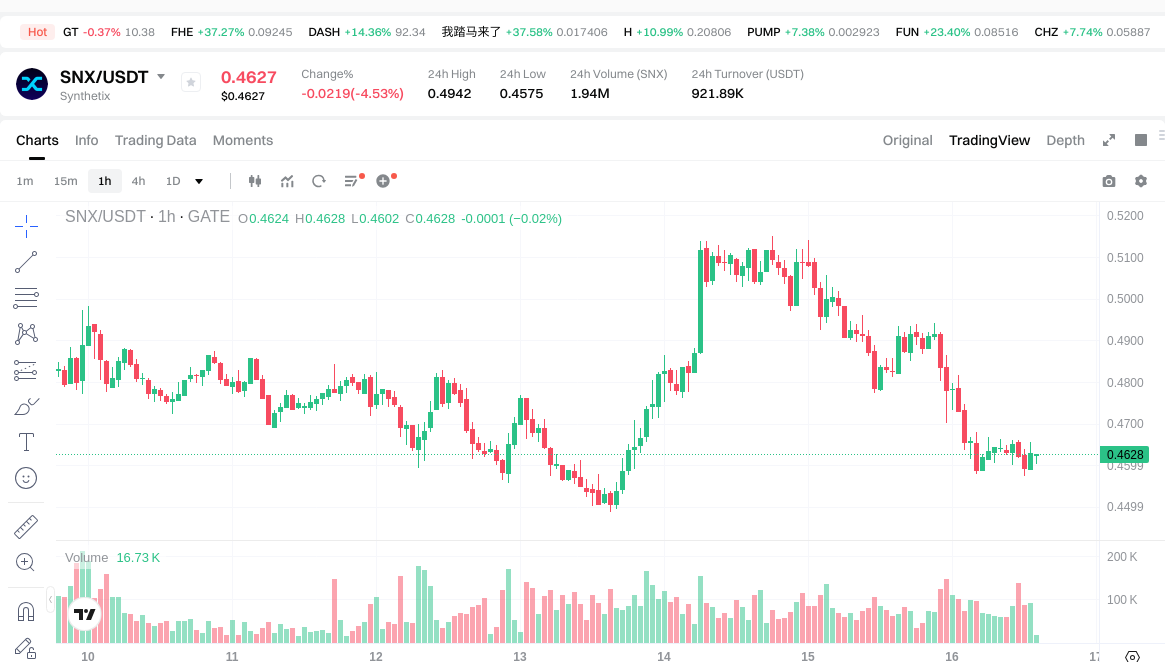
- SNX Current Price: $0.4611
- Market Sentiment: The broader crypto market experienced significant volatility in late 2025, with a major de-leveraging event in October affecting sentiment across altcoins. Current market conditions reflect recovery from extreme fear levels.
- 24-Hour Trading Volume: $924,490
- Circulating Supply: 343,466,216 SNX (99.88% of total supply)
- Market Capitalization: Approximately $158 million
- Total Value Locked: Historical data indicates Synthetix protocol maintained substantial locked assets, though specific current figures require verification
Click to view real-time SNX market price
II. Core Factors Influencing Whether SNX is a Good Investment
Supply Mechanism and Scarcity (SNX Investment Scarcity)
- SNX has a maximum supply of 343,889,850 tokens, with a current circulating supply of 343,466,216 tokens, representing approximately 99.88% of the total supply already in circulation.
- The near-complete circulation of SNX tokens indicates limited future supply expansion, which may contribute to price stability relative to supply-side pressures.
- Investment significance: The high circulation ratio suggests that scarcity dynamics are already largely reflected in the current market structure, making supply-side factors less of a driver for future price appreciation compared to demand-side developments.
Institutional Investment and Mainstream Adoption (Institutional Investment in SNX)
- SNX is listed on 51 exchanges as of January 16, 2026, indicating a degree of accessibility and market liquidity for both retail and institutional participants.
- The protocol's focus on decentralized synthetic assets positions it within the broader DeFi ecosystem, which has attracted institutional interest in recent years, though specific institutional holdings data for SNX is not provided in the reference materials.
- As a DeFi protocol, Synthetix's value proposition depends on continued adoption of synthetic asset trading, which may be influenced by regulatory clarity and institutional participation in decentralized finance.
Macroeconomic Environment's Impact on SNX Investment
- As a DeFi token, SNX's investment attractiveness may be influenced by broader cryptocurrency market sentiment, which is often affected by monetary policy changes, interest rate adjustments, and macroeconomic conditions.
- In periods of heightened inflation or economic uncertainty, decentralized finance protocols like Synthetix may experience increased interest as alternative financial infrastructure, though this relationship is not guaranteed.
- Regulatory developments affecting cryptocurrency markets and DeFi protocols could significantly impact SNX's investment outlook, as policy changes may affect trading volumes, liquidity, and overall market participation.
Technology and Ecosystem Development (Technology & Ecosystem for SNX Investment)
- Synthetix operates as a decentralized protocol designed to enable the creation and trading of synthetic assets, including those representing fiat currencies, commodities, indices, and other cryptocurrencies.
- The protocol requires users to stake SNX tokens as collateral to mint synthetic assets, creating a direct utility relationship between token holdings and protocol functionality.
- SNX is deployed on both Ethereum (contract: 0xC011a73ee8576Fb46F5E1c5751cA3B9Fe0af2a6F) and Optimism (contract: 0x8700dAec35aF8Ff88c16BdF0418774CB3D7599B4), indicating multi-chain infrastructure that may enhance accessibility and reduce transaction costs for users.
- The protocol's value proposition is tied to the growth of decentralized synthetic asset trading, and its long-term investment viability depends on continued technological development, user adoption, and competitive positioning within the DeFi landscape.
III. SNX Future Investment Forecast and Price Outlook (Is Synthetix(SNX) worth investing in 2026-2031)
Short-term Investment Forecast (2026, short-term SNX investment outlook)
Based on available market analysis, SNX price projections for 2026 show varied scenarios:
- Conservative forecast: $0.285 - $0.461 (reflecting potential downward pressure in Q4 2026)
- Neutral forecast: $0.461 - $0.667 (representing average trading scenarios throughout the year)
- Optimistic forecast: $0.667 - $0.800 (corresponding to favorable market conditions and positive sentiment)
Short-term indicators suggest potential volatility, with 24-hour projections showing approximately -2.48% movement to $0.471, and 7-day forecasts indicating possible decline to $0.4285. However, 30-day predictions point to potential recovery with +6.42% growth to $0.514.
Mid-term Investment Outlook (2027-2029, mid-term Synthetix(SNX) investment forecast)
-
Market stage expectation: Gradual recovery and consolidation phase, with potential for steady appreciation as the protocol matures and expands its synthetic asset offerings
-
Investment return forecast:
- 2027: $0.376 - $0.666 (representing 4% average price change from 2026 baseline)
- 2028: $0.505 - $0.821 (corresponding to 24% average growth trajectory)
- 2029: $0.558 - $0.949 (reflecting 51% cumulative appreciation potential)
-
Key catalysts: Global digital asset regulatory developments, technological advancements in the DeFi sector, protocol upgrades, and adoption rates of synthetic assets across the broader crypto ecosystem
Long-term Investment Outlook (Is SNX a good long-term investment?)
-
Base scenario: $0.535 - $0.938 (2030-2031) (assuming steady protocol development, moderate market conditions, and gradual increase in synthetic asset adoption)
-
Optimistic scenario: $0.819 - $1.057 (2030-2031) (corresponding to accelerated DeFi growth, favorable regulatory environment, and significant expansion of the Synthetix ecosystem)
-
Risk scenario: Below $0.319 (under adverse market conditions, regulatory challenges, or significant protocol disruptions)
For detailed SNX long-term investment analysis and price predictions: Price Prediction
2026-2031 Long-term Outlook
-
Base scenario: $0.535 - $0.881 (corresponding to steady progress and gradual mainstream application growth)
-
Optimistic scenario: $0.819 - $1.057 (corresponding to large-scale adoption and favorable market environment)
-
Transformative scenario: Above $1.057 (in case of breakthrough ecosystem developments and mainstream popularization)
-
December 31, 2031 projected high: $1.057 (based on optimistic development assumptions)
Disclaimer: Price predictions are speculative and based on technical analysis, historical data, and market trends. Cryptocurrency investments carry inherent risks, and past performance does not guarantee future results. Market conditions, regulatory changes, technological developments, and macroeconomic factors can significantly impact actual prices. This information is for educational purposes only and should not be considered as financial or investment advice.
| Year |
Predicted High Price |
Predicted Average Price |
Predicted Low Price |
Price Change |
| 2026 |
0.503253 |
0.4617 |
0.318573 |
0 |
| 2027 |
0.66581757 |
0.4824765 |
0.37633167 |
4 |
| 2028 |
0.82103026005 |
0.574147035 |
0.5052493908 |
24 |
| 2029 |
0.948720560634 |
0.697588647525 |
0.55807091802 |
51 |
| 2030 |
0.93839624865063 |
0.8231546040795 |
0.535050492651675 |
78 |
| 2031 |
1.056930511638078 |
0.880775426365065 |
0.81912114651951 |
90 |
IV. Synthetix Investment Strategy and Risk Management (How to invest in Synthetix)
Investment Methodology (Synthetix investment strategy)
Long-term Holding (HODL SNX)
Long-term holding strategies may be suitable for investors with a conservative risk profile. This approach involves acquiring SNX tokens and maintaining positions over extended periods, potentially reducing exposure to short-term price fluctuations. Investors considering this method typically focus on the fundamental development of the Synthetix protocol and its ecosystem growth rather than daily market movements.
Active Trading
Active trading approaches rely on technical analysis and swing trading techniques. Given SNX's historical price volatility, with 24-hour changes reaching -4.82% and 7-day fluctuations of -5.60%, traders may identify opportunities through chart patterns, support and resistance levels, and momentum indicators. This strategy requires continuous market monitoring and understanding of cryptocurrency market dynamics.
Risk Management (Risk management for Synthetix investment)
Asset Allocation Ratios
- Conservative Investors: May consider allocating a smaller percentage (1-3%) of their cryptocurrency portfolio to SNX, focusing primarily on established digital assets.
- Moderate Investors: Could allocate 3-8% of their crypto holdings to SNX, balancing potential growth with risk diversification.
- Experienced Investors: Might allocate 8-15% or more, depending on their risk tolerance and market outlook, while maintaining broader portfolio diversification.
Risk Hedging Solutions
Implementing a multi-asset portfolio approach can help mitigate concentration risk. Investors may consider:
- Diversifying across different cryptocurrency categories (Layer 1 protocols, DeFi tokens, stablecoins)
- Utilizing stablecoin positions to preserve capital during volatile periods
- Considering derivative instruments where available for hedging purposes
Secure Storage
Cold and Hot Wallet Solutions:
- Hot Wallets: Suitable for active traders who need frequent access to their SNX tokens. These include mobile wallets and exchange wallets, though they carry higher security risks.
- Cold Wallets: Recommended for long-term holders. Hardware wallets such as Ledger and Trezor provide offline storage solutions that significantly reduce exposure to online threats.
Hardware Wallet Recommendations:
Investors holding substantial SNX positions should consider hardware wallet solutions that support ERC-20 tokens (for Ethereum mainnet) and Optimism network compatibility, as SNX operates on both networks.
V. Synthetix Investment Risks and Challenges (Risks of investing in Synthetix)
Market Risk
High Volatility: SNX has demonstrated significant price volatility, with a 1-year decline of -75.86% from previous levels. The token's 24-hour price range between $0.4575 and $0.4942 illustrates ongoing price fluctuations. Historical data shows SNX reached an all-time high of $28.53 on February 14, 2021, compared to its current price of $0.4611, representing substantial drawdown from peak levels.
Price Manipulation Concerns: As with many cryptocurrency assets, lower liquidity periods may present risks related to market manipulation. The 24-hour trading volume of $924,490 indicates varying liquidity levels that could impact price stability.
Regulatory Risk
Different jurisdictions maintain varying regulatory frameworks for decentralized finance (DeFi) protocols and synthetic assets. Synthetix's operation as a decentralized synthetic asset platform may face:
- Potential regulatory scrutiny regarding synthetic asset creation and trading
- Varying compliance requirements across different countries
- Evolving regulatory frameworks that could impact protocol operations
- Uncertainty regarding the classification of synthetic assets and governance tokens
Investors should monitor regulatory developments in their respective jurisdictions and assess potential impacts on Synthetix protocol operations.
Technical Risk
Network Security Vulnerabilities: As a DeFi protocol, Synthetix faces potential smart contract risks. While the project maintains active development on GitHub with repositories for both the core protocol and SDK, investors should be aware that:
- Smart contract vulnerabilities could potentially be exploited
- Protocol upgrades may introduce unforeseen technical challenges
- Integration with multiple blockchain networks (Ethereum and Optimism) creates additional complexity
Upgrade Implementation Risks: Protocol modifications and network upgrades carry inherent risks. Failed or problematic upgrades could temporarily disrupt protocol functionality or user access to their assets.
VI. Conclusion: Is Synthetix a Good Investment?
Investment Value Summary
Synthetix (SNX) presents a complex investment profile characterized by both potential opportunities and significant risks. The protocol's focus on synthetic asset creation within the DeFi ecosystem offers exposure to an evolving segment of cryptocurrency markets. However, the token has experienced substantial price decline over the past year (-75.86%), and short-term price movements remain volatile.
Key considerations include:
- Market capitalization of approximately $158.37 million with a circulating supply of 343.47 million tokens (99.88% of maximum supply)
- Established presence with 86,380 holders and availability on 51 exchanges
- Active development as evidenced by maintained GitHub repositories
- Multi-chain deployment on both Ethereum and Optimism networks
Investor Recommendations
✅ Beginners:
- Consider dollar-cost averaging (DCA) strategies to mitigate timing risk
- Prioritize secure storage using hardware wallets or reputable custody solutions
- Allocate only capital that can be afforded to lose
- Conduct thorough research on Synthetix protocol mechanics before investing
✅ Experienced Investors:
- Evaluate swing trading opportunities based on technical analysis and market conditions
- Implement portfolio allocation strategies aligned with risk tolerance
- Monitor protocol developments and ecosystem growth metrics
- Consider correlation with broader DeFi market trends
✅ Institutional Investors:
- Assess strategic long-term allocation potential within DeFi exposure
- Evaluate regulatory compliance requirements in relevant jurisdictions
- Consider liquidity requirements and market depth for position sizing
- Monitor protocol governance and development trajectory
⚠️ Important Notice: Cryptocurrency investments carry substantial risk, including potential loss of principal. Market volatility, regulatory uncertainty, and technical risks should be carefully evaluated. This content is provided for informational purposes only and does not constitute investment advice, financial advice, trading advice, or recommendations. Investors should conduct independent research and consult with qualified financial professionals before making investment decisions.
VII. FAQ
Q1: What is the current price of Synthetix (SNX) and is it a good entry point for investment?
As of January 2026, SNX is trading at approximately $0.4611 with a market capitalization of $158.37 million. Whether this represents a good entry point depends on your investment strategy and risk tolerance. The token has experienced a significant 75.86% decline over the past year from higher levels, which could suggest either a value opportunity or ongoing downward pressure. Short-term technical indicators show mixed signals, with 7-day forecasts suggesting potential decline to $0.4285, while 30-day predictions indicate possible recovery to $0.514 (+6.42%). Conservative investors might consider dollar-cost averaging to mitigate timing risk, while experienced traders could evaluate technical support and resistance levels. It's crucial to note that SNX reached an all-time high of $28.53 in February 2021, meaning the current price represents substantial distance from peak levels.
Q2: How does Synthetix's supply mechanism affect its investment potential?
SNX has a maximum supply of 343,889,850 tokens, with 343,466,216 tokens currently in circulation, representing 99.88% of the total supply already released. This near-complete circulation significantly impacts investment dynamics. Unlike cryptocurrencies with substantial future emissions, SNX's price movements will primarily be driven by demand-side factors rather than supply expansion concerns. The high circulation ratio means scarcity dynamics are largely reflected in the current market structure, reducing potential dilution risks for existing holders. However, this also suggests that supply-side scarcity alone is unlikely to be a major catalyst for future price appreciation, making protocol adoption and ecosystem growth more critical factors for investment value.
Q3: What are the key risks associated with investing in Synthetix?
Investing in SNX involves several significant risk categories. Market risk is substantial, evidenced by high volatility and the 75.86% year-over-year decline. The token's 24-hour trading volume of $924,490 suggests varying liquidity levels that could impact price stability during periods of selling pressure. Regulatory risk represents another concern, as Synthetix operates as a DeFi protocol creating synthetic assets, which may face evolving compliance requirements across different jurisdictions. Technical risks include potential smart contract vulnerabilities, protocol upgrade complications, and challenges associated with multi-chain deployment on both Ethereum and Optimism networks. Additionally, the protocol's value proposition depends on continued adoption of synthetic asset trading, which is not guaranteed and faces competition from other DeFi protocols.
Q4: What is the long-term price forecast for SNX and what factors could influence it?
Long-term price projections for SNX through 2031 show varied scenarios. The base scenario estimates prices ranging from $0.535 to $0.938 by 2030-2031, representing steady but modest growth from current levels. An optimistic scenario projects $0.819 to $1.057, contingent on favorable conditions including accelerated DeFi adoption, positive regulatory developments, and significant Synthetix ecosystem expansion. By December 31, 2031, the optimistic forecast suggests a potential high of $1.057. Key factors influencing these outcomes include: global regulatory frameworks for DeFi and synthetic assets, technological advancement in the protocol, competition within the DeFi sector, broader cryptocurrency market trends, and the rate of synthetic asset adoption. It's important to note that these projections are speculative and based on technical analysis, and actual prices may significantly differ due to unforeseen market developments, regulatory changes, or technological disruptions.
Q5: How should different investor types approach SNX investment?
Investment approaches should align with experience level and risk tolerance. Beginners should consider conservative strategies such as dollar-cost averaging (DCA) to mitigate timing risk, allocate only 1-3% of their cryptocurrency portfolio to SNX, prioritize secure storage using hardware wallets, and thoroughly research Synthetix protocol mechanics before investing. Experienced investors might pursue active trading strategies based on technical analysis, allocate 3-8% of crypto holdings to SNX, implement swing trading approaches to capitalize on volatility, and monitor protocol developments and DeFi market trends closely. Institutional investors should evaluate strategic long-term allocation potential within broader DeFi exposure, assess regulatory compliance requirements in relevant jurisdictions, consider liquidity requirements for position sizing given the $924,490 daily volume, and monitor protocol governance structures. All investor categories should maintain diversified portfolios and avoid concentration risk.
Q6: What makes Synthetix different from other DeFi protocols?
Synthetix distinguishes itself through its focus on synthetic asset creation and trading, enabling users to gain exposure to various assets including fiat currencies, precious metals, indices, and cryptocurrencies without directly holding the underlying assets. The protocol requires users to stake SNX tokens as collateral to mint synthetic assets, creating direct utility between token holdings and protocol functionality. Synthetix operates on both Ethereum (contract: 0xC011a73ee8576Fb46F5E1c5751cA3B9Fe0af2a6F) and Optimism (contract: 0x8700dAec35aF8Ff88c16BdF0418774CB3D7599B4), providing multi-chain infrastructure that enhances accessibility and reduces transaction costs. The protocol has evolved significantly since its 2018 launch as Havven, integrating Chainlink oracle services for reliable price feeds and introducing multi-collateral lending and short selling capabilities. However, its success depends on continued adoption of synthetic asset trading, which faces competition from other DeFi protocols and depends on user demand for decentralized synthetic exposure.
Q7: Where can I buy SNX and how should I store it securely?
SNX is available on 51 exchanges as of January 2026, providing multiple options for acquisition. When selecting an exchange, consider factors such as trading fees, liquidity, regulatory compliance, and security track record. For storage, investors should choose between hot and cold wallet solutions based on their trading frequency and security preferences. Hot wallets, including mobile and exchange wallets, offer convenience for active traders but carry higher security risks. Cold wallets, particularly hardware wallets such as Ledger and Trezor, are recommended for long-term holders and those with substantial SNX positions. These hardware solutions provide offline storage that significantly reduces exposure to online threats. Ensure your chosen wallet supports ERC-20 tokens for Ethereum mainnet and has Optimism network compatibility, as SNX operates on both networks. Never store significant amounts on exchanges for extended periods, and always enable two-factor authentication and other available security features.
Q8: Is now the right time to invest in Synthetix for 2026?
Whether 2026 represents an opportune time to invest in SNX depends on multiple factors and individual circumstances. Current market conditions show recovery from extreme fear levels following October 2025's de-leveraging event, potentially offering entry opportunities for risk-tolerant investors. Technical indicators present mixed signals: short-term forecasts suggest potential volatility with 7-day predictions showing possible decline to $0.4285, while 30-day projections indicate recovery potential to $0.514. The 2026 full-year forecast ranges from conservative estimates of $0.285-$0.461 to optimistic scenarios of $0.667-$0.800. Market factors supporting investment include SNX's established presence in the DeFi sector, active development, and multi-chain infrastructure. However, challenging factors include the 75.86% year-over-year decline, regulatory uncertainty, and competitive pressures within DeFi. Rather than attempting to time the market perfectly, investors should focus on their investment horizon, risk tolerance, and portfolio allocation strategy. Dollar-cost averaging may be appropriate for those seeking to build positions while managing volatility risk.
* The information is not intended to be and does not constitute financial advice or any other recommendation of any sort offered or endorsed by Gate.