Tagger (TAG) is a decentralized AI data solutions platform launched in December 2024, operating in the emerging intersection of blockchain and artificial intelligence. This comprehensive analysis evaluates TAG's investment potential through multiple dimensions: historical price performance showing a 625.63% one-year return despite recent volatility, current market position with $45.13 million market cap and 26,147 token holders, and core investment factors including institutional partnerships ($9.89M in enterprise deals), proprietary AI Copilot labeling technology, and supply dynamics. The article projects TAG price forecasts across conservative, moderate, and optimistic scenarios through 2031, with base case estimations of $0.000575-$0.000769. Critical investment considerations include market risks from limited liquidity, regulatory uncertainties, technical vulnerabilities on BSC infrastructure, and significant token supply overhang (73.26% unlocked). Strategic recommendations address different investor prof
Introduction: Tagger (TAG) Investment Position and Market Outlook
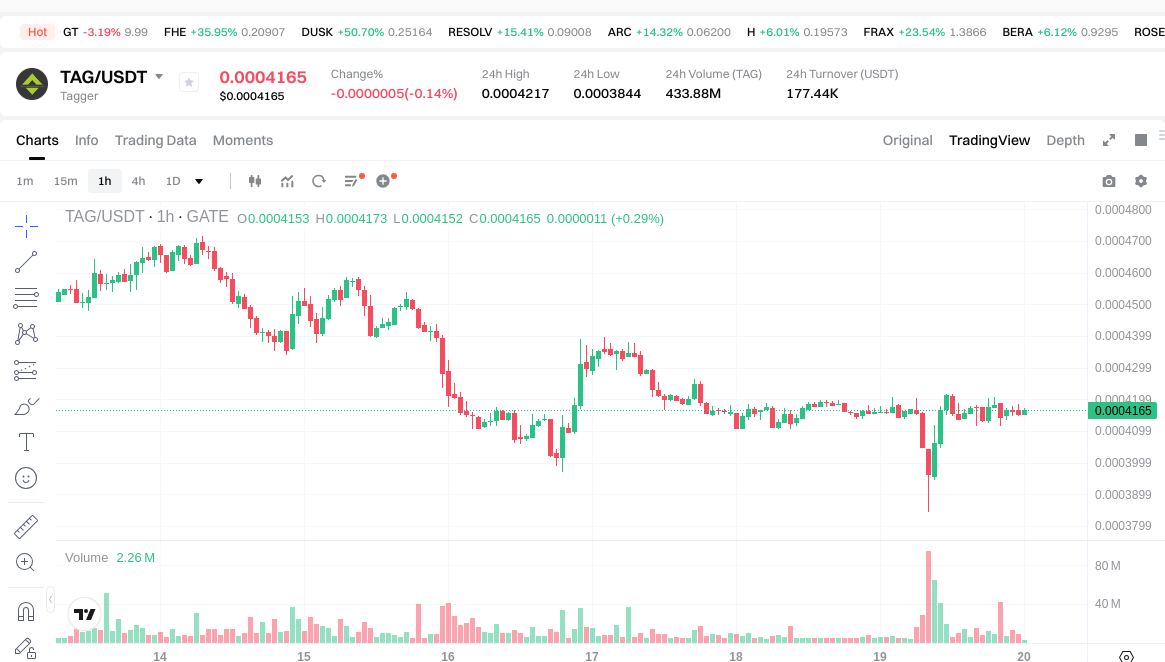
Tagger (TAG) represents a notable asset in the cryptocurrency sector, launched in 2024, and has positioned itself within the decentralized AI data solutions domain. As of January 20, 2026, TAG maintains a market capitalization of approximately $45.13 million, with a circulating supply of around 108.40 billion tokens, and a current price level near $0.0004163. Characterized as a permissionless hub for AI data labeling, collection, management, and trading, Tagger has gradually become a focal point when investors discuss "Is Tagger (TAG) a good investment?" This article provides a comprehensive analysis of TAG's investment characteristics, historical performance, future price outlook, and associated risks, offering reference materials for market participants.
I. Tagger (TAG) Historical Price Review and Current Investment Value
- 2025: TOKEN LAUNCH AND INITIAL TRADING → TAG was launched on December 27, 2024, establishing its initial market presence in the decentralized AI data solutions sector.
- August 2025: PEAK VALUATION PERIOD → TAG reached a price level of $0.0012772, representing a significant appreciation from its launch period.
- October 2025: MARKET CORRECTION PHASE → Price declined to $0.0001298, reflecting broader market volatility and sector-specific adjustments.
- Late 2025 to Early 2026: RECOVERY AND CONSOLIDATION → TAG demonstrated resilience with a one-year price change showing substantial growth, moving from lower valuation levels toward the current trading range.
Current TAG Investment Market Status (January 2026)
- TAG Current Price: $0.0004163
- Market Sentiment (Fear & Greed Index): 19 (Extreme Fear)
- 24-Hour Trading Volume: $177,278.15
- Circulating Supply: 108.4 billion TAG tokens
- Market Capitalization: $45.13 million
- Fully Diluted Valuation: $168.76 million
- Token Holders: 26,147 addresses
- Listed Exchanges: 11 platforms
Click to view real-time TAG market price
- 1-Hour Change: -0.16%
- 24-Hour Change: -0.19%
- 7-Day Change: -8.17%
- 30-Day Change: -27.31%
- 1-Year Change: +625.63%
The current market environment reflects a period of consolidation, with TAG trading approximately 67.4% below its August 2025 peak. The circulating supply represents 26.74% of the maximum supply of 405.38 billion tokens. Trading activity remains distributed across multiple platforms, with BSC serving as the primary blockchain infrastructure for TAG token deployment.
II. Core Factors Influencing Whether TAG is a Good Investment
Supply Mechanism and Scarcity (TAG Investment Scarcity)
- Supply structure: Tagger (TAG) has a maximum supply of 405,380,800,000 tokens, with approximately 108,404,572,594 tokens currently in circulation, representing roughly 26.74% of the total supply.
- Token burn activity: According to available data, approximately 11.6 million tokens were zeroed out in 2025, with the majority concentrated in Q4, potentially affecting circulating supply dynamics.
- Investment implication: The large gap between circulating supply and maximum supply suggests continued token releases may dilute scarcity effects over time, which investors should consider when evaluating long-term value retention.
Institutional Investment and Mainstream Adoption (Institutional Investment in TAG)
- Enterprise partnerships: Tagger secured $9.89 million in enterprise deals since July 2025, including a $5 million computer-vision contract with Stables Money and Huawei Cloud, indicating growing institutional interest in the platform's AI data solutions.
- Market presence: TAG is currently listed on 11 exchanges and has approximately 26,147 holders, reflecting moderate but growing adoption within the crypto community.
- Ecosystem positioning: As a decentralized AI data solutions platform, Tagger operates in the intersection of blockchain and artificial intelligence sectors, areas that have attracted increasing institutional attention for their potential applications in data labeling, collection, and management.
Technology and Ecosystem Development (Technology & Ecosystem for TAG Investment)
- AI Copilot Tool: Tagger's proprietary AI Copilot labeling tool enables users to produce annotations for images, text, video, and audio across specialized fields such as medical diagnostics, agriculture, and autonomous vehicles, regardless of professional expertise level.
- Platform functionality: TAG serves as the native utility token for incentivizing data work, paying for data services, and facilitating transactions within Tagger's decentralized data marketplace.
- Cross-border protocol: The platform aims to establish a cross-border data authentication protocol, creating a permissionless hub that connects data workers with AI developers globally, potentially expanding its utility as the AI industry continues to address data sourcing and verification challenges.
III. TAG Future Investment Outlook and Price Forecast (Is Tagger(TAG) worth investing in 2026-2031)
Short-term TAG Investment Outlook (2026)
- Conservative forecast: $0.000221 - $0.000417
- Moderate forecast: $0.000417 - $0.000567
- Optimistic forecast: $0.000567 - $0.00095
Based on reference materials, TAG may experience price fluctuation within a relatively narrow range in 2026. The conservative scenario assumes the current market cap remains stable with limited new demand drivers. The moderate scenario reflects steady progress in platform development and user adoption. The optimistic scenario anticipates successful expansion of cross-border data validation protocols and increased demand for TAG tokens.
Mid-term Tagger(TAG) Investment Forecast (2027-2029)
- Market stage expectation: Platform ecosystem development phase, with potential gradual expansion in data labeling services across multiple specialized sectors
- Investment return forecast:
- 2027: $0.000423 - $0.000698
- 2028: $0.000541 - $0.000631
- 2029: $0.000466 - $0.000760
- Key catalysts: Platform adoption rate in specialized data labeling fields (such as medical diagnostics, agriculture, and autonomous vehicles), partnerships with AI training data providers, and overall market sentiment toward decentralized AI infrastructure
Long-term Investment Outlook (Is TAG a good long-term investment?)
- Base scenario: $0.000575 - $0.000768 (assuming steady platform development and moderate market adoption through 2030-2031)
- Optimistic scenario: $0.000727 - $0.000880 (assuming accelerated ecosystem expansion and favorable regulatory environment for decentralized data solutions)
- Risk scenario: Below $0.000400 (in case of intensified competition, technological challenges, or unfavorable macroeconomic conditions affecting crypto market)
View TAG long-term investment and price prediction: Price Prediction
2026-01-20 - 2031 Long-term Outlook
- Base scenario: $0.000575 - $0.000769 USD (corresponding to steady progress and gradual mainstream application adoption)
- Optimistic scenario: $0.000727 - $0.000880 USD (corresponding to large-scale adoption and favorable market environment)
- Transformative scenario: Above $0.00095 USD (subject to breakthrough developments in ecosystem and mainstream adoption)
- 2031-12-31 forecast high: $0.000880 USD (based on optimistic development assumptions)
Disclaimer: The above analysis is for informational purposes only and does not constitute investment advice. Cryptocurrency markets involve significant risks including price volatility, regulatory uncertainty, and technological challenges. Historical performance and predictive models do not guarantee future results. Investors should conduct thorough due diligence and consider their own risk tolerance before making any investment decisions.
| Year |
Predicted High Price |
Predicted Average Price |
Predicted Low Price |
Price Change |
| 2026 |
0.000566712 |
0.0004167 |
0.000220851 |
0 |
| 2027 |
0.00069822252 |
0.000491706 |
0.00042286716 |
18 |
| 2028 |
0.0006306621156 |
0.00059496426 |
0.0005414174766 |
42 |
| 2029 |
0.000759888352872 |
0.0006128131878 |
0.000465738022728 |
47 |
| 2030 |
0.000768712862776 |
0.000686350770336 |
0.000658896739522 |
64 |
| 2031 |
0.000880313498033 |
0.000727531816556 |
0.000574750135079 |
74 |
IV. Tagger Investment Strategy and Risk Management (How to invest in Tagger)
Investment Strategy (Tagger investment strategy)
Long-term Holding (HODL Tagger): This approach may suit conservative investors who believe in the long-term potential of decentralized AI data solutions. Given Tagger's focus on data labeling, collection, management, and trading across specialized fields such as medical diagnostics, agriculture, and autonomous vehicles, investors with a longer time horizon might consider accumulating TAG tokens gradually.
Active Trading: Traders who rely on technical analysis and swing trading strategies might monitor TAG's price movements closely. With a 24-hour trading volume of approximately $177,278 and recent price fluctuations (including a 7-day decline of 8.17% and a 30-day decline of 27.31%), active traders may identify entry and exit points based on support and resistance levels, volume patterns, and broader market sentiment.
Risk Management (Risk management for Tagger investment)
Asset Allocation Ratio:
- Conservative investors might limit TAG exposure to a small percentage (e.g., 1-3%) of their overall crypto portfolio
- Moderate investors could consider allocating 3-8% depending on their risk tolerance and conviction in the AI data sector
- Aggressive investors with higher risk appetite might allocate a larger portion, though diversification remains essential
Risk Hedging Approaches: Investors may consider diversifying across multiple crypto assets, including established cryptocurrencies and other AI-related tokens. Additionally, maintaining positions in stablecoins or traditional assets can help balance portfolio volatility.
Secure Storage:
- Cold wallets: Hardware wallets (such as Ledger or Trezor) offer enhanced security for long-term storage
- Hot wallets: For active traders, reputable exchange wallets or mobile wallets with strong security features may be more convenient, though they carry higher security risks
- Best practice: Store the majority of holdings in cold storage while keeping only trading amounts in hot wallets
V. Tagger Investment Risks and Challenges (Risks of investing in Tagger)
Market Risk: TAG exhibits notable price volatility, with a current circulating market cap of approximately $45.13 million and a fully diluted market cap of $168.76 million. The token has experienced significant price swings, with a 1-year increase of 625.63% but recent declines of 8.17% over 7 days and 27.31% over 30 days. The relatively low market share of 0.0051% suggests limited liquidity, which may amplify price movements.
Regulatory Risk: As a decentralized AI data platform operating across borders, Tagger may face evolving regulatory frameworks in different jurisdictions. Regulatory uncertainty around data privacy, cross-border data transfer, and cryptocurrency classification could impact the platform's operations and token value. Investors should monitor regulatory developments in key markets.
Technical Risk: The platform's reliance on AI copilot labeling tools and blockchain infrastructure introduces technical vulnerabilities. Potential risks include smart contract bugs, network security breaches, or challenges in platform scalability. With the contract deployed on the BSC (BNB Smart Chain) network using the BEP-20 standard, investors should be aware of network-specific risks and the platform's dependency on the underlying blockchain's security and performance.
Project-Specific Risk: With a circulating supply of approximately 108.4 billion tokens (26.74% of maximum supply), future token unlocks could create selling pressure. The relatively recent listing on exchanges (published December 2024) means the project has limited historical performance data, making long-term viability assessment more challenging.
VI. Conclusion: Is Tagger a Good Investment?
Investment Value Summary: Tagger operates in the emerging intersection of AI and blockchain technology, addressing data labeling and management needs across specialized sectors. The platform's permissionless approach to data annotation could attract users from various professional fields. However, investors should note the token's recent price volatility and relatively small market presence. The project's long-term potential depends on successful platform adoption, technological execution, and competitive positioning within the decentralized AI data sector.
Investor Recommendations:
✅ Beginners: Consider dollar-cost averaging (DCA) strategies to mitigate timing risk, and prioritize secure storage using hardware wallets. Start with a small allocation to understand market dynamics before increasing exposure.
✅ Experienced Investors: May employ swing trading strategies based on technical indicators while maintaining a diversified portfolio. Monitor platform development updates, partnership announcements, and token unlock schedules.
✅ Institutional Investors: Could evaluate Tagger as part of a broader AI and data-focused investment thesis, conducting thorough due diligence on the team, technology, and market opportunity.
⚠️ Reminder: Cryptocurrency investments carry substantial risk, including the potential loss of principal. This content is for informational purposes only and does not constitute investment advice. Conduct your own research and consult with financial professionals before making investment decisions.
VII. FAQ
Q1: What is Tagger (TAG) and what makes it unique in the cryptocurrency market?
Tagger (TAG) is a decentralized AI data solutions platform launched in December 2024 that serves as a permissionless hub for AI data labeling, collection, management, and trading. What distinguishes TAG from other crypto projects is its AI Copilot labeling tool, which enables users to produce annotations for images, text, video, and audio across specialized fields such as medical diagnostics, agriculture, and autonomous vehicles, regardless of their professional expertise level. The platform aims to establish a cross-border data authentication protocol that connects data workers with AI developers globally, positioning itself at the strategic intersection of blockchain technology and artificial intelligence.
Q2: How has TAG performed historically and what is its current market status?
TAG reached its peak price of $0.0012772 in August 2025 but experienced a market correction to $0.0001298 in October 2025. As of January 20, 2026, TAG trades at approximately $0.0004163, representing a 625.63% increase over the past year despite being 67.4% below its August peak. The token maintains a market capitalization of $45.13 million with a circulating supply of 108.4 billion tokens (26.74% of maximum supply), 26,147 holders, and listings on 11 exchanges. The current market sentiment shows extreme fear (Fear & Greed Index: 19), with recent price declines of 8.17% over 7 days and 27.31% over 30 days.
Q3: What are the projected price ranges for TAG through 2031?
Based on multiple scenario analyses, TAG's price forecasts vary by timeframe:
- 2026: Conservative ($0.000221-$0.000417), Moderate ($0.000417-$0.000567), Optimistic ($0.000567-$0.00095)
- 2027-2029: Expected range of $0.000423-$0.000760, depending on platform adoption and market conditions
- 2030-2031: Base scenario ($0.000575-$0.000769), Optimistic scenario ($0.000727-$0.000880), with a predicted high of $0.000880 by December 2031
These projections assume varying degrees of ecosystem expansion, institutional adoption, and favorable market conditions. However, investors should note that cryptocurrency price predictions carry significant uncertainty and do not guarantee future performance.
Q4: What are the main investment risks associated with TAG?
TAG carries four primary risk categories: Market Risk - notable volatility with limited liquidity (market cap of $45.13M and market share of 0.0051%), amplifying price movements; Regulatory Risk - potential challenges from evolving frameworks around data privacy, cross-border data transfer, and cryptocurrency classification across jurisdictions; Technical Risk - vulnerabilities in smart contracts, network security, and platform scalability, particularly given its deployment on BSC using BEP-20 standard; Project-Specific Risk - future token unlocks from the remaining 73.26% of maximum supply could create selling pressure, and the project's recent launch (December 2024) means limited historical data for long-term viability assessment.
Q5: What investment strategies are recommended for different types of TAG investors?
Investment approaches should align with risk tolerance and experience levels:
- Beginners: Employ dollar-cost averaging (DCA) to mitigate timing risk, allocate only 1-3% of crypto portfolio to TAG, and prioritize secure cold wallet storage (hardware wallets like Ledger or Trezor)
- Experienced Investors: May use swing trading strategies based on technical analysis, considering the recent volatility patterns (24-hour volume of $177,278), while maintaining portfolio diversification at 3-8% allocation
- Institutional Investors: Should evaluate TAG within a broader AI and data-focused investment thesis, conducting thorough due diligence on team credentials, technology infrastructure, partnership developments, and monitoring the $9.89M enterprise deals secured since July 2025
All investors should monitor platform development updates, token unlock schedules, and maintain the majority of holdings in cold storage while keeping only active trading amounts in hot wallets.
Q6: How does TAG's supply mechanism affect its investment potential?
TAG has a maximum supply of 405.38 billion tokens with approximately 108.4 billion currently in circulation (26.74%), creating a substantial supply overhang that could impact future price appreciation. Approximately 11.6 million tokens were burned in 2025, primarily in Q4, but this burn rate is relatively modest compared to the total supply. The large gap between circulating and maximum supply suggests continued token releases may dilute scarcity effects over time. Investors should monitor the token unlock schedule carefully, as future releases of the remaining 73.26% supply could create downward price pressure, particularly during periods of low market demand or negative sentiment.
Q7: What are the key catalysts that could drive TAG's value in the coming years?
Several factors may influence TAG's investment trajectory: Platform Adoption - successful expansion of data labeling services across specialized sectors (medical diagnostics, agriculture, autonomous vehicles); Enterprise Partnerships - building on the $9.89M in secured deals, including the $5M computer-vision contract with Stables Money and Huawei Cloud; Technology Development - enhancement of the AI Copilot tool and cross-border data authentication protocol; Market Positioning - growing institutional interest in the intersection of blockchain and AI sectors; Token Utility Expansion - increased use of TAG for incentivizing data work, paying for data services, and facilitating marketplace transactions. The realization of these catalysts depends on successful execution, competitive positioning, and favorable macroeconomic conditions for the broader cryptocurrency market.
Q8: Is TAG suitable as a long-term investment?
TAG's long-term investment suitability depends on individual risk tolerance and conviction in decentralized AI data solutions. Potential Advantages: operates in an emerging sector at the intersection of AI and blockchain, addresses real-world data labeling needs across specialized industries, and has secured notable enterprise contracts. Key Concerns: limited operational history (launched December 2024), small market capitalization ($45.13M) with low liquidity, significant supply overhang (73.26% of tokens yet to circulate), and exposure to regulatory uncertainties. Conservative investors might allocate 1-3% of their crypto portfolio for long-term holding (HODL), while monitoring platform development milestones, adoption metrics, and competitive positioning. Given the substantial risks involved, TAG should be considered a speculative investment suitable only for those who can afford potential loss of principal and have diversified portfolios across multiple asset classes.
* The information is not intended to be and does not constitute financial advice or any other recommendation of any sort offered or endorsed by Gate.