Taiko (TAIKO) operates as an Ethereum Layer 2 scaling solution launched in June 2024, currently trading at $0.1634 with a market cap of $31.09 million. This comprehensive analysis evaluates whether TAIKO represents a viable investment by examining its price history, tokenomics featuring 1 billion maximum supply with 19.02% circulation, and market positioning across 24 exchanges. The article addresses core investment factors including supply scarcity, ecosystem adoption, and technology fundamentals, then presents price forecasts through 2031 alongside differentiated strategies for conservative, aggressive, and institutional investors. Critical risk assessment covers market volatility, regulatory uncertainty, and technical vulnerabilities inherent in Layer 2 solutions. Investment recommendations emphasize dollar-cost averaging for beginners, diversified portfolio management for experienced traders, and thorough due diligence for institutional participants, with emphasis on secure storage and risk-appropriate al
Introduction: Taiko (TAIKO)'s Investment Position and Market Outlook
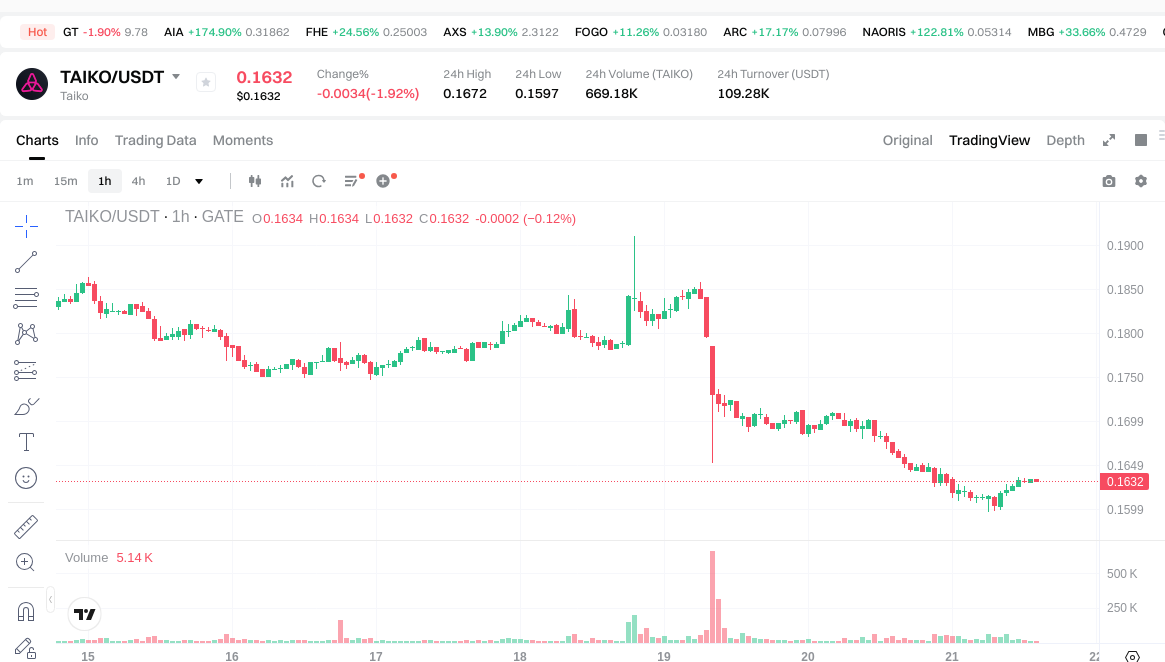
Taiko (TAIKO) is an Ethereum Layer 2 scaling solution that has been operational since June 2024. As of January 21, 2026, TAIKO maintains a market capitalization of approximately $31.09 million with a circulating supply of 190.24 million tokens out of a maximum supply of 1 billion tokens. The current price stands at $0.1634, representing a circulation ratio of approximately 19.02%. Positioned as a based rollup solution for Ethereum, Taiko aims to provide developers and users with a frictionless onboarding experience without compromising security. The token is currently listed on 24 exchanges and ranks #702 in the cryptocurrency market with a market dominance of 0.0051%. Over the past year, TAIKO has experienced notable price fluctuations, with recent performance showing a 2.33% decline in 24 hours, an 11.20% decrease over 7 days, and an 87.68% decline over one year from its June 2024 launch. This article provides a comprehensive analysis of TAIKO's investment characteristics, historical performance, price trends, and associated risks to support informed investment considerations.
I. Taiko (TAIKO) Price History Review and Current Investment Value Status
- 2024: Token launch on June 5, 2024 at $3.8 → Price experienced significant volatility in initial trading period
- 2024: Reached peak valuation in early June → TAIKO price reflected strong initial market interest
- 2025: Market adjustment phase → Price declined from elevated levels to lower range during December
Current TAIKO Investment Market Status (January 2026)
- TAIKO current price: $0.1634
- Market sentiment (Fear & Greed Index): Data not available in provided materials
- 24-hour trading volume: $110,644.03
- Institutional investor holdings: Data not available in provided materials
Click to view real-time TAIKO market price
II. Core Factors Affecting Whether TAIKO is a Good Investment (Is Taiko(TAIKO) a Good Investment)
Supply Mechanism and Scarcity (TAIKO investment scarcity)
- Maximum Supply of 1,000,000,000 TAIKO with Current Circulating Supply of Approximately 190,244,920 TAIKO (19.02% of Total Supply) → Impacts Price and Investment Value
- Current Market Conditions: Token price has experienced fluctuations, with notable volatility observed across different time periods
- Investment Significance: The controlled supply release mechanism and substantial unreleased token portion may influence long-term scarcity dynamics
Institutional Investment and Mainstream Adoption (Institutional investment in TAIKO)
- Current holder base includes approximately 2,547 addresses according to available data
- Exchange Presence: Listed on 24 exchanges, indicating a level of market accessibility and liquidity for investors
- Adoption Status: As an Ethereum Layer 2 scaling solution, TAIKO aims to provide developers and users with seamless onboarding experience while maintaining security
Macroeconomic Environment's Impact on TAIKO Investment
- General market conditions and broader cryptocurrency sector trends may influence TAIKO's investment attractiveness
- Layer 2 solutions' positioning within the blockchain infrastructure landscape could affect long-term demand dynamics
- Regulatory developments surrounding Ethereum scaling solutions may impact investment considerations
Technology and Ecosystem Development (Technology & Ecosystem for TAIKO investment)
- Layer 2 Scaling Technology: Taiko functions as an Ethereum Layer 2 scaling solution designed to enhance network performance without compromising security
- Developer and User Experience: The project focuses on providing convenient onboarding experience for both developers and users
- Infrastructure Positioning: As a based rollup for Ethereum, TAIKO aims to serve as a default scaling solution within the Ethereum ecosystem
III. TAIKO Future Investment Forecast and Price Outlook (Is Taiko(TAIKO) worth investing in 2026-2031)
Short-term Investment Forecast (2026, short-term TAIKO investment outlook)
- Conservative Forecast: $0.096 - $0.163
- Neutral Forecast: $0.163 - $0.169
- Optimistic Forecast: $0.169 - $0.180
Mid-term Investment Outlook (2027-2028, mid-term Taiko(TAIKO) investment forecast)
-
Market Stage Expectation: The mid-term period may witness gradual ecosystem development and potential expansion of Layer 2 adoption as Ethereum scaling solutions continue to evolve. Market conditions and technological progress could influence TAIKO's trajectory during this phase.
-
Investment Return Forecast:
- 2027: $0.151 - $0.195
- 2028: $0.105 - $0.233
-
Key Catalysts: Ethereum Layer 2 ecosystem growth, developer adoption rates, security enhancements, and broader market sentiment toward scaling solutions.
Long-term Investment Outlook (Is TAIKO a good long-term investment?)
- Base Scenario: $0.128 - $0.253 (assuming steady ecosystem development and moderate market growth)
- Optimistic Scenario: $0.233 - $0.331 (assuming accelerated adoption and favorable market conditions)
- Risk Scenario: $0.096 - $0.132 (considering competitive pressures or adverse market cycles)
Click to view TAIKO long-term investment and price forecast: Price Prediction
2026-01-21 - 2031 Long-term Outlook
- Base Scenario: $0.128 - $0.253 (corresponding to steady progress and incremental mainstream application growth)
- Optimistic Scenario: $0.220 - $0.331 (corresponding to large-scale adoption and favorable market environment)
- Transformative Scenario: Above $0.331 (in case of breakthrough ecosystem developments and mainstream adoption)
- 2031-12-31 Predicted High: $0.331 (based on optimistic development assumptions)
Disclaimer: The above forecasts are based on historical data analysis and market projections. Cryptocurrency investments carry significant risks, and price predictions do not constitute investment advice. Investors should conduct independent research and consider their risk tolerance before making investment decisions.
| Year |
Predicted High Price |
Predicted Average Price |
Predicted Low Price |
Price Change |
| 2026 |
0.169728 |
0.1632 |
0.096288 |
0 |
| 2027 |
0.19476288 |
0.166464 |
0.15148224 |
1 |
| 2028 |
0.2329913376 |
0.18061344 |
0.1047557952 |
10 |
| 2029 |
0.233686699344 |
0.2068023888 |
0.117877361616 |
26 |
| 2030 |
0.2532812256828 |
0.220244544072 |
0.12774183556176 |
34 |
| 2031 |
0.33146803882836 |
0.2367628848774 |
0.132587215531344 |
44 |
IV. Taiko Investment Strategy and Risk Management (How to invest in Layer 2 Scaling Solutions)
Investment Methodology (Taiko investment strategy)
Long-term Holding (HODL Taiko)
Long-term holding represents a strategy suitable for conservative investors who believe in the fundamental value proposition of Layer 2 scaling solutions. This approach involves acquiring TAIKO tokens and maintaining positions through market cycles, focusing on the project's development trajectory rather than short-term price movements. Investors adopting this strategy typically evaluate factors such as technological advancement, ecosystem growth, and adoption metrics.
Active Trading
Active trading strategies rely on technical analysis and swing trading operations. Traders utilizing this approach monitor price patterns, volume indicators, and market sentiment to identify entry and exit points. Given TAIKO's 24-hour price range between $0.1597 and $0.1673, as well as its recent price fluctuations showing -2.33% in 24 hours and -11.20% over 7 days, traders may find opportunities in volatility-driven movements.
Risk Management (Risk management for Taiko investment)
Asset Allocation Ratio
Conservative Investors: May consider allocating 1-3% of their cryptocurrency portfolio to TAIKO, maintaining larger positions in established assets while exploring Layer 2 solutions as a supplementary holding.
Aggressive Investors: Might allocate 5-10% of their portfolio to TAIKO, accepting higher volatility in exchange for potential growth opportunities in the Layer 2 scaling sector.
Professional Investors: Could consider 10-15% allocation within their cryptocurrency holdings, actively monitoring technical developments and market dynamics while maintaining diversified exposure across multiple blockchain layers.
Risk Hedging Solutions
Implementing a multi-asset portfolio approach combined with risk mitigation tools can help manage exposure. This includes diversifying across different Layer 2 solutions, maintaining positions in base layer assets like Ethereum, and potentially utilizing stablecoin allocations to manage volatility. Portfolio rebalancing based on predefined thresholds can help maintain desired risk levels.
Secure Storage
Cold and Hot Wallet Management: For security purposes, investors should consider separating their TAIKO holdings between cold storage (offline) for long-term holdings and hot wallets (online) for active trading needs. Cold wallets provide enhanced security against online threats, while hot wallets offer convenience for frequent transactions.
Hardware Wallet Recommendations: Hardware wallets represent a secure storage solution for TAIKO tokens. These physical devices store private keys offline, providing protection against malware and hacking attempts. Users should ensure compatibility with ERC20 tokens and Taiko's Layer 2 infrastructure when selecting hardware wallet solutions.
V. Taiko Investment Risks and Challenges (Risks of investing in Layer 2 Scaling Solutions)
Market Risk
High Volatility
TAIKO has demonstrated considerable price volatility, with the token showing a 1-year decline of -87.68% from its levels. The 24-hour trading range indicates ongoing price fluctuations, and the current market capitalization of approximately $31.09 million suggests susceptibility to larger percentage movements compared to higher-capitalization assets.
Price Manipulation Concerns
With a circulating supply of approximately 190.24 million tokens representing 19.02% of the total supply, and a holder count of 2,547, concentration risks exist. Lower liquidity environments can potentially create conditions where large transactions may impact price discovery mechanisms.
Regulatory Risk
Policy Uncertainty Across Jurisdictions
Different countries maintain varying approaches to cryptocurrency regulation, and Layer 2 solutions face evolving regulatory frameworks. Changes in securities classification, taxation policies, or operational requirements in major markets could impact TAIKO's accessibility and utility. The project's multi-jurisdictional nature requires investors to monitor regulatory developments across multiple regions.
Technical Risk
Network Security Vulnerabilities
As a Layer 2 scaling solution, TAIKO's infrastructure involves complex technical architecture. Potential vulnerabilities in smart contracts, bridge mechanisms, or consensus protocols could pose security challenges. While the project aims to provide scaling without compromising security, the technical complexity inherent in Layer 2 solutions introduces specific risk considerations.
Upgrade Failures
Technological evolution in the blockchain space requires periodic upgrades and improvements. Implementation risks associated with protocol upgrades, compatibility issues with Ethereum base layer changes, or unforeseen technical complications during development milestones represent potential challenges that could affect network performance and user confidence.
VI. Conclusion: Is Layer 2 Scaling Solutions a Good Investment?
Investment Value Summary
Taiko presents an investment opportunity within the Layer 2 scaling sector, offering exposure to Ethereum scaling infrastructure development. The project's focus on providing developer and user-friendly scaling solutions without compromising security aligns with broader blockchain scalability needs. However, the token has experienced substantial price decline over the past year, and short-term price movements remain volatile. The relatively early stage of circulation (19.02% of total supply) and the project's ongoing development present both opportunity and uncertainty.
Investor Recommendations
✅ Beginners
New investors should consider dollar-cost averaging (DCA) strategies combined with secure wallet storage practices. Starting with smaller positions allows familiarity with the asset's behavior while managing risk exposure. Prioritize understanding Layer 2 technology fundamentals and secure storage methods before increasing allocation.
✅ Experienced Investors
Seasoned market participants may explore swing trading opportunities while maintaining diversified portfolio configurations. Monitoring technical indicators, development milestones, and ecosystem growth metrics can inform tactical allocation decisions. Combining medium-term trading approaches with strategic core positions may provide balanced exposure.
✅ Institutional Investors
Institutional participants might evaluate strategic long-term allocation within broader blockchain infrastructure portfolios. Conducting thorough due diligence on technological capabilities, team expertise, competitive positioning, and ecosystem development trajectories should inform allocation decisions. Consider TAIKO as part of diversified Layer 2 exposure rather than concentrated positioning.
⚠️ Important Notice
Cryptocurrency investments carry substantial risk, including the possibility of complete capital loss. Market volatility, regulatory changes, technological challenges, and liquidity constraints can significantly impact investment outcomes. This content is provided for informational purposes only and does not constitute investment advice, financial guidance, or recommendations to buy, sell, or hold any asset. Investors should conduct independent research, assess their risk tolerance, and consult qualified financial advisors before making investment decisions.
VII. FAQ
Q1: What is Taiko and how does it differ from other Layer 2 solutions?
Taiko is an Ethereum Layer 2 scaling solution that functions as a "based rollup" designed to provide seamless onboarding for developers and users without compromising security. Unlike traditional Layer 2 solutions, Taiko emphasizes a frictionless user experience while maintaining Ethereum's security guarantees. The project launched in June 2024 and aims to serve as a default scaling solution within the Ethereum ecosystem, distinguishing itself through its focus on developer-friendly infrastructure and user accessibility.
Q2: What is the current tokenomics structure of TAIKO?
TAIKO has a maximum supply of 1 billion tokens, with approximately 190.24 million tokens currently in circulation (19.02% of total supply). As of January 21, 2026, the token trades at $0.1634 with a market capitalization of approximately $31.09 million. The token is held by approximately 2,547 addresses and is listed on 24 exchanges. The controlled supply release mechanism means approximately 80.98% of tokens remain unreleased, which may influence long-term scarcity dynamics and price behavior.
Q3: What has been TAIKO's price performance since launch?
TAIKO launched on June 5, 2024, at $3.8 and experienced significant volatility in its initial trading period, reaching peak valuation in early June 2024. The token has since experienced substantial decline, showing a -87.68% decrease over one year from launch. Recent short-term performance indicates -2.33% in 24 hours, -11.20% over 7 days, with the current price at $0.1634. This performance reflects broader market adjustments and the challenges faced by newer Layer 2 scaling solutions in establishing market positioning.
Q4: What are the main risks associated with investing in TAIKO?
The primary risks include: (I) High volatility, with significant price fluctuations and an 87.68% decline since launch; (II) Market risk due to relatively low market capitalization ($31.09 million) and trading volume ($110,644.03 in 24 hours), which can lead to susceptibility to price manipulation; (III) Regulatory uncertainty surrounding Layer 2 solutions across different jurisdictions; (IV) Technical risks including potential smart contract vulnerabilities, bridge mechanism security, and upgrade implementation challenges; (V) Competition from established Layer 2 solutions in the Ethereum ecosystem.
Q5: What investment strategies are suitable for different types of TAIKO investors?
Conservative investors should consider allocating 1-3% of their cryptocurrency portfolio to TAIKO using dollar-cost averaging (DCA) strategies combined with cold wallet storage for long-term holdings. Aggressive investors might allocate 5-10% while exploring active trading opportunities based on technical analysis and volatility patterns. Professional investors could consider 10-15% allocation within diversified cryptocurrency holdings, actively monitoring development milestones and ecosystem metrics. All investor types should implement risk management through portfolio diversification, secure storage practices, and regular rebalancing based on predefined thresholds.
Q6: What are the price predictions for TAIKO from 2026 to 2031?
Short-term forecasts for 2026 range from $0.096 (conservative) to $0.180 (optimistic). Mid-term projections show 2027 estimates of $0.151-$0.195 and 2028 estimates of $0.105-$0.233. Long-term outlook through 2031 presents a base scenario of $0.128-$0.253, an optimistic scenario of $0.233-$0.331, and a risk scenario of $0.096-$0.132. The predicted high for 2031 stands at $0.331 based on optimistic development assumptions. These forecasts depend on factors including Ethereum Layer 2 ecosystem growth, developer adoption rates, technological progress, and broader cryptocurrency market conditions.
Q7: What factors could drive TAIKO's future value appreciation?
Key catalysts include: (I) Ethereum Layer 2 ecosystem expansion and increased adoption of scaling solutions; (II) Developer adoption rates and ecosystem growth as more applications build on Taiko infrastructure; (III) Security enhancements and technological improvements that strengthen the platform's competitive positioning; (IV) Broader market sentiment toward Layer 2 solutions and blockchain scalability infrastructure; (V) Successful implementation of protocol upgrades and integration with Ethereum base layer developments; (VI) Increased liquidity through additional exchange listings and institutional participation.
Q8: How should investors approach storage and security for TAIKO tokens?
Investors should implement a dual-storage approach separating holdings between cold storage (offline) for long-term positions and hot wallets (online) for active trading needs. Hardware wallets provide enhanced security against online threats and are recommended for significant holdings, ensuring compatibility with ERC20 tokens and Taiko's Layer 2 infrastructure. For active traders, reputable exchange wallets with strong security measures and two-factor authentication may be suitable for operational balances. Regular security audits of storage methods, private key backup procedures, and avoiding concentration on single platforms help mitigate storage-related risks.
* The information is not intended to be and does not constitute financial advice or any other recommendation of any sort offered or endorsed by Gate.