This comprehensive analysis examines whether Tars AI (TAI) represents a viable investment opportunity. Launched in May 2024, TAI trades at $0.02316 with a $16 million market cap on Gate exchange and 12 other platforms. The analysis covers TAI's historical price volatility—including a 95.3% decline from its $0.495 peak—alongside supply mechanics, ecosystem development, and institutional adoption factors. Long-term price forecasts project ranges from $0.0438 to $0.0766 by 2031 under various scenarios. The article addresses investment strategies including HODL positioning and active trading, risk management through asset allocation, and critical concerns such as market volatility, regulatory uncertainty, and technical dependencies. Essential for investors evaluating AI-driven Web3 infrastructure exposure, this guide provides decision frameworks for beginner, experienced, and institutional investors while emphasizing substantial downside risks inherent in early-stage cryptocurrency projects.
Introduction: Tars AI (TAI) Investment Position and Market Outlook
TAI represents a notable asset in the cryptocurrency sector, launched in 2024 with a focus on AI-driven Web3 infrastructure solutions. As of January 2026, Tars AI maintains a market capitalization of approximately $16.02 million, with a circulating supply of around 691.69 million tokens and a current price near $0.02316. Positioned as an AI-powered modular infrastructure platform offering Blockchain-as-a-Service (BaaS) solutions, TAI has attracted attention among investors examining "Is Tars AI (TAI) a good investment?" This analysis will comprehensively examine TAI's investment characteristics, historical price movements, future price considerations, and associated risks to provide reference information for market participants.
I. Tars AI (TAI) Price History Review and Investment Value Status
- 2024: Token Launch and Initial Trading → TAI was launched on May 2, 2024, at an initial price of $0.01. During its first year of trading, the token experienced significant volatility. In December 2024, TAI reached a peak price of $0.495 on December 13, representing substantial growth from its launch price. However, this was followed by a notable correction period.
- 2024-2025: Market Adjustment Phase → Following the December 2024 peak, TAI entered a correction phase. The token's price declined considerably over subsequent months as market conditions shifted.
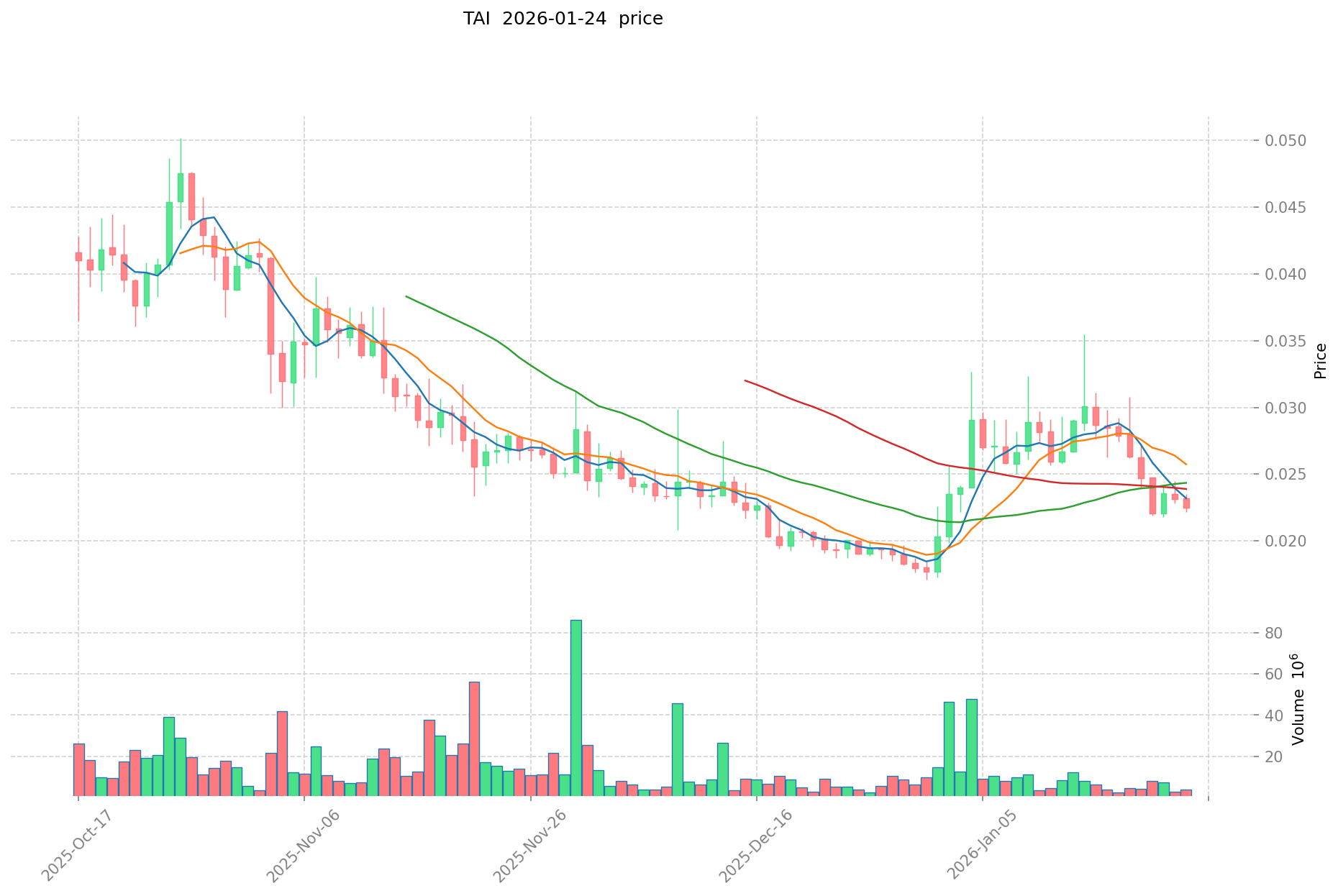
- 2026: Current Trading Range → As of January 24, 2026, TAI is trading at $0.02316, reflecting an adjustment from previous levels.
Current TAI Investment Market Status (January 2026)
- TAI Current Price: $0.02316
- 24-hour Price Range: High of $0.02349, Low of $0.02215
- 24-hour Trading Volume: $82,998.32
- Price Performance: 1-hour change of +0.96%, 7-day change of -18.13%, 30-day change of +18.47%, 1-year change of -91.8%
- Market Capitalization: $16,019,429
- Circulating Supply: 691,685,195 TAI (69.17% of total supply)
- Fully Diluted Valuation: $23,160,000
- Market Dominance: 0.00072%
- Number of Holders: 71,757
- Listed on 13 exchanges
Click to view real-time TAI market price
II. Core Factors Affecting Whether TAI is a Good Investment (Is Tars AI(TAI) a Good Investment)
Supply Mechanism and Scarcity (TAI investment scarcity)
- Fixed supply mechanism → impacts price and investment value
- Maximum supply: 1,000,000,000 TAI, with a circulating supply of 691,685,195 TAI (approximately 69.17% of total supply)
- Market cap to fully diluted valuation ratio stands at 69.17%, indicating significant token circulation
- Investment significance: The defined supply cap may contribute to potential scarcity considerations in long-term investment analysis
Institutional Investment and Mainstream Adoption (Institutional investment in TAI)
- Holder base: The token has attracted 71,757 holders as of the latest data
- Exchange presence: TAI is listed on 13 exchanges, reflecting a degree of market accessibility
- TARS Protocol positions itself as an AI-driven, scalable Web3 modular infrastructure platform, offering BaaS (Blockchain-as-a-Service) solutions, which may appeal to projects seeking integrated blockchain services
Macroeconomic Environment's Impact on TAI Investment
- The broader cryptocurrency market environment continues to influence investor sentiment toward AI and Web3-focused tokens
- Market share: TAI currently represents 0.00072% of the total cryptocurrency market capitalization
- Price volatility: TAI has experienced notable price fluctuations, with a 1-year change of -91.8%, reflecting sensitivity to market conditions and risk factors inherent in emerging crypto assets
Technology and Ecosystem Development (Technology & Ecosystem for TAI investment)
- AI-driven infrastructure: TARS Protocol leverages artificial intelligence solutions to empower Web3 projects, potentially positioning TAI within the growing AI and blockchain convergence sector
- Modular infrastructure approach: The platform's one-stop BaaS offering aims to provide scalable blockchain services, which may support ecosystem expansion
- Ecosystem applications: The protocol's focus on AI integration and blockchain services could facilitate adoption across DeFi, enterprise solutions, and other Web3 use cases, though specific deployment details require further observation
III. TAI Future Investment Forecast and Price Outlook (Is Tars AI(TAI) worth investing in 2026-2031)
Short-term Investment Forecast (2026, short-term TAI investment outlook)
- Conservative forecast: $0.0146 - $0.0231
- Neutral forecast: $0.0231 - $0.0276
- Optimistic forecast: $0.0276 - $0.0322
Mid-term Investment Outlook (2027-2028, mid-term Tars AI(TAI) investment forecast)
-
Market stage expectation: During the mid-term period, TAI may experience gradual growth as the project continues to develop its AI-driven Web3 modular infrastructure platform and BaaS solutions. The token's price trajectory could be influenced by technological advancements, ecosystem expansion, and broader market sentiment toward AI and blockchain integration.
-
Investment return forecast:
- 2027: $0.0147 - $0.0384
- 2028: $0.0195 - $0.0463
-
Key catalysts: Platform adoption, partnerships within the Web3 and AI sectors, technological upgrades to the TARS Protocol, and overall cryptocurrency market conditions.
Long-term Investment Outlook (Is TAI a good long-term investment?)
- Base scenario: $0.0311 - $0.0605 (assuming steady development and moderate adoption of the TARS Protocol ecosystem)
- Optimistic scenario: $0.0480 - $0.0766 (assuming accelerated ecosystem growth, strategic partnerships, and favorable market conditions for AI-blockchain projects)
- Risk scenario: Below $0.0146 (considering potential project setbacks, competitive pressures, or adverse crypto market conditions)
Click to view TAI long-term investment and price forecast: Price Prediction
2026-01-24 - 2031 Long-term Outlook
- Base scenario: $0.0438 - $0.0607 (corresponding to steady progress and gradual mainstream application growth)
- Optimistic scenario: $0.0522 - $0.0766 (corresponding to large-scale adoption and favorable market environment)
- Transformative scenario: Above $0.0766 (if the ecosystem achieves breakthrough developments and mainstream adoption)
- 2031-12-31 forecast high: $0.0766 (based on optimistic development assumptions)
Disclaimer: Price predictions are based on historical data analysis and market trends. Cryptocurrency investments carry substantial risk, and actual prices may differ significantly from forecasts due to market volatility, regulatory changes, technological developments, and other unforeseen factors. This analysis does not constitute investment advice.
| Year |
Predicted High Price |
Predicted Average Price |
Predicted Low Price |
Price Change |
| 2026 |
0.0321646 |
0.02314 |
0.0145782 |
0 |
| 2027 |
0.038436697 |
0.0276523 |
0.014655719 |
19 |
| 2028 |
0.0462622979 |
0.0330444985 |
0.019496254115 |
42 |
| 2029 |
0.047980611822 |
0.0396533982 |
0.030929650596 |
71 |
| 2030 |
0.06046746691518 |
0.043817005011 |
0.03111007355781 |
89 |
| 2031 |
0.076649086865742 |
0.05214223596309 |
0.043799478208995 |
125 |
IV. Tars AI Investment Strategy and Risk Management (How to invest in AI-driven Web3 infrastructure)
Investment Methodology (Tars AI investment strategy)
Long-term Holding (HODL TAI)
For conservative investors seeking exposure to AI-integrated blockchain infrastructure, a long-term holding strategy may align with the project's modular BaaS (Blockchain-as-a-Service) positioning. Given TAI's significant price fluctuations—with a historical high of $0.495 in December 2024 and a current trading price around $0.02316—long-term holders should be prepared for extended periods of volatility. The token's 30-day performance showing an 18.47% increase suggests potential recovery phases, though the 1-year decline of 91.8% from initial levels indicates substantial downside risk over longer timeframes.
Active Trading
Traders utilizing technical analysis may find opportunities in TAI's price movements, particularly given its 24-hour range between $0.02215 and $0.02349. The token's relatively modest 24-hour trading volume of approximately $83,000 suggests lower liquidity compared to major cryptocurrencies, which can result in wider spreads and slippage during active trading. Technical traders should monitor key support and resistance levels, noting the token's all-time low of $0.01 (May 2024) as a potential psychological support floor.
Risk Management (Risk management for Tars AI investment)
Asset Allocation Ratios
- Conservative investors: Consider limiting TAI exposure to 1-3% of total crypto portfolio, given the project's relatively recent market entry (May 2024) and limited track record
- Moderate investors: May allocate 3-7% to AI-focused Web3 infrastructure projects, with TAI representing a portion of this segment
- Aggressive investors: Could allocate up to 10-15% to emerging AI blockchain protocols, understanding the elevated risk profile
Risk Hedging Solutions
Diversification across multiple asset classes remains essential. Investors might consider:
- Balancing TAI holdings with established cryptocurrencies to offset volatility
- Incorporating stablecoin positions to maintain liquidity during market downturns
- Monitoring correlation with broader AI and Web3 sector performance
The token's market capitalization of approximately $16 million and fully diluted valuation of $23.16 million indicates a relatively small market presence, which amplifies both potential returns and downside risks.
Secure Storage Recommendations
TAI operates on the Solana blockchain as an SPL token (contract address: Hax9LTgsQkze1YFychnBLtFH8gYbQKtKfWKKg2SP6gdD). Storage considerations include:
- Cold Storage: Hardware wallets supporting Solana SPL tokens provide optimal security for long-term holdings
- Hot Wallets: Solana-compatible software wallets may be used for active trading, though with increased security protocols
- Exchange Storage: While TAI is listed on 13 exchanges, extended storage on centralized platforms carries custodial risks
With over 71,000 token holders, the TAI community demonstrates notable participation, though investors should implement proper private key management regardless of holding size.
V. Tars AI Investment Risks and Challenges (Risks of investing in AI-driven Web3 infrastructure)
Market Risks
TAI exhibits substantial price volatility, evidenced by its 95.3% decline from its all-time high of $0.495 to current levels around $0.02316. The token's 7-day performance decline of 18.13% alongside a 30-day gain of 18.47% illustrates unpredictable short-term price movements. With a relatively modest 24-hour trading volume of approximately $83,000 and market dominance of just 0.00072%, the token faces limited liquidity, which can amplify price swings during periods of concentrated buying or selling activity.
The circulating supply of 691,685,195 tokens represents 69.17% of the maximum supply of 1 billion tokens, indicating potential future supply increases that could exert downward pressure on prices if demand does not correspondingly increase.
Regulatory Risks
AI-integrated blockchain platforms face evolving regulatory frameworks across different jurisdictions. As governments worldwide develop policies addressing both artificial intelligence applications and cryptocurrency operations, projects combining these technologies may encounter:
- Compliance requirements for AI-driven services that vary significantly by region
- Potential classification uncertainties regarding tokens associated with AI infrastructure
- Changing regulations affecting blockchain-as-a-service offerings
Investors should monitor regulatory developments in their respective jurisdictions, as policy changes could impact TAI's operational capabilities or market accessibility.
Technical Risks
As a Web3 modular infrastructure platform built on Solana, TARS Protocol faces several technical considerations:
- Smart contract vulnerabilities inherent in SPL token implementations
- Network security challenges associated with AI-driven blockchain services
- Dependency on Solana blockchain performance and reliability
- Integration risks when implementing AI solutions within decentralized infrastructure
The project's relatively recent launch in May 2024 means its technology infrastructure has limited operational history, increasing uncertainty regarding long-term technical stability and upgrade implementation.
VI. Conclusion: Is AI-driven Web3 Infrastructure a Good Investment?
Investment Value Summary
Tars AI (TAI) represents participation in the emerging intersection of artificial intelligence and Web3 infrastructure, specifically through its modular BaaS platform approach. The token's performance since its May 2024 launch has demonstrated significant volatility, with a 91.8% decline over one year despite recent 30-day gains of 18.47%. Its relatively small market capitalization of approximately $16 million and modest trading volumes indicate an early-stage project with corresponding risk-reward characteristics.
The platform's positioning within AI-driven blockchain services addresses a growing sector, though investors should recognize the substantial gap between current price levels ($0.02316) and historical peaks ($0.495), alongside limited liquidity and market presence (0.00072% dominance).
Investor Recommendations
✅ Beginners: Consider extremely limited exposure (under 2% of crypto portfolio) through dollar-cost averaging, with secure storage in Solana-compatible hardware wallets. Prioritize understanding both AI and blockchain fundamentals before allocating capital.
✅ Experienced Investors: May implement measured position sizing (3-5% of crypto allocation) with active monitoring of technical levels, particularly the $0.01 support zone. Consider TAI as part of a diversified AI-blockchain thesis rather than a standalone investment.
✅ Institutional Investors: Could evaluate TAI within specialized AI-Web3 infrastructure allocations, recognizing the project's early development stage and limited institutional participation indicators. Conduct thorough due diligence on team credentials, technical architecture, and competitive positioning.
⚠️ Important Notice: Cryptocurrency investments carry substantial risks, including potential complete loss of capital. TAI's extreme volatility, limited liquidity, and brief operational history amplify these risks. This analysis provides informational context only and does not constitute financial, investment, or legal advice. Individuals should conduct independent research and consult qualified financial advisors before making investment decisions.
VII. FAQ
Q1: Is Tars AI (TAI) a good investment for beginners in 2026?
TAI carries significant risks for beginners due to extreme volatility and limited liquidity. The token has declined 91.8% over one year despite recent gains, with a modest market cap of $16 million and 24-hour trading volume of only $83,000. Beginners should limit exposure to under 2% of their crypto portfolio and prioritize understanding AI-blockchain fundamentals before investing. The project's brief operational history since May 2024 and minimal market dominance (0.00072%) suggest this is a high-risk, speculative asset suitable only for those prepared to potentially lose their entire investment.
Q2: What are the main factors affecting TAI's investment value?
TAI's investment value is primarily influenced by its AI-driven Web3 modular infrastructure positioning, fixed supply of 1 billion tokens (with 69.17% circulating), and technology adoption within the BaaS sector. Key factors include the platform's ability to attract developers to its blockchain-as-a-service solutions, partnerships within AI and Web3 ecosystems, and broader cryptocurrency market sentiment toward AI-integrated projects. The token's listing on 13 exchanges and holder base of 71,757 users indicate moderate accessibility, though regulatory developments affecting both AI services and cryptocurrencies could significantly impact future valuation.
Q3: What is the long-term price forecast for TAI through 2031?
Price predictions suggest TAI could reach between $0.0438 and $0.0766 by December 2031 under various scenarios, representing potential growth from current levels of $0.02316. Conservative forecasts estimate 2026 year-end prices around $0.0146-$0.0322, with gradual growth toward 2031 highs near $0.0766 in optimistic scenarios assuming successful ecosystem development and mainstream adoption. However, these projections carry substantial uncertainty—historical performance shows TAI declined from $0.495 to current levels, demonstrating significant downside risk. Investors should recognize that actual prices may differ dramatically from forecasts due to market volatility, regulatory changes, and technological developments.
Q4: How should investors manage risks when investing in TAI?
Risk management strategies include strict position sizing (1-3% for conservative investors, up to 10-15% for aggressive investors within crypto allocations), diversification across multiple asset classes, and secure storage using Solana-compatible hardware wallets for long-term holdings. Investors should implement dollar-cost averaging rather than lump-sum purchases given TAI's volatility, maintain stablecoin reserves for liquidity during downturns, and monitor technical support levels (particularly the $0.01 historical low). The token's limited liquidity of $83,000 daily volume requires careful order execution to avoid slippage, while the SPL token structure on Solana necessitates proper private key management and awareness of network-specific security considerations.
Q5: What are the primary risks associated with investing in TAI?
TAI faces multiple risk categories: market risks including 95.3% decline from all-time highs, limited liquidity causing potential price manipulation, and minimal market dominance; regulatory risks from evolving AI and cryptocurrency frameworks across jurisdictions; and technical risks related to smart contract vulnerabilities, Solana blockchain dependencies, and unproven infrastructure given the project's May 2024 launch. Additional risks include 30.83% of tokens remaining unvested (potential future supply pressure), competition from established AI-blockchain projects, and correlation with broader cryptocurrency market downturns. The token's brief operational history provides insufficient data to assess long-term technical stability or team execution capabilities.
Q6: How does TAI compare to other AI-focused cryptocurrency investments?
TAI occupies a niche position within AI-blockchain infrastructure through its modular BaaS approach, differentiating it from pure AI tokens or established blockchain platforms. With a market cap of $16 million, TAI represents a significantly smaller market presence compared to major AI crypto projects, translating to higher volatility but potentially greater upside if adoption accelerates. The token's focus on Web3 modular infrastructure and one-stop blockchain services targets developers and enterprises, whereas many AI tokens emphasize consumer applications or computational networks. However, TAI's 91.8% one-year decline and limited exchange listings (13 platforms) suggest lower institutional confidence compared to more established AI-crypto projects with greater liquidity and market recognition.
Q7: What investment strategy works best for TAI given current market conditions?
Current market conditions favor a cautious, diversified approach to TAI investment. Active traders may exploit the token's volatility within its $0.02215-$0.02349 daily range, though limited volume of $83,000 requires careful execution. Long-term holders should consider dollar-cost averaging over 6-12 months rather than single purchases, given the token's historical 95.3% drawdown from peaks. A hybrid strategy combining 60-70% long-term cold storage with 30-40% for opportunistic trading may balance growth potential against volatility risk. Investors should establish clear exit criteria—both for profit-taking (e.g., at previous resistance levels) and loss limitation (e.g., if price breaks below $0.015 support)—while maintaining position sizes aligned with individual risk tolerance and portfolio composition.
Q8: What technological developments could impact TAI's future investment potential?
Key technological catalysts include expansion of the TARS Protocol's AI-driven modular infrastructure capabilities, successful implementation of scalable BaaS solutions attracting enterprise clients, and integration partnerships with established Web3 projects requiring blockchain-as-a-service offerings. Platform upgrades enhancing AI functionality, cross-chain compatibility beyond Solana, or novel use cases combining artificial intelligence with decentralized infrastructure could positively influence valuation. Conversely, technical setbacks such as smart contract vulnerabilities, scalability limitations, or failure to differentiate from competing AI-blockchain platforms could undermine investment potential. The project's ability to demonstrate real-world adoption metrics—including active users, transaction volumes, and revenue generation from BaaS services—will be critical for validating the technology's market fit and long-term viability.
* The information is not intended to be and does not constitute financial advice or any other recommendation of any sort offered or endorsed by Gate.