This comprehensive analysis examines whether Tenset (10SET) represents a viable investment opportunity as of January 2026. The article evaluates the deflationary token's market performance, revealing a significant 72.34% decline over the past year to its current price of $0.03167, down from a 2021 peak of $6.48. Key assessment factors include 10SET's unique ETF 2.0 integration, staking mechanisms, and deflationary tokenomics creating scarcity with a 74.31% circulating supply ratio. With a market capitalization of $4.94 million and presence on Gate and one other exchange, Tenset maintains a niche market position ranking 1538 globally. The article provides investment forecasts ranging from conservative to optimistic scenarios through 2031, detailed risk management strategies for different investor profiles, and comprehensive warnings regarding market volatility, regulatory uncertainty, and technical vulnerabilities. Suitable for risk-aware investors only.
Introduction: Tenset (10SET) Investment Position and Market Outlook
Tenset (10SET) represents a notable digital asset in the cryptocurrency landscape, launched in March 2021 with a distinctive approach combining deflationary tokenomics and ETF2.0 elements. As of January 2026, 10SET maintains a market capitalization of approximately $4.94 million, with a circulating supply of around 156.04 million tokens and a current trading price near $0.03167. The token operates on the BSC chain with a maximum supply cap of 210 million tokens, reflecting a circulating ratio of approximately 74.31%. Positioned as a deflationary token that integrates hedge fund principles with staking mechanisms, 10SET has attracted attention from investors exploring "Is Tenset (10SET) a good investment?" This article provides a comprehensive analysis of 10SET's investment characteristics, historical price movements, future price projections, and associated investment risks to assist investors in making informed decisions.
I. Tenset (10SET) Price History Review and Investment Value Status
- 2021: Token reached a notable price level of $6.48 in May → Represented an early-stage price peak during market expansion
- 2026: Price experienced downward pressure → 10SET trading at $0.03167, reflecting significant contraction from previous levels
- Recent Period: Price volatility continued → Trading range between $0.02757133 and current levels, with 72.34% decline observed over one-year timeframe
Current 10SET Investment Market Status (January 2026)
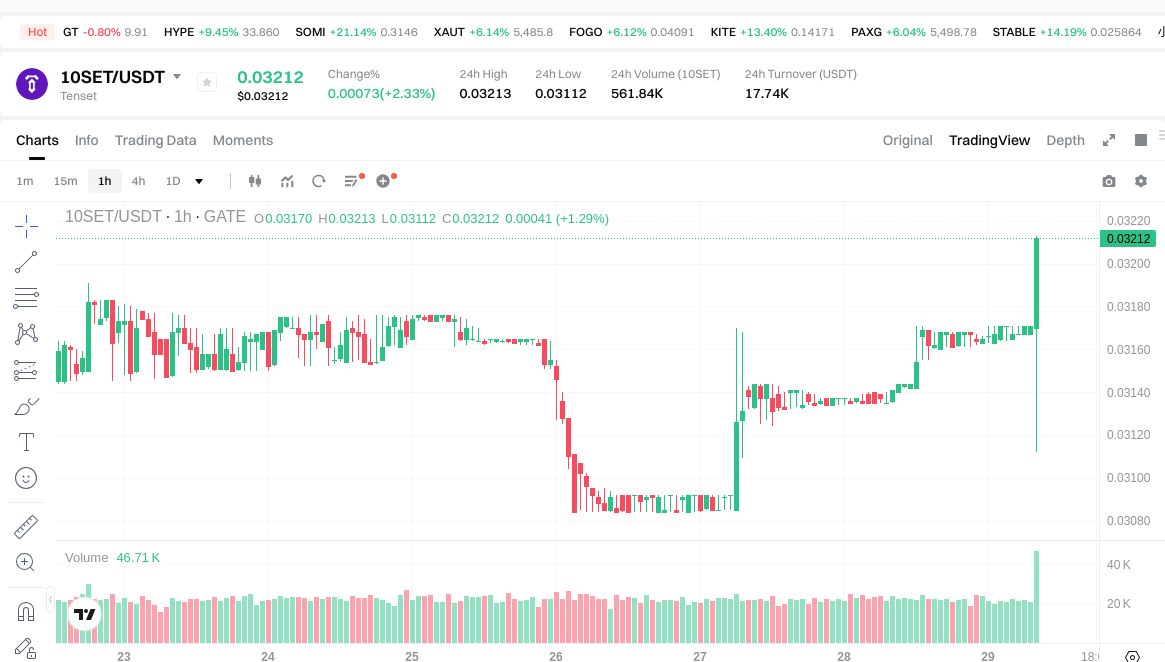
- 10SET current price: $0.03167
- 24-hour trading volume: $16,570.86
- Circulating supply: 156,042,726.95 tokens (74.31% of maximum supply)
- Market capitalization: $4,941,873.16
Click to view real-time 10SET market price
II. Core Factors Affecting Whether 10SET is a Good Investment
Supply Mechanism and Scarcity (10SET Investment Scarcity)
- Deflationary token design → influences price and investment value
- Historical pattern: Total supply of 156,042,726.9464019 10SET with a maximum supply of 210,000,000, creating a circulating ratio of 74.31%
- Investment significance: Built-in scarcity mechanism through deflation serves as a key element supporting long-term investment considerations
Institutional Investment and Mainstream Adoption (Institutional Investment in 10SET)
- Current holder base: 25,107 holders as of January 2026
- Trading availability: Listed on 2 exchanges with Gate.com as a confirmed trading platform
- Market presence: Limited exchange coverage may affect liquidity and institutional accessibility
Macroeconomic Environment Impact on 10SET Investment
- Cryptocurrency market conditions → alter investment attractiveness across digital assets
- Market capitalization positioning: Ranked #1538 with a market cap of $4,941,873.16, representing 0.00015% market dominance
- Economic uncertainty factors → influence demand patterns in alternative digital assets
Technology and Ecosystem Development (Technology & Ecosystem for 10SET Investment)
- ETF 2.0 elements: Integration of exchange-traded fund concepts with cryptocurrency mechanisms
- Core technology features: Staking capabilities, deflationary model, and bridge functionality between cryptocurrency and traditional markets
- Hybrid power system: Utilizes hedge fund principles combined with "entity operation" concepts to support ecosystem development
III. 10SET Future Investment Forecast and Price Outlook (Is Tenset(10SET) worth investing in 2026-2031)
Short-term Investment Forecast (2026, short-term 10SET investment outlook)
- Conservative forecast: $0.0215 - $0.0321
- Neutral forecast: $0.0321 - $0.0395
- Optimistic forecast: $0.0395 and above
Mid-term Investment Outlook (2027-2029, mid-term Tenset(10SET) investment forecast)
- Market stage expectation: The token may enter a gradual recovery phase with expected price fluctuations reflecting broader market sentiment and ecosystem development progress.
- Investment return forecast:
- 2027: $0.0329 - $0.0476
- 2028: $0.0271 - $0.0488
- 2029: $0.0367 - $0.0647
- Key catalysts: Market adoption trends, ecosystem partnerships, regulatory developments, and overall crypto market conditions may influence price movements during this period.
Long-term Investment Outlook (Is Tenset a good long-term investment?)
- Base scenario: $0.0374 - $0.0550 (assuming steady ecosystem growth and moderate market conditions)
- Optimistic scenario: $0.0550 - $0.0659 (assuming favorable market environment and increased adoption)
- Risk scenario: Below $0.0374 (under adverse market conditions or unfavorable regulatory changes)
Click to view 10SET long-term investment and price forecast: Price Prediction
2026-01-29 - 2031 Long-term Outlook
- Base scenario: $0.0380 - $0.0550 USD (corresponding to steady progress and gradual mainstream application enhancement)
- Optimistic scenario: $0.0550 - $0.0660 USD (corresponding to large-scale adoption and favorable market environment)
- Transformative scenario: Above $0.0660 USD (subject to breakthrough ecosystem developments and mainstream popularization)
- 2031-12-31 forecast high: $0.0659 USD (based on optimistic development assumptions)
Disclaimer: The above forecasts are based on historical data and market analysis models, and do not constitute investment advice. Cryptocurrency markets are highly volatile and subject to various risk factors. Investors should conduct independent research and consider their own risk tolerance before making any investment decisions.
| Year |
Predicted High Price |
Predicted Average Price |
Predicted Low Price |
Price Change |
| 2026 |
0.0395076 |
0.03212 |
0.0215204 |
1 |
| 2027 |
0.047632354 |
0.0358138 |
0.032948696 |
13 |
| 2028 |
0.04881600009 |
0.041723077 |
0.02712000005 |
31 |
| 2029 |
0.06473544011935 |
0.045269538545 |
0.03666832622145 |
42 |
| 2030 |
0.064902937411966 |
0.055002489332175 |
0.037401692745879 |
73 |
| 2031 |
0.065947984709277 |
0.05995271337207 |
0.038969263691846 |
89 |
IV. Tenset Investment Strategy and Risk Management (How to invest in Tenset)
Investment Methodology (Tenset investment strategy)
Long-term Holding (HODL Tenset): Suitable for Conservative Investors
Long-term holding strategies may be considered by investors who believe in the underlying technology and deflationary tokenomics of Tenset. The token incorporates staking mechanisms and scarcity features that could potentially support value over extended periods. However, the 72.34% decline over the past year indicates significant volatility that investors should carefully evaluate.
Active Trading: Relying on Technical Analysis and Swing Operations
Active traders may utilize technical analysis given Tenset's price movements. Recent data shows a 4.10% increase over 1 hour and 1.02% over 24 hours, suggesting short-term trading opportunities. The 24-hour high of $0.03171 and low of $0.03135 provide reference points for entry and exit strategies. With a 24-hour trading volume of approximately $16,571, liquidity considerations should be factored into trading decisions.
Risk Management (Risk management for Tenset investment)
Asset Allocation Ratios: Conservative / Aggressive / Professional Investors
- Conservative investors: May consider allocating no more than 1-3% of their crypto portfolio to Tenset, given its ranking of 1538 by market capitalization and market dominance of 0.00015%.
- Aggressive investors: Could allocate 5-10% while maintaining awareness of the token's volatility profile.
- Professional investors: Should conduct thorough due diligence on the project's fundamentals and consider position sizing based on comprehensive risk models.
Investors may consider diversifying across different asset classes and market cap categories. Given Tenset's relatively small market capitalization of approximately $4.94 million and circulating supply of 156,042,726.95 tokens (74.31% of max supply), correlation analysis with broader market movements should inform hedging strategies.
Secure Storage: Hot and Cold Wallets + Hardware Wallet Recommendations
Tenset (10SET) is deployed on the BSC (Binance Smart Chain) network with the contract address 0x1AE369A6AB222aFF166325B7b87Eb9aF06C86E57. Investors should:
- Use hardware wallets compatible with BSC for long-term storage
- Consider reputable software wallets with BSC support for active trading
- Enable multi-factor authentication and maintain secure backup procedures
- Verify contract addresses through official sources before any transactions
V. Tenset Investment Risks and Challenges (Risks of investing in Tenset)
Market Risk: High Volatility and Price Manipulation
Tenset exhibits substantial price volatility. The token has experienced a 72.34% decline over the past year, with a historical high of $6.48 (May 30, 2021) and a historical low of $0.02757133 (January 7, 2026). The current price of $0.03167 represents a significant distance from its all-time high. With only 2 exchanges listing the token and relatively modest trading volume, the asset may be susceptible to price fluctuations and potential liquidity constraints.
Regulatory Risk: Policy Uncertainty Across Different Countries
As with all cryptocurrency assets, Tenset faces regulatory uncertainty that varies by jurisdiction. Investors should stay informed about evolving regulations in their respective countries regarding cryptocurrency trading, taxation, and custody requirements. Changes in regulatory frameworks could impact the token's accessibility and market dynamics.
Technical Risk: Network Security Vulnerabilities and Upgrade Failures
Investors should be aware of technical considerations including:
- Smart contract risks associated with the BSC deployment
- Potential vulnerabilities in the staking mechanisms
- Dependencies on the underlying BSC network infrastructure
- Risks associated with any protocol upgrades or changes to the deflationary mechanisms
With approximately 25,107 holders, the distribution and community engagement metrics should be evaluated as part of technical risk assessment.
VI. Conclusion: Is Tenset a Good Investment?
Investment Value Summary
Tenset presents as a deflationary token with ETF 2.0 elements and features including staking, scarcity mechanisms, and bridging concepts between cryptocurrency and traditional markets. The token's performance over the past year has been challenging, with significant price decline. The relatively small market capitalization and limited exchange listings indicate an early-stage or niche market position.
Investor Recommendations
✅ Beginners: If considering exposure to Tenset, implement a dollar-cost averaging approach with very conservative position sizing. Prioritize secure wallet storage using hardware solutions compatible with BSC. Thoroughly research the project's fundamentals and only invest amounts you can afford to lose entirely.
✅ Experienced Investors: May explore swing trading opportunities while maintaining strict risk management protocols. Consider Tenset as a small-cap speculative position within a diversified cryptocurrency portfolio. Monitor technical indicators, trading volume patterns, and fundamental developments.
✅ Institutional Investors: Should conduct comprehensive due diligence including technical audits, team evaluation, and long-term viability assessment. Position sizing should reflect the token's liquidity profile and market maturity.
⚠️ Disclaimer: Cryptocurrency investment carries high risk. The information in this article is for reference purposes only and does not constitute investment advice. Past performance does not indicate future results. Investors should conduct independent research and consult with financial advisors before making investment decisions.
VII. FAQ
Q1: Is Tenset (10SET) a good investment for beginners in 2026?
For beginners, Tenset represents a high-risk speculative investment that requires careful consideration. The token has experienced a 72.34% decline over the past year and currently trades at $0.03167, significantly below its historical high of $6.48 in May 2021. With a relatively small market capitalization of approximately $4.94 million and limited exchange listings (only 2 exchanges), beginners should approach with extreme caution. If considering investment, implement dollar-cost averaging with no more than 1-3% of your crypto portfolio allocated to Tenset, prioritize secure hardware wallet storage compatible with BSC, and only invest amounts you can afford to lose entirely.
Q2: What are the primary factors affecting Tenset's future price outlook?
Tenset's price outlook depends on several interconnected factors. The deflationary tokenomics with a maximum supply of 210 million tokens (74.31% currently circulating) creates scarcity that could support value appreciation. The integration of ETF 2.0 elements, staking mechanisms, and bridging functionality between cryptocurrency and traditional markets represent technological foundations. However, limited exchange availability, modest trading volume of approximately $16,571 (24-hour), and ranking of 1538 by market capitalization indicate challenges in mainstream adoption. Price forecasts range from conservative estimates of $0.0215-$0.0395 in 2026 to optimistic long-term projections reaching $0.0659 by 2031, though these depend heavily on ecosystem development, regulatory environment, and overall crypto market conditions.
Q3: What are the main risks associated with investing in Tenset?
Investing in Tenset carries multiple significant risks. Market risk is pronounced with extreme volatility demonstrated by the 72.34% annual decline and price fluctuations between $0.02757133 and $6.48 historically. With only 2 exchange listings and limited liquidity, the token may be susceptible to price manipulation and difficulty executing large trades. Regulatory risk exists as cryptocurrency regulations evolve globally, potentially affecting accessibility and market dynamics. Technical risks include smart contract vulnerabilities on the BSC deployment, potential issues with staking mechanisms, and dependencies on underlying network infrastructure. The relatively small holder base of 25,107 users and market dominance of only 0.00015% further indicate early-stage market positioning with associated uncertainties.
Q4: How should different types of investors approach Tenset investment strategies?
Investment strategies for Tenset should align with investor experience and risk tolerance. Conservative investors should limit allocation to 1-3% of their crypto portfolio, focusing on long-term holding (HODL) strategies while understanding the deflationary tokenomics and staking mechanisms. Aggressive investors may allocate 5-10% while employing active trading based on technical analysis, utilizing recent price movements (4.10% increase over 1 hour, 1.02% over 24 hours) to identify entry and exit points. Professional investors require comprehensive due diligence including technical audits, team evaluation, and correlation analysis with broader markets before position sizing. All investors must implement proper security measures using hardware wallets compatible with BSC (contract address: 0x1AE369A6AB222aFF166325B7b87Eb9aF06C86E57) and maintain multi-factor authentication protocols.
Q5: What is Tenset's current market position and how does it compare to other cryptocurrencies?
Tenset occupies a niche position in the cryptocurrency market with a current market capitalization of approximately $4.94 million, ranking 1538 globally with 0.00015% market dominance. The token has 156,042,726.95 tokens in circulation (74.31% of the 210 million maximum supply) and is accessible on 2 exchanges, with Gate.com as a confirmed trading platform. The 24-hour trading volume of approximately $16,571 indicates relatively modest liquidity compared to mainstream cryptocurrencies. With 25,107 holders, the token demonstrates limited but established community engagement. This market positioning suggests Tenset operates as a small-cap cryptocurrency with corresponding liquidity constraints, heightened volatility, and potentially greater growth potential but also substantially higher risk compared to larger market cap assets.
Q6: What technology and features differentiate Tenset from other cryptocurrency investments?
Tenset distinguishes itself through several unique technological features combining deflationary tokenomics with ETF 2.0 elements. The token operates on the BSC (Binance Smart Chain) network and incorporates hedge fund principles with "entity operation" concepts. Key technological features include built-in staking mechanisms allowing holders to earn rewards, a deflationary model designed to create scarcity over time, and bridge functionality intended to connect cryptocurrency markets with traditional financial markets. The hybrid power system integrates exchange-traded fund concepts with cryptocurrency mechanisms, positioning Tenset as an experimental approach to merging conventional finance with decentralized assets. However, investors should note that these features' practical effectiveness requires ongoing evaluation, particularly given the token's recent performance metrics.
* The information is not intended to be and does not constitute financial advice or any other recommendation of any sort offered or endorsed by Gate.