This comprehensive guide analyzes whether Tezos (XTZ) represents a viable investment opportunity in 2026 and beyond. Currently trading at $0.5842 with a market capitalization of $626.25 million, Tezos differentiates itself through its self-amending blockchain protocol and formal verification capabilities, attracting investors seeking innovative smart contract platforms. The article examines XTZ price history from its 2018 inception through January 2026, providing realistic price forecasts ranging from $0.55-$0.78 in 2026 to $1.07-$1.30 by 2031 under optimistic scenarios. Key investment considerations include the platform's nearly-complete 98.16% token circulation, Liquid Proof of Stake mechanism, and governance flexibility against market volatility, regulatory uncertainty, and technical risks. Tailored investment strategies address beginners, experienced traders, and institutional investors, emphasizing risk management through diversification, secure storage via hardware wallets, and appropriate portfolio all
Introduction: Tezos (XTZ) Investment Position and Market Outlook
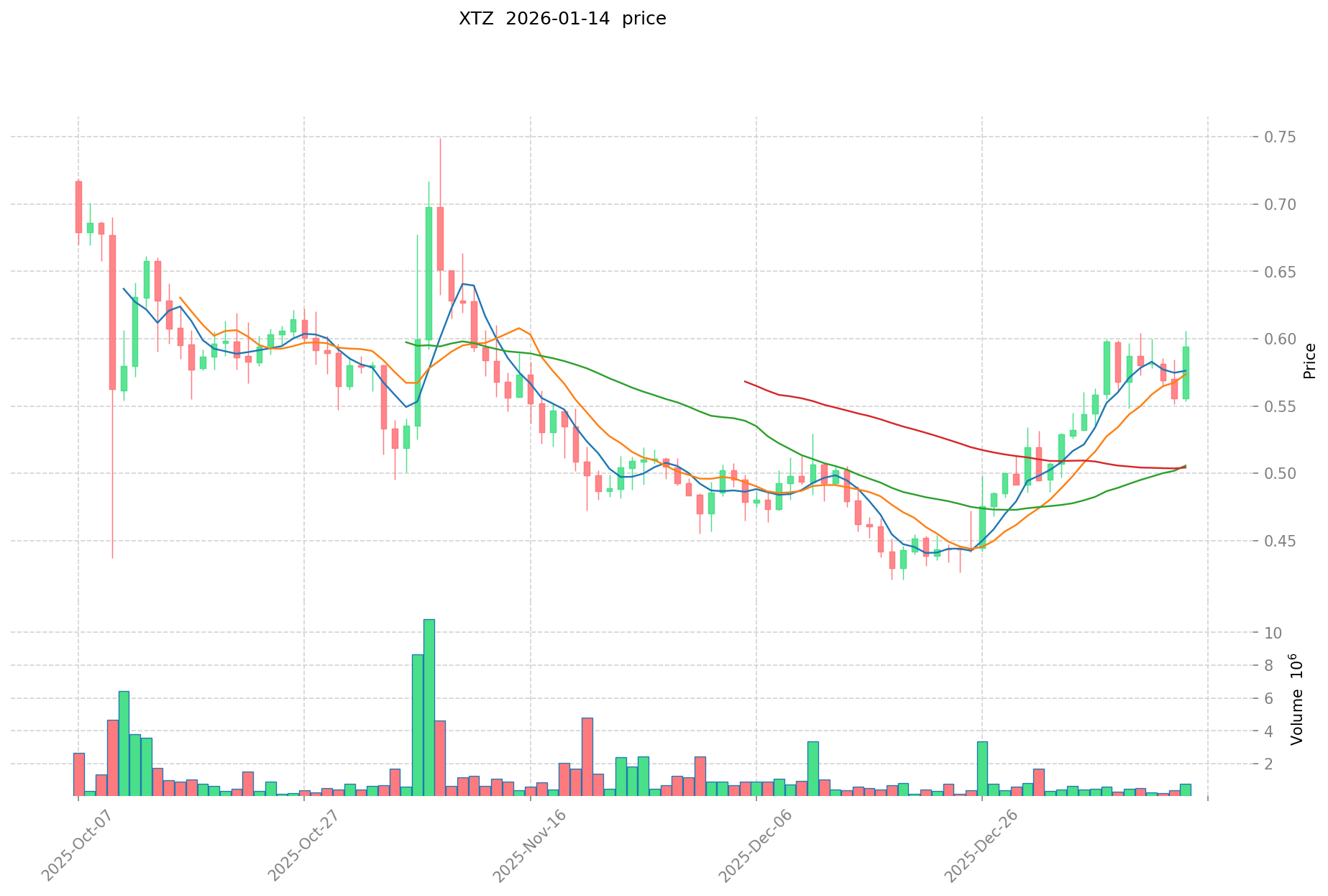
Tezos (XTZ) is a notable asset in the cryptocurrency space. As of January 14, 2026, Tezos holds a market capitalization of approximately $626.25 million, with a circulating supply of about 1.07 billion tokens and a current price around $0.5842. With its positioning as a self-amending blockchain platform that emphasizes formal verification and on-chain governance, Tezos has attracted attention from investors exploring the question "Is Tezos (XTZ) a good investment?" The project has demonstrated a circulating supply ratio of 98.16%, indicating a relatively mature token distribution. Over the past 30 days, XTZ has shown a price increase of 21.18%, though the annual performance reflects a decline of 52.62%. This article provides a comprehensive analysis of Tezos' investment value, historical price movements, future price projections, and associated investment risks to serve as a reference for investors.
I. Tezos (XTZ) Price History Review and Current Investment Value
- 2018: XTZ began trading in July at approximately $3, but experienced a decline to $0.36 by December → investors faced notable losses during the early trading period
- 2021: XTZ reached a significant price level of $8.55 in October, with market capitalization approaching $4.8 billion → the token demonstrated substantial growth momentum during this market cycle
- 2022-2025: From the peak level, XTZ experienced a downward trajectory → prices declined from the October 2021 levels to the current trading range
Current XTZ Investment Market Status (January 2026)
- XTZ current price: $0.58
- Market sentiment (Fear & Greed Index): data not provided in reference materials
- 24-hour trading volume: $30.24M
- Institutional investor holdings: specific institutional holding data not available in provided materials
Click to view real-time XTZ market price
II. Core Factors Influencing Whether XTZ is a Good Investment
Supply Mechanism and Scarcity (XTZ investment scarcity)
- Circulating supply mechanism → impacts price and investment value
- The circulating supply of XTZ stands at approximately 1.07 billion tokens, representing about 98.16% of the total supply of 1.09 billion. The maximum supply is unlimited, indicating an inflationary token model.
- Investment implication: The lack of a hard supply cap may affect long-term scarcity dynamics, which is a consideration for investors evaluating XTZ as a store of value.
Institutional Investment and Mainstream Adoption (Institutional investment in XTZ)
- Institutional holding trends: Current data shows approximately 20,481 holders of XTZ, with the token listed on 45 exchanges, indicating a moderate level of market accessibility and institutional participation.
- Mainstream adoption considerations: Tezos' self-amending blockchain protocol and formal verification capabilities have attracted attention in the smart contract space, though specific large-scale enterprise adoption details are limited in available data.
Macroeconomic Environment's Impact on XTZ Investment
- Monetary policy and interest rate changes → alter investment attractiveness
- In inflationary environments, blockchain assets may serve as alternative investment vehicles, though their correlation with traditional hedging assets varies.
- Geopolitical uncertainty and market volatility → may influence demand for decentralized blockchain platforms like Tezos.
Technology and Ecosystem Development (Technology & Ecosystem for XTZ investment)
- Self-amending protocol: Tezos' on-chain governance mechanism allows the network to upgrade without hard forks, potentially enhancing long-term technical sustainability and reducing fragmentation risks.
- Formal verification capabilities: The platform's mathematical approach to ensuring smart contract accuracy may appeal to security-conscious developers and institutional users.
- Ecosystem applications: Tezos supports various use cases including DeFi, NFTs, and decentralized applications, though the scale and growth trajectory of these applications should be evaluated relative to competing platforms.
- Network performance: The blockchain's modular architecture, utilizing a "shell" approach to handle network layer operations, provides flexibility for protocol evolution and potential integration of features from other blockchain systems.
III. XTZ Future Investment Forecast and Price Outlook (Is Tezos(XTZ) Worth Investing in 2026-2031)
Short-term Investment Forecast (2026, Short-term XTZ Investment Outlook)
Based on available market analysis, Tezos (XTZ) demonstrates varied price trajectories for the near-term period. Conservative estimates suggest that XTZ may trade within a range of $0.55 to $0.60 during 2026, reflecting current market conditions and moderate growth expectations. A neutral forecast indicates potential price movements between $0.58 and $0.70, accounting for typical market fluctuations and ongoing network developments. Under an optimistic scenario, XTZ could reach levels between $0.70 and $0.78, particularly if market sentiment improves and adoption metrics strengthen during the second quarter of 2026.
Mid-term Investment Outlook (2027-2028, Mid-term Tezos(XTZ) Investment Forecast)
The mid-term outlook for Tezos suggests a transitional phase characterized by potential consolidation and gradual appreciation. The market stage expectation indicates that XTZ may experience increased volatility with noticeable highs and lows, creating opportunities for swing trading strategies.
Investment return forecast:
- 2027: Price range of $0.54 to $0.72, with an average projection around $0.67
- 2028: Price range of $0.65 to $1.01, reflecting anticipated network developments and broader smart contract adoption
Key catalysts for this period include the continued evolution of Tezos' self-amending protocol capabilities, potential integrations with NFT marketplaces, and the overall expansion of decentralized applications within the ecosystem. The platform's Liquid Proof of Stake (LPoS) mechanism may continue to attract participants seeking staking rewards without custody transfer.
Long-term Investment Outlook (Is XTZ a Good Long-term Investment?)
Long-term projections for Tezos through 2031 present multiple scenarios based on varying market conditions and adoption rates.
Baseline scenario: $0.78 - $1.13 (corresponding to steady progress and gradual mainstream application growth). This scenario assumes continued network updates and moderate expansion of the Tezos ecosystem without major market disruptions.
Optimistic scenario: $1.07 - $1.30 (corresponding to large-scale adoption and favorable market environment). This projection factors in successful protocol enhancements, increased institutional interest, and broader acceptance of Tezos-based solutions.
Risk scenario: $0.55 - $0.65 (under adverse market conditions or significant competitive pressures). This conservative view accounts for potential challenges in maintaining market share and possible macroeconomic headwinds affecting the broader cryptocurrency sector.
Click to view XTZ long-term investment and price prediction: Price Prediction
2026-01-14 to 2031 Long-term Outlook
- Base scenario: $0.78 - $1.12 (corresponding to steady progress and gradual mainstream application enhancement)
- Optimistic scenario: $1.07 - $1.30 (corresponding to large-scale adoption and favorable market environment)
- Transformative scenario: Above $1.30 (contingent upon breakthrough ecosystem developments and mainstream proliferation)
- 2031-12-31 projected high: $1.28 (based on optimistic development assumptions)
Disclaimer: The information provided represents analytical projections based on available data and should not be construed as financial advice. Cryptocurrency markets remain inherently volatile and unpredictable. Past performance does not guarantee future results. Investors should conduct thorough research and consider their risk tolerance before making investment decisions.
| Year |
Predicted High Price |
Predicted Average Price |
Predicted Low Price |
Price Change |
| 2026 |
0.765302 |
0.5842 |
0.55499 |
0 |
| 2027 |
0.72198357 |
0.674751 |
0.5398008 |
15 |
| 2028 |
1.01263256325 |
0.698367285 |
0.64948157505 |
19 |
| 2029 |
1.03515490819125 |
0.855499924125 |
0.62451494461125 |
46 |
| 2030 |
1.304551834298212 |
0.945327416158125 |
0.775168481249662 |
61 |
| 2031 |
1.282431172760112 |
1.124939625228168 |
1.06869264396676 |
92 |
IV. Tezos Investment Strategy and Risk Management (How to invest in Tezos)
Investment Methodology (Tezos investment strategy)
Long-term Holding (HODL Tezos): Suitable for Conservative Investors
Long-term holding of XTZ may appeal to investors who believe in the fundamental technology of Tezos' self-amending blockchain architecture. This approach involves purchasing XTZ tokens and holding them through market cycles, anticipating potential appreciation as the ecosystem develops. Conservative investors typically focus on the platform's technical capabilities, including its formal verification features and on-chain governance mechanisms, rather than short-term price movements.
Given Tezos' current market position with a circulating supply of approximately 1.07 billion XTZ tokens and a market capitalization around $626 million, long-term holders often view the asset as a stake in the platform's governance and development trajectory. The nearly complete circulation ratio of 98.16% suggests limited future dilution from token releases.
Active Trading: Technical Analysis and Swing Trading
Active traders may utilize technical analysis to capitalize on XTZ price fluctuations. Recent data shows 24-hour volatility with prices ranging between $0.5712 and $0.6061, indicating intraday trading opportunities. The token has demonstrated varied performance across different timeframes: a 1.77% increase over 24 hours, 0.86% gain over 7 days, and a more substantial 21.18% rise over 30 days.
Traders should note the significant year-over-year decline of 52.62%, suggesting the importance of identifying proper entry and exit points. The current price of $0.5842 remains considerably below the all-time high of $9.12 recorded in October 2021, which may influence technical resistance levels.
Risk Management (Risk management for Tezos investment)
Asset Allocation Ratios: Conservative / Aggressive / Professional Investors
Conservative Investors: May consider allocating 1-3% of their cryptocurrency portfolio to XTZ, balancing exposure with established assets like Bitcoin and Ethereum. This approach limits downside risk while maintaining potential upside participation.
Aggressive Investors: Could allocate 5-10% of their crypto holdings to XTZ, particularly if they have conviction in the platform's governance model and technical capabilities. This higher allocation accepts greater volatility in exchange for potentially enhanced returns.
Professional Investors: May implement dynamic allocation strategies ranging from 3-15% based on market conditions, technical indicators, and fundamental developments within the Tezos ecosystem. Professional allocations often incorporate risk metrics and portfolio rebalancing protocols.
Diversification across multiple blockchain platforms can mitigate platform-specific risks. Investors might pair XTZ holdings with assets that have different risk profiles or market correlations. Some strategies include:
- Combining XTZ with more established cryptocurrencies to balance innovation exposure with market stability
- Utilizing stablecoin positions to maintain liquidity for opportunistic purchases during price corrections
- Considering derivatives or options strategies where available to hedge against downside movements
The 24-hour trading volume of approximately $486,377 should be considered when executing larger positions, as liquidity constraints may impact price execution.
Secure Storage: Hot and Cold Wallets + Hardware Wallet Recommendations
Cold Wallet Storage: For long-term holdings, cold storage solutions provide enhanced security by keeping private keys offline. Hardware wallets compatible with Tezos offer physical security against online threats.
Hot Wallet Solutions: For active trading or regular transactions, web-based or mobile wallets like Kukai Wallet (available at wallet.kukai.app) provide convenient access while maintaining reasonable security for smaller amounts. These wallets enable participation in Tezos staking and governance.
Security Best Practices:
- Store the majority of holdings in cold storage
- Maintain only necessary trading amounts in exchange wallets
- Enable all available security features including two-factor authentication
- Regularly verify wallet addresses and backup recovery phrases securely
- Use dedicated hardware wallets from reputable manufacturers for significant holdings
V. Tezos Investment Risks and Challenges (Risks of investing in Tezos)
Market Risks: High Volatility and Price Dynamics
XTZ exhibits substantial price volatility characteristic of cryptocurrency markets. The token has experienced significant price swings, with a historical range from an all-time low of $0.350476 in December 2018 to an all-time high of $9.12 in October 2021. Currently trading at $0.5842, the asset has declined 52.62% over the past year, illustrating the magnitude of potential downward movements.
The relatively modest 24-hour trading volume of approximately $486,377 across 45 exchanges may contribute to price sensitivity, as lower liquidity can amplify price movements during periods of concentrated buying or selling pressure. The token's market dominance of 0.018% indicates limited influence on broader cryptocurrency market dynamics, potentially exposing it to greater volatility from sector-wide trends.
Short-term price fluctuations are evident in recent performance metrics, with gains of 1.77% over 24 hours and 21.18% over 30 days, contrasted against more modest 7-day performance of 0.86%. These variations underscore the challenges of timing market entries and exits.
Regulatory Risks: Policy Uncertainty Across Jurisdictions
Cryptocurrency regulations continue to evolve globally, creating uncertainty for blockchain platforms and token holders. Different jurisdictions maintain varying approaches to digital asset classification, taxation, and permissible uses. Tezos, as a platform enabling smart contracts and tokenization, may face scrutiny regarding:
- Securities law implications for tokens created on the platform
- Cross-border transaction regulations and compliance requirements
- Tax treatment variations across different countries
- Potential restrictions on proof-of-stake mechanisms or staking activities
- Evolving requirements for decentralized governance systems
The lack of regulatory harmonization means that policy changes in major markets could impact XTZ accessibility, trading venues, or use cases. Investors should monitor regulatory developments in their jurisdictions and consider how changing rules might affect their ability to hold, trade, or utilize XTZ tokens.
Technical Risks: Network Security and Upgrade Challenges
Network Security Considerations: Despite Tezos' implementation of formal verification methods designed to enhance smart contract security, blockchain platforms face ongoing security challenges. Potential vulnerabilities include:
- Smart contract bugs or exploits that could affect applications built on Tezos
- Network-level attacks or consensus mechanism vulnerabilities
- Third-party integrations and bridge security concerns
- Wallet and key management risks affecting individual users
Protocol Upgrade Risks: While Tezos' self-amendment capability is designed to enable smooth protocol upgrades through on-chain governance, this mechanism introduces specific considerations:
- Governance participation requirements and proposal evaluation complexities
- Potential for contentious upgrades that could impact network cohesion
- Technical implementation risks during protocol transitions
- Coordination challenges among diverse stakeholder groups
The platform's reliance on formal verification and mathematical proofs, while enhancing security assurances, requires ongoing maintenance and expertise. Any failures in these systems could undermine confidence in the network's security properties.
VI. Conclusion: Is Tezos a Good Investment?
Investment Value Summary
Tezos presents a distinctive proposition in the blockchain space through its self-amending protocol and formal verification approach. The platform's technical architecture, emphasizing governance flexibility and mathematical security assurances, differentiates it from other smart contract platforms. However, the investment case involves balancing these technical attributes against market realities.
The token's market position reflects both opportunities and challenges. With a current price of $0.5842—significantly below its historical peak—and a 52.62% decline over the past year, XTZ has experienced substantial price compression. Conversely, the 21.18% gain over 30 days indicates potential for recovery momentum. The nearly complete token circulation (98.16%) limits future supply-side pressure.
Long-term potential depends on factors including ecosystem adoption, developer activity, competitive positioning against other smart contract platforms, and the effectiveness of its governance model in implementing valuable protocol improvements. Short-term price movements are likely to remain volatile, influenced by broader cryptocurrency market trends, technical developments, and shifting investor sentiment.
Investor Recommendations
✅ Beginners: Consider dollar-cost averaging strategies to build positions gradually, reducing timing risk in volatile markets. Prioritize secure storage solutions, starting with reputable wallet options like Kukai Wallet for Tezos-specific functionality. Begin with modest allocations (1-3% of crypto portfolio) while developing understanding of the platform's technology and ecosystem. Focus on security fundamentals including backup procedures and private key management.
✅ Experienced Investors: Evaluate swing trading opportunities based on technical analysis, considering the token's demonstrated volatility patterns. Implement portfolio allocation strategies that balance XTZ exposure with other digital assets having different risk characteristics. Monitor on-chain metrics, governance proposals, and ecosystem developments to inform position adjustments. Consider participation in staking mechanisms where appropriate for yield generation and network engagement.
✅ Institutional Investors: Assess strategic allocation potential within diversified digital asset portfolios, considering Tezos' differentiated technical approach and governance model. Conduct thorough due diligence on custody solutions, regulatory compliance requirements, and counterparty risks. Evaluate long-term positioning based on protocol development roadmaps, competitive dynamics, and adoption metrics. Implement appropriate risk management frameworks including position sizing, rebalancing protocols, and liquidity considerations given trading volumes.
⚠️ Important Notice: Cryptocurrency investments involve substantial risk, including potential loss of principal. Price volatility, regulatory uncertainty, and technical risks materially affect digital asset values. This analysis provides informational context and does not constitute investment advice, financial guidance, or recommendations to buy, sell, or hold any digital asset. Readers should conduct independent research, consider their financial circumstances and risk tolerance, and consult qualified financial advisors before making investment decisions. Past performance does not indicate future results.
VII. FAQ
Q1: Is Tezos (XTZ) currently a good investment opportunity in 2026?
The investment suitability of Tezos depends on individual risk tolerance and investment objectives. Currently trading at $0.5842 with a market cap of $626.25 million, XTZ has declined 52.62% year-over-year but demonstrated a 21.18% recovery over the past 30 days. The platform's self-amending blockchain protocol and formal verification capabilities provide technical differentiation, though market positioning remains moderate. Conservative investors might consider 1-3% portfolio allocation, while those with higher risk tolerance could allocate 5-10% based on conviction in the platform's governance model and ecosystem development potential.
Q2: What are the realistic price projections for XTZ through 2031?
Price forecasts suggest varied trajectories across different scenarios. Short-term estimates for 2026 range from $0.55 to $0.78 depending on market conditions. Mid-term projections indicate 2027 prices between $0.54-$0.72 and 2028 between $0.65-$1.01. Long-term outlook through 2031 presents a baseline scenario of $0.78-$1.13, an optimistic scenario of $1.07-$1.30, and a risk scenario of $0.55-$0.65. The 2031 projected high reaches $1.28 under favorable development assumptions. These projections should be viewed as analytical estimates rather than guarantees, as cryptocurrency markets remain inherently unpredictable.
Q3: What are the primary risks associated with investing in Tezos?
Three main risk categories affect XTZ investments: market volatility, regulatory uncertainty, and technical challenges. Market risks include substantial price fluctuations evidenced by the historical range from $0.35 to $9.12, modest trading volume of approximately $486,377 that may amplify price movements, and correlation with broader cryptocurrency market trends. Regulatory risks encompass evolving global policies on digital assets, varying jurisdictional treatment of staking mechanisms, and potential securities law implications. Technical risks involve smart contract vulnerabilities, network security considerations, protocol upgrade implementation challenges, and the ongoing need for formal verification system maintenance.
Q4: How does Tezos' self-amending protocol affect its long-term investment value?
The self-amending protocol represents a distinctive technical feature that enables on-chain governance and network upgrades without hard forks. This mechanism potentially enhances long-term sustainability by allowing the platform to evolve through community consensus rather than contentious splits. However, investment implications are multifaceted: the governance system may facilitate timely protocol improvements and feature integrations, reducing fragmentation risks common in other blockchain networks. Conversely, coordination challenges among stakeholders, contentious proposal outcomes, and implementation complexities during transitions introduce specific risks. The effectiveness of this governance model in driving valuable upgrades will significantly influence competitive positioning and adoption rates.
Q5: What investment strategies are most appropriate for different investor types?
Investment approaches should align with experience levels and risk profiles. Beginners benefit from dollar-cost averaging strategies, building positions gradually with 1-3% portfolio allocations while prioritizing secure storage through reputable wallets and focusing on security fundamentals. Experienced investors might implement swing trading based on technical analysis, utilizing the token's volatility patterns, with 5-10% allocations balanced against other digital assets, while monitoring on-chain metrics and governance developments. Institutional investors should assess strategic allocation potential within diversified portfolios, conduct thorough custody and compliance due diligence, and implement risk management frameworks including position sizing protocols, given the current 24-hour trading volume and liquidity considerations.
Q6: How does Tezos' unlimited maximum supply affect its investment scarcity?
The absence of a hard supply cap introduces important considerations for long-term value preservation. With circulating supply at approximately 1.07 billion tokens representing 98.16% of current total supply, near-term dilution from token releases appears limited. However, the unlimited maximum supply indicates an inflationary token model that differs from fixed-supply assets like Bitcoin. This characteristic may affect scarcity dynamics and store-of-value properties over extended periods. Investors evaluating XTZ should weigh this inflationary structure against the platform's utility value, staking yield opportunities through the Liquid Proof of Stake mechanism, and potential demand growth from ecosystem expansion and application adoption.
Q7: What security measures should investors implement when holding XTZ?
Comprehensive security practices involve multi-layered approaches combining storage solutions and operational procedures. Cold wallet storage through hardware wallets should house the majority of long-term holdings, providing offline security against digital threats. Hot wallet solutions like Kukai Wallet enable convenient access for active trading and staking participation with smaller amounts. Essential security practices include storing only necessary trading amounts on exchanges, enabling two-factor authentication across all platforms, maintaining secure backups of recovery phrases in physical locations, regularly verifying wallet addresses before transactions, and using dedicated hardware wallets from reputable manufacturers for significant holdings. Security implementation should scale with position size and holding duration.
Q8: How does Tezos compare competitively to other smart contract platforms?
Tezos differentiates through formal verification capabilities, self-amending governance, and mathematical approaches to smart contract security. The platform supports various use cases including DeFi, NFTs, and decentralized applications similar to competing platforms. However, market position metrics reveal competitive challenges: with 0.018% market dominance and $626 million market cap, Tezos holds a modest position relative to larger smart contract platforms. The Liquid Proof of Stake mechanism enables staking without custody transfer, offering operational advantages. Competitive assessment requires evaluating ecosystem size, developer activity, transaction volumes, and institutional adoption rates against alternatives. Investment decisions should consider whether Tezos' technical differentiation translates into sustainable competitive advantages and market share growth.
* The information is not intended to be and does not constitute financial advice or any other recommendation of any sort offered or endorsed by Gate.