This comprehensive analysis examines whether ThetaDrop (TDROP) represents a viable investment opportunity within the NFT ecosystem. TDROP is a TNT-20 token on the Theta blockchain with a market capitalization of $7.99 million, serving as the governance and reward mechanism for the ThetaDrop NFT marketplace. The article evaluates TDROP's investment characteristics through price history review (98.8% decline from peak), tokenomics analysis with 55.25% circulating supply, and core factors including ecosystem integration, liquidity constraints, and institutional adoption potential. It presents multiple investment scenarios ranging from conservative to optimistic forecasts through 2031, coupled with practical risk management strategies suitable for beginner, experienced, and institutional investors. The analysis addresses critical risks including market volatility, regulatory uncertainty, and limited trading volume on Gate exchange, while providing actionable guidance on portfolio allocation, secure storage, and l
Introduction: ThetaDrop (TDROP) Investment Position and Market Prospects
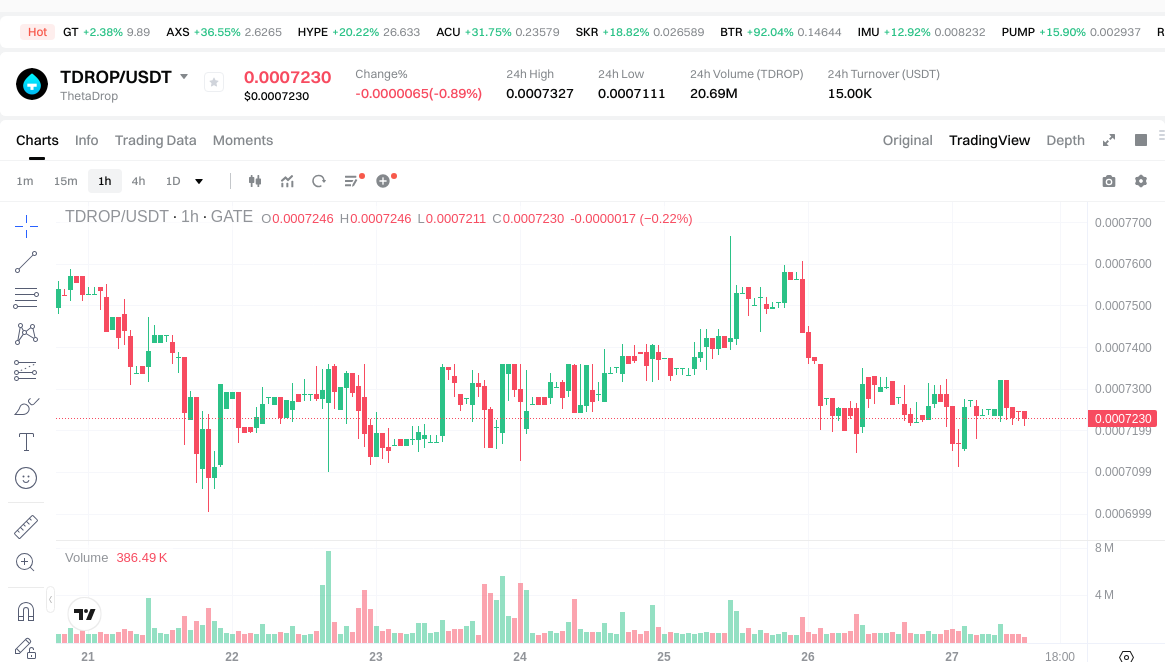
TDROP is a TNT-20 token operating within the Theta blockchain ecosystem, primarily focused on NFT marketplace activities and decentralized governance. As of January 27, 2026, TDROP maintains a market capitalization of approximately $7.99 million, with a circulating supply of 11.05 billion tokens and a current price of $0.000723. The token ranks 1313 in the cryptocurrency market, representing a 0.00025% market dominance.
Since its launch, TDROP has served the ThetaDrop NFT Marketplace by rewarding user activity, providing governance mechanisms, and offering staking rewards. The token operates on the Theta blockchain and implements the concept of NFT Liquidity Mining. With a maximum supply capped at 20 billion tokens and approximately 55.25% currently in circulation, TDROP presents a specific use case within the NFT and blockchain video streaming sector.
Recent price performance indicates notable volatility, with the token experiencing a 1.1% decline over the past 24 hours, a 3.04% decrease over the past week, and a 10.85% drop over the past 30 days. Over the annual period, TDROP has recorded a 78.32% decline from previous levels. The token's historical price range spans from a recorded high of $0.061086 in February 2022 to a low of $0.00068144 in December 2025.
This analysis examines TDROP's investment characteristics, historical price movements, potential future scenarios, and associated risks. The assessment considers market data, tokenomics, and ecosystem positioning to provide context for those evaluating "Is ThetaDrop (TDROP) a good investment?" within their portfolio considerations.
I. TDROP Price History Review and Investment Value Status
- 2022: Token reached a notable price level of $0.061086 on February 18, 2022 → Early investors experienced significant price appreciation during this period
- 2025: Market conditions led to price compression → TDROP declined to $0.00068144 on December 18, 2025
- Recent Period: Market volatility continues → Price fluctuated between the December 2025 level and current trading range
Current TDROP Investment Market Status (January 2026)
- TDROP current price: $0.000723
- 24-hour trading volume: $14,978.28
- Market capitalization: $7,989,726.85
- Circulating supply: 11,050,797,860 TDROP (55.25% of maximum supply)
- Price changes: +0.32% (1H), -1.1% (24H), -3.04% (7D), -10.85% (30D), -78.32% (1Y)
Click to view real-time TDROP market price
II. Core Factors Influencing Whether TDROP is a Good Investment
Supply Mechanism and Scarcity (TDROP Investment Scarcity)
- Supply Structure → Influences price and investment value
- TDROP has a circulating supply of approximately 11,050,797,860 tokens, representing about 55.25% of the maximum supply of 20,000,000,000 tokens
- The circulating ratio suggests a substantial portion of tokens remains locked or unvested, which may impact future supply dynamics
- Historical Price Patterns: Supply dynamics have contributed to price volatility, with TDROP experiencing significant fluctuations since its launch
- The token reached a notable price level in February 2022, while experiencing lower price points in December 2025
- The year-over-year performance shows a decline of approximately 78.32%, reflecting broader market conditions and project-specific factors
- Investment Implications: The controlled release of tokens from the maximum supply may serve as a factor in long-term price considerations, though market conditions and adoption rates remain primary determinants
Institutional Investment and Mainstream Adoption (Institutional Investment in TDROP)
- Market Capitalization Trends: As of January 2026, TDROP maintains a market capitalization of approximately $7.99 million, with a fully diluted valuation at similar levels
- The market cap to fully diluted valuation ratio of 55.25% indicates that token circulation is gradually progressing
- Ecosystem Integration: TDROP operates within the ThetaDrop NFT marketplace ecosystem, which is built on the Theta blockchain infrastructure
- The token serves multiple functions including rewarding marketplace activity, providing governance rights, and enabling staking rewards
- NFT Liquidity Mining represents a distinctive application within the project's framework
- Exchange Availability: TDROP is listed on 2 exchanges, with trading activity recorded at approximately $14,978 in 24-hour volume
Macroeconomic Environment's Impact on TDROP Investment
- Cryptocurrency Market Conditions → Affect investment attractiveness
- The broader digital asset market environment influences TDROP's price performance and investor sentiment
- Market volatility remains a significant consideration, with TDROP showing price changes of -1.1% over 24 hours, -3.04% over 7 days, and -10.85% over 30 days
- NFT Market Dynamics: As a token centered on NFT marketplace activities, TDROP's value proposition is connected to the broader NFT sector trends
- NFT market cycles and liquidity conditions may impact token utility and demand
Technology and Ecosystem Development (Technology & Ecosystem for TDROP Investment)
- Theta Blockchain Integration: TDROP functions as a TNT-20 token on the Theta blockchain
- The token contract is deployed at address 0x1336739b05c7ab8a526d40dcc0d04a826b5f8b03 on the Theta network
- Integration with Theta's infrastructure provides technical foundation for marketplace operations
- NFT Liquidity Mining Innovation: The project introduces concepts around NFT Liquidity Mining, representing an approach to incentivize marketplace participation
- Users can earn TDROP rewards through various marketplace activities
- Staking mechanisms offer additional reward opportunities for token holders
- Governance Function: TDROP provides decentralized governance capabilities for the ThetaDrop platform
- Token holders may participate in decision-making processes affecting platform development
- Application Scope: The token's utility is primarily focused on the ThetaDrop NFT marketplace ecosystem
- Future expansion of use cases may depend on platform growth and community adoption
III. TDROP Future Investment Prediction and Price Outlook (Is ThetaDrop(TDROP) worth investing in 2026-2031)
Short-term Investment Prediction (2026, short-term TDROP investment outlook)
- Conservative forecast: $0.00059286 - $0.000723
- Neutral forecast: $0.000723 - $0.00085
- Optimistic forecast: $0.00085 - $0.00098328
Mid-term Investment Outlook (2027-2029, mid-term ThetaDrop(TDROP) investment forecast)
- Market stage expectation: Based on available data, TDROP may experience gradual growth during the mid-term period, with potential price appreciation driven by NFT market dynamics and ecosystem development on the Theta blockchain.
- Investment return prediction:
- 2027: $0.0006910434 - $0.001194396
- 2028: $0.00072687528 - $0.00123875928
- 2029: $0.0007466340024 - $0.0014027669136
- Key catalysts: NFT marketplace activity, governance participation, staking rewards distribution, and liquidity mining initiatives may influence token performance.
Long-term Investment Outlook (Is TDROP a good long-term investment?)
- Base scenario: $0.000785549471616 - $0.001381046651712 (assuming steady ecosystem growth and sustained NFT market interest)
- Optimistic scenario: $0.001324030964256 - $0.00181392242103 (assuming increased adoption of ThetaDrop NFT marketplace and favorable market conditions)
- Risk scenario: Below $0.00059286 (under adverse market conditions or reduced platform activity)
Check TDROP long-term investment and price prediction: Price Prediction
2026-2031 Long-term Outlook
- Base scenario: $0.000723 - $0.001324030964256 (corresponding to steady progress and gradual mainstream application adoption)
- Optimistic scenario: $0.001324030964256 - $0.00181392242103 (corresponding to large-scale adoption and favorable market environment)
- Transformative scenario: Above $0.00181392242103 (if ecosystem achieves breakthrough progress and mainstream adoption)
- 2031-12-31 predicted high: $0.00181392242103 (based on optimistic development assumptions)
Disclaimer: Price predictions are based on historical data and market analysis. Cryptocurrency investments involve substantial risk, and actual prices may differ significantly from forecasts. This information does not constitute investment advice.
| Year |
Predicted High Price |
Predicted Average Price |
Predicted Low Price |
Price Change |
| 2026 |
0.00098328 |
0.000723 |
0.00059286 |
0 |
| 2027 |
0.001194396 |
0.00085314 |
0.0006910434 |
18 |
| 2028 |
0.00123875928 |
0.001023768 |
0.00072687528 |
41 |
| 2029 |
0.0014027669136 |
0.00113126364 |
0.0007466340024 |
56 |
| 2030 |
0.001381046651712 |
0.0012670152768 |
0.000785549471616 |
75 |
| 2031 |
0.00181392242103 |
0.001324030964256 |
0.00072821703034 |
83 |
IV. TDROP Investment Strategy and Risk Management (How to invest in NFT tokens)
Investment Methodology (TDROP investment strategy)
-
Long-term Holding (HODL TDROP): Suitable for conservative investors
Long-term holding may be appropriate for investors who believe in the potential growth of the ThetaDrop NFT marketplace and the Theta blockchain ecosystem. This approach involves purchasing TDROP tokens and holding them through market fluctuations, with the expectation that the value may appreciate as the platform develops and user adoption increases.
-
Active Trading: Relies on technical analysis and swing trading
Active traders may utilize technical analysis tools to identify entry and exit points based on price trends. Given TDROP's price movements (1H: +0.32%, 24H: -1.1%, 7D: -3.04%, 30D: -10.85%), traders might look for short-term opportunities during volatility periods. This strategy requires continuous market monitoring and understanding of chart patterns.
Risk Management (Risk management for TDROP investment)
-
Asset Allocation Ratios: Conservative / Aggressive / Professional investors
Conservative investors: May allocate 1-3% of their crypto portfolio to TDROP, minimizing exposure to this lower market cap asset (market cap: $7,989,726.85).
Aggressive investors: Could consider 5-10% allocation if they have strong conviction in the NFT marketplace sector and Theta ecosystem.
Professional investors: May use dynamic allocation strategies based on market conditions and technical indicators.
-
Risk Hedging Solutions: Multi-asset portfolio + hedging tools
Investors might consider diversifying across multiple blockchain ecosystems rather than concentrating solely in Theta-based tokens. Portfolio diversification with established cryptocurrencies alongside NFT-focused tokens may help balance risk exposure. Professional investors might explore derivatives or stablecoin positions to hedge against downside volatility.
-
Secure Storage: Hot/cold wallets + hardware wallet recommendations
Given that TDROP is a TNT-20 token on the Theta blockchain, investors should use wallets that support Theta network tokens. Cold storage solutions such as hardware wallets provide enhanced security for long-term holdings. For active traders, a combination of hot wallets for trading convenience and cold wallets for the majority of holdings may offer a balanced approach to security and accessibility.
V. TDROP Investment Risks and Challenges (Risks of investing in NFT tokens)
-
Market Risk: High volatility, price manipulation
TDROP has demonstrated significant volatility, with a 1-year decline of -78.32%. The token's 24-hour trading volume of $14,978.28 indicates relatively limited liquidity, which may increase the risk of price fluctuations. With a current price of $0.000723 compared to its historical high of $0.061086 (recorded on February 18, 2022), the token has experienced substantial downward pressure. Limited exchange listings (2 exchanges) may contribute to lower liquidity and potentially higher susceptibility to large order impacts.
-
Regulatory Risk: Policy uncertainty across different jurisdictions
NFT-related tokens face evolving regulatory frameworks worldwide. Different countries are developing varied approaches to regulating NFTs and associated tokens. Changes in cryptocurrency regulations, particularly those affecting NFT marketplaces or staking mechanisms, could impact TDROP's utility and value proposition. Investors should stay informed about regulatory developments in their jurisdictions and where the project operates.
-
Technical Risk: Network security vulnerabilities, upgrade failures
As a token built on the Theta blockchain, TDROP's functionality depends on the underlying network's stability and security. Technical issues with the Theta network, smart contract vulnerabilities in the ThetaDrop marketplace, or problems with staking mechanisms could affect token utility. Additionally, any major upgrades or protocol changes to the Theta ecosystem could introduce temporary disruptions or unexpected outcomes.
VI. Conclusion: Is NFT token a Good Investment?
-
Investment Value Summary: TDROP presents opportunities within the NFT marketplace sector but exhibits substantial short-term price volatility.
TDROP serves specific functions within the ThetaDrop NFT marketplace ecosystem, including activity rewards, governance participation, and staking incentives. The token's circulating supply represents 55.25% of the maximum supply of 20 billion tokens. Current market metrics show a relatively small market cap of approximately $7.99 million with a market dominance of 0.00025%, positioning it as a smaller market cap asset with corresponding risk-reward characteristics.
-
Investor Recommendations:
✅ Beginners: Consider dollar-cost averaging with small amounts + secure wallet storage
New investors should start with minimal exposure and use only funds they can afford to lose entirely. Focus on understanding the Theta ecosystem and ThetaDrop platform functionality before increasing position size. Prioritize security by using reputable wallets that support TNT-20 tokens.
✅ Experienced Investors: Swing trading opportunities + portfolio diversification
Experienced traders may identify opportunities during volatility periods while maintaining strict position sizing and stop-loss disciplines. Consider TDROP as part of a broader NFT-sector allocation rather than a standalone investment. Monitor the development of the ThetaDrop marketplace and user adoption metrics.
✅ Institutional Investors: Strategic long-term allocation considerations
Institutions exploring NFT marketplace exposure might evaluate TDROP within a broader Theta ecosystem investment thesis. Due diligence should include analysis of the ThetaDrop platform's competitive positioning, user growth metrics, and the sustainability of the NFT liquidity mining model.
⚠️ Disclaimer: Cryptocurrency investment carries substantial risk. This content is for informational purposes only and does not constitute investment advice. Investors should conduct their own research and consider their financial situation and risk tolerance before making investment decisions.
VII. FAQ
Q1: What is the current circulating supply of TDROP and how does it affect investment potential?
TDROP has a circulating supply of 11,050,797,860 tokens, representing approximately 55.25% of the maximum supply of 20 billion tokens. This controlled circulation means that nearly half of the total token supply remains locked or unvested, which could impact future price dynamics as additional tokens enter the market. The gradual release of remaining tokens may create selling pressure, though it also suggests a structured token distribution approach. Investors should consider that as the remaining 44.75% of tokens gradually enter circulation, dilution effects may influence price performance alongside demand factors from marketplace activity and ecosystem growth.
Q2: How does TDROP's price performance compare to its historical high, and what does this indicate?
TDROP is currently trading at $0.000723, representing a 98.8% decline from its historical high of $0.061086 reached in February 2022. This substantial decrease reflects both broader cryptocurrency market conditions and project-specific factors. The token has experienced a 78.32% decline over the past year alone, indicating significant bearish momentum. While this positions TDROP at a considerably lower valuation than its peak, it also suggests elevated risk. The price history demonstrates extreme volatility characteristic of smaller market cap tokens, which investors should carefully evaluate against their risk tolerance before considering investment.
Q3: What are the primary use cases that give TDROP utility within its ecosystem?
TDROP serves three main functions within the ThetaDrop NFT marketplace ecosystem. First, it rewards users for marketplace activity through NFT Liquidity Mining, incentivizing participation in the platform. Second, it provides governance rights, allowing token holders to participate in decision-making processes affecting platform development. Third, it offers staking rewards, enabling holders to earn additional tokens by locking their TDROP. These utility mechanisms are designed to create ongoing demand for the token while fostering community engagement. However, the token's value remains closely tied to the success and adoption of the ThetaDrop marketplace itself.
Q4: What level of liquidity does TDROP currently have, and why does this matter for investors?
TDROP demonstrates limited liquidity with a 24-hour trading volume of approximately $14,978.28 across 2 exchanges. This low trading volume relative to the market capitalization of $7.99 million indicates that large buy or sell orders could significantly impact the price. Limited liquidity presents several challenges: wider bid-ask spreads, difficulty executing large trades without slippage, and increased vulnerability to price manipulation. For investors, this means entry and exit strategies require careful planning, and position sizes should account for the potential difficulty in selling large amounts quickly without adverse price movement.
Q5: How does TDROP's integration with the Theta blockchain affect its investment characteristics?
TDROP operates as a TNT-20 token on the Theta blockchain, which provides the technical foundation for its marketplace operations. This integration means TDROP's functionality and security are dependent on the Theta network's performance and stability. The relationship offers potential benefits from Theta's video streaming and NFT infrastructure while also creating concentration risk. Investors should evaluate both TDROP-specific factors and the broader Theta ecosystem health. Technical issues, upgrades, or changes to the Theta protocol could directly impact TDROP's utility. Additionally, wallet support is limited to those compatible with Theta network tokens, which may affect accessibility for some users.
Q6: What allocation percentage is recommended for different investor types considering TDROP?
Conservative investors should limit TDROP exposure to 1-3% of their cryptocurrency portfolio due to its small market cap, high volatility, and limited liquidity. Aggressive investors with higher risk tolerance might consider 5-10% allocation if they have strong conviction in the NFT marketplace sector and Theta ecosystem prospects. Professional investors may employ dynamic allocation strategies based on technical indicators and market conditions. These recommendations reflect TDROP's classification as a higher-risk asset with its 78.32% annual decline and volatile price history. Regardless of investor type, position sizing should only include capital that can be lost entirely without affecting financial stability.
Q7: What are the main risk factors that could negatively impact a TDROP investment?
TDROP faces multiple significant risk factors. Market risk is substantial, with demonstrated volatility including a 78.32% decline over the past year and daily fluctuations exceeding 1%. The limited trading volume ($14,978.28 daily) on only 2 exchanges increases vulnerability to price manipulation and liquidity constraints. Regulatory risk exists as global jurisdictions develop varied approaches to NFT-related tokens and marketplace activities. Technical risk stems from dependence on Theta blockchain stability, potential smart contract vulnerabilities, and possible issues with staking mechanisms. Additionally, the token's value is closely tied to ThetaDrop marketplace adoption, creating concentration risk if platform growth fails to meet expectations or faces competition from alternative NFT marketplaces.
Q8: Is TDROP suitable for long-term holding, and what factors should influence this decision?
TDROP as a long-term holding depends on multiple factors and requires careful consideration. The investment thesis would rest on belief in the ThetaDrop NFT marketplace's competitive positioning, the Theta ecosystem's growth trajectory, and broader NFT market expansion. Favorable factors include the structured token supply with 44.75% still locked, governance rights, and staking rewards that could compound holdings over time. However, significant concerns include the 98.8% decline from all-time highs, small market cap, limited liquidity, and concentration in a single marketplace platform. Long-term holders should evaluate whether the NFT marketplace sector justifies exposure, assess the ThetaDrop platform's competitive advantages, and determine if they can withstand continued volatility and potential further downside before considering multi-year holding periods.
* The information is not intended to be and does not constitute financial advice or any other recommendation of any sort offered or endorsed by Gate.