This comprehensive analysis evaluates whether Tokocrypto (TKO) represents a viable investment opportunity in 2024-2031. The article examines TKO's position as Indonesia's native exchange token, currently priced at $0.07914 with a market cap of $5.94 million and 15% circulation ratio of its 500 million total supply. It covers critical factors including price history (down 78.7% year-over-year), utility functions (trading fee discounts, DeFi integration, NFT marketplace access), and liquidity across 15 exchanges. The analysis presents multiple investment scenarios ranging from conservative ($0.0601-$0.0788) to optimistic ($0.1811 by 2031), alongside risk assessments covering market volatility, regulatory uncertainties in Indonesia, and concentration exposure. Detailed investment strategies for different investor profiles and comprehensive risk management approaches are provided. Suitable for investors seeking Southeast Asian market exposure through exchange tokens on Gate.
Introduction: Tokocrypto (TKO)'s Investment Position and Market Prospects
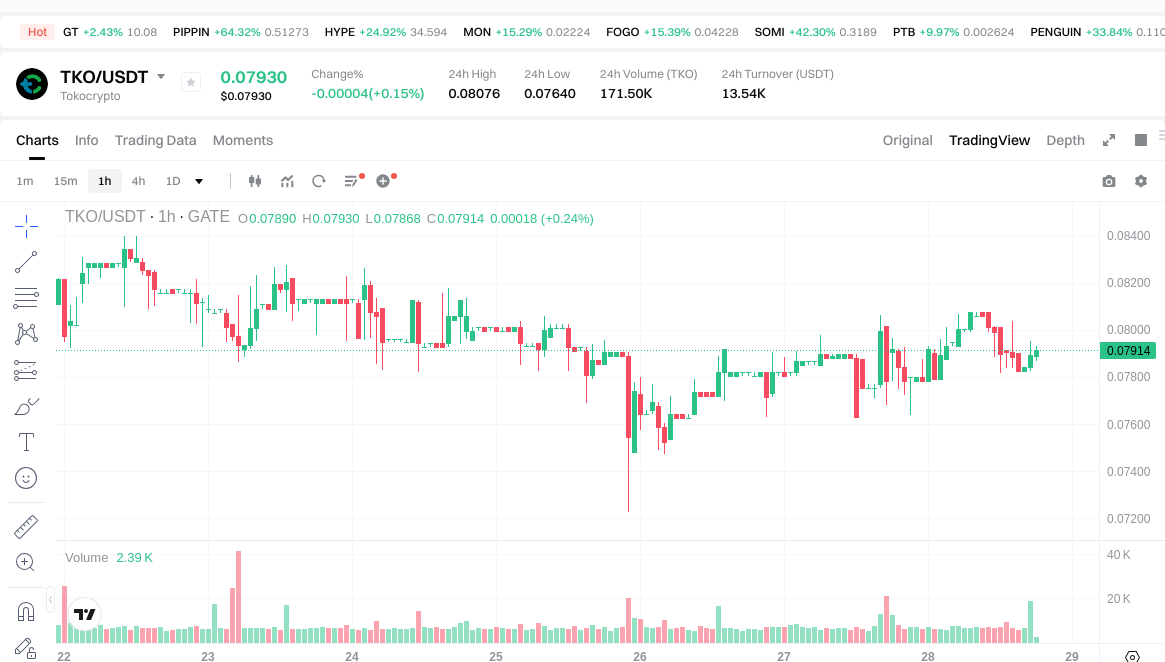
TKO is a functional token in the cryptocurrency field. Since its launch in 2021, it has been associated with the Tokocrypto platform, a digital asset exchange based in Indonesia. As of January 28, 2026, TKO has a market capitalization of approximately $5.94 million, with a circulating supply of 75 million tokens out of a maximum supply of 500 million. The current price stands at around $0.07914. As the native token of the Tokocrypto exchange, TKO offers various utility functions including transaction fee discounts, participation in CeFi programs, DeFi applications, and serves as a payment channel within the TKO NFT Arcade. This article will comprehensively analyze TKO's investment characteristics, historical price movements, future price considerations, and associated investment risks to provide reference information for those interested in understanding "Is Tokocrypto (TKO) a good investment?"
I. Tokocrypto (TKO) Price History Review and Current Investment Value
- 2021: TKO launched and entered the market → Price reached $4.91 in early May
- 2022-2024: Market correction phase → Price declined from higher levels to below $0.20
- 2025: Market stabilization period → TKO traded around $0.19, showing relatively stable performance
- 2026: Recent price movement → TKO recorded a price of $0.07914 on January 28, 2026
Current TKO Investment Market Status (January 2026)
- TKO current price: $0.07914
- Market sentiment: Data not available in provided materials
- 24-hour trading volume: $13,583.83
- Institutional investor holdings: Data not available in provided materials
Click to view real-time TKO market price
II. Core Factors Affecting Whether TKO is a Good Investment
Supply Mechanism and Scarcity (TKO Investment Scarcity)
- Total Supply and Circulation: TKO has a maximum supply of 500,000,000 tokens, with a current circulating supply of 75,000,000 tokens (15% circulation ratio). The limited circulation relative to total supply may create a scarcity dynamic that could influence token valuation over time.
- Supply Distribution Pattern: The relatively low circulation ratio suggests a significant portion of tokens remains unlocked, which could affect future supply dynamics and price stability as additional tokens enter circulation.
- Investment Implications: The scarcity factor derived from the current circulation ratio may serve as one element supporting long-term investment considerations, though future token release schedules should be monitored.
Institutional Investment and Mainstream Adoption (Institutional Investment in TKO)
- Holder Base: TKO currently has 58,997 token holders, indicating a moderate level of adoption within the cryptocurrency community.
- Exchange Availability: The token is listed on 15 exchanges, providing reasonable liquidity and accessibility for investors seeking exposure to the asset.
- Regional Focus: As Indonesia's digital asset exchange with growth in transaction volume and user registration, Tokocrypto's performance may be influenced by regulatory developments and adoption trends within the Indonesian market.
Macroeconomic Environment's Impact on TKO Investment
- Regional Economic Factors: TKO's investment outlook may be affected by economic conditions in Indonesia, including monetary policy shifts and local currency fluctuations that influence digital asset adoption.
- Market Volatility Context: The token has experienced significant price fluctuations, with a 1-year change of -78.7%, reflecting sensitivity to broader cryptocurrency market conditions and macroeconomic uncertainty.
- Diversification Considerations: Within a diversified portfolio, TKO represents exposure to the Indonesian digital asset market segment, which carries both regional opportunities and specific risk factors.
Technology and Ecosystem Development (Technology & Ecosystem for TKO Investment)
- Platform Utilities: TKO serves multiple functions within the Tokocrypto ecosystem, including trading fee discounts, airdrop rights, and participation in CeFi programs such as deposits, savings, and cash-back initiatives.
- Cross-Platform Integration: Planned use cases include integration with third-party DeFi platforms through mining pools and lending protocols, potentially expanding the token's utility beyond the primary exchange platform.
- NFT Market Development: TKO functions as the core payment mechanism for TKO NFT Arcade, Indonesia's digital collectibles and creative asset marketplace, positioning the token within the growing NFT sector.
- Ecosystem Applications: The token's utility extends across multiple sectors including DeFi, NFT markets, and payment channels, which may contribute to sustained demand depending on ecosystem adoption rates and user engagement levels.
III. TKO Future Investment Forecast and Price Outlook (Is Tokocrypto (TKO) worth investing in 2026-2031)
Short-term Investment Forecast (2026, short-term TKO investment outlook)
- Conservative forecast: $0.0601 - $0.0788
- Neutral forecast: $0.0788 - $0.0791
- Optimistic forecast: $0.0791 - $0.1163
Mid-term Investment Outlook (2027-2028, mid-term Tokocrypto (TKO) investment forecast)
- Market stage expectation: TKO may enter a gradual recovery phase, with price fluctuations potentially stabilizing as the platform continues to develop its Indonesian market presence and expand its NFT marketplace initiatives.
- Investment return forecast:
- 2027: $0.0655 - $0.1447
- 2028: $0.0654 - $0.1782
- Key catalysts: Platform ecosystem development, user base growth in the Indonesian market, NFT marketplace adoption, and DeFi integration progress.
Long-term Investment Outlook (Is TKO a good long-term investment?)
- Base scenario: $0.0943 - $0.1770 (assuming steady platform development and moderate market conditions)
- Optimistic scenario: $0.1377 - $0.1811 (assuming enhanced adoption, successful ecosystem expansion, and favorable regulatory environment in Indonesia)
- Risk scenario: $0.0601 - $0.0788 (under challenging market conditions or regulatory headwinds)
View TKO long-term investment and price forecast: Price Prediction
2026-01-28 - 2031 Long-term Outlook
- Base scenario: $0.0943 - $0.1653 (corresponding to steady progress and gradual mainstream application growth)
- Optimistic scenario: $0.1377 - $0.1811 (corresponding to large-scale adoption and favorable market environment)
- Transformational scenario: Above $0.1800 (if the ecosystem achieves breakthrough developments and mainstream adoption)
- 2031-12-31 forecast high: $0.1797 (based on optimistic development assumptions)
Disclaimer: The forecasts presented are based on analytical models and historical data patterns. Cryptocurrency markets are highly volatile and subject to various unpredictable factors. Past performance does not guarantee future results. These projections should not be considered as financial advice, and investors should conduct their own research and consult with qualified financial advisors before making investment decisions.
| Year |
Predicted High Price |
Predicted Average Price |
Predicted Low Price |
Price Change |
| 2026 |
0.1163358 |
0.07914 |
0.0601464 |
0 |
| 2027 |
0.144652092 |
0.0977379 |
0.065484393 |
23 |
| 2028 |
0.17815664412 |
0.121194996 |
0.06544529784 |
53 |
| 2029 |
0.1811077422726 |
0.14967582006 |
0.1377017544552 |
89 |
| 2030 |
0.176969205847941 |
0.1653917811663 |
0.094273315264791 |
108 |
| 2031 |
0.179739518182476 |
0.17118049350712 |
0.140368004675838 |
116 |
IV. TKO Investment Strategy and Risk Management (How to invest in Tokocrypto)
Investment Methodology (TKO investment strategy)
-
Long-term Holding (HODL TKO): Suitable for conservative investors who believe in the long-term development of the Indonesian digital asset market and the expansion of Tokocrypto's ecosystem. This approach may involve holding TKO tokens to benefit from platform incentives, including transaction fee discounts, airdrop rights, and merchandise redemption programs.
-
Active Trading: Relies on technical analysis and swing trading strategies. Traders may monitor price movements within the historical range and utilize support and resistance levels for entry and exit points. Given the token's price volatility, this approach requires continuous market monitoring and risk assessment.
Risk Management (Risk management for TKO investment)
V. TKO Investment Risks and Challenges (Risks of investing in Tokocrypto)
-
Market Risk: TKO exhibits notable price volatility, with historical data showing significant fluctuations. The token experienced a substantial decline from its previous levels, reflecting sensitivity to broader market conditions and exchange-specific factors. The circulating supply represents 15% of the total supply, which may create additional price pressure as more tokens enter circulation.
-
Regulatory Risk: As an exchange token primarily focused on the Indonesian market, TKO faces regulatory uncertainties specific to Indonesia's evolving digital asset policies. Changes in local regulations regarding cryptocurrency exchanges, trading activities, or token classifications could materially impact the token's utility and value proposition. Different jurisdictions may impose varying restrictions on exchange tokens, affecting international accessibility and liquidity.
-
Technical Risk: Potential vulnerabilities include smart contract security on the BSC network, platform infrastructure reliability, and integration challenges with DeFi protocols and NFT marketplace operations. Network congestion or security incidents on the underlying blockchain could affect token transactions and platform functionality. The success of planned use cases, including cross-platform DeFi integrations and the TKO NFT Arcade, remains subject to execution risk and market adoption.
-
Concentration Risk: The platform's geographic focus on Indonesia creates exposure to country-specific economic conditions, regulatory changes, and market sentiment. Limited exchange availability (15 exchanges) may constrain liquidity compared to more widely distributed tokens.
VI. Conclusion: Is Tokocrypto a Good Investment?
-
Investment Value Summary: TKO represents exposure to the Indonesian digital asset exchange sector and associated utility functions, including trading fee discounts, participation in CeFi and DeFi programs, and access to the NFT marketplace. The token's value proposition is tied to the growth of Tokocrypto's platform and adoption within the Indonesian market. However, the token has experienced substantial price fluctuations, and its performance is closely linked to both exchange-specific developments and broader market conditions.
-
Investor Recommendations:
- ✅ Beginners: Consider dollar-cost averaging with small amounts and prioritize secure storage solutions compatible with BSC. Understand the platform's specific utility features before investing.
- ✅ Experienced Investors: May explore swing trading opportunities based on technical analysis while maintaining portfolio diversification. Evaluate the token's role within a broader exchange token allocation strategy.
- ✅ Institutional Investors: Conduct comprehensive due diligence on Tokocrypto's operational metrics, regulatory compliance, competitive positioning, and growth trajectory in the Indonesian market before considering strategic allocation.
⚠️ Notice: Cryptocurrency investments carry substantial risk, and this article is provided for informational purposes only and does not constitute investment advice. Investors should conduct independent research and consider their risk tolerance before making investment decisions.
VII. FAQ
Q1: What is the current circulating supply ratio of TKO, and how might this affect future price movements?
TKO currently has a circulating supply of 75 million tokens out of a maximum supply of 500 million, representing only 15% of the total supply. This low circulation ratio creates a scarcity dynamic in the short term, but also means that 425 million tokens (85%) remain to be released into circulation. As additional tokens are unlocked and distributed over time, this could create significant selling pressure and potentially impact price stability. Investors should monitor the token release schedule carefully, as large supply increases without corresponding demand growth could lead to price dilution. This supply structure presents both an opportunity (current scarcity) and a risk (future dilution), making it crucial to understand the vesting schedules and distribution mechanisms before making investment decisions.
Q2: How does TKO's regional focus on Indonesia impact its investment risk profile?
TKO is primarily focused on the Indonesian market as the native token of Indonesia's Tokocrypto exchange, which creates concentration risk. The token's performance is closely tied to Indonesia's regulatory environment, economic conditions, and local adoption of digital assets. While this regional focus allows TKO to potentially capture growth in Southeast Asia's emerging cryptocurrency market, it also means the token is vulnerable to country-specific challenges such as regulatory changes, economic downturns, or shifts in local cryptocurrency sentiment. Unlike globally distributed tokens, TKO's limited geographic diversification means that adverse developments in Indonesia could disproportionately affect the token's value and utility.
Q3: What utility functions does TKO provide, and how do these contribute to its investment value?
TKO offers multiple utility functions within the Tokocrypto ecosystem: transaction fee discounts on the exchange, airdrop rights, participation in CeFi programs (deposits, savings, cash-back), access to DeFi integrations through mining pools and lending protocols, and serves as the payment mechanism for TKO NFT Arcade. These utilities create demand drivers beyond pure speculation, as users holding TKO receive tangible benefits when actively using the platform. However, the value derived from these utilities depends on the platform's user activity levels, trading volumes, and adoption rates of the NFT marketplace and DeFi features. Investors should assess whether the current utility offerings justify the token's valuation and whether planned integrations with third-party DeFi platforms materialize as expected.
Q4: Given TKO's 78.7% decline over the past year, what factors should be considered before investing?
The significant price decline reflects both broader cryptocurrency market weakness and token-specific challenges. Before investing, consider: (1) whether the fundamentals of the Tokocrypto platform have deteriorated or if this is primarily market-driven volatility, (2) the token's historical price patterns and support levels, (3) recent platform developments including user growth metrics and transaction volumes, (4) regulatory developments in Indonesia that could affect operations, and (5) your own risk tolerance for high-volatility assets. The sharp decline could present a potential entry opportunity if fundamentals remain sound, but it may also signal underlying issues with platform adoption or competitive positioning. Conduct thorough due diligence on Tokocrypto's operational performance before interpreting the price decline as solely a buying opportunity.
Q5: How liquid is TKO, and what are the implications for investors?
TKO is listed on 15 exchanges with a 24-hour trading volume of approximately $13,583.83 (as of January 28, 2026), which indicates relatively limited liquidity compared to major cryptocurrencies. This limited liquidity presents several implications: (1) larger trades may experience significant slippage, affecting execution prices, (2) bid-ask spreads may be wider, increasing transaction costs, (3) during market stress, it may be difficult to exit positions quickly without accepting substantial price discounts, and (4) the token may be more susceptible to price manipulation due to lower trading volumes. Conservative investors should maintain appropriate position sizing relative to daily trading volumes, while active traders should be prepared for potential liquidity constraints during volatile market conditions.
Q6: What are the key risk factors specific to investing in exchange tokens like TKO?
Exchange tokens carry unique risks beyond typical cryptocurrency investments: (1) Platform Dependency: TKO's value is directly tied to Tokocrypto's success, meaning any operational issues, security breaches, or competitive pressures affecting the exchange directly impact the token, (2) Regulatory Vulnerability: Authorities may specifically target exchange operations, and tokens could lose utility if the platform faces regulatory restrictions or licensing challenges, (3) Business Model Risk: Changes to fee structures, reward programs, or utility offerings could diminish the token's value proposition, (4) Centralization: Unlike decentralized protocols, exchange tokens depend on a centralized entity's decision-making and operational competence, and (5) Market Correlation: Exchange tokens often correlate strongly with trading volumes, meaning bear markets that reduce exchange activity can disproportionately impact token demand. These factors require investors to continuously monitor the exchange's operational health, not just market conditions.
Q7: Based on the price predictions, what return scenarios should investors consider for TKO through 2031?
The forecasted price ranges suggest varied potential outcomes: Conservative scenario ($0.0601-$0.0788 for 2026) implies limited upside from current levels around $0.07914, with potential downside risk. Base scenario projects gradual appreciation to $0.0943-$0.1653 by 2031, representing potential returns of 19-109% over approximately five years. Optimistic scenario forecasts prices reaching $0.1377-$0.1811 by 2031, suggesting potential returns of 74-129%. However, these projections assume continued platform development and favorable market conditions. Given the token's historical volatility and 78.7% decline over the past year, investors should prepare for significant fluctuations and the possibility that actual outcomes differ substantially from these models. The projections should be viewed as potential scenarios rather than expected outcomes, and any investment should align with personal risk tolerance and portfolio diversification strategies.
Q8: What investment approach is most suitable for TKO given its characteristics?
The optimal approach depends on investor profile and risk tolerance: Long-term holders might consider dollar-cost averaging into small positions (1-3% of portfolio for conservative investors) if they believe in Tokocrypto's long-term growth potential in the Indonesian market, focusing on accumulating tokens during periods of weakness while utilizing platform benefits like fee discounts. Active traders may find opportunities in TKO's volatility by employing technical analysis and swing trading strategies within established support and resistance levels, though this requires continuous monitoring and acceptance of execution risk due to limited liquidity. Risk-averse investors should likely avoid TKO or maintain minimal exposure given the concentration risk, limited liquidity, and substantial historical volatility. Regardless of approach, secure storage using hardware wallets compatible with BSC/BEP-20 tokens is essential for long-term holdings, while active traders should never store more than necessary amounts on exchanges.
* The information is not intended to be and does not constitute financial advice or any other recommendation of any sort offered or endorsed by Gate.