This article provides a comprehensive investment analysis of Trac Network (TNK), a Layer 1 peer-to-peer cryptocurrency protocol with a current market cap of $2.835 million and price of $0.135. The analysis examines TNK's historical price movements—from a peak of $0.7 in November 2025 to recent volatility of -44.81% in 24 hours—alongside investment fundamentals including its fixed 21 million token supply and complete circulation. The article evaluates core investment factors such as supply mechanisms, macroeconomic impacts, and technological infrastructure, then presents price forecasts across conservative, neutral, and optimistic scenarios through 2031. Critical sections address investment strategies including long-term holding and active trading approaches, comprehensive risk management with portfolio allocation recommendations, and major risk factors including market volatility, regulatory uncertainty, technical vulnerabilities, and liquidity constraints. Suitable for investors seeking TNK exposure on Gate
Introduction: Trac Network (TNK) Investment Position and Market Prospects
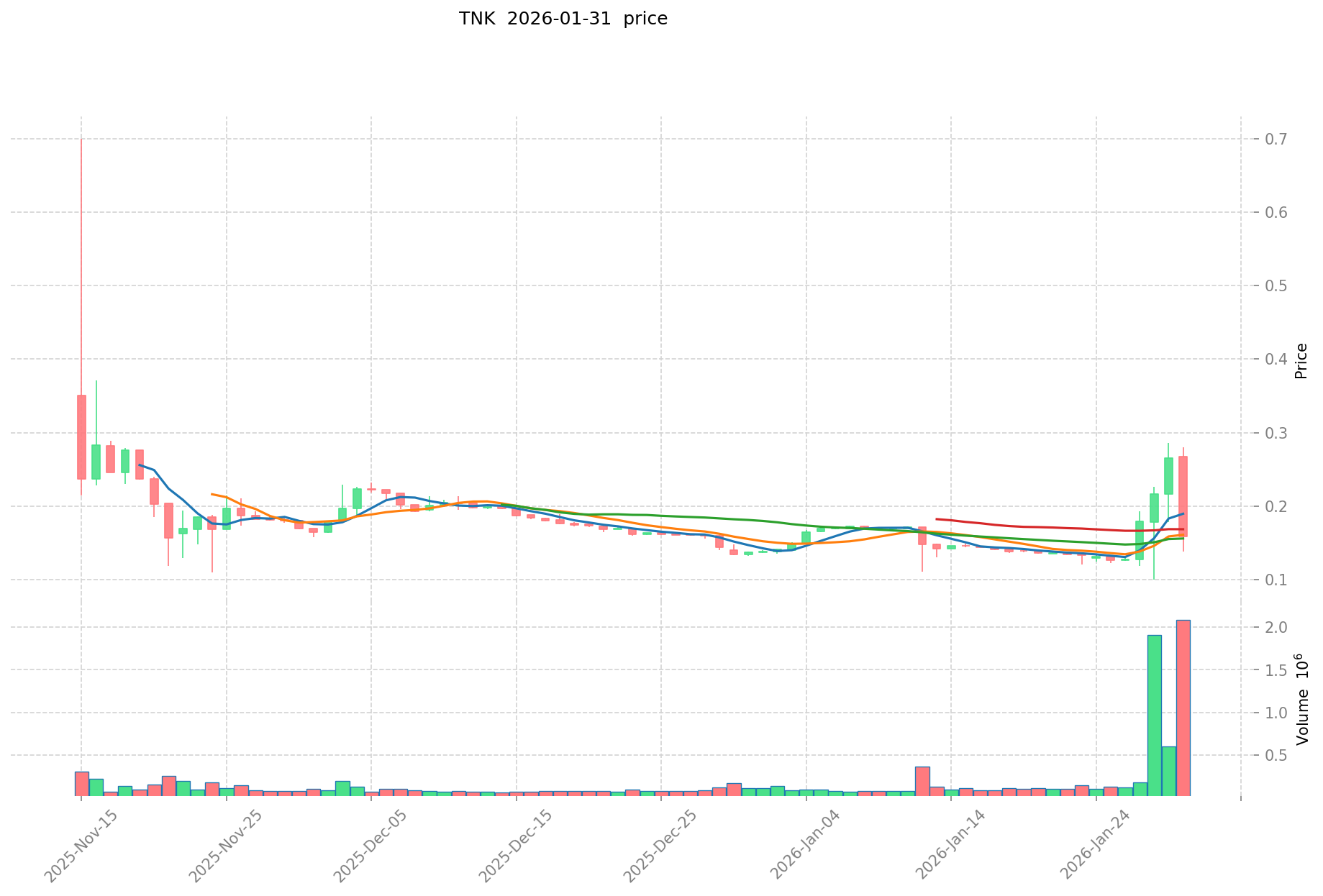
Trac Network (TNK) represents a notable asset in the cryptocurrency sector, positioning itself as a local-first Layer 1 protocol and peer-to-peer crypto network designed to support both enterprise and consumer-grade applications. As of January 31, 2026, TNK maintains a market capitalization of approximately $2.835 million, with a circulating supply of 21 million tokens and a current price around $0.135. The project's fully diluted valuation aligns with its market cap at $2.835 million, reflecting a complete token circulation ratio of 100%. With a market ranking of 1860 and a dominance of 0.000095%, TNK occupies a niche position within the broader cryptocurrency ecosystem. The token has experienced notable price volatility, having recorded a historical high of $0.7 on November 15, 2025, and a low of $0.0999 on January 28, 2026. Recent market performance shows mixed signals, with a 4.74% increase over one hour, a 0.75% gain over seven days, but a substantial 44.81% decline over 24 hours and a 2.19% decrease over 30 days. This article provides a comprehensive analysis of TNK's investment value, historical price movements, future price forecasts, and associated risks to assist investors in evaluating the asset's potential.
I. Trac Network (TNK) Price History Review and Current Investment Value
- November 2025: TNK reached a notable price level of $0.7 during its initial market phase → Early participants observed significant price appreciation from the launch period
- January 2026: The token experienced considerable volatility → Price fluctuated from approximately $0.25 to $0.13 within a 24-hour period, reflecting active market dynamics
- Recent Trading Period: The market demonstrated price adjustment patterns → Values ranged between $0.13 and $0.25, with the 24-hour low recorded at $0.1305
Current TNK Investment Market Status (January 2026)
- TNK Current Price: $0.135
- Market Sentiment: Trading data indicates a -44.81% change over 24 hours, suggesting increased market activity and price discovery
- 24-Hour Trading Volume: $392,623.66
- Market Capitalization: $2,835,000 with 100% of total supply (21,000,000 TNK) in circulation
- Fully Diluted Market Cap: $2,835,000, representing complete token circulation
Click to view real-time TNK market price
Project Context: Trac Network positions itself as a local-first Layer 1 protocol designed to enable peer-to-peer cryptocurrency applications for both business and consumer use cases. The token currently trades on one exchange platform with an algorithmic structure based on its mainnet implementation.
II. Core Factors Influencing Whether TNK is a Good Investment (Is Trac Network (TNK) a Good Investment)
Supply Mechanism and Scarcity (TNK Investment Scarcity)
- Fixed supply cap → influences price and investment value
- Trac Network has a maximum supply of 21,000,000 TNK tokens, with 100% already in circulation, creating a fully diluted market condition
- Historical context: TNK's price reached approximately $0.70 in November 2025, while experiencing a low point near $0.0999 in January 2026, demonstrating volatility patterns
- Investment significance: the complete circulation of the total supply eliminates inflationary pressure from new token releases, which may support scarcity-driven value considerations
Macroeconomic Environment's Impact on TNK Investment
- Market volatility indicators: TNK experienced a 44.81% decline over 24 hours as of January 31, 2026, reflecting sensitivity to broader market conditions
- Price fluctuation range: 24-hour trading showed movement between $0.1305 and $0.2502, indicating substantial intraday volatility
- Trading volume context: approximately $392,623.66 in 24-hour volume suggests relatively limited liquidity compared to major crypto assets
- Short-term performance: 1-hour gain of 4.74% and 7-day gain of 0.75% show mixed momentum patterns, while the 30-day decline of 2.19% indicates recent downward pressure
Technology and Ecosystem Development (Technology & Ecosystem for TNK Investment)
- Protocol foundation: Trac Network operates as a local-first Layer 1 protocol with peer-to-peer architecture, designed to support both enterprise and consumer-grade applications
- Network infrastructure: the project maintains its own mainnet with a dedicated blockchain explorer at explorer.trac.network
- Development transparency: technical documentation is available through the project's litepaper published on Medium
- Market positioning: with a market capitalization of approximately $2.835 million and ranking around #1860, TNK represents a small-cap crypto asset with corresponding risk-reward characteristics
III. TNK Future Investment Forecast and Price Outlook (Is Trac Network(TNK) worth investing in 2026-2031)
Short-term Investment Forecast (2026, short-term TNK investment outlook)
- Conservative forecast: $0.12213 - $0.1357
- Neutral forecast: $0.1357 - $0.15
- Optimistic forecast: $0.15 - $0.184552
Mid-term Investment Outlook (2027-2029, mid-term Trac Network(TNK) investment forecast)
- Market stage expectation: TNK may experience gradual development with potential volatility across the mid-term period. Market dynamics and adoption patterns could influence price movements during 2027-2029.
- Investment return forecast:
- 2027: $0.09127182 - $0.20656254
- 2028: $0.1631764003 - $0.1980118116
- 2029: $0.148728871824 - $0.244067892224
- Key catalysts: Market adoption trends, technological developments within the Trac Network ecosystem, and broader crypto market conditions.
Long-term Investment Outlook (Is TNK a good long-term investment?)
- Base scenario: $0.20433058852128 - $0.29562723445632 (assuming steady ecosystem growth and moderate market conditions through 2030)
- Optimistic scenario: $0.25650010048416 - $0.364230142687507 (assuming enhanced adoption and favorable market environment through 2031)
- Risk scenario: Below $0.12213 (under adverse market conditions or significant ecosystem challenges)
Check TNK long-term investment and price forecast: Price Prediction
2026-01-31 - 2031 Long-term Outlook
- Base scenario: $0.20433058852128 - $0.29562723445632 (corresponding to steady progress and gradual mainstream application enhancement)
- Optimistic scenario: $0.25650010048416 - $0.364230142687507 (corresponding to large-scale adoption and favorable market environment)
- Transformative scenario: Above $0.364230142687507 (subject to breakthrough developments in the ecosystem and mainstream adoption)
- 2031-12-31 forecast high: $0.364230142687507 (based on optimistic development assumptions)
Disclaimer: Price forecasts are analytical estimates based on historical data and market models. Cryptocurrency markets are highly volatile and unpredictable. These projections should not be construed as investment advice. Actual prices may differ significantly from forecasts due to various market factors, regulatory changes, technological developments, and macroeconomic conditions. Investors should conduct their own research and consider their risk tolerance before making investment decisions.
| Year |
Predicted High Price |
Predicted Average Price |
Predicted Low Price |
Price Change |
| 2026 |
0.184552 |
0.1357 |
0.12213 |
0 |
| 2027 |
0.20656254 |
0.160126 |
0.09127182 |
18 |
| 2028 |
0.1980118116 |
0.18334427 |
0.1631764003 |
35 |
| 2029 |
0.244067892224 |
0.1906780408 |
0.148728871824 |
41 |
| 2030 |
0.29562723445632 |
0.217372966512 |
0.20433058852128 |
61 |
| 2031 |
0.364230142687507 |
0.25650010048416 |
0.22572008842606 |
90 |
IV. TNK Investment Strategy and Risk Management (How to invest in Trac Network)
Investment Methodology (TNK investment strategy)
-
Long-term Holding (HODL TNK): Suitable for conservative investors seeking exposure to local-first Layer 1 protocols. This approach involves accumulating TNK tokens during market corrections and maintaining positions through price fluctuations, focusing on the project's fundamental development rather than short-term price movements.
-
Active Trading: Relies on technical analysis and swing trading strategies. Given TNK's notable price volatility (24-hour range between $0.1305 and $0.2502), experienced traders may identify opportunities through price pattern recognition, volume analysis, and momentum indicators to capture short-term gains.
Risk Management (Risk management for TNK investment)
V. TNK Investment Risks and Challenges (Risks of investing in Trac Network)
-
Market Risk: TNK exhibits substantial price volatility, as evidenced by the 44.81% decline over 24 hours and historical price range between $0.0999 and $0.7. The relatively low market capitalization of $2.835 million increases susceptibility to rapid price movements and potential liquidity constraints.
-
Regulatory Risk: As a Layer 1 blockchain protocol, Trac Network faces evolving regulatory frameworks across different jurisdictions. Changes in cryptocurrency regulations, classification determinations, or compliance requirements may impact TNK's accessibility and operational capabilities in various markets.
-
Technical Risk: As a peer-to-peer crypto network, Trac Network's infrastructure faces potential security vulnerabilities, network stability challenges, and protocol upgrade risks. The success of enterprise and consumer-grade applications depends on continuous technical development and network security maintenance.
-
Liquidity Risk: With limited exchange availability (currently listed on 1 exchange) and a 24-hour trading volume of approximately $392,624, TNK may experience liquidity constraints during periods of market stress, potentially impacting execution quality and price discovery.
VI. Conclusion: Is Trac Network a Good Investment?
Investment Value Summary
Trac Network (TNK) presents characteristics of an early-stage Layer 1 protocol targeting local-first and peer-to-peer applications. With 100% of its maximum supply of 21 million tokens in circulation, TNK exhibits full token distribution. However, the project faces considerable price volatility and limited market presence, as reflected in its market share of 0.000095%.
Investor Recommendations
✅ Beginners: Consider dollar-cost averaging (DCA) strategies combined with secure wallet storage. Begin with minimal allocations to understand TNK's price dynamics and network development before increasing position sizes.
✅ Experienced Investors: Employ swing trading strategies to capitalize on price volatility while maintaining core long-term positions. Implement portfolio diversification across multiple Layer 1 protocols to mitigate concentration risk.
✅ Institutional Investors: Conduct comprehensive due diligence on Trac Network's technical infrastructure, development roadmap, and competitive positioning within the Layer 1 ecosystem before considering strategic allocations.
⚠️ Disclaimer: Cryptocurrency investments carry substantial risk, including potential total loss of capital. This analysis is provided for informational purposes only and does not constitute investment advice. Investors should conduct independent research and consult qualified financial advisors before making investment decisions.
VII. FAQ
Q1: What is Trac Network (TNK) and what makes it unique in the crypto market?
Trac Network (TNK) is a local-first Layer 1 protocol and peer-to-peer crypto network designed to support both enterprise and consumer-grade applications. What distinguishes TNK is its focus on local-first architecture, enabling peer-to-peer cryptocurrency applications with emphasis on both business and consumer use cases. The network operates on its own mainnet with complete technical infrastructure, including a dedicated blockchain explorer. With a fixed maximum supply of 21 million tokens—all currently in circulation—TNK exhibits full token distribution without inflationary pressure from new token releases.
Q2: How volatile is TNK's price, and what does this mean for investors?
TNK demonstrates substantial price volatility. The token experienced a 44.81% decline over 24 hours as of January 31, 2026, with intraday trading showing movement between $0.1305 and $0.2502. Historically, TNK reached a high of $0.7 in November 2025 and dropped to $0.0999 in January 2026. This significant price fluctuation indicates that TNK is a high-risk, high-volatility asset suitable primarily for investors with strong risk tolerance. The volatility presents both opportunities for active traders to capture short-term gains and substantial downside risks for those unprepared for rapid price movements.
Q3: What are the main risks associated with investing in Trac Network?
TNK faces four primary investment risks. First, market risk stems from its low market capitalization of $2.835 million, making it susceptible to rapid price swings and liquidity constraints. Second, regulatory risk exists as evolving cryptocurrency regulations across jurisdictions may impact TNK's accessibility and operations. Third, technical risk arises from potential security vulnerabilities, network stability challenges, and protocol upgrade requirements inherent in maintaining a Layer 1 blockchain. Fourth, liquidity risk is evident from limited exchange availability (currently listed on only 1 exchange) and modest 24-hour trading volume of approximately $392,624, which may affect execution quality during market stress periods.
Q4: What is the price forecast for TNK through 2031?
Price forecasts suggest varied scenarios based on different market conditions. For 2026, estimates range from $0.12213 (conservative) to $0.184552 (optimistic). Mid-term projections for 2027-2029 show potential ranges between $0.09127182 and $0.244067892224, depending on adoption trends and ecosystem development. Long-term forecasts through 2031 suggest a base scenario of $0.20433058852128 to $0.29562723445632, with an optimistic scenario reaching $0.25650010048416 to $0.364230142687507. However, these are analytical estimates based on historical data and models—actual prices may differ significantly due to market volatility, regulatory changes, and technological developments.
Q5: How much should I allocate to TNK in my investment portfolio?
Portfolio allocation should align with your risk tolerance level. Conservative investors should consider limiting TNK allocation to 1-3% of their crypto portfolio, focusing on established assets for core holdings. Moderate investors may allocate 3-7% to TNK as part of a diversified crypto strategy. Aggressive investors with high risk tolerance could allocate up to 10% of their crypto portfolio to TNK, though this requires careful monitoring and risk management. Given TNK's volatility and limited market presence, it should represent only a small portion of overall investment portfolios, with the majority held in more established assets.
Q6: What investment strategies work best for TNK?
Two primary strategies suit different investor types. The long-term holding (HODL) strategy is appropriate for conservative investors seeking exposure to Layer 1 protocols, involving accumulation during market corrections and maintaining positions through volatility while focusing on fundamental development. Active trading strategies suit experienced traders who can leverage TNK's significant price volatility—with 24-hour ranges often exceeding 40%—through technical analysis, swing trading, and momentum indicators. For both strategies, implementing dollar-cost averaging (DCA) helps mitigate timing risk, while secure storage in hardware wallets protects long-term holdings from security threats.
Q7: Is TNK suitable for beginners in cryptocurrency investing?
TNK presents considerable challenges for beginners due to its extreme volatility, limited liquidity, and small market capitalization. New investors should approach TNK with caution, starting with minimal allocations to understand its price dynamics before increasing position sizes. Dollar-cost averaging (DCA) strategies combined with secure wallet storage provide a structured approach for beginners. However, TNK should represent only a small experimental portion of a beginner's portfolio, with the majority allocated to established cryptocurrencies with greater stability, liquidity, and market presence. Beginners must understand they could experience rapid and substantial losses given TNK's volatility profile.
Q8: How does TNK's fully circulated supply affect its investment value?
TNK has achieved 100% token circulation with all 21 million tokens already in the market, creating a fully diluted market condition. This complete circulation eliminates inflationary pressure from new token releases, which can support scarcity-driven value considerations. Unlike projects with ongoing token emissions that dilute existing holders, TNK's fixed supply means price movements reflect pure supply-demand dynamics without additional token inflation. However, full circulation also means there are no upcoming token unlock events that could catalyze price movements, and the entire supply is available for trading, potentially contributing to volatility if large holders decide to sell.
* The information is not intended to be and does not constitute financial advice or any other recommendation of any sort offered or endorsed by Gate.