This comprehensive guide evaluates whether Trac Network (TNK) represents a viable investment opportunity for cryptocurrency investors. Trading at $0.2286 with a $4.8 million market capitalization, TNK is a local-first Layer 1 protocol designed for peer-to-peer applications, featuring 100% circulating supply of 21 million tokens with no future dilution risk. The article analyzes TNK's significant price volatility (115% daily swings), technical capabilities (3 million transactions per second), and market positioning as an early-stage asset. Detailed price forecasts range from $0.2298 (conservative 2026) to $0.4519 (optimistic 2031), while exploring fundamental investment factors including tokenomics, ecosystem development, and regulatory risks. Strategic recommendations address different investor profiles from beginners utilizing dollar-cost averaging to experienced traders exploiting volatility, emphasizing risk management and portfolio allocation guidelines appropriate for high-risk emerging assets.
Introduction: Trac Network (TNK) Investment Position and Market Outlook
Trac Network (TNK) represents a notable asset within the cryptocurrency sector. As a local-first Layer 1 protocol designed as a true peer-to-peer network, it aims to enable both business and consumer-grade applications. As of January 29, 2026, TNK maintains a market capitalization of approximately $4.8 million, with a circulating supply of 21 million tokens and a current price around $0.2286. With its positioning as a Layer 1 infrastructure project, TNK has become a subject of interest among investors evaluating "Is Trac Network (TNK) a good investment?" This article provides a comprehensive analysis of TNK's investment characteristics, historical price movements, future price projections, and associated risks to serve as reference material for investors.
I. Trac Network (TNK) Price History Review and Current Investment Value
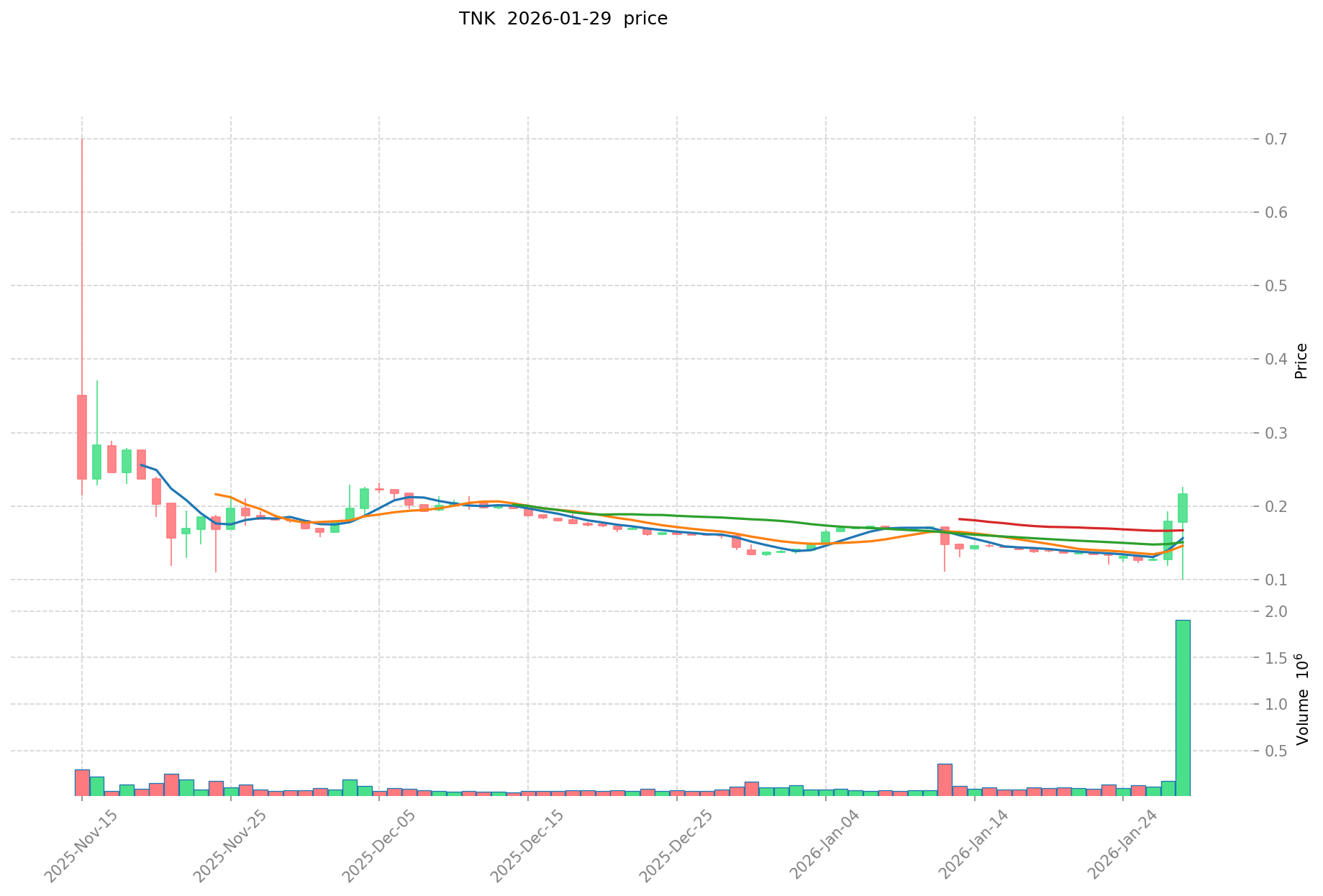
- November 2025: TNK reached $0.7 during its initial trading period, representing the upper range of early price discovery
- January 2026: Price declined to $0.0999, reflecting broader market volatility and adjustment phases
- Recent Period: TNK demonstrated recovery momentum with a 115.34% increase over 24 hours, rising from approximately $0.1141 to $0.2286
Current TNK Investment Market Status (January 2026)
- Current TNK Price: $0.2286
- Market Sentiment: Bullish momentum observed with significant short-term gains across multiple timeframes (1H: +17.65%, 7D: +89.42%, 30D: +84.01%)
- 24-Hour Trading Volume: $289,179.76
- Market Capitalization: $4.80 million with 100% circulating supply (21 million TNK)
Click to view real-time TNK market price
II. Core Factors Affecting Whether TNK is a Good Investment (Is Trac Network(TNK) a Good Investment)
Supply Mechanism and Scarcity (TNK investment scarcity)
- Fixed supply cap → influences price and investment value
- TNK has a maximum supply of 21,000,000 tokens, with 100% already in circulation. This fixed supply model creates a scarcity dynamic similar to traditional deflationary assets.
- Historical context: TNK reached a notable price level of $0.7 on November 15, 2025, and experienced a low of $0.0999 on January 28, 2026, demonstrating significant price volatility within a relatively short timeframe.
- Investment significance: The complete circulation of the maximum supply means no additional dilution from new token releases, which may support long-term value retention for investors considering scarcity as a factor.
Technology and Ecosystem Development (Technology & Ecosystem for TNK investment)
- Layer 1 protocol architecture: Trac Network positions itself as a local-first Layer 1 protocol and peer-to-peer network designed to enable business and consumer-grade applications.
- Performance specifications: According to community discussions, the network claims maximum speeds of approximately 3 million transactions per second with instant finality of around 1 second, alongside interoperability with other Layer 1 blockchains.
- Bitcoin integration: The protocol features direct Bitcoin access through associated protocols, potentially expanding its use cases and integration capabilities within the broader cryptocurrency ecosystem.
- Investment implication: Technical capabilities and ecosystem features may influence the platform's ability to attract developers and users, which could impact long-term investment value.
- Recent price dynamics: As of January 29, 2026, TNK is trading at $0.2286, with 24-hour trading volume of approximately $289,179.76.
- Short-term volatility: The token has experienced significant price movements, with a 115.34% increase over 24 hours, an 89.42% gain over 7 days, and an 84.01% increase over 30 days. The 24-hour price range spans from $0.1141 to $0.265.
- Market position: TNK holds a market capitalization of approximately $4.8 million, representing 0.00015% of the total cryptocurrency market, indicating its status as a smaller-cap asset.
- Liquidity consideration: With trading available on a limited number of exchanges, liquidity may be a factor for investors to consider when evaluating entry and exit strategies.
Investment Risk Factors
- Price volatility: The substantial price fluctuations observed in recent periods suggest high volatility, which may present both opportunities and risks for investors.
- Market maturity: Having launched in 2025, TNK is a relatively new project in the cryptocurrency space, which may carry higher uncertainty compared to more established assets.
- Market cap and liquidity: The relatively small market capitalization and limited exchange availability may impact price stability and trading execution for larger positions.
III. TNK Future Investment Forecast and Price Outlook (Is Trac Network(TNK) worth investing in 2026-2031)
Short-term Investment Forecast (2026, short-term TNK investment outlook)
- Conservative forecast: $0.22983 - $0.2445
- Neutral forecast: $0.2445 - $0.28851
- Optimistic forecast: $0.28851 - $0.33252
Mid-term Investment Outlook (2027-2029, mid-term Trac Network(TNK) investment forecast)
-
Market stage expectations: TNK may experience continued volatility with potential growth driven by market dynamics and adoption trends. Price movements are expected to reflect broader market sentiment and technological developments.
-
Investment return forecast:
- 2027: $0.2192676 - $0.3231312
- 2028: $0.238540068 - $0.348635484
- 2029: $0.17343086226 - $0.34686172452
-
Key catalysts: Market adoption rates, technological advancements in Layer 1 protocols, peer-to-peer network developments, and overall cryptocurrency market conditions.
Long-term Investment Outlook (Is TNK a good long-term investment?)
- Base scenario: $0.2595245601102 - $0.3673789227534 (assuming steady market conditions and gradual adoption)
- Optimistic scenario: $0.3673789227534 - $0.451876074986682 (assuming favorable market environment and increased adoption)
- Risk scenario: $0.17343086226 - $0.2595245601102 (under challenging market conditions)
View TNK long-term investment and price forecast: Price Prediction
2026-2031 Long-term Outlook
- Base scenario: $0.22983 - $0.3673789227534 (corresponding to steady progress and gradual mainstream application growth)
- Optimistic scenario: $0.3673789227534 - $0.451876074986682 (corresponding to large-scale adoption and favorable market environment)
- Transformative scenario: Above $0.451876074986682 (if ecosystem achieves breakthrough progress and mainstream adoption)
- 2031-12-31 predicted high: $0.451876074986682 (based on optimistic development assumptions)
Disclaimer: Price predictions are based on historical data and market analysis models. Cryptocurrency markets are highly volatile and unpredictable. Past performance does not guarantee future results. This information is for reference only and does not constitute investment advice. Investors should conduct their own research and consult with financial professionals before making investment decisions.
| Year |
Predicted High Price |
Predicted Average Price |
Predicted Low Price |
Price Change |
| 2026 |
0.33252 |
0.2445 |
0.22983 |
6 |
| 2027 |
0.3231312 |
0.28851 |
0.2192676 |
26 |
| 2028 |
0.348635484 |
0.3058206 |
0.238540068 |
33 |
| 2029 |
0.34686172452 |
0.327228042 |
0.17343086226 |
43 |
| 2030 |
0.3977129622468 |
0.33704488326 |
0.2595245601102 |
47 |
| 2031 |
0.451876074986682 |
0.3673789227534 |
0.301250716657788 |
60 |
IV. TNK Investment Strategy and Risk Management (How to invest in Trac Network)
Investment Strategy (TNK investment strategy)
-
Long-term Holding (HODL TNK): This approach suits conservative investors who believe in the fundamental value proposition of Trac Network as a local-first Layer 1 protocol. Given the token's 100% circulating supply and maximum supply cap of 21 million tokens, long-term holders may benefit from potential network growth and adoption without concerns about additional token dilution.
-
Active Trading: Traders employing technical analysis and swing trading strategies should note TNK's significant price volatility. The 24-hour price fluctuation between $0.1141 and $0.265 demonstrates substantial intraday movement opportunities, though this also indicates elevated risk levels.
Risk Management (Risk management for TNK investment)
V. TNK Investment Risks and Challenges (Risks of investing in Trac Network)
-
Market Risk: TNK exhibits high volatility characteristics, with 24-hour price changes exceeding 115%. The token's relatively low market capitalization of approximately $4.8 million and limited exchange availability (currently listed on one exchange) may contribute to price manipulation susceptibility and liquidity constraints.
-
Regulatory Risk: As a Layer 1 protocol, Trac Network faces evolving regulatory frameworks across different jurisdictions. Policy uncertainty regarding blockchain infrastructure and cryptocurrency classifications could impact project development and token valuation.
-
Technical Risk: As a local-first peer-to-peer network, potential vulnerabilities include network security challenges, consensus mechanism stability, and successful implementation of protocol upgrades. The project's relatively recent launch (November 2025) means the network has limited operational history for assessing long-term technical reliability.
VI. Conclusion: Is Trac Network a Good Investment?
-
Investment Value Summary: TNK presents potential opportunities as an emerging Layer 1 protocol focused on local-first and peer-to-peer architecture. However, investors should recognize the token's high price volatility, limited exchange availability, and early-stage development status.
-
Investor Recommendations:
✅ Beginners: Consider dollar-cost averaging (DCA) strategy with small, regular investments. Prioritize secure wallet storage and thorough research before participation.
✅ Experienced Investors: May explore swing trading opportunities given volatility patterns, while maintaining diversified portfolio allocation and implementing stop-loss strategies.
✅ Institutional Investors: Conduct comprehensive due diligence on protocol architecture, team credentials, and competitive positioning before considering strategic allocation.
⚠️ Disclaimer: Cryptocurrency investments carry substantial risk. This content provides informational analysis only and does not constitute investment advice. Investors should conduct independent research and consult qualified financial advisors before making investment decisions.
VII. FAQ
Q1: What is the current market position of Trac Network (TNK) and how does it compare to other Layer 1 protocols?
TNK currently holds a market capitalization of approximately $4.8 million with a circulating supply of 21 million tokens (100% of maximum supply). As of January 29, 2026, TNK represents only 0.00015% of the total cryptocurrency market, positioning it as a smaller-cap Layer 1 protocol. The token is trading at $0.2286 with 24-hour trading volume of $289,179.76, available on a limited number of exchanges. This relatively small market presence indicates TNK is in its early development stage compared to established Layer 1 protocols, which may present both higher growth potential and elevated investment risk.
Q2: How volatile has TNK's price been since its launch?
TNK has demonstrated significant price volatility since its November 2025 launch. The token reached an early high of $0.7 on November 15, 2025, then declined to $0.0999 on January 28, 2026—representing approximately an 85% decrease from its peak. Recent trading shows a 115.34% increase over 24 hours, with the price ranging from $0.1141 to $0.265 within a single day. Additional volatility indicators include a 89.42% gain over 7 days and 84.01% increase over 30 days. This substantial price fluctuation pattern suggests TNK exhibits high-risk characteristics typical of emerging cryptocurrency assets with limited liquidity and market maturity.
Q3: What makes TNK's tokenomics unique from an investment perspective?
TNK features a fixed maximum supply of 21 million tokens with 100% already in circulation, creating a scarcity model similar to Bitcoin's deflationary approach. This complete circulation means investors face no future dilution risk from new token releases or scheduled unlock events, which can impact other cryptocurrency projects. The fixed supply cap combined with full circulation creates a supply-constrained environment where price movements depend primarily on demand dynamics rather than inflationary pressure. For long-term investors, this tokenomic structure may support value retention if network adoption increases, though it does not eliminate price volatility risks inherent to cryptocurrency markets.
Q4: What technical capabilities does Trac Network claim, and are they relevant to investment decisions?
Trac Network positions itself as a local-first Layer 1 protocol and peer-to-peer network designed for business and consumer-grade applications. According to available information, the network claims transaction processing speeds of approximately 3 million transactions per second with instant finality around 1 second, alongside interoperability features with other Layer 1 blockchains and direct Bitcoin access through associated protocols. From an investment perspective, these technical specifications suggest potential competitive advantages in scalability and performance. However, investors should independently verify these claims and assess whether the protocol can successfully attract developer activity and real-world application adoption, as technical capabilities alone do not guarantee investment success without corresponding ecosystem development.
Q5: What are the price predictions for TNK over the next five years?
Based on analytical models incorporating historical data and market trends, TNK price forecasts show a wide range of potential outcomes. Short-term 2026 predictions range from $0.22983 (conservative low) to $0.33252 (optimistic high) with a neutral average around $0.2445. Mid-term projections for 2027-2029 suggest possible ranges between $0.17343 and $0.34868 depending on market conditions. Long-term forecasts extend to 2031 with a predicted high of $0.451876 under optimistic scenarios and a base range of $0.2595 to $0.3674. These predictions assume varying levels of adoption success and favorable market environments. However, cryptocurrency markets remain highly unpredictable, and these forecasts should be viewed as reference scenarios rather than guaranteed outcomes. Actual prices may differ substantially based on technological developments, regulatory changes, and overall market dynamics.
Q6: How should different types of investors approach TNK investment?
Investment approaches should align with individual risk tolerance and experience levels. Beginners should consider dollar-cost averaging (DCA) strategies with small, regular investments while prioritizing secure wallet storage and comprehensive research before participation. The high volatility and limited liquidity of TNK suggest conservative position sizing for new investors. Experienced investors may explore swing trading opportunities given the token's significant price movements, while maintaining strict risk management through portfolio diversification (3-7% allocation) and stop-loss strategies. Institutional investors should conduct thorough due diligence on protocol architecture, team credentials, competitive positioning, and operational history before considering strategic allocations. Regardless of experience level, investors should recognize TNK's early-stage status and only allocate capital they can afford to lose entirely.
Q7: What are the primary risks associated with investing in TNK?
TNK investment carries several significant risks that investors must carefully evaluate. Market risk includes extreme price volatility (24-hour changes exceeding 115%), low liquidity due to limited exchange availability, and susceptibility to price manipulation given the small $4.8 million market capitalization. Regulatory risk stems from evolving global frameworks governing blockchain infrastructure and cryptocurrency classifications, which could adversely impact project operations. Technical risks include potential network security vulnerabilities, consensus mechanism challenges, and implementation uncertainties for a protocol with limited operational history since its November 2025 launch. Additionally, the token's concentration on a single exchange creates liquidity constraints that may affect large position entries or exits. These combined factors make TNK suitable primarily for investors with high risk tolerance who understand and accept the possibility of substantial or total capital loss.
Q8: Is TNK suitable as a long-term investment compared to short-term trading?
The suitability of TNK for long-term versus short-term strategies depends on individual investment objectives and market perspectives. For long-term holding, TNK's fixed supply of 21 million tokens with 100% circulation offers a scarcity advantage without future dilution concerns, potentially benefiting holders if the Trac Network ecosystem achieves substantial adoption and mainstream use. However, the project's early stage (launched November 2025), limited operational history, and small market presence create significant uncertainty regarding long-term viability. For short-term trading, TNK's extreme volatility (daily ranges of 100%+ and intraday fluctuations between $0.1141 and $0.265) presents opportunities for active traders employing technical analysis and swing trading strategies. The high risk-reward profile means long-term investors should maintain conservative portfolio allocation (1-3% for risk-averse investors), while short-term traders must implement strict risk management including stop-losses and position sizing appropriate for volatile assets.
* The information is not intended to be and does not constitute financial advice or any other recommendation of any sort offered or endorsed by Gate.