This comprehensive analysis examines whether Tranchess (CHESS) represents a viable investment opportunity in 2024-2031. The article evaluates CHESS—a tokenized asset management and derivatives trading protocol operating on BSC—across multiple dimensions including historical performance from its October 2021 peak of $7.91 to current price of $0.02943, current market fundamentals with $6.06 million market cap and 205.97 million circulating supply, and multi-year price forecasts through 2031. Key sections address core investment factors such as token supply mechanics, ecosystem development, and institutional adoption; detailed risk analysis covering market volatility, regulatory uncertainty, and technical vulnerabilities; investment strategies tailored for beginners, active traders, and institutional participants; and comprehensive FAQ addressing participation methods and security considerations. The analysis provides reference frameworks for investors assessing CHESS's position within the DeFi landscape while e
Introduction: Tranchess (CHESS) Investment Position and Market Outlook
CHESS is a significant asset in the cryptocurrency space, representing a tokenized asset management and derivatives trading protocol inspired by tranched funds that cater to investors with varying risk preferences. Since its launch in July 2021, Tranchess has established itself within the decentralized finance sector. As of January 28, 2026, CHESS maintains a market capitalization of approximately $6.06 million, with a circulating supply of around 205.97 million tokens, and a current price hovering at $0.02943. The protocol enables BTC holders to create Token QUEEN using BTCB and stake them to earn additional CHESS rewards, while also offering token acquisition through Tranchess Swap using USDC. With its position ranked at 1433 in the market and trading across 17 exchanges, CHESS has become a point of discussion among investors exploring "Is Tranchess (CHESS) a good investment?" This article provides a comprehensive analysis of CHESS's investment value, historical performance, future price projections, and associated investment risks to serve as a reference for potential investors.
I. CHESS Token Price History Review and Current Investment Value Status
- October 2021: CHESS reached a significant price level of $7.91 during the early stage of the project launch → Early investors experienced substantial gains during this period
- 2025: The token entered a challenging market phase → CHESS price showed considerable volatility with downward pressure
- Past 12 months: Market underwent a correction cycle → Price declined from higher levels to the current range, reflecting broader market dynamics
Current CHESS Investment Market Status (January 2026)
- CHESS current price: $0.02943
- 24-hour trading volume: $13,950.29
- Market capitalization: $6,061,746.98
- Circulating supply: 205,971,695 CHESS (68.66% of total supply)
- Total supply: 300,000,000 CHESS
- Market ranking: #1433 in the cryptocurrency market
Click to view real-time CHESS market price
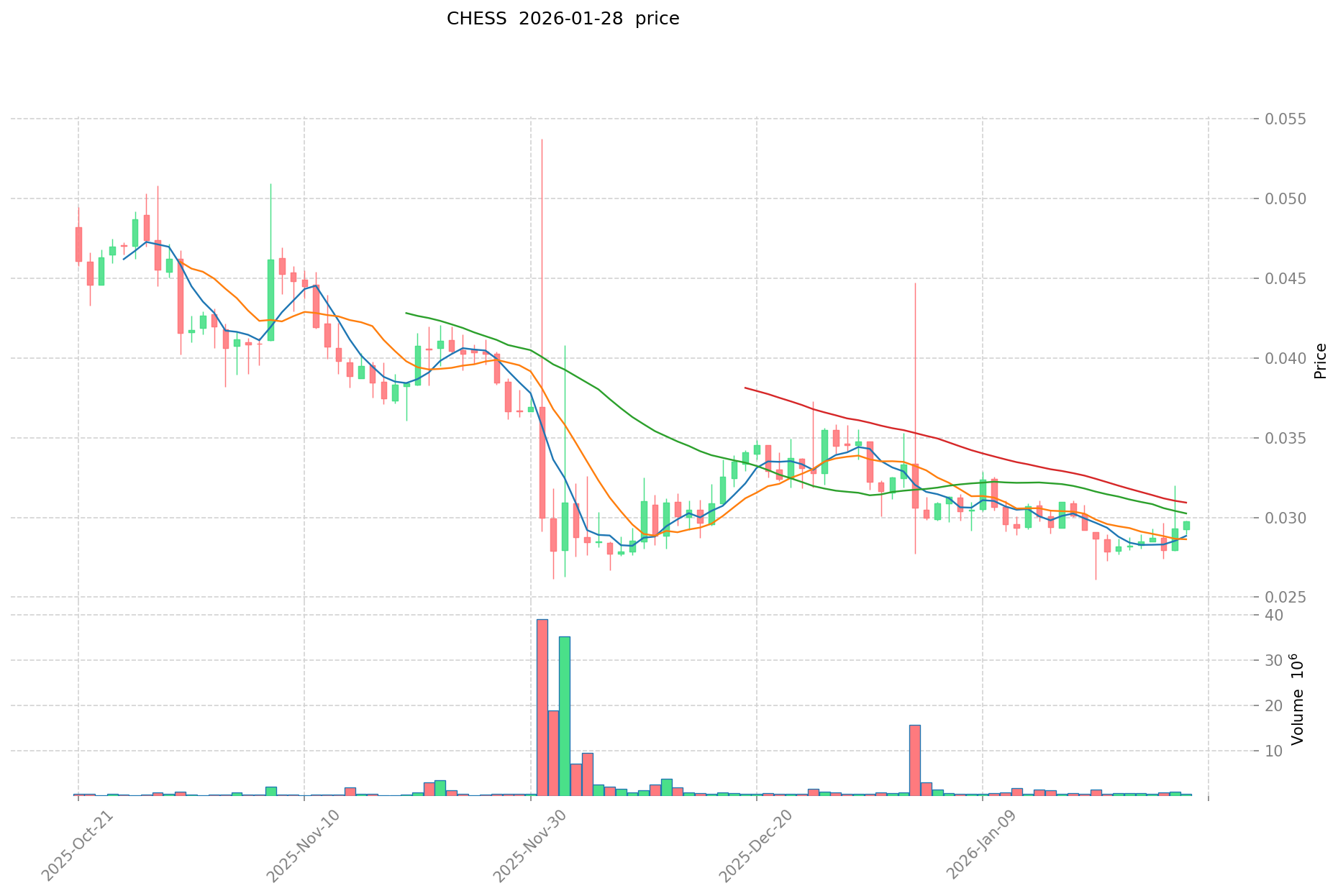
II. Core Factors Affecting Whether CHESS Is a Good Investment (Is Tranchess(CHESS) a Good Investment)
Supply Mechanism and Scarcity (CHESS investment scarcity)
- Total supply capped at 300,000,000 tokens with circulating supply at 205,971,695 tokens (68.66% of total supply) → influences price dynamics and investment considerations
- Market capitalization to fully diluted valuation ratio at 68.66% indicates substantial token circulation relative to maximum supply
- Investment consideration: token supply structure represents one factor among multiple variables affecting long-term investment evaluation
Institutional Investment and Mainstream Adoption (Institutional investment in CHESS)
- Holder count reaches 17,438 addresses with trading activity across 17 exchanges
- Token deployment on BSC (BNB Smart Chain) via contract address 0x20de22029ab63cf9a7cf5feb2b737ca1ee4c82a6
- Trading availability on Gate.com platform provides access channels for market participants
Macroeconomic Environment Impact on CHESS Investment
- Broader cryptocurrency market conditions affect CHESS performance, with 24-hour trading volume at $13,950.29
- Market dominance at 0.00027% reflects CHESS positioning within the overall digital asset landscape
- Price volatility patterns show 1-hour change of 0.2%, 24-hour change of 1.37%, 7-day change of 3.92%, 30-day change of -15.70%, and 1-year change of -80.7%
Technology and Ecosystem Development (Technology & Ecosystem for CHESS investment)
- Tranchess operates as a tokenized asset management and derivatives trading protocol inspired by tranched fund structures serving different risk preferences
- BTC holders can create Token QUEEN using BTCB and stake within the protocol to earn additional CHESS rewards
- Tranchess Swap functionality enables participants to acquire tokens using USDC, expanding protocol utility and ecosystem engagement options
III. CHESS Future Investment Forecast and Price Outlook (Is Tranchess(CHESS) worth investing in 2026-2031)
Short-term Investment Forecast (2026, short-term CHESS investment outlook)
- Conservative forecast: $0.0171 - $0.0250
- Neutral forecast: $0.0250 - $0.0295
- Optimistic forecast: $0.0295 - $0.0348
Mid-term Investment Outlook (2027-2029, mid-term Tranchess(CHESS) investment forecast)
-
Market stage expectation: During 2027-2029, CHESS may experience gradual price consolidation with moderate volatility. Market participants may observe a phase where price movements reflect broader DeFi sector dynamics and ecosystem development progress.
-
Investment return forecast:
- 2027: $0.0235 - $0.0370
- 2028: $0.0311 - $0.0359
- 2029: $0.0300 - $0.0483
-
Key catalysts: Broader adoption of tokenized asset management protocols, potential expansion of trading volume, shifts in DeFi market sentiment, and developments in derivatives trading infrastructure.
Long-term Investment Outlook (Is CHESS a good long-term investment?)
- Base scenario: $0.0234 - $0.0497 (assuming steady protocol development and stable market conditions)
- Optimistic scenario: $0.0361 - $0.0581 (assuming expanded ecosystem adoption and favorable regulatory environment)
- Risk scenario: Below $0.0234 (under conditions of prolonged market downturn or significant competitive pressure)
Click to view CHESS long-term investment and price forecast: Price Prediction
2026-01-28 - 2031 Long-term Outlook
- Base scenario: $0.0234 - $0.0418 USD (corresponding to steady progress and gradual mainstream application improvement)
- Optimistic scenario: $0.0361 - $0.0581 USD (corresponding to large-scale adoption and favorable market environment)
- Transformative scenario: Above $0.0581 USD (such as breakthrough progress in ecosystem and mainstream popularization)
- 2031-12-31 predicted high: $0.0581 USD (based on optimistic development assumptions)
Disclaimer: Price forecasts are based on historical data analysis and current market conditions. Cryptocurrency markets involve substantial risk and volatility. These projections should not be considered as investment advice. Past performance does not guarantee future results. Investors should conduct independent research and assess their risk tolerance before making investment decisions.
| Year |
Predicted High Price |
Predicted Average Price |
Predicted Low Price |
Price Change |
| 2026 |
0.0347982 |
0.02949 |
0.0171042 |
0 |
| 2027 |
0.036965715 |
0.0321441 |
0.023465193 |
9 |
| 2028 |
0.0359371038 |
0.0345549075 |
0.03109941675 |
17 |
| 2029 |
0.0482870277405 |
0.03524600565 |
0.0299591048025 |
19 |
| 2030 |
0.049702154867347 |
0.04176651669525 |
0.02338924934934 |
41 |
| 2031 |
0.058082606442249 |
0.045734335781298 |
0.036130125267226 |
55 |
IV. Tranchess Investment Strategy and Risk Management (How to invest in Tranchess)
Investment Methodology (Tranchess investment strategy)
Long-term Holding (HODL Tranchess)
For conservative investors, a long-term holding strategy may be considered. This approach involves acquiring CHESS tokens and holding them through market cycles, potentially benefiting from the protocol's asset management and derivatives trading features. Investors can stake CHESS tokens within the protocol ecosystem or participate in liquidity provision on Tranchess Swap.
Active Trading
Active traders may employ technical analysis and swing trading strategies based on CHESS price movements. With a 24-hour trading volume of approximately $13,950, traders should be mindful of liquidity conditions when executing trades. The token has shown varied performance across different timeframes, with recent 7-day gains contrasting with longer-term price trends.
Risk Management (Risk management for Tranchess investment)
Asset Allocation Ratios
- Conservative investors: Consider limiting CHESS exposure to 1-3% of total crypto portfolio
- Aggressive investors: May allocate 5-10% depending on risk tolerance
- Professional investors: Can structure positions based on comprehensive analysis of tokenized asset management protocols
Risk Hedging Approaches
Investors should consider diversifying across multiple asset classes and protocols rather than concentrating in a single project. Portfolio construction might include exposure to different DeFi categories alongside traditional crypto assets. Risk mitigation strategies should account for the protocol's specific use cases in asset management and derivatives trading.
Secure Storage
- Cold wallets: Recommended for long-term holdings
- Hot wallets: Suitable for active trading and staking activities
- Hardware wallets: Provide enhanced security for significant holdings
Given that CHESS is deployed on BSC (BNB Smart Chain), investors should use compatible wallet solutions that support BEP-20 tokens.
V. Tranchess Investment Risks and Challenges (Risks of investing in Tranchess)
Market Risks
CHESS exhibits considerable price volatility, with historical data showing fluctuations from $0.0170983 to previous higher levels. The token's current circulating market cap of approximately $6.06 million represents a relatively small market presence (0.00027% market dominance), which can contribute to heightened price sensitivity. The 30-day price movement and longer-term trends reflect the volatile nature of smaller-cap crypto assets.
Regulatory Risks
As a tokenized asset management and derivatives protocol, Tranchess operates in a regulatory environment that varies across jurisdictions. Policy changes regarding DeFi protocols, derivatives trading, and tokenized assets could impact the protocol's operations and token value. Investors should monitor regulatory developments in their respective regions and in key markets where the protocol operates.
Technical Risks
The protocol's infrastructure relies on smart contract functionality for asset management, token creation (such as QUEEN tokens mentioned in the project description), and derivatives trading. Potential vulnerabilities include:
- Smart contract security vulnerabilities
- Protocol upgrade complications
- Integration risks with underlying assets and platforms
- Network congestion or issues on the BSC network
The project's GitHub repository provides transparency into code development, though investors should assess the protocol's security audit history and track record.
VI. Conclusion: Is Tranchess a Good Investment?
Investment Value Summary
Tranchess represents a specialized approach to tokenized asset management and derivatives trading within the DeFi ecosystem. The protocol's design caters to investors with varying risk preferences through its structured products. However, the token's price history reflects the challenges facing smaller DeFi protocols, with significant fluctuations observed across different time periods.
Investor Recommendations
✅ Beginners:
- Consider starting with small allocations
- Use dollar-cost averaging approach
- Prioritize secure wallet storage (hardware wallets for BSC-compatible tokens)
- Thoroughly research the protocol's mechanics before investing
✅ Experienced Investors:
- May incorporate swing trading strategies based on technical analysis
- Diversify across multiple DeFi protocols and asset management solutions
- Monitor protocol developments and community engagement
- Assess risk-reward ratios relative to portfolio objectives
✅ Institutional Investors:
- Evaluate protocol fundamentals within broader DeFi asset management landscape
- Consider long-term strategic positioning if aligned with investment thesis
- Conduct comprehensive due diligence on protocol security and governance
- Account for liquidity considerations given market depth
⚠️ Disclaimer: Cryptocurrency investments carry substantial risks, including potential loss of principal. This analysis is provided for informational purposes only and does not constitute investment advice. Investors should conduct independent research and consult with financial advisors before making investment decisions.
VII. FAQ
Q1: What is the current market position and circulation status of CHESS tokens?
CHESS currently holds the #1433 ranking in the cryptocurrency market with a market capitalization of approximately $6.06 million. The token has a circulating supply of 205,971,695 CHESS, representing 68.66% of the total supply cap of 300,000,000 tokens. The current price stands at $0.02943 with a 24-hour trading volume of $13,950.29, and the token is available for trading across 17 exchanges. The holder count has reached 17,438 addresses, indicating distributed ownership across the community.
Q2: How can investors participate in the Tranchess ecosystem to earn CHESS rewards?
Investors can participate in the Tranchess ecosystem through two primary methods. First, BTC holders can create Token QUEEN using BTCB and stake them within the protocol to earn additional CHESS rewards. Second, participants can acquire tokens through Tranchess Swap using USDC. The protocol operates on BSC (BNB Smart Chain) and is designed as a tokenized asset management and derivatives trading platform that caters to investors with varying risk preferences through its tranched fund structure.
Q3: What are the key risk factors investors should consider before investing in CHESS?
Investors should consider three primary risk categories. Market risks include significant price volatility, with the token showing an 80.7% decline over the past year and a relatively small market presence (0.00027% market dominance). Regulatory risks involve potential policy changes regarding DeFi protocols, derivatives trading, and tokenized assets across different jurisdictions. Technical risks encompass smart contract vulnerabilities, protocol upgrade complications, BSC network issues, and integration risks with underlying assets. Given these factors, conservative investors are advised to limit CHESS exposure to 1-3% of their total crypto portfolio.
Q4: What is the price forecast for CHESS in the short-term and mid-term periods?
For 2026, the short-term forecast presents three scenarios: conservative ($0.0171 - $0.0250), neutral ($0.0250 - $0.0295), and optimistic ($0.0295 - $0.0348). The mid-term outlook for 2027-2029 suggests gradual price consolidation with moderate volatility. Specific forecasts include 2027 ($0.0235 - $0.0370), 2028 ($0.0311 - $0.0359), and 2029 ($0.0300 - $0.0483). These projections assume various factors including broader DeFi sector dynamics, ecosystem development progress, and potential expansion of trading volume. However, these forecasts are based on historical data analysis and should not be considered as investment advice.
Q5: What investment strategies are suitable for different types of CHESS investors?
Different investor profiles should adopt tailored approaches. Beginners should start with small allocations using dollar-cost averaging, prioritize secure BSC-compatible hardware wallets, and thoroughly research the protocol's mechanics before investing. Experienced investors may incorporate swing trading strategies based on technical analysis, diversify across multiple DeFi protocols, and monitor protocol developments while assessing risk-reward ratios. Institutional investors should evaluate protocol fundamentals within the broader DeFi asset management landscape, conduct comprehensive due diligence on protocol security and governance, and account for liquidity considerations given the current market depth of approximately $13,950 in 24-hour trading volume.
Q6: How does CHESS's historical performance compare to its initial launch period?
CHESS reached a significant price peak of $7.91 in October 2021 during the early stage of the project launch, providing substantial gains for early investors. However, the token has since experienced considerable downward pressure, with the current price of $0.02943 representing a decline of approximately 99.6% from its all-time high. The past 12 months have been particularly challenging, with an 80.7% decline over the year. This performance reflects both project-specific factors and broader market dynamics affecting smaller-cap DeFi protocols.
Q7: What security measures should investors implement when holding CHESS tokens?
Investors should implement a tiered security approach based on their holding strategy. For long-term holdings, cold wallets are recommended to maximize security. Hot wallets are suitable for active trading and staking activities that require frequent access. Hardware wallets provide enhanced security for significant holdings and are particularly important given CHESS's deployment on BSC (BNB Smart Chain). Investors must ensure they use wallet solutions compatible with BEP-20 tokens and the BSC network. Additionally, investors should verify they are interacting with the correct contract address (0x20de22029ab63cf9a7cf5feb2b737ca1ee4c82a6) when conducting transactions.
Q8: What factors could potentially influence CHESS's long-term price trajectory through 2031?
Several key factors may influence CHESS's long-term trajectory. The base scenario ($0.0234 - $0.0418) assumes steady protocol development and stable market conditions. The optimistic scenario ($0.0361 - $0.0581) requires expanded ecosystem adoption, favorable regulatory environment, and large-scale mainstream application. Critical catalysts include broader adoption of tokenized asset management protocols, expansion of trading volume, positive shifts in DeFi market sentiment, and developments in derivatives trading infrastructure. The transformative scenario (above $0.0581) would require breakthrough progress in ecosystem development and mainstream popularization. However, these projections carry substantial uncertainty and should be viewed as reference points rather than guarantees.
* The information is not intended to be and does not constitute financial advice or any other recommendation of any sort offered or endorsed by Gate.