This comprehensive analysis examines whether TRON (TRX) represents a sound investment by evaluating its market position, technological fundamentals, and growth potential through 2031. With a market capitalization of $28.38 billion and 218 million holders as of January 2026, TRON has established itself as a significant blockchain infrastructure platform. The article evaluates TRX's price history ranging from $0.00180434 to current levels, assesses core investment factors including deflationary mechanisms and institutional adoption via partnerships, and projects multi-year price forecasts across conservative, neutral, and optimistic scenarios. Beyond price analysis, the content addresses TRON's ecosystem advantages including low transaction fees, scalable DApp infrastructure, and USDD stablecoin integration. Investors will discover actionable strategies encompassing long-term holding and active trading approaches, complemented by comprehensive risk management frameworks covering market volatility, regulatory un
Introduction: TRON (TRX) Investment Position and Market Outlook
TRX represents a significant asset within the cryptocurrency space. Launched in 2017, TRON has established a notable presence in decentralized application development and blockchain infrastructure. As of January 13, 2026, TRX holds a market capitalization of approximately $28.38 billion, with a circulating supply of around 94.70 billion tokens and a current price near $0.2997. Trading across 74 exchanges and serving over 218 million holders, TRON has evolved into a widely adopted platform. The project entered the decentralized stablecoin era in May 2022 with the launch of USDD, and later that year, Dominica designated TRON as its official national blockchain infrastructure, marking a notable development in sovereign blockchain partnerships. With a market share of 0.87% and year-over-year price movement showing a 28.24% change, TRX continues to attract attention from those exploring "Is TRON (TRX) a good investment?" This article provides a comprehensive analysis of TRX's investment characteristics, historical performance, future price considerations, and associated risks to inform investment decisions.
I. TRON (TRX) Price History Review and Current Investment Value Status
- 2017: Network launch period → TRX recorded a price of $0.001804 in November 2017
- 2018: Early market cycle → Price movement reached $0.3003 in January 2018
- 2024: Market development phase → Price observed at $0.431288 in December 2024
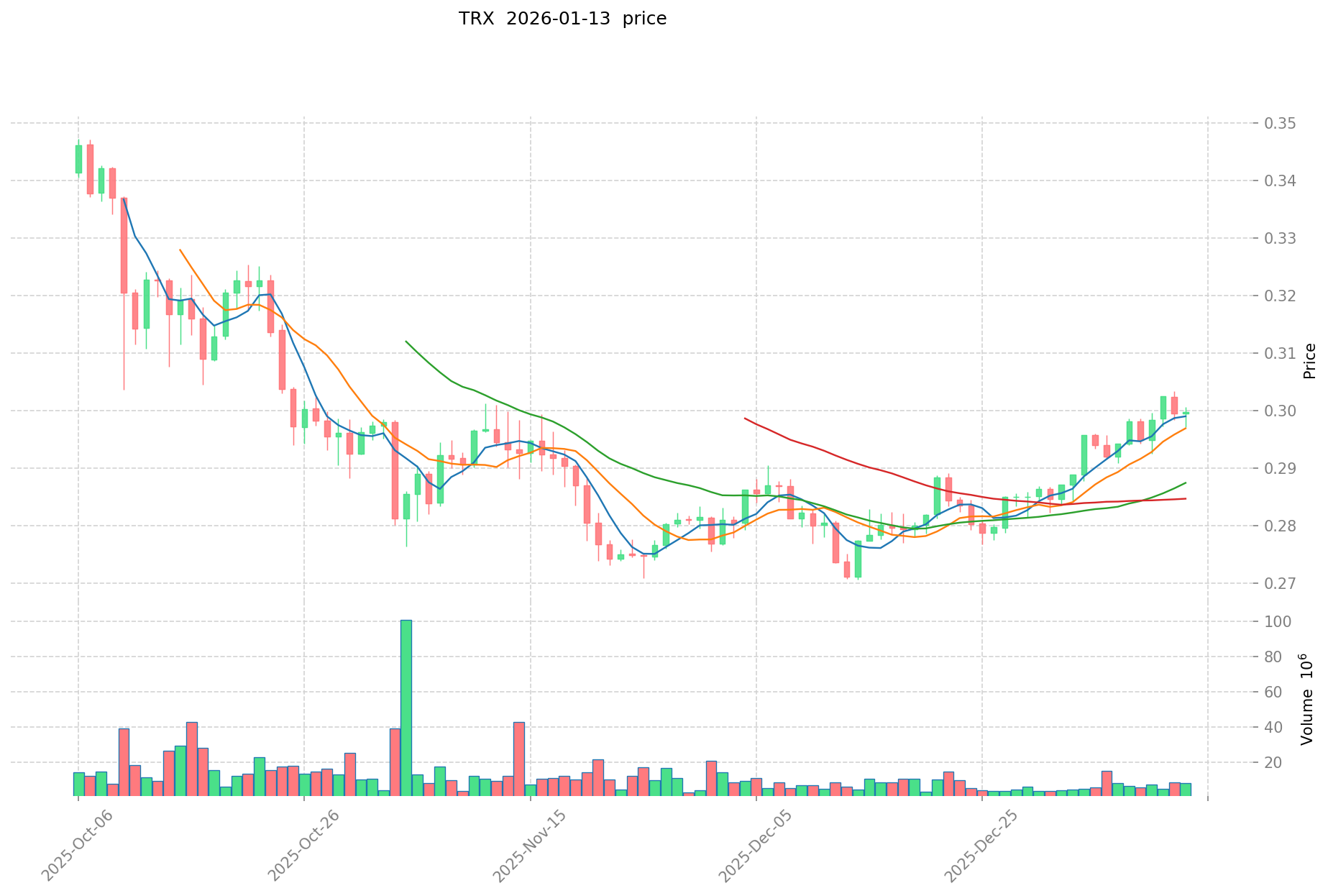
- Recent period: Market adjustment → Price fluctuated between $0.29707 and $0.30067 within 24 hours
Current TRX Investment Market Status (January 2026)
- TRX current price: $0.29972
- 24-hour trading volume: $2,086,203.4188601
- Market capitalization: $28,384,725,168.387836
- Circulating supply: 94,704,141,092.97957 TRX
- Holder count: 218,701,317 addresses
Click to view real-time TRX market price
II. Core Factors Influencing Whether TRX is a Good Investment
Supply Mechanism and Scarcity (TRX investment scarcity)
- Deflationary mechanism through four primary burning channels → impacts price and investment value
- Total circulating supply approximately 94.6 billion tokens, with circulating ratio at 99.99% → near-complete circulation status
- Historical pattern: TRX price has shown growth from historical lows of $0.00180434 to current levels around $0.29972
- Investment significance: the deflationary mechanism through token burning channels provides scarcity support for long-term investment considerations
Institutional Investment and Mainstream Adoption (Institutional investment in TRX)
- National-level partnership: Dominica designated TRON as its official national blockchain infrastructure in October 2022 → enhancing institutional credibility
- Strong market position in stablecoin transfers → increasing practical adoption
- Growing ecosystem with decentralized applications (DApps) → expanding use cases and adoption
Macroeconomic Environment's Impact on TRX Investment
- Current market capitalization of approximately $28.38 billion with 0.87% market dominance → positioning among top cryptocurrencies
- Active on-chain activity with over 218 million holders → indicating sustained user engagement
- Market performance showing resilience with year-over-year growth of 28.24% → reflecting broader market trends
Technology and Ecosystem Development (Technology & Ecosystem for TRX investment)
- Low transaction fees and high scalability → core competitive advantages supporting investment value
- Expanding DApp ecosystem for digital entertainment and content sharing → long-term value foundation
- Stablecoin infrastructure including USDD launch in May 2022 backed by TRON Joint Reserve → diversified ecosystem development
- Smart contract capabilities enabling developer participation → generating TRX through platform transactions and services
- DeFi and payment applications establishing strong market positioning → practical utility driving investment attractiveness
III. TRX Future Investment Prediction and Price Outlook (Is TRON(TRX) worth investing in 2026-2031)
Short-term Investment Prediction (2026, short-term TRX investment outlook)
- Conservative Forecast: $0.21 - $0.27
- Neutral Forecast: $0.27 - $0.30
- Optimistic Forecast: $0.30 - $0.38
Mid-term Investment Outlook (2027-2029, mid-term TRON(TRX) investment forecast)
-
Market Stage Expectation: Based on technical analysis indicators, TRX may experience gradual growth supported by ecosystem development and increasing dApp adoption. The 200-day simple moving average shows an upward trajectory, suggesting potential for sustained momentum through the mid-term period.
-
Investment Return Prediction:
- 2027: $0.28 - $0.43
- 2028: $0.28 - $0.47
- 2029: $0.38 - $0.62
-
Key Catalysts: Low transaction fees and scalability features may continue to attract decentralized application developers. The USDD stablecoin infrastructure and strategic partnerships could support network utilization growth.
Long-term Investment Outlook (Is TRX a good long-term investment?)
- Baseline Scenario: $0.36 - $0.57 (assuming steady ecosystem expansion and stable market conditions through 2030-2031)
- Optimistic Scenario: $0.55 - $0.67 (assuming accelerated adoption of decentralized applications and favorable regulatory environment)
- Risk Scenario: $0.21 - $0.39 (under conditions of heightened market volatility or reduced network activity)
Click to view TRX long-term investment and price prediction: Price Prediction
2026-01-13 - 2031 Long-term Outlook
- Base Scenario: $0.36 - $0.55 USD (corresponding to steady progress and gradual mainstream application growth)
- Optimistic Scenario: $0.52 - $0.67 USD (corresponding to large-scale adoption and favorable market environment)
- Transformative Scenario: Above $0.67 USD (if ecosystem achieves breakthrough developments and mainstream penetration)
- 2031-12-31 Predicted High: $0.67 USD (based on optimistic development assumptions)
Disclaimer: Cryptocurrency markets exhibit high volatility. Price predictions are based on current data and analytical models, which cannot account for unforeseen market events, regulatory changes, or technological disruptions. These projections should not be construed as financial advice. Investors should conduct independent research and consider their risk tolerance before making investment decisions.
| Year |
Predicted High Price |
Predicted Average Price |
Predicted Low Price |
Price Change |
| 2026 |
0.3803396 |
0.29948 |
0.2126308 |
0 |
| 2027 |
0.431685446 |
0.3399098 |
0.275326938 |
13 |
| 2028 |
0.47453107629 |
0.385797623 |
0.28163226479 |
28 |
| 2029 |
0.6194366634888 |
0.430164349645 |
0.38284627118405 |
43 |
| 2030 |
0.572032552157921 |
0.5248005065669 |
0.356864344465492 |
75 |
| 2031 |
0.674552331115764 |
0.54841652936241 |
0.394859901140935 |
83 |
IV. TRON Investment Strategy and Risk Management (How to invest in TRON)
Investment Methodology (TRON investment strategy)
Long-term Holding (HODL TRON)
For conservative investors seeking exposure to TRON (TRX), a long-term holding strategy may be appropriate. This approach involves purchasing TRX tokens and maintaining positions over extended periods, potentially benefiting from the network's development of blockchain infrastructure partnerships and decentralized stablecoin ecosystem. As of January 13, 2026, TRX demonstrates a one-year price increase of 28.24%, though past performance does not guarantee future results.
Active Trading
Traders focusing on short-term price movements may utilize technical analysis and swing trading strategies. With a 24-hour trading volume of approximately $2.09 million and a 24-hour price range between $0.29707 and $0.30067, TRX exhibits price fluctuations that may present trading opportunities. However, such strategies require continuous market monitoring and technical expertise.
Risk Management (Risk management for TRON investment)
Asset Allocation Ratios
- Conservative investors: May consider allocating a smaller portion (typically 1-5%) of their overall portfolio to TRX as part of a diversified cryptocurrency exposure
- Aggressive investors: Might allocate a higher percentage (5-15%) while maintaining awareness of concentration risks
- Professional investors: May implement dynamic allocation strategies based on market conditions and risk tolerance
Risk Hedging Solutions
Investors can consider:
- Multi-asset portfolio construction including different cryptocurrency categories
- Correlation analysis with other digital assets
- Position sizing based on individual risk tolerance
- Regular portfolio rebalancing
Secure Storage
Cold Wallet Storage: For long-term holdings, cold storage solutions provide enhanced security by keeping private keys offline
Hot Wallet Usage: For frequent transactions, hot wallets offer convenience but require additional security measures
Hardware Wallet Recommendations: Physical hardware wallets provide a balance between security and accessibility for TRX storage
V. TRON Investment Risks and Challenges (Risks of investing in TRON)
Market Risks
Price Volatility: TRX exhibits significant price fluctuations. The token's price has ranged from a low of $0.00180434 to varying levels throughout its trading history. Recent data shows weekly price changes of 2.17% and monthly changes of 9.3%, indicating ongoing volatility.
Liquidity Considerations: While TRX trades on 74 exchanges with substantial daily volume, market depth and liquidity can vary across different trading platforms.
Regulatory Risks
Jurisdictional Uncertainty: Cryptocurrency regulations vary significantly across countries and continue to evolve. TRON's partnership with Dominica as national blockchain infrastructure demonstrates engagement with sovereign entities, though regulatory frameworks remain in development globally.
Compliance Requirements: Different jurisdictions maintain varying requirements for cryptocurrency operations, which may impact network operations and token accessibility.
Technical Risks
Network Security: As with any blockchain infrastructure, potential vulnerabilities in smart contracts or network protocols could pose risks to the ecosystem.
Technology Evolution: The blockchain industry undergoes rapid technological changes. Network upgrades or protocol modifications carry inherent implementation risks.
Infrastructure Dependencies: TRON's ecosystem, including its decentralized stablecoin USDD and various applications, relies on interconnected technical components.
VI. Conclusion: Is TRON a Good Investment?
Investment Value Summary
TRON (TRX) presents characteristics of a established blockchain infrastructure with over 218 million holders and a market capitalization of approximately $28.38 billion as of January 13, 2026. The network's development includes decentralized stablecoin initiatives and infrastructure partnerships. However, price volatility remains a notable characteristic, with historical price ranges spanning from $0.00180434 to varying levels over time.
Investor Recommendations
✅ Beginners: Consider dollar-cost averaging strategies combined with secure wallet storage solutions. Focus on understanding basic blockchain concepts and TRON's ecosystem before investing.
✅ Experienced Investors: May explore swing trading opportunities while maintaining diversified portfolio allocations. Technical analysis tools and risk management protocols should be integral to trading strategies.
✅ Institutional Investors: Could evaluate strategic long-term positioning within broader cryptocurrency allocations, considering TRON's infrastructure partnerships and ecosystem development.
⚠️ Disclaimer: Cryptocurrency investments involve substantial risks and high volatility. This content is for informational purposes only and does not constitute investment advice. Individuals should conduct thorough research and consider their financial situation and risk tolerance before making investment decisions.
VII. FAQ
Q1: Is TRON (TRX) a good investment for beginners in 2026?
TRX may be suitable for beginners as part of a diversified cryptocurrency portfolio, though it requires careful consideration of risks and proper research. As of January 13, 2026, TRON demonstrates established infrastructure with over 218 million holders and a market capitalization of approximately $28.38 billion. The network's relatively straightforward blockchain concept and active ecosystem make it accessible for those new to cryptocurrency. However, beginners should start with small allocations (typically 1-5% of investment portfolio), utilize dollar-cost averaging strategies to mitigate volatility risks, and prioritize secure storage solutions such as hardware wallets. Understanding TRON's core technology, including its low transaction fees and DApp ecosystem, is essential before committing funds. The cryptocurrency's historical price volatility—ranging from $0.00180434 to varying levels—underscores the importance of risk tolerance assessment and the recognition that past performance does not guarantee future results.
Q2: What are the main factors that could drive TRX price growth in the future?
The primary factors potentially supporting TRX price appreciation include ecosystem expansion, institutional adoption, and technological development. TRON's low transaction fees and high scalability continue to attract decentralized application developers, which may increase network utilization and demand for TRX tokens. The USDD stablecoin infrastructure launched in May 2022 and backed by TRON Joint Reserve provides diversified use cases beyond simple value transfer. Strategic partnerships, such as Dominica's designation of TRON as official national blockchain infrastructure in October 2022, enhance institutional credibility and potential mainstream adoption. The deflationary mechanism through four primary token burning channels creates scarcity that may support long-term value. Additionally, the network's strong market position in stablecoin transfers and growing DeFi applications establish practical utility that could drive sustained demand. However, these factors must be weighed against market volatility, regulatory uncertainties, and competitive pressures from other blockchain platforms.
Q3: How does TRON's token burning mechanism affect its investment value?
TRON's deflationary mechanism through four primary burning channels potentially enhances long-term investment value by reducing circulating supply over time. Token burning occurs through various network activities, creating scarcity as tokens are permanently removed from circulation. With approximately 94.6 billion TRX tokens in circulation and a circulating ratio at 99.99%, the burning mechanism becomes an important factor in supply dynamics. This deflationary approach contrasts with inflationary tokenomics models where supply continuously increases. The reduction in available tokens, combined with sustained or growing demand from network usage, may create upward price pressure according to basic supply-demand economics. However, the actual impact depends on the rate of burning relative to overall market conditions, trading volume, and ecosystem growth. Investors should note that while the burning mechanism provides theoretical scarcity support, it does not guarantee price appreciation, as numerous other factors including market sentiment, regulatory developments, and technological competition also influence TRX valuation.
Q4: What are the primary risks associated with investing in TRON (TRX)?
Investing in TRX involves several significant risks that require careful evaluation. Market volatility represents the most immediate concern, with TRX demonstrating substantial price fluctuations throughout its history—ranging from lows of $0.00180434 to varying levels over time. Recent data shows weekly price changes of 2.17% and monthly changes of 9.3%, indicating ongoing volatility that could result in considerable short-term losses. Regulatory uncertainty poses another critical risk, as cryptocurrency regulations continue to evolve globally with varying requirements across jurisdictions. Technical risks include potential vulnerabilities in smart contracts, network protocols, or infrastructure dependencies within TRON's ecosystem, including the USDD stablecoin and various applications. Competition from other blockchain platforms offering similar scalability and low-fee features may impact TRON's market position. Liquidity considerations vary across the 74 exchanges where TRX trades, potentially affecting execution prices during periods of market stress. Additionally, the concentration of over 218 million holders creates network effects but also potential coordination challenges. These risks underscore the importance of thorough due diligence, appropriate position sizing, and diversification strategies.
Q5: How does TRON compare to other blockchain platforms for long-term investment?
TRON's investment profile features distinct characteristics when compared to other blockchain platforms, though direct comparisons require consideration of multiple factors. TRON's competitive advantages include low transaction fees and high scalability, which support its strong market position in stablecoin transfers and DApp hosting. The network's infrastructure partnership with Dominica as national blockchain distinguishes it from platforms lacking sovereign-level adoption. With a market capitalization of approximately $28.38 billion and 0.87% market dominance as of January 13, 2026, TRX ranks among established cryptocurrencies but below major platforms like Bitcoin and Ethereum in market share. The USDD stablecoin ecosystem and focus on digital entertainment and content sharing differentiate TRON's use cases from platforms emphasizing different applications. However, TRON faces competition from other scalable networks offering similar technical features. Long-term investment considerations should evaluate TRON's developer ecosystem growth, network activity trends, and ability to maintain relevance amid technological evolution. The platform's historical price performance showing a one-year increase of 28.24% reflects specific market conditions that may not persist. Investors should assess TRON within the context of their overall cryptocurrency allocation strategy rather than as an isolated investment decision.
Q6: What is the recommended storage solution for TRON (TRX) tokens?
The optimal storage solution for TRX tokens depends on investment timeline and usage patterns. For long-term holdings, cold wallet storage provides the highest security level by keeping private keys completely offline, protecting against online threats such as hacking attempts, phishing attacks, or exchange compromises. Hardware wallets represent a recommended cold storage option, offering a balance between security and accessibility—these physical devices store private keys offline while enabling periodic transactions when needed. Popular hardware wallet manufacturers support TRX, providing user-friendly interfaces for secure storage. For investors requiring frequent transactions or trading, hot wallets offer convenience through constant internet connectivity, though this accessibility comes with increased security risks. Hot wallet users should implement additional protective measures including two-factor authentication, strong passwords, and limiting stored amounts to operational needs only. Exchange wallets, while convenient for active trading, should not serve as long-term storage solutions due to custodial risks and potential platform vulnerabilities. A layered approach—utilizing cold storage for the majority of holdings and hot wallets for active trading amounts—provides optimal security while maintaining necessary liquidity. Regardless of storage method chosen, maintaining backup recovery phrases in secure physical locations remains essential for protecting TRX investments.
Q7: Should investors consider TRON's national blockchain partnership when evaluating investment potential?
TRON's designation as Dominica's official national blockchain infrastructure in October 2022 represents a notable development in sovereign blockchain partnerships, though its investment implications require nuanced evaluation. This partnership enhances institutional credibility and demonstrates real-world government adoption of TRON's technology, potentially differentiating it from platforms lacking such formal relationships. National-level partnerships may provide regulatory clarity within specific jurisdictions and establish precedents for broader institutional adoption. The collaboration could drive network usage through government-related applications and services, increasing transaction volume and TRX utility. However, investors should recognize that a single national partnership, particularly with a smaller economy, does not guarantee widespread adoption or sustained price appreciation. The partnership's practical implementation, actual usage metrics, and ability to attract additional sovereign or institutional partners will determine its long-term significance. Geopolitical factors, regulatory changes in partner countries, or shifts in government priorities could affect partnership sustainability. Therefore, while the Dominica partnership adds to TRON's narrative and demonstrates technical capability, it should be considered as one factor among many—including ecosystem development, market conditions, and competitive positioning—when evaluating TRX investment potential rather than as a singular determinant of investment value.
Q8: What dollar-cost averaging strategy would be appropriate for TRX investment?
Dollar-cost averaging (DCA) represents a prudent approach for TRX investment, particularly for investors seeking to mitigate volatility risks while building positions over time. A basic DCA strategy involves investing fixed amounts at regular intervals—such as weekly, biweekly, or monthly—regardless of TRX's current price. For example, an investor allocating $500 monthly to TRX would purchase tokens at prevailing market prices each month, acquiring more tokens when prices decline and fewer when prices rise. This approach reduces the impact of short-term price fluctuations and eliminates the difficulty of timing market entries. Given TRX's historical volatility, with weekly price changes of 2.17% and monthly changes of 9.3%, DCA helps avoid the risk of investing significant capital at local price peaks. Conservative investors might implement longer intervals (monthly or quarterly) with smaller amounts, while more active participants could consider weekly purchases. The strategy should align with overall portfolio allocation targets—beginners typically limiting TRX to 1-5% of total portfolio, while more experienced investors might allocate 5-15% depending on risk tolerance. Investors should establish predetermined investment amounts and schedules, maintaining discipline regardless of short-term price movements. Combining DCA with secure storage practices and periodic portfolio rebalancing enhances long-term investment outcomes while managing the inherent risks of cryptocurrency volatility.
* The information is not intended to be and does not constitute financial advice or any other recommendation of any sort offered or endorsed by Gate.