This comprehensive article analyzes whether Trusta.AI (TA) represents a viable investment opportunity in the AI-driven identity verification sector. The analysis covers TA's current market position with a $6.72 million market cap and $0.03733 price as of January 2026, alongside its historical performance trajectory from $0.1 launch price to a $0.3854 peak. The article examines core investment factors including supply scarcity (18% circulation of 1 billion tokens), institutional adoption via Gate and four other exchanges, and ecosystem technology built on BSC and Linea networks. It presents tiered price forecasts ranging from conservative 2026 projections of $0.024232-$0.0439904 to optimistic 2031 scenarios reaching $0.093511677384362. The investment analysis includes diversified strategies for different investor profiles, comprehensive risk management frameworks addressing market volatility, regulatory uncertainty, and technical vulnerabilities, alongside detailed risk assessments and investor recommendations
Introduction: Trusta.AI (TA) Investment Position and Market Prospects
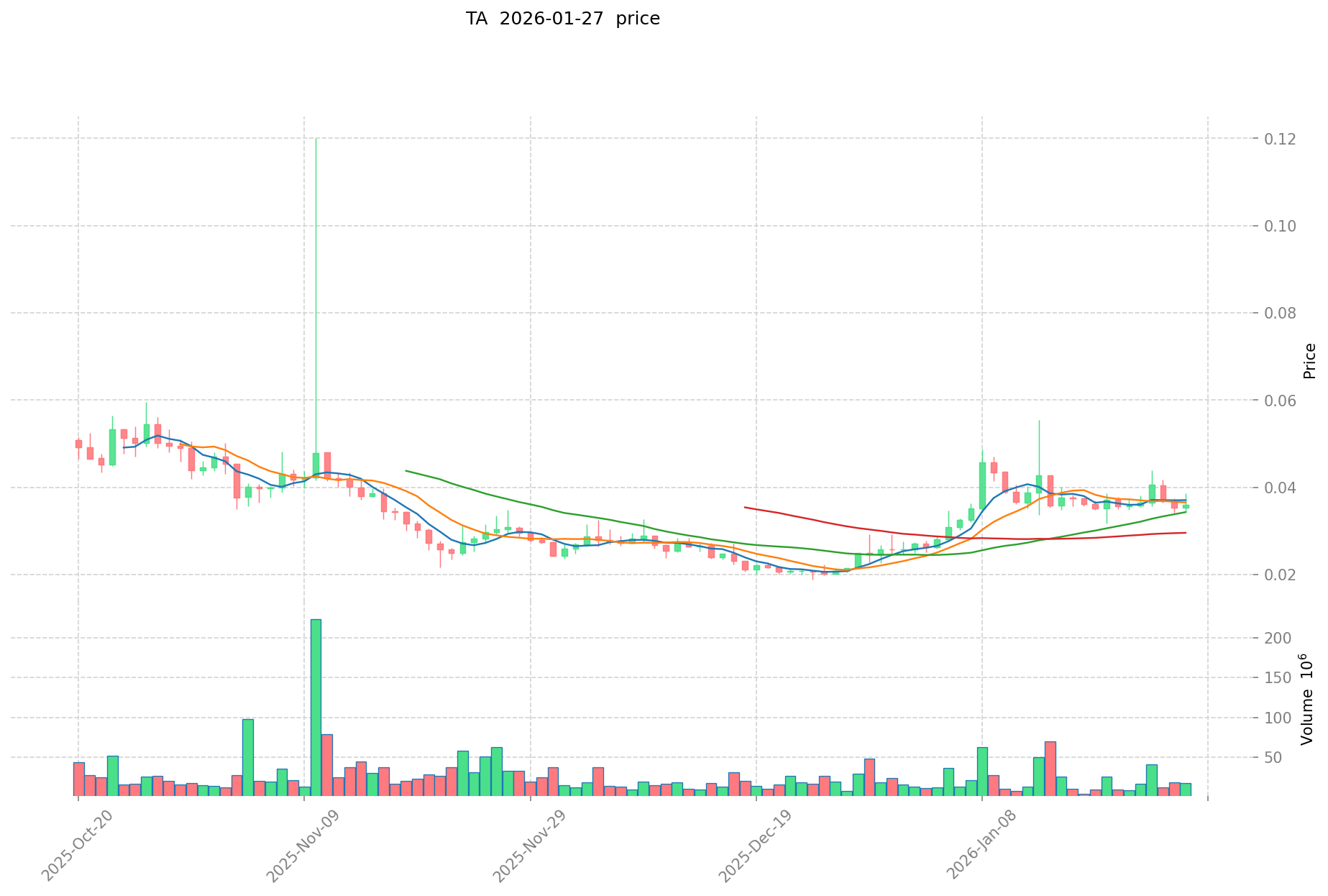
TA is an emerging asset in the cryptocurrency field. Since its launch in 2025, it has been focused on establishing a trusted identity network for AI and crypto applications. As of January 28, 2026, TA has a market capitalization of approximately $6.72 million, with a circulating supply of 180 million tokens and a current price around $0.03733. With its positioning in the AI-driven identity verification sector, TA has gradually become a subject of discussion among investors exploring "Is Trusta.AI (TA) a good investment?" This article provides a comprehensive analysis of TA's investment value, historical performance, future price forecasts, and investment risks to serve as a reference for investors.
I. Trusta.AI (TA) Price History Review and Current Investment Value
- 2025: Token launched with an initial price of $0.1 → Early investors experienced notable market fluctuations
- 2025: On September 2, TA recorded a price of $0.3854 → The token demonstrated significant upward momentum during this period
- 2025: Market adjustment phase → Price declined from the September levels to $0.01652 during periods of market correction
Current TA Investment Market Status (January 2026)
- TA current price: $0.03733
- 24-hour trading volume: $435,425.87
- Circulating supply: 180,000,000 TA tokens
- Market capitalization: $6,719,400
Click to view real-time TA market price
II. Core Factors Influencing Whether TA is a Good Investment
Supply Mechanism and Scarcity (TA Investment Scarcity)
- Total Supply Cap: Trusta.AI (TA) has a maximum supply of 1,000,000,000 tokens, with a current circulating supply of 180,000,000 tokens (18% circulation ratio). This controlled supply structure creates a framework for potential scarcity as adoption grows.
- Circulation Dynamics: With only 18% of tokens currently in circulation, future token unlocks may introduce supply pressure that could impact price dynamics. Investors should monitor the token release schedule as part of their investment assessment.
- Investment Implication: The limited circulation relative to total supply suggests that scarcity mechanisms could support long-term value appreciation, provided demand growth outpaces scheduled token releases.
Institutional Investment and Mainstream Adoption (Institutional Investment in TA)
- Exchange Listings: TA gained visibility through its listing on Binance in July 2025, with trading beginning at 07:00 UTC on Binance Alpha and futures trading launching at 07:30 UTC. The token is currently available on 5 exchanges, indicating growing institutional recognition.
- Market Response: Following the Binance listing announcement and associated trading competitions, TA experienced notable price movement, demonstrating market sensitivity to exchange-related developments.
- Holder Base: With 3,078 current holders, the token shows early-stage adoption metrics that suggest room for potential growth as the project expands its user base.
Macroeconomic Environment's Impact on TA Investment
- Market Position: TA maintains a market cap of approximately $6.72 million with a fully diluted valuation of $37.33 million, representing 0.0011% market dominance. This positioning reflects its status as an emerging asset within the broader cryptocurrency landscape.
- Price Volatility: The token has demonstrated significant price fluctuation patterns, with 30-day changes of +58.62% and historical price ranges between $0.01652 and $0.3854, indicating sensitivity to market sentiment and broader economic conditions.
- Risk Profile: Multiple analysis sources characterize TA as a high-risk investment option, suggesting that macroeconomic uncertainty and broader market volatility may significantly impact its price trajectory.
Technology and Ecosystem Development (Technology & Ecosystem for TA Investment)
- Core Technology: Trusta.AI operates as an identity and on-chain reputation protocol designed to create a trusted network for Crypto-Intelligence, aiming to establish a universal credit system for both human and artificial intelligence.
- Multi-Chain Deployment: The token utilizes BEP-20 and Linea standards, with contract addresses deployed on both BSC (BNB Chain) and Linea networks, demonstrating cross-chain technical capabilities.
- Technical Analysis: Some market analysis indicates bullish technical patterns based on chart indicators, though these assessments should be considered within the context of the token's high volatility and early development stage.
III. TA Future Investment Forecast and Price Outlook (Is Trusta.AI (TA) worth investing in 2026-2031)
Short-term Investment Forecast (2026, short-term TA investment outlook)
Based on available market data and technical analysis, short-term projections for TA in 2026 suggest the following scenarios:
- Conservative forecast: $0.024232 - $0.03728
- Neutral forecast: $0.03728 - $0.0439904
- Optimistic forecast: $0.0439904 and above
The token's recent performance shows a 24-hour price increase of 3.18% and a 30-day surge of 58.62%, indicating notable short-term momentum. Current trading at $0.03733 reflects market activity supported by approximately $435,425.87 in 24-hour volume.
Mid-term Investment Outlook (2027-2029, mid-term Trusta.AI (TA) investment forecast)
-
Market stage expectations: The mid-term period may witness gradual expansion of Trusta.AI's trusted identity network infrastructure, potentially accompanied by increased adoption in AI and crypto verification use cases. Market sentiment could be influenced by broader developments in AI-related blockchain applications and identity verification technologies.
-
Investment return projections:
- 2027: $0.037790736 - $0.053232112
- 2028: $0.02956820328 - $0.05021901192
- 2029: $0.0432329372244 - $0.0694641575628
-
Key catalysts: Potential factors include platform adoption rates, strategic partnerships within AI and crypto ecosystems, technological developments in identity verification protocols, and overall market conditions affecting AI-related tokens.
Long-term Investment Outlook (Is TA a good long-term investment?)
Long-term projections through 2031 present multiple scenarios based on different development trajectories:
- Base scenario: $0.050757411354804 - $0.068758586312031 (assuming steady development and moderate ecosystem expansion)
- Optimistic scenario: $0.078496926862662 - $0.093511677384362 (assuming accelerated adoption and favorable market conditions)
- Risk scenario: Below $0.050757411354804 (under challenging market conditions or limited adoption)
For detailed TA long-term investment and price forecasts: Price Prediction
2026-01-28 - 2031 Long-term Outlook
- Base scenario: $0.050757411354804 - $0.068758586312031 (corresponding to steady progress and gradual mainstream application enhancement)
- Optimistic scenario: $0.078496926862662 - $0.093511677384362 (corresponding to large-scale adoption and favorable market environment)
- Transformative scenario: Above $0.093511677384362 (if ecosystem achieves breakthrough progress and mainstream popularization)
- 2031-12-31 projected high: $0.093511677384362 (based on optimistic development assumptions)
Disclaimer: Price forecasts are based on historical data, technical analysis, and market projections. Actual results may vary significantly due to market volatility, regulatory changes, technological developments, and other unforeseen factors. These projections should not be construed as investment advice. The cryptocurrency market involves substantial risk, and investors should conduct thorough research and consider their risk tolerance before making investment decisions. Past performance does not guarantee future results.
| Year |
Predicted High Price |
Predicted Average Price |
Predicted Low Price |
Price Change |
| 2026 |
0.0439904 |
0.03728 |
0.024232 |
0 |
| 2027 |
0.053232112 |
0.0406352 |
0.037790736 |
8 |
| 2028 |
0.05021901192 |
0.046933656 |
0.02956820328 |
25 |
| 2029 |
0.0694641575628 |
0.04857633396 |
0.0432329372244 |
30 |
| 2030 |
0.078496926862662 |
0.0590202457614 |
0.050757411354804 |
58 |
| 2031 |
0.093511677384362 |
0.068758586312031 |
0.054319283186504 |
84 |
IV. TA Investment Strategy and Risk Management (How to invest in Trusta.AI)
Investment Methodology (TA investment strategy)
Long-term Holding (HODL TA)
For conservative investors seeking exposure to AI-driven identity verification infrastructure, a long-term holding strategy may be appropriate. This approach involves:
- Accumulating positions during market corrections
- Holding through market cycles to capture potential value appreciation
- Monitoring project development milestones and adoption metrics
Active Trading
Traders with experience in technical analysis may consider:
- Utilizing support and resistance levels identified through price action analysis
- Implementing momentum-based strategies during periods of increased volatility
- Setting predetermined entry and exit points based on risk-reward ratios
Risk Management (Risk management for TA investment)
Asset Allocation Proportions
- Conservative investors: 1-3% of crypto portfolio allocation
- Moderate investors: 3-7% of crypto portfolio allocation
- Experienced investors: Up to 10% of crypto portfolio allocation
Risk Hedging Approaches
- Diversification across multiple blockchain infrastructure projects
- Maintaining exposure to established cryptocurrencies alongside smaller-cap positions
- Regular portfolio rebalancing based on market conditions
Secure Storage Solutions
- Cold wallets: Hardware wallets for long-term holdings (Ledger, Trezor)
- Hot wallets: Reputable exchange wallets or mobile wallets for active trading positions
- Multi-signature solutions for institutional-grade security
V. TA Investment Risks and Challenges (Risks of investing in Trusta.AI)
Market Risks
TA exhibits considerable price volatility, with historical data showing a range from $0.01652 to $0.3854. Key concerns include:
- Limited liquidity relative to major cryptocurrencies, with 24-hour trading volume of approximately $435,426
- Potential for rapid price movements in either direction
- Market cap of approximately $6.72 million, indicating smaller market depth
Regulatory Risks
The AI-crypto intersection faces evolving regulatory frameworks:
- Uncertainty regarding AI-related crypto projects across different jurisdictions
- Potential classification changes affecting token utility and trading availability
- Compliance requirements for identity verification services may vary by region
Technical Risks
As a dual-chain project operating on BSC and Linea networks:
- Smart contract vulnerabilities could impact token functionality
- Cross-chain bridge risks associated with multi-network deployment
- Dependence on underlying blockchain infrastructure performance
- Technology adoption risks in the competitive AI identity verification space
VI. Conclusion: Is Trusta.AI a Good Investment?
Investment Value Summary
TA represents exposure to the emerging sector of AI-driven identity verification within crypto ecosystems. The project's positioning at the intersection of artificial intelligence and blockchain technology offers potential growth opportunities, though investors should note the token's relatively small market presence with 18% of total supply currently in circulation.
Investor Recommendations
✅ Newcomers to Crypto
- Consider dollar-cost averaging to mitigate timing risks
- Utilize hardware wallet storage for security
- Allocate only funds you can afford to lose entirely
✅ Experienced Crypto Investors
- Evaluate position sizing within broader portfolio context
- Monitor project development updates and partnership announcements
- Consider technical indicators alongside fundamental analysis
✅ Institutional Participants
- Conduct comprehensive due diligence on project fundamentals
- Assess liquidity requirements against available market depth
- Evaluate regulatory implications in relevant jurisdictions
⚠️ Disclaimer: Cryptocurrency investments carry substantial risk, including potential total loss of capital. This content is provided for informational purposes only and does not constitute financial advice, investment recommendations, or an offer to buy or sell securities. Conduct independent research and consult qualified financial advisors before making investment decisions.
VII. FAQ
Q1: What is Trusta.AI (TA) and how does its technology differentiate it from other crypto identity projects?
Trusta.AI is an identity and on-chain reputation protocol designed to create a trusted network for Crypto-Intelligence, establishing a universal credit system for both human users and artificial intelligence. The project operates as a dual-chain implementation utilizing BEP-20 (BSC/BNB Chain) and Linea network standards. Its core differentiation lies in its focus on AI-driven identity verification specifically tailored for crypto applications, rather than traditional blockchain identity solutions. The protocol aims to bridge the gap between artificial intelligence systems and cryptocurrency ecosystems through reputation scoring and trusted network formation, positioning it at the intersection of two rapidly evolving technology sectors.
Q2: What is the current market capitalization and trading status of TA tokens?
As of January 28, 2026, TA maintains a market capitalization of approximately $6.72 million with a current price around $0.03733. The token has a 24-hour trading volume of $435,425.87 and is listed on 5 exchanges, including Binance which added TA in July 2025. The circulating supply stands at 180 million tokens out of a maximum supply of 1 billion tokens, representing an 18% circulation ratio. The token currently has 3,078 holders and accounts for 0.0011% of total crypto market dominance, indicating its position as an emerging small-cap asset within the broader cryptocurrency landscape.
Q3: How has TA performed historically, and what are the price forecasts for 2026-2031?
TA launched in 2025 with an initial price of $0.1 and reached a peak of $0.3854 on September 2, 2025, before experiencing market corrections that brought it to a low of $0.01652. Recent performance shows positive momentum with a 30-day increase of 58.62%. Short-term 2026 forecasts suggest a range of $0.024232-$0.0439904, while mid-term projections for 2027-2029 range from $0.037790736 to $0.0694641575628. Long-term forecasts through 2031 present scenarios from a base case of $0.050757411354804-$0.068758586312031 to an optimistic scenario of $0.078496926862662-$0.093511677384362, with the predicted 2031 high at $0.093511677384362 under favorable development conditions.
Q4: What investment strategy and portfolio allocation should investors consider for TA?
Investment approaches vary based on investor experience and risk tolerance. For long-term holding (HODL) strategies, conservative investors should allocate 1-3% of their crypto portfolio to TA, moderate investors 3-7%, and experienced investors up to 10%. Active traders may utilize technical analysis, focusing on support/resistance levels and momentum-based strategies during volatility periods. Dollar-cost averaging is recommended for newcomers to mitigate timing risks. Storage solutions should include cold wallets (hardware wallets like Ledger or Trezor) for long-term holdings and secure hot wallets for active trading positions. Risk hedging should involve diversification across multiple blockchain infrastructure projects and regular portfolio rebalancing based on market conditions.
Q5: What are the primary investment risks associated with TA?
TA carries several significant risk categories. Market risks include high price volatility (historical range of $0.01652-$0.3854), limited liquidity with relatively modest 24-hour trading volume, and the challenges associated with its small market cap of $6.72 million. Regulatory risks stem from evolving frameworks governing AI-crypto intersection projects, potential classification changes, and varying compliance requirements across jurisdictions for identity verification services. Technical risks encompass smart contract vulnerabilities in its dual-chain deployment on BSC and Linea networks, cross-chain bridge security concerns, dependence on underlying blockchain infrastructure, and technology adoption uncertainties in the competitive AI identity verification space. Multiple analysis sources characterize TA as a high-risk investment option.
Q6: How did the Binance listing impact TA, and what does institutional adoption look like?
The Binance listing in July 2025 marked a significant milestone for TA, with trading commencing at 07:00 UTC on Binance Alpha and futures trading launching at 07:30 UTC. Following the listing announcement and associated trading competitions, TA experienced notable price movement, demonstrating market sensitivity to exchange-related developments. This listing enhanced the token's visibility and institutional recognition. Currently, TA is available on 5 exchanges total, suggesting growing but still early-stage institutional adoption. The relatively modest holder base of 3,078 indicates room for substantial growth as the project expands its user base and gains further institutional attention through additional exchange listings and partnership announcements.
Q7: What factors should investors monitor to evaluate TA's long-term investment potential?
Critical monitoring factors include project development milestones and the expansion of Trusta.AI's trusted identity network infrastructure, particularly adoption metrics within AI and crypto verification use cases. Investors should track strategic partnerships within AI and crypto ecosystems, technological developments in identity verification protocols, and the project's progress toward establishing a universal credit system for both human and AI users. Market-related factors include token unlock schedules (given only 18% circulation), broader developments in AI-related blockchain applications, and overall market conditions affecting AI tokens. Additionally, monitoring the growth rate of the holder base, exchange listing announcements, and any regulatory developments affecting AI-crypto intersection projects will provide insight into the token's trajectory and mainstream adoption potential.
Q8: Is TA suitable for different types of investors, and what precautions should be taken?
TA may appeal to different investor profiles with varying approaches. Newcomers to crypto should utilize dollar-cost averaging, implement hardware wallet storage, and only allocate funds they can afford to lose entirely given the high-risk nature of the asset. Experienced crypto investors should evaluate TA within their broader portfolio context, monitor project updates and partnership announcements regularly, and combine technical indicators with fundamental analysis. Institutional participants require comprehensive due diligence on project fundamentals, assessment of liquidity requirements against available market depth, and evaluation of regulatory implications in relevant jurisdictions. All investors should recognize that cryptocurrency investments carry substantial risk, including potential total loss of capital, and this information is provided for educational purposes only, not as financial advice or investment recommendations.
* The information is not intended to be and does not constitute financial advice or any other recommendation of any sort offered or endorsed by Gate.