This comprehensive analysis evaluates whether Trust Wallet Token (TWT) represents a sound investment opportunity. The article examines TWT's current market position—trading at $0.9197 with a $383.19 million market cap—alongside its historical performance and future price outlook spanning 2026-2031. Key investment factors include TWT's governance utility within the Trust Wallet ecosystem supporting 40+ blockchain protocols, strategic partnerships with MoonPay and Onramper, and its listing across 37 exchanges including Gate. The analysis provides tiered investment strategies for beginners, experienced traders, and institutional investors, emphasizing risk management through portfolio diversification and secure storage on Gate or hardware wallets. However, investors must understand substantial risks: market volatility (-23.86% annually), regulatory uncertainty, technical vulnerabilities, and liquidity constraints. The article concludes that TWT suits long-term ecosystem believers willing to accept crypto market
Introduction: TrustWallet (TWT) Investment Position and Market Prospects
TWT is a significant asset in the cryptocurrency field. As the native token of Trust Wallet, a digital currency wallet that allows users to buy, store, trade, and earn digital currencies, TWT has been actively traded since its launch in April 2020. As of January 15, 2026, TWT holds a market capitalization of approximately $383.19 million, with a circulating supply of around 416.65 million tokens, and the current price maintains around $0.92. With its positioning as a governance and utility token within the Trust Wallet ecosystem, which supports over 40 blockchain protocols and more than 160,000 digital assets, TWT has gradually become a focal point when investors discuss "Is TrustWallet (TWT) a good investment?" The token exists in two standards, BEP-2 and BEP-20, and offers use cases including governance participation in network decision-making processes and discounts for in-app digital currency purchases and decentralized exchange services. TWT ranks 161st by market capitalization, representing approximately 0.026% market dominance, with over 269,793 holders. This article will comprehensively analyze TWT's investment value, historical trends, future price predictions, and investment risks to provide reference for investors.
I. TrustWallet Token (TWT) Price History Review and Investment Value Status
- 2020: TWT launched with an initial offering price of approximately $0.009362, representing the early stage of the Trust Wallet ecosystem token deployment.
- 2022: The token experienced notable price movement, with reported trading activity around $0.914878 during certain periods, reflecting broader market dynamics and ecosystem development.
- 2024-2025: The token's price fluctuated between $0.8489 and $0.9962 within a 24-hour trading window, demonstrating ongoing market volatility characteristic of digital asset markets.
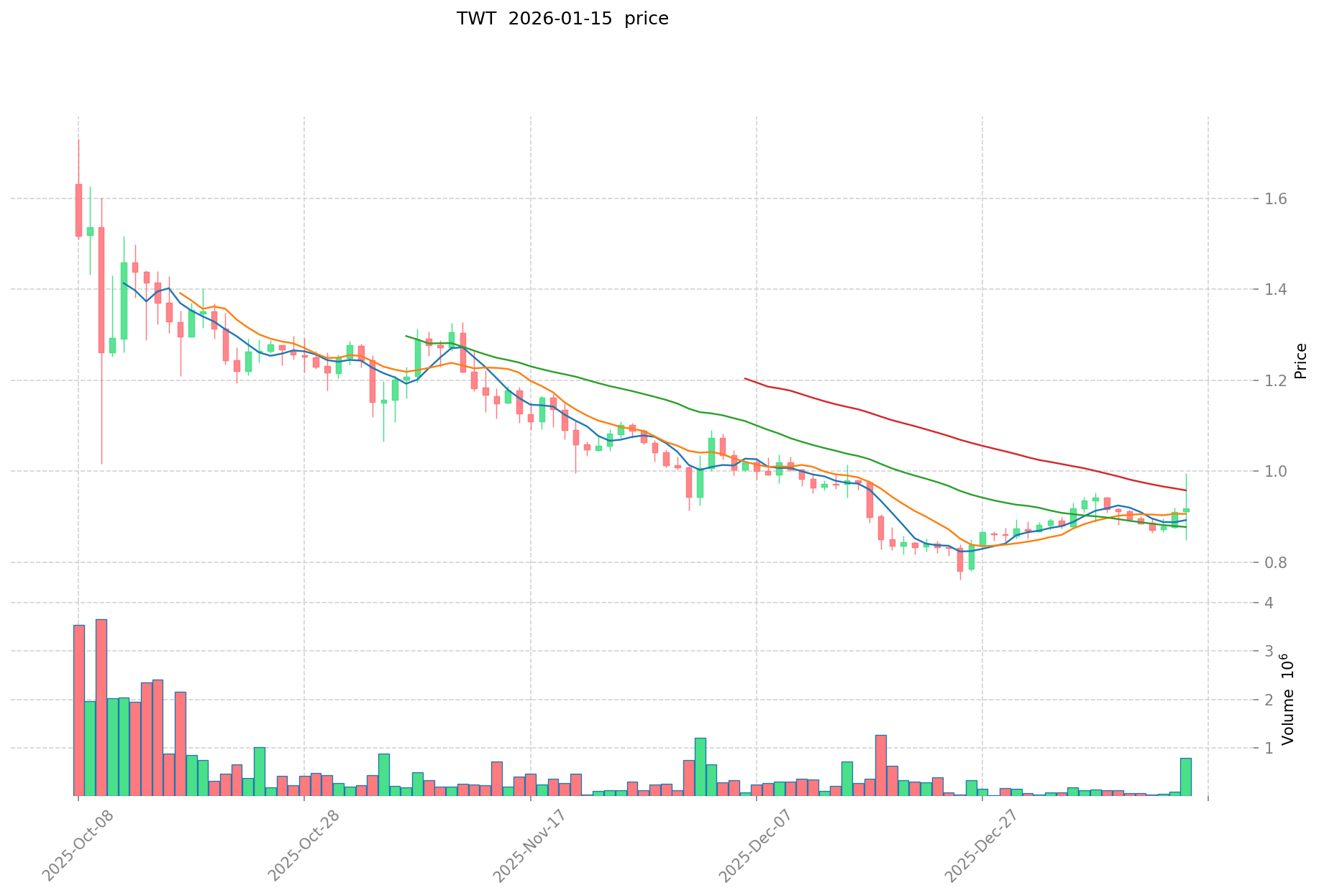
Current TWT Investment Market Status (January 2026)
- TWT current price: $0.9197
- 24-hour trading volume: approximately $746,061
- Market capitalization: approximately $383.19 million
- Circulating supply: 416.65 million tokens
- Total supply: 1 billion tokens
- Fully diluted market cap: approximately $919.7 million
Click to view real-time TWT market price
II. Core Factors Influencing Whether TWT is a Good Investment
Supply Mechanism and Scarcity (TWT Investment Scarcity)
- Token Supply Structure → Influences price dynamics and investment valuation
- TWT operates with a maximum supply of approximately 999,860,531 tokens, with a current circulating supply of 416,649,900 tokens (representing about 41.67% of total supply)
- The token exists in two standards: BEP-2 and BEP-20, deployed on the BSC (Binance Smart Chain) network
- Historical price movements show the token reached a notable price level of $2.72 on December 12, 2022, while the current price as of January 15, 2026, stands at $0.9197
- Investment Significance: The controlled supply mechanism and gradual token release schedule may provide structural support for long-term value retention, though market conditions remain the primary determinant
Institutional Investment and Mainstream Adoption (Institutional Investment in TWT)
- Holder Distribution: As of the latest data, TWT has approximately 269,793 token holders across supported networks
- Strategic Partnerships: Trust Wallet Token has established partnerships with payment infrastructure providers including MoonPay and Onramper, which enhance the utility of the wallet ecosystem and potentially broaden the token's use cases
- Exchange Availability: TWT is currently listed on 37 cryptocurrency exchanges, providing liquidity channels for institutional and retail participants
- Enterprise Integration: Trust Wallet's support for over 40 blockchain protocols and more than 160,000 digital assets positions the platform as a comprehensive infrastructure solution in the Web3 space
Macroeconomic Environment's Impact on TWT Investment
- Market Correlation: As a utility token tied to a non-custodial wallet platform, TWT's investment appeal may correlate with broader trends in cryptocurrency adoption and regulatory developments affecting digital asset custody solutions
- Web3 Growth Dynamics: The expansion of decentralized finance (DeFi) applications and self-custody solutions creates potential tailwinds for platforms like Trust Wallet, which may translate into enhanced utility for TWT holders
- Market Sentiment Indicators: Current market data shows TWT with a 24-hour price change of +0.38%, 7-day change of -0.33%, 30-day change of -5.66%, and 1-year change of -23.86%, reflecting varied short-term and medium-term price movements
Technology and Ecosystem Development (Technology & Ecosystem for TWT Investment)
- Multi-Chain Infrastructure: Trust Wallet's support for 40+ blockchain protocols provides technical diversification and reduces dependency on single-network performance
- Staking Capabilities: The platform enables staking across multiple blockchain protocols including Cosmos, Tezos, and Kava, expanding utility beyond basic wallet functions
- Governance Mechanism: TWT token holders can participate in network decision-making processes, including votes on adding new blockchain protocols, tokens, and product features
- Fee Discount Structure: Token holders receive discounts on in-app digital currency purchases and decentralized exchange services, creating tangible utility that may support demand
- Trust Wallet Premium Program: Introduced loyalty program features a tier-based system combining XP earning with TWT token locking, providing enhanced benefits and potentially reducing circulating supply through staking mechanisms
- NFT and Digital Collectibles: The wallet provides integrated storage and access solutions for digital collectibles, aligning with the growth trajectory of NFT markets
- Ecosystem Innovations: Recent implementations include FlexGas functionality and enhanced DeFi integrations, which may strengthen the platform's competitive position in the self-custody wallet segment
III. TWT Future Investment Prediction and Price Outlook (Is TrustWallet(TWT) worth investing in 2026-2031)
Short-term Investment Prediction (2026, short-term TWT investment outlook)
- Conservative prediction: $0.47632 - $0.916
- Neutral prediction: $0.916 - $1.08088
- Optimistic prediction: $1.08088 and above
Mid-term Investment Outlook (2027-2029, mid-term TrustWallet(TWT) investment forecast)
- Market stage expectation: The ecosystem is anticipated to experience gradual expansion, with staking participation potentially increasing and the token supply base broadening through enhanced utility within the Trust Wallet platform.
- Investment return prediction:
- 2027: $0.6190328 - $1.048362
- 2028: $0.6140406 - $1.13597511
- 2029: $0.7125941163 - $1.19845374105
- Key catalysts: Ecosystem growth exceeding 4%, increased staking activity, expansion of Trust Wallet's multi-chain support, and potential enhancements in decentralized exchange services.
Long-term Investment Outlook (Is TWT a good long-term investment?)
- Base scenario: $0.92264742740025 - $1.139070898025 (Assuming steady ecosystem development and consistent platform user growth)
- Optimistic scenario: $1.361189723139875 - $1.715099051156242 (Assuming accelerated adoption of Trust Wallet services and favorable market conditions)
- Risk scenario: Below $0.721430553264133 (In cases of significant market downturns or competitive pressure)
Click to view TWT long-term investment and price prediction: Price Prediction
2026-01-15 - 2031 Long-term Outlook
- Base scenario: $0.92264742740025 - $1.139070898025 (Corresponding to steady progress and gradual mainstream application enhancement)
- Optimistic scenario: $1.361189723139875 - $1.715099051156242 (Corresponding to large-scale adoption and favorable market environment)
- Transformative scenario: Above $1.715099051156242 (If the ecosystem achieves breakthrough developments and mainstream popularization)
- 2031-12-31 predicted high: $1.715099051156242 (Based on optimistic development assumptions)
Disclaimer: The predictions provided are based on historical data, technical analysis, and market trends. Cryptocurrency investments carry substantial risk, and actual prices may vary significantly from predictions. Investors should conduct thorough research and consider their risk tolerance before making investment decisions.
| Year |
Predicted High Price |
Predicted Average Price |
Predicted Low Price |
Price Change |
| 2026 |
1.08088 |
0.916 |
0.47632 |
0 |
| 2027 |
1.048362 |
0.99844 |
0.6190328 |
8 |
| 2028 |
1.13597511 |
1.023401 |
0.6140406 |
11 |
| 2029 |
1.19845374105 |
1.079688055 |
0.7125941163 |
17 |
| 2030 |
1.58330854825475 |
1.139070898025 |
0.92264742740025 |
23 |
| 2031 |
1.715099051156242 |
1.361189723139875 |
0.721430553264133 |
48 |
IV. TWT Investment Strategy and Risk Management (How to invest in Trust Wallet Token)
Investment Methodology (TWT investment strategy)
Long-term Holding (HODL TWT): Suitable for Conservative Investors
Long-term holding strategies focus on TWT's fundamental value proposition as the native token of Trust Wallet, a multi-chain digital asset wallet. This approach may appeal to investors who believe in the long-term adoption of decentralized wallet solutions and the expansion of Trust Wallet's ecosystem, which currently supports over 40 blockchain protocols and more than 160,000 digital assets. Conservative investors may consider accumulating TWT during price dips and holding through market cycles, benefiting from potential governance participation and discount utilities within the Trust Wallet ecosystem.
Active Trading: Relying on Technical Analysis and Swing Operations
Active traders may leverage TWT's price volatility for short-term gains. Recent data shows TWT experienced a 24-hour high of $0.9962 and a low of $0.8489, indicating intraday price fluctuations. Technical analysis tools such as support and resistance levels, moving averages, and volume indicators can help identify entry and exit points. Traders should monitor market sentiment, trading volume changes, and correlation with broader crypto market trends when executing swing trading strategies.
Risk Management (Risk management for TWT investment)
Asset Allocation Ratio: Conservative / Aggressive / Professional Investors
- Conservative Investors: May allocate 2-5% of their crypto portfolio to TWT, maintaining larger positions in established assets while gaining exposure to utility tokens.
- Aggressive Investors: Could allocate 10-15% to TWT, accepting higher volatility for potential returns tied to Trust Wallet's ecosystem growth.
- Professional Investors: May employ dynamic allocation strategies based on market conditions, fundamental developments, and risk-adjusted return metrics.
Risk Hedging Solutions: Multi-Asset Portfolio + Risk Mitigation Tools
Diversification across different crypto categories (layer-1 protocols, DeFi tokens, stablecoins) can reduce concentration risk. Investors may consider:
- Pairing TWT holdings with stablecoins to manage volatility exposure
- Diversifying across multiple wallet and infrastructure tokens
- Utilizing stop-loss orders to limit downside risk
- Monitoring correlation with BNB and BSC ecosystem tokens, given TWT's presence on Binance Smart Chain
Secure Storage: Hot and Cold Wallets + Hardware Wallet Recommendations
Given TWT's availability on BSC (contract address: 0x4b0f1812e5df2a09796481ff14017e6005508003), investors should prioritize security:
- Cold Storage: Hardware wallets (Ledger, Trezor) for long-term holdings
- Hot Wallets: Trust Wallet itself or other reputable mobile/desktop wallets for active trading and staking
- Security Practices: Enable two-factor authentication, verify contract addresses before transactions, and regularly update wallet software
V. TWT Investment Risks and Challenges (Risks of investing in Trust Wallet Token)
Market Risk: High Volatility and Price Manipulation
TWT exhibits considerable price volatility, with a 1-hour change of -0.97%, 24-hour change of 0.38%, and 30-day decline of -5.66%. The token has experienced substantial price movements historically, with an all-time high of $2.72 (December 2022) and current price of $0.9197, representing a significant drawdown. The relatively modest 24-hour trading volume of approximately $746,061 may expose the token to liquidity risks and potential price manipulation during low-volume periods.
Regulatory Risk: Policy Uncertainty Across Different Countries
As a utility token associated with a digital wallet service, TWT faces regulatory uncertainties related to:
- Classification of wallet tokens under securities laws in various jurisdictions
- Evolving regulations governing crypto wallets and custodial services
- Potential restrictions on token-based governance mechanisms
- Compliance requirements for cross-border digital asset services
Investors should monitor regulatory developments in major markets that could impact Trust Wallet's operations and TWT's utility.
Technical Risk: Network Security Vulnerabilities and Upgrade Failures
Technical risks include:
- Smart contract vulnerabilities on the BSC platform where TWT operates
- Potential bugs in Trust Wallet's integration with multiple blockchain protocols
- Risks associated with wallet security breaches or exploits
- Challenges in maintaining compatibility across 40+ supported blockchain networks
- Dependencies on third-party blockchain infrastructure and their respective upgrade schedules
VI. Conclusion: Is Trust Wallet Token a Good Investment?
Investment Value Summary
TWT presents a unique value proposition as the native token of a widely-adopted multi-chain wallet supporting over 160,000 digital assets. The token's utility in governance and transaction discounts provides fundamental demand drivers. However, TWT has experienced significant price volatility, with a -23.86% decline over the past year and currently trading approximately 66% below its all-time high. The token's market capitalization stands at approximately $383 million with a circulating supply of 416.6 million tokens (41.67% of maximum supply), indicating substantial future supply considerations.
Investor Recommendations
✅ Beginners: Consider dollar-cost averaging strategies to mitigate entry timing risk, combined with secure storage in hardware wallets or Trust Wallet itself. Start with small allocations (1-3% of crypto portfolio) to understand token dynamics before increasing exposure.
✅ Experienced Investors: May implement swing trading strategies leveraging TWT's volatility, while maintaining a core long-term position. Consider portfolio diversification across multiple wallet and infrastructure tokens, monitoring Trust Wallet's ecosystem development and user growth metrics.
✅ Institutional Investors: Could evaluate TWT for strategic long-term allocation as part of a broader crypto infrastructure thesis, conducting thorough due diligence on Trust Wallet's competitive positioning, user acquisition trends, and token economics.
⚠️ Disclaimer: Cryptocurrency investments carry substantial risk due to market volatility, regulatory uncertainty, and technological challenges. This analysis is for informational purposes only and does not constitute financial, investment, or trading advice. Investors should conduct independent research and consult with qualified financial advisors before making investment decisions.
VII. FAQ
Q1: What is TrustWallet Token (TWT) and what is its primary use case?
TWT is the native utility and governance token of Trust Wallet, a multi-chain digital asset wallet supporting over 40 blockchain protocols and more than 160,000 digital assets. The token serves multiple purposes: it enables holders to participate in governance decisions (such as voting on adding new blockchain protocols and features), provides discounts on in-app digital currency purchases and decentralized exchange services, and offers benefits through the Trust Wallet Premium loyalty program. TWT exists in two standards (BEP-2 and BEP-20) on the Binance Smart Chain, with a maximum supply of approximately 1 billion tokens and current circulating supply of 416.65 million tokens.
Q2: How has TWT performed historically, and what is its current market position?
TWT launched in April 2020 at approximately $0.009362 and reached an all-time high of $2.72 on December 12, 2022. As of January 15, 2026, the token trades at $0.9197, representing approximately 66% below its peak. The token holds a market capitalization of $383.19 million, ranking 161st by market cap with 0.026% market dominance. Recent performance shows mixed trends: +0.38% (24-hour), -0.33% (7-day), -5.66% (30-day), and -23.86% (1-year), indicating significant volatility characteristic of utility tokens in the cryptocurrency sector.
Q3: What are the predicted price ranges for TWT in the short-term and long-term?
Short-term predictions for 2026 range from conservative estimates of $0.47632-$0.916 to optimistic projections above $1.08088. Mid-term forecasts suggest gradual growth: 2027 ($0.619-$1.048), 2028 ($0.614-$1.136), and 2029 ($0.713-$1.198). Long-term projections for 2030-2031 indicate a base scenario of $0.923-$1.139, an optimistic scenario of $1.361-$1.715, with the 2031 predicted high reaching $1.715. These predictions assume steady ecosystem development and increased Trust Wallet adoption, though actual prices may vary significantly due to market volatility, regulatory changes, and competitive dynamics.
Q4: What investment strategies are suitable for different types of TWT investors?
Conservative investors should consider long-term holding (HODL) strategies with 2-5% portfolio allocation, focusing on TWT's fundamental value as a wallet ecosystem token while accumulating during price dips. Aggressive investors may allocate 10-15% of their crypto portfolio, accepting higher volatility for potential returns tied to ecosystem growth. Active traders can leverage TWT's intraday volatility (recent 24-hour range: $0.8489-$0.9962) using technical analysis tools for swing trading. All investors should implement risk management through diversification, secure storage in hardware wallets or Trust Wallet itself, stop-loss orders, and monitoring correlation with BSC ecosystem tokens.
Q5: What are the main risks associated with investing in TWT?
TWT faces several significant risks: Market Risk includes high volatility and relatively low 24-hour trading volume ($746,061), which may expose the token to liquidity constraints and potential price manipulation. Regulatory Risk stems from uncertain classification of wallet tokens under securities laws, evolving regulations governing crypto wallets, and potential restrictions across different jurisdictions. Technical Risk encompasses smart contract vulnerabilities on BSC, wallet security threats, challenges maintaining compatibility across 40+ supported blockchains, and dependencies on third-party infrastructure. Additionally, the token has substantial future supply considerations with only 41.67% of maximum supply currently circulating.
Q6: How does TWT generate utility for holders within the Trust Wallet ecosystem?
TWT provides tangible utility through multiple mechanisms: holders receive discounts on in-app digital currency purchases and decentralized exchange transaction fees, reducing costs for active users. The governance function allows token holders to participate in decision-making processes, including voting on new blockchain protocol integrations, token additions, and product feature developments. The Trust Wallet Premium Program offers a tier-based loyalty system combining XP earning with TWT token locking, providing enhanced benefits while potentially reducing circulating supply. These utility features create ongoing demand drivers beyond speculative trading, though the value of these utilities depends on Trust Wallet's continued user growth and platform development.
Q7: What factors could drive TWT price appreciation in the coming years?
Several catalysts could support TWT price growth: expansion of Trust Wallet's user base (currently over 269,793 token holders) and increased adoption of the platform's multi-chain capabilities across 40+ blockchain protocols. Enhanced staking participation and integration of new DeFi services could increase token utility and reduce circulating supply. Strategic partnerships with payment providers like MoonPay and Onramper may broaden use cases. The growth of Web3 adoption and self-custody solutions creates structural tailwinds for wallet platforms. Additionally, the implementation of innovative features like FlexGas functionality and NFT storage solutions could strengthen Trust Wallet's competitive position, potentially translating into increased demand for TWT tokens.
Q8: Is TWT suitable for beginners, and what allocation strategy is recommended?
TWT can be appropriate for beginners who understand cryptocurrency risks and seek exposure to wallet ecosystem tokens, though it should represent a small portion of a diversified portfolio. Recommended approach for beginners: start with 1-3% allocation of crypto holdings to understand token dynamics before potentially increasing exposure. Employ dollar-cost averaging to mitigate entry timing risk rather than attempting to time market bottoms. Prioritize secure storage using hardware wallets (Ledger, Trezor) or Trust Wallet itself with two-factor authentication enabled. Focus on long-term holding rather than active trading, as TWT's volatility and technical analysis requirements may prove challenging for inexperienced investors. Most importantly, only invest amounts you can afford to lose, and conduct independent research beyond this analysis before making investment decisions.
* The information is not intended to be and does not constitute financial advice or any other recommendation of any sort offered or endorsed by Gate.