This comprehensive analysis evaluates TuringBitChain (TBC) as a Bitcoin Virtual Machine pioneer offering scalable smart contract solutions. Trading at $7.21 with a $200.3 million market cap as of January 2026, TBC demonstrates significant volatility—surging 242.85% annually while declining 30.06% recently. The article examines core investment factors including limited token circulation (1.32% of maximum supply), technical ecosystem development, and macroeconomic influences. Price predictions span conservative ($5.14-$7.24 short-term) to optimistic scenarios ($15.80+ by 2031). Investment strategies include long-term HODL approaches and active swing trading, with recommended allocations of 1-3% for conservative investors. Key risks encompass extreme volatility, regulatory uncertainty, technical dependencies on Bitcoin protocol upgrades, and limited exchange availability (Gate only). Suitable for experienced investors with high risk tolerance, TBC represents speculative infrastructure exposure requiring thorough
Introduction: TuringBitChain (TBC)'s Investment Position and Market Prospects
TBC is a significant asset in the cryptocurrency field. As a pioneer of the Bitcoin Virtual Machine (BVM), it has launched a scalable BTC smart contract layer solution based on BVM. As of January 16, 2026, TBC has a market capitalization of approximately $200.30 million, with a circulating supply of around 27.80 million tokens, and the current price is maintained at approximately $7.21. With its positioning as a "scalable smart contract layer for Bitcoin," TBC has gradually become a focal point for investors discussing "Is TuringBitChain (TBC) a good investment?" The project aims to address Bitcoin's congestion issues and expand its utility beyond a store of value, potentially enabling daily transactions and native smart contract functionality similar to Ethereum. This article will comprehensively analyze TBC's investment value, historical trends, future price predictions, and investment risks to provide reference for investors.
I. TuringBitChain (TBC) Historical Price Review and Current Investment Value
-
2025: TBC experienced significant volatility during its first year of trading, with the token reaching its peak in September 2025 at $19.8. Investors who purchased during the early listing period in February 2025 saw substantial returns, though market corrections followed in subsequent months.
-
Mid-2025: Following initial enthusiasm, TBC underwent a corrective phase, with the price declining from higher levels to test support around the $7-8 range by late 2025 and early 2026. This adjustment reflected broader market dynamics and profit-taking behavior among early participants.
-
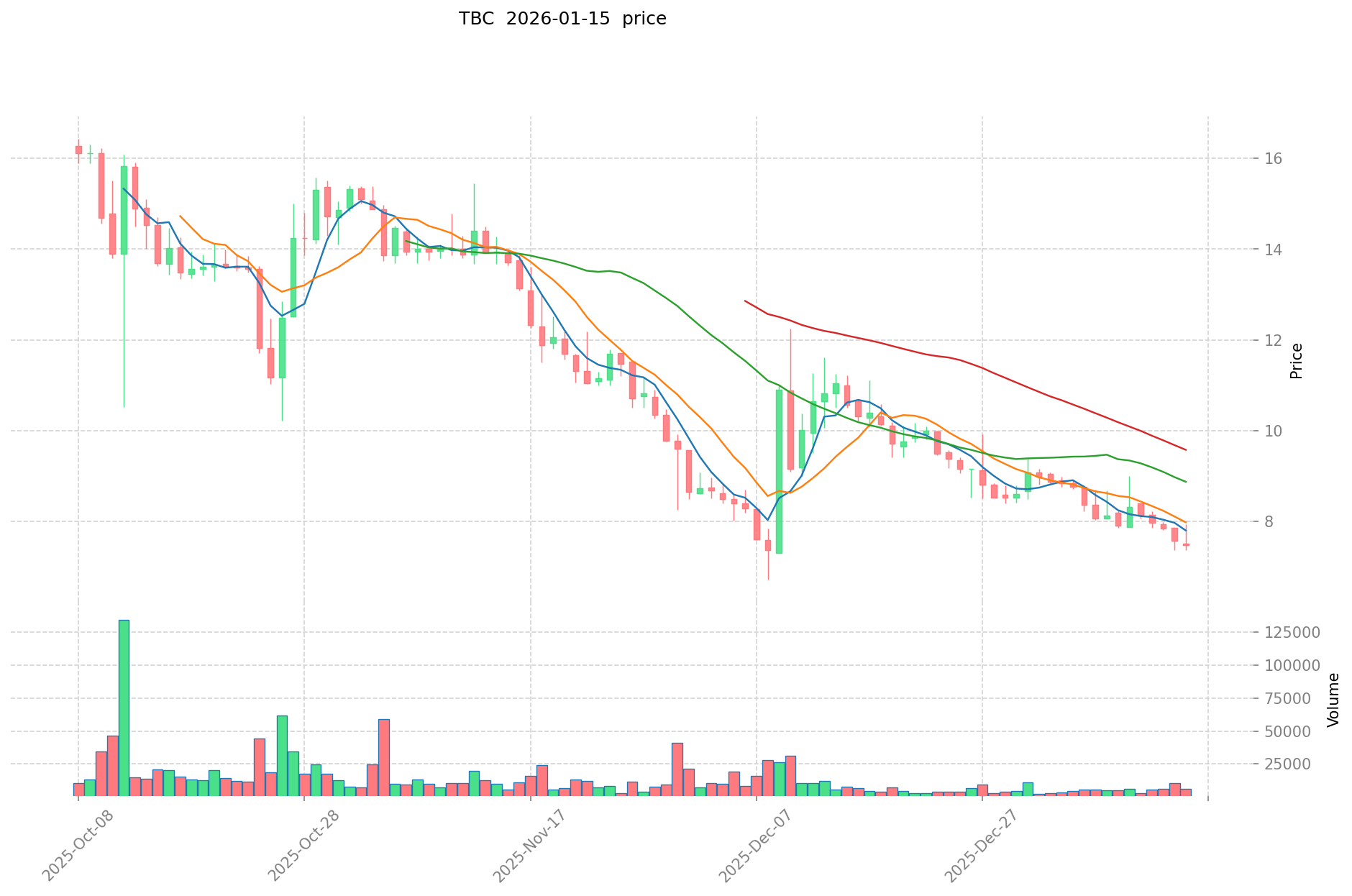
Early 2026: As of January 16, 2026, TBC traded at $7.205, showing mixed short-term performance with a 1-hour increase of 0.47% but facing downward pressure over longer timeframes including a 7-day decline of 9.34% and a 30-day drop of 30.06%.
Current TBC Investment Market Status (January 2026)
- Current TBC Price: $7.205 (as of January 16, 2026)
- 24-Hour Trading Volume: $32,255.33
- Market Capitalization: Approximately $200.3 million
- Circulating Supply: 27.8 million TBC (representing 1.32% of the maximum supply of 2.1 billion tokens)
- Recent Price Range: 24-hour high of $7.656 and low of $7.205
Click to view real-time TBC market price
Market Performance Metrics:
- Despite recent short-term declines, TBC has demonstrated resilience over a longer horizon, with a 1-year performance showing growth of 242.85% from earlier trading levels
- The token currently ranks #236 among tracked digital assets by market capitalization
- Trading activity remains concentrated on select exchanges, with Gate.com serving as a primary trading venue
Investment Landscape:
TBC's market positioning reflects its role as a Bitcoin Virtual Machine (BVM) pioneer, aiming to establish a scalable smart contract layer for Bitcoin. The project's value proposition centers on unlocking Bitcoin's potential beyond store-of-value functionality, targeting capabilities similar to Ethereum's smart contract ecosystem. Current market conditions suggest investors are weighing the project's technical ambitions against broader market uncertainties and the early-stage nature of BVM infrastructure development.
II. Core Factors Influencing Whether TBC is a Good Investment
Supply Mechanism and Scarcity (TBC Investment Scarcity)
- Supply structure → impacts price and investment value
- TBC has a maximum supply of 2.1 billion tokens with current circulating supply of 27.8 million, representing approximately 1.32% of total supply
- The low circulation ratio suggests potential supply expansion, which investors should monitor when evaluating scarcity dynamics
- Investment significance: The relationship between circulating supply and maximum supply remains a factor in assessing long-term value proposition
Institutional Investment and Mainstream Adoption (Institutional Investment in TBC)
- TBC is currently listed on 1 exchange with 24-hour trading volume of approximately $32,255
- The project positions itself as a pioneer of Bitcoin Virtual Machine (BVM), aiming to create a scalable smart contract layer for Bitcoin
- Adoption considerations: TBC's vision involves creating a relationship similar to ETH-ARB after Bitcoin completes relevant BIP protocol upgrades
Macroeconomic Environment's Impact on TBC Investment
- Broader cryptocurrency market conditions influence TBC's investment appeal, with the token showing price fluctuations across different timeframes
- Market dominance stands at 0.030%, indicating TBC represents a smaller segment within the overall crypto asset landscape
- Economic uncertainties and market sentiment shifts affect investor interest in emerging blockchain projects like TBC
Technology and Ecosystem Development (Technology & Ecosystem for TBC Investment)
- Bitcoin Virtual Machine (BVM): TBC implements a scalable smart contract layer solution based on BVM technology
- Smart contract capabilities: The platform aims to provide Turing-complete smart contract functionality for Web3 application development and deployment
- Ecosystem vision: TBC seeks to help Bitcoin expand beyond a value storage tool to support daily transactions and create a prosperous BVM ecosystem comparable to EVM
- Technical positioning: The project aims to address Bitcoin network congestion issues and unlock additional potential for the Bitcoin network
III. TBC Future Investment Predictions and Price Outlook (Is TuringBitChain(TBC) worth investing in 2026-2031)
Short-term Investment Prediction (2026, short-term TBC investment outlook)
- Conservative Estimate: $5.14 - $7.24
- Neutral Estimate: $7.24 - $8.84
- Optimistic Estimate: $8.84 - $10.00
Mid-term Investment Outlook (2027-2029, mid-term TuringBitChain(TBC) investment forecast)
-
Market Stage Expectation: The price trends suggest a gradual upward trajectory with projected average prices increasing from $8.04 in 2027 to $9.34 in 2029, reflecting potential growth in adoption and ecosystem development.
-
Investment Return Prediction:
- 2027: $7.72 - $10.37
- 2028: $8.28 - $9.48
- 2029: $8.41 - $11.31
-
Key Catalysts: Development of Bitcoin Virtual Machine (BVM) ecosystem, completion of Bitcoin BIP protocol upgrades, expansion of smart contract layer capabilities, and broader adoption of BTC-based decentralized applications.
Long-term Investment Outlook (Is TBC a good long-term investment?)
- Base Scenario: $10.32 - $11.77 (2030), $11.05 - $15.80 (2031) (assuming steady ecosystem growth and continued BVM development)
- Optimistic Scenario: $11.77 - $15.80 (2030-2031) (assuming accelerated adoption and favorable market conditions for Bitcoin layer-2 solutions)
- Risk Scenario: $7.02 - $9.06 (considering potential market corrections or delays in Bitcoin protocol upgrades)
View TBC long-term investment and price prediction: Price Prediction
2026-2031 Long-term Outlook
- Base Scenario: $7.24 - $11.05 (corresponding to steady progress and gradual mainstream application growth)
- Optimistic Scenario: $11.77 - $15.80 (corresponding to large-scale adoption and favorable market environment)
- Transformative Scenario: Above $15.80 (if ecosystem achieves breakthrough developments and mainstream penetration)
- December 31, 2031 Predicted High: $15.80 (based on optimistic development assumptions)
Disclaimer: The above predictions are based on historical data analysis and projected growth rates. Cryptocurrency markets are highly volatile and subject to numerous external factors including regulatory changes, technological developments, and market sentiment. Past performance does not guarantee future results. These predictions should not be considered as investment advice, and investors should conduct their own research and risk assessment before making investment decisions.
| Year |
Predicted High Price |
Predicted Average Price |
Predicted Low Price |
Price Change |
| 2026 |
8.83646 |
7.243 |
5.14253 |
0 |
| 2027 |
10.3712517 |
8.03973 |
7.7181408 |
11 |
| 2028 |
9.4816555755 |
9.20549085 |
8.284941765 |
27 |
| 2029 |
11.3057235874275 |
9.34357321275 |
8.409215891475 |
29 |
| 2030 |
11.770099176101175 |
10.32464840008875 |
7.02076091206035 |
43 |
| 2031 |
15.797744516975796 |
11.047373788094962 |
9.058846506237869 |
53 |
IV. TBC Investment Strategy and Risk Management (How to invest in TBC)
Investment Methodology (TBC investment strategy)
Long-term Holding (HODL TBC): Suitable for Conservative Investors
For investors seeking steady exposure to Bitcoin Virtual Machine (BVM) ecosystem development, a long-term holding strategy may be considered. This approach involves accumulating TBC tokens during market corrections and maintaining positions through various market cycles. Given TBC's positioning as a scalable smart contract layer solution for Bitcoin, long-term holders are essentially betting on the maturation of Bitcoin's programmability infrastructure. This strategy requires patience and tolerance for short-term price fluctuations, as reflected in TBC's 30-day price decline of 30.06% despite a one-year gain of 242.85%.
Active Trading: Relying on Technical Analysis and Swing Operations
Active traders may leverage TBC's notable price volatility for shorter-term opportunities. With a 24-hour trading range between $7.205 and $7.656, and historical price swings from an all-time low of $2 (July 2025) to an all-time high of $19.8 (September 2025), technical analysis tools such as support/resistance levels, moving averages, and volume indicators can inform entry and exit points. The current trading volume of approximately $32,255 suggests moderate liquidity for active trading strategies. Swing traders should monitor hourly and daily price movements, noting that TBC demonstrated a 0.47% increase over one hour but a 2% decline over 24 hours as of the latest update.
Risk Management (Risk management for TBC investment)
Asset Allocation Ratios: Conservative / Aggressive / Professional Investors
-
Conservative Investors: May consider limiting TBC exposure to 1-3% of their total crypto portfolio, given its relatively recent launch (February 2024) and significant volatility. This allocation allows participation in potential upside while limiting downside exposure.
-
Aggressive Investors: Could allocate 5-10% to TBC as part of a broader altcoin strategy, particularly if they have conviction in Bitcoin's smart contract layer development and the BVM ecosystem's potential.
-
Professional Investors: May implement dynamic allocation strategies, adjusting positions based on technical indicators, market conditions, and developments in Bitcoin's protocol upgrades (particularly relevant BIP proposals that could impact TBC's utility).
Risk Hedging Solutions: Multi-asset Portfolio + Hedging Tools
Investors can implement several hedging approaches:
-
Portfolio Diversification: Balance TBC holdings with established assets like Bitcoin and Ethereum, as well as other Layer 2 solutions to reduce concentration risk.
-
Stablecoin Reserves: Maintain a portion of capital in stablecoins to enable quick rebalancing during significant price movements.
-
Position Sizing: Use scaled entry and exit strategies rather than all-at-once positions to manage timing risk.
Secure Storage: Hot/Cold Wallets + Hardware Wallet Recommendations
-
Cold Storage: For long-term holdings, hardware wallets provide the highest security level by keeping private keys offline. Popular options include Ledger and Trezor devices, which support various blockchain assets.
-
Hot Wallets: For active traders requiring frequent access, reputable software wallets with strong security features are necessary. Enable two-factor authentication and use wallets that provide full control over private keys.
-
Exchange Storage: Keep only actively traded amounts on exchanges. Given TBC's availability on Gate.com, traders should utilize exchange security features such as withdrawal whitelists and security notifications.
-
Backup Protocols: Regardless of storage method, maintain secure backups of recovery phrases in multiple physical locations, never stored digitally.
V. TBC Investment Risks and Challenges (Risks of investing in TBC)
Market Risks: High Volatility and Price Manipulation
TBC exhibits substantial price volatility characteristic of lower market cap cryptocurrencies. The token's journey from $2 to $19.8 within months, followed by a current price of $7.205, demonstrates extreme price swings. With a market capitalization of approximately $200.3 million and relatively limited exchange availability (currently listed on one major exchange), TBC faces liquidity constraints that can amplify price movements. The market cap to fully diluted valuation ratio of 1.32% indicates significant future token supply yet to enter circulation, which could create selling pressure. Lower trading volumes compared to major cryptocurrencies increase susceptibility to large orders moving prices significantly.
Regulatory Risks: Policy Uncertainty Across Different Countries
As a Bitcoin-related smart contract layer project, TBC operates in an evolving regulatory environment. Different jurisdictions maintain varying stances on cryptocurrency projects, particularly those interfacing with Bitcoin's network. Potential regulatory developments could impact:
-
Classification Status: How regulators categorize TBC (as a utility token, security, or otherwise) affects legal compliance requirements.
-
Cross-border Operations: International regulatory coordination efforts may impose new compliance burdens on projects operating globally.
-
Bitcoin Protocol Changes: The project's description notes that TBC's relationship with Bitcoin depends on "specific BIP proposal upgrades" being completed. Regulatory attitudes toward such protocol modifications remain uncertain.
-
Exchange Listings: Regulatory actions affecting cryptocurrency exchanges could impact TBC's accessibility and liquidity.
Technical Risks: Network Security Vulnerabilities and Upgrade Failures
Several technical risk factors warrant consideration:
-
Smart Contract Security: As a smart contract layer solution, TBC's infrastructure must maintain robust security against exploits, bugs, or vulnerabilities that could compromise user funds or network integrity.
-
Bitcoin Integration Dependencies: TBC's functionality appears tied to Bitcoin's development roadmap. Delays or changes in Bitcoin protocol upgrades could affect TBC's value proposition and technical implementation.
-
Network Congestion Solutions: While TBC aims to address Bitcoin congestion issues, the effectiveness and adoption of its scaling solutions remain to be demonstrated at scale.
-
BVM Ecosystem Development: The project's success depends on building a thriving Bitcoin Virtual Machine ecosystem comparable to Ethereum's EVM. This requires developer adoption, tooling development, and application deployment, all of which carry execution risk.
-
SHA256 Algorithm: While utilizing Bitcoin's proven SHA256 algorithm provides security benefits, it also means competing with Bitcoin's network for mining resources if applicable to TBC's consensus mechanism.
VI. Conclusion: Is TBC a Good Investment?
Investment Value Summary
TBC presents a speculative opportunity within the Bitcoin infrastructure development sector. Its positioning as a Bitcoin Virtual Machine pioneer and scalable smart contract layer addresses a genuine need in the cryptocurrency ecosystem. The one-year price appreciation of 242.85% demonstrates market interest, while the 30-day decline of 30.06% reflects the token's volatility. With a circulating supply of only 27.8 million tokens out of a maximum supply of 2.1 billion, significant token distribution lies ahead, which may create both opportunity and dilution concerns. The project's ultimate value depends heavily on Bitcoin protocol developments, BVM ecosystem adoption, and the team's ability to execute its technical roadmap.
Investor Recommendations
✅ Beginners: Consider dollar-cost averaging with small, regular purchases rather than lump-sum investments to manage volatility. Prioritize secure storage using hardware wallets and invest only amounts you can afford to lose completely. Focus on understanding TBC's relationship to Bitcoin's development before increasing exposure.
✅ Experienced Investors: May employ swing trading strategies to capitalize on TBC's price volatility while maintaining a core long-term position if convinced by the project's fundamentals. Implement strict stop-loss orders and take-profit targets. Balance TBC holdings within a diversified portfolio including established Layer 2 solutions and Bitcoin itself.
✅ Institutional Investors: Could consider strategic allocation as part of Bitcoin infrastructure exposure, particularly if monitoring Bitcoin Improvement Proposal developments relevant to smart contract functionality. Conduct thorough due diligence on team credentials, technical architecture, and competitive positioning within the Bitcoin scaling landscape. Consider TBC as a satellite position rather than core holding given its early-stage nature.
⚠️ Disclaimer: Cryptocurrency investments carry substantial risk including potential total loss of capital. TBC's early-stage development, limited exchange availability, high volatility, and dependence on future Bitcoin protocol changes create significant uncertainty. This analysis is for informational purposes only and does not constitute financial, investment, or trading advice. Conduct independent research and consult qualified financial advisors before making investment decisions.
VII. FAQ
Q1: What makes TuringBitChain (TBC) different from other Bitcoin layer-2 solutions?
TBC distinguishes itself as a pioneer of the Bitcoin Virtual Machine (BVM), providing a scalable smart contract layer specifically designed for Bitcoin. Unlike traditional Bitcoin layer-2 solutions that primarily focus on payment scalability, TBC aims to bring Turing-complete smart contract functionality to Bitcoin, similar to Ethereum's capabilities. The project utilizes Bitcoin's proven SHA256 algorithm while building an infrastructure that could enable Web3 application development directly on Bitcoin's network. TBC's vision involves creating a relationship comparable to ETH-ARB after Bitcoin completes relevant BIP protocol upgrades, positioning it to unlock Bitcoin's potential beyond its current store-of-value function. This technical positioning differentiates TBC from other scaling solutions that focus solely on transaction throughput improvements.
Q2: Why has TBC's price declined 30% over the past month despite a 242% annual gain?
The 30-day decline of 30.06% reflects natural market correction following TBC's substantial rally throughout 2025. The token reached its all-time high of $19.8 in September 2025, and the current price of $7.205 represents profit-taking behavior among early participants who experienced significant gains. Additionally, several factors contribute to this short-term volatility: the broader cryptocurrency market conditions affecting altcoins, TBC's relatively limited liquidity with approximately $32,255 in 24-hour trading volume, and investor sentiment reassessing early-stage blockchain infrastructure projects. The low circulating supply of 27.8 million tokens (only 1.32% of maximum supply) also means price movements can be amplified by relatively smaller trading volumes. This volatility pattern is common for emerging cryptocurrency projects that experience rapid initial appreciation followed by consolidation phases.
Q3: How does TBC's token supply structure affect its investment potential?
TBC's supply structure presents both opportunities and considerations for investors. With a circulating supply of 27.8 million tokens representing only 1.32% of the maximum supply of 2.1 billion tokens, significant token distribution remains ahead. This means substantial future supply expansion could create selling pressure as more tokens enter circulation, potentially impacting price dynamics. However, the controlled current circulation also contributes to scarcity in the short term, which can support price appreciation during periods of increased demand. The supply structure requires investors to monitor token release schedules and vesting periods that may affect market conditions. Long-term investment value depends on whether ecosystem growth and adoption can absorb future supply increases, making the relationship between circulating supply expansion and user base growth a critical factor in TBC's valuation trajectory.
Q4: What are the main technical risks associated with investing in TBC?
TBC faces several technical risk factors that investors should evaluate. First, smart contract security remains paramount—as a smart contract layer solution, any vulnerabilities or exploits could compromise user funds and network integrity. Second, TBC's functionality depends heavily on Bitcoin protocol developments, particularly specific BIP proposal upgrades. Delays or changes in Bitcoin's development roadmap could affect TBC's value proposition and technical implementation timeline. Third, the project's success requires building a thriving Bitcoin Virtual Machine ecosystem with developer adoption, tooling infrastructure, and application deployment—all carrying execution risk. Fourth, while TBC aims to address Bitcoin network congestion, the effectiveness and adoption of its scaling solutions remain unproven at scale. Finally, as an early-stage infrastructure project with limited exchange availability, technical issues or network disruptions could significantly impact accessibility and investor confidence.
Q5: Is TBC suitable for long-term holding or short-term trading?
TBC's suitability depends on investor profile and risk tolerance. For long-term holding, TBC offers exposure to Bitcoin Virtual Machine ecosystem development, appealing to investors who believe in Bitcoin's programmability future and are willing to tolerate significant volatility. The one-year gain of 242.85% suggests potential for substantial appreciation, but requires patience through market cycles and confidence in the project's technical execution. For short-term trading, TBC's price volatility presents opportunities—historical swings from $2 to $19.8, and a current 24-hour trading range between $7.205 and $7.656 enable technical trading strategies. However, relatively modest liquidity ($32,255 in 24-hour volume) may limit execution for larger positions. Conservative investors might consider 1-3% portfolio allocation for long-term exposure, while active traders could employ swing strategies with strict risk management. The investment approach should align with individual risk tolerance, technical analysis capabilities, and conviction in Bitcoin infrastructure development.
Q6: What regulatory challenges could impact TBC's investment outlook?
TBC operates within an evolving regulatory landscape that presents several uncertainty factors. As a Bitcoin-related smart contract layer project, TBC faces potential classification questions—whether regulators categorize it as a utility token, security, or other designation affects legal compliance requirements and market access. International regulatory coordination efforts may impose new compliance burdens on globally operating projects like TBC. The project's dependence on Bitcoin protocol changes adds another layer of regulatory consideration, as authorities' attitudes toward such modifications remain uncertain. Exchange listing regulations could impact TBC's accessibility, particularly given its current availability on limited exchanges. Different jurisdictions maintain varying cryptocurrency stances, and policy changes in major markets could affect TBC's adoption trajectory. Cross-border operation requirements may increase operational complexity and costs. Investors should monitor regulatory developments in their jurisdictions and key markets where TBC operates, recognizing that regulatory clarity—or restrictions—could significantly influence investment outcomes.
Q7: How does TBC's limited exchange availability affect investment decisions?
TBC's current listing on a single major exchange (Gate.com) creates several investment considerations. Limited exchange availability reduces liquidity, meaning larger buy or sell orders can move prices more significantly than widely-listed cryptocurrencies. This concentration increases counterparty risk—if the primary exchange experiences technical issues, regulatory challenges, or security incidents, TBC trading and accessibility could be severely impacted. Lower trading volume ($32,255 in 24 hours) compared to established cryptocurrencies amplifies price volatility and may result in wider bid-ask spreads. For investors, this means potentially higher transaction costs and reduced flexibility in entering or exiting positions quickly. However, additional exchange listings could serve as positive catalysts for price appreciation by expanding TBC's investor base and improving liquidity. Investors should consider maintaining only actively traded amounts on exchanges while using secure cold storage for long-term holdings, and should monitor announcements regarding potential additional exchange listings that could enhance market access.
Q8: What role does Bitcoin's development roadmap play in TBC's investment value?
Bitcoin's development roadmap is fundamental to TBC's value proposition and represents both opportunity and dependency risk. TBC's vision involves creating a scalable smart contract layer that activates after Bitcoin completes relevant BIP (Bitcoin Improvement Proposal) protocol upgrades. This means TBC's functionality and utility are closely tied to Bitcoin's core development progress—a factor outside TBC's direct control. If Bitcoin successfully implements protocols enabling enhanced smart contract capabilities, TBC could benefit significantly as infrastructure positioned to capitalize on expanded Bitcoin functionality. Conversely, delays, modifications, or abandonment of relevant Bitcoin protocol upgrades could undermine TBC's technical roadmap and market narrative. The project aims to help Bitcoin evolve beyond a store-of-value tool toward supporting daily transactions and decentralized applications, comparable to Ethereum's ecosystem. Investors should monitor Bitcoin development discussions, BIP proposal progress, and Bitcoin developer community sentiment regarding smart contract functionality, as these factors directly influence TBC's long-term viability and investment thesis.
* The information is not intended to be and does not constitute financial advice or any other recommendation of any sort offered or endorsed by Gate.