Unibase (UB) is an emerging digital asset launched in 2025, functioning as a high-performance decentralized AI memory layer infrastructure within the DeFi ecosystem. Trading at $0.03675 with a market capitalization of $91.88 million as of January 2026, UB enables AI agents to maintain long-term memory and cross-platform interoperability across the Open Agent Internet. This comprehensive analysis examines UB's investment potential through multiple dimensions: historical price performance from $0.008 launch to $0.092791 peak, current market dynamics with 2.5 billion circulating tokens, and key investment drivers including ecosystem adoption and technology development. The article evaluates investment strategies for different investor profiles, from conservative dollar-cost averaging approaches to active trading opportunities, while addressing substantial risks including high volatility, regulatory uncertainty, and technical implementation challenges. Price forecasts range from $0.025-$0.054 for 2026 to potentia
Introduction: Unibase (UB)'s Investment Position and Market Outlook
Unibase (UB) is an emerging digital asset in the cryptocurrency field, launched in 2025, and has achieved notable recognition in the decentralized AI infrastructure sector. As of January 17, 2026, Unibase has a market capitalization of approximately $91.88 million, with a circulating supply of 2.5 billion tokens, and the current price is around $0.03675. Positioned as a high-performance decentralized AI memory layer, UB aims to empower AI agents with long-term memory and cross-platform interoperability, enabling them to remember, collaborate, and self-evolve. With its vision of building the Open Agent Internet, Unibase has gradually attracted attention from investors exploring "Is Unibase (UB) a good investment?" This article will comprehensively analyze UB's investment value, historical trends, future price predictions, and associated risks to provide reference for investors.
I. UB Price History Review and Current Investment Value
- 2025: Project launch and initial market entry → The token was published at $0.008 on September 12, 2025, and experienced significant price volatility during its early trading period
- 2025: Peak market performance in October → UB reached a notable price level of $0.092791 on October 28, 2025, representing substantial growth from its initial offering
- 2025-2026: Market correction phase → Price declined from the October peak to lower levels, with the token trading around $0.015082 in mid-September 2025
Current UB Investment Market Status (January 2026)
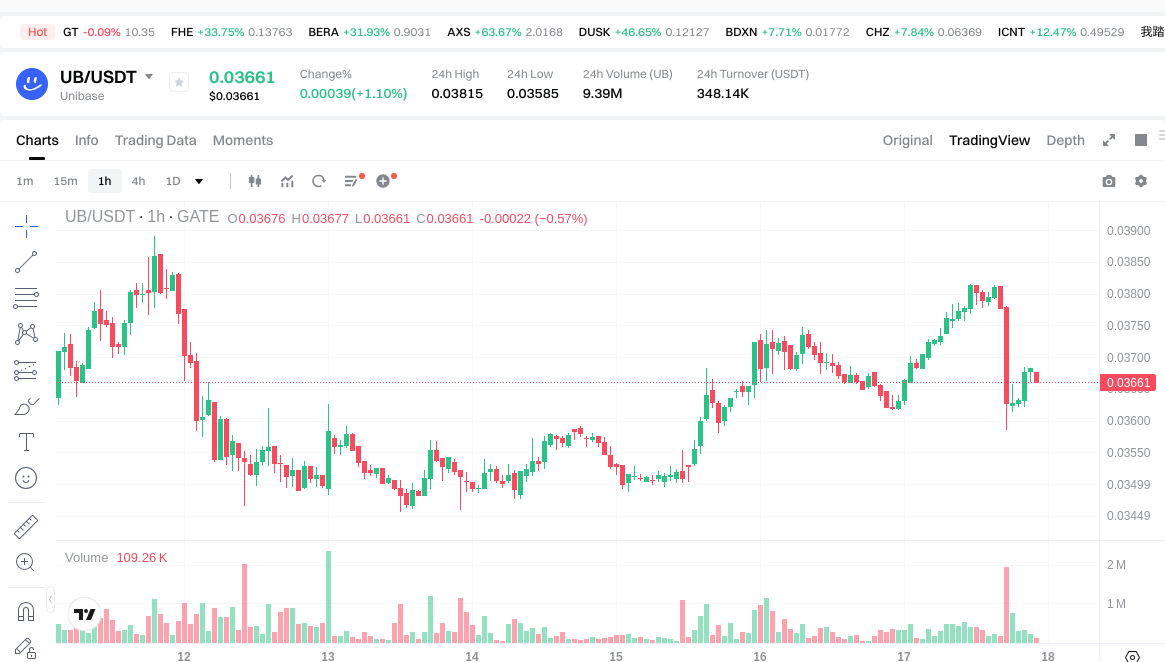
- Current UB price: $0.03675 (as of January 17, 2026)
- Market sentiment: Data not available in provided materials
- 24-hour trading volume: $347,585.84
- 24-hour price range: High of $0.03815, Low of $0.03585
- Recent price movements: +0.22% (1H), +1.21% (24H), -1.08% (7D), -11.60% (30D)
- Market capitalization: $91.88 million
- Circulating supply: 2.5 billion UB (25% of total supply)
- Fully diluted market cap: $367.5 million
- Market dominance: 0.010%
- Trading availability: Listed on 8 exchanges
- Institutional investor holdings: Data not available in provided materials
Click to view real-time UB market price
II. Core Factors Influencing Whether UB is a Good Investment (Is Unibase(UB) a Good Investment)
Supply Mechanism and Scarcity (UB investment scarcity)
- Total supply is capped at 10 billion tokens, with a maximum supply of 10 billion UB
- Current circulating supply stands at 2.5 billion tokens, representing 25% of the total supply
- The token distribution structure includes allocation for developers, community staking, and ecosystem growth initiatives
- Investment significance: The controlled release schedule and finite supply model may provide structural support for long-term value considerations
Institutional Investment and Mainstream Adoption (Institutional investment in UB)
- Institutional holding trends: Currently, there are 7 recorded holders according to available data
- Exchange adoption: UB is listed on 8 exchanges, including Gate.com, with Binance Futures listing confirmed in September 2025
- Developer and community adoption: The ecosystem supports AI agent deployment, token staking, and knowledge contribution, fostering a self-sustaining community
- Market positioning: Unibase aims to build the Open Agent Internet, supporting seamless collaboration among intelligent agents across ecosystems
Macroeconomic Environment Impact on UB Investment
- Cryptocurrency market conditions: Market sentiment indicators suggest neutral positioning
- Broader market trends: As of January 17, 2026, UB holds a market share of approximately 0.010%
- Regulatory environment: The evolving regulatory landscape for AI infrastructure projects may influence investor sentiment and market access
- Risk considerations: The intersection of AI technology and cryptocurrency introduces unique exposure to both sectors' market dynamics
Technology and Ecosystem Development (Technology & Ecosystem for UB investment)
- Core technology: Unibase operates as a high-performance decentralized AI memory layer, providing long-term memory and cross-platform interoperability for AI agents
- Technical infrastructure: The platform utilizes a modular architecture to address AI agent memory and interoperability challenges
- Ecosystem applications: Support for decentralized AI DeFi agents, multi-agent gaming, and developer tools for building next-generation AI applications
- Token utility: UB tokens serve functions including staking, governance participation, and ecosystem incentivization
- Multi-chain deployment: Token contracts are available on Ethereum (ETH-20) and Binance Smart Chain (BEP-20), facilitating broader ecosystem integration
III. UB Future Investment Forecast and Price Outlook (Is Unibase(UB) worth investing in 2026-2031)
Short-term Investment Forecast (2026, short-term UB investment outlook)
- Conservative Forecast: $0.025 - $0.037
- Neutral Forecast: $0.037 - $0.048
- Optimistic Forecast: $0.048 - $0.054
Mid-term Investment Outlook (2027-2029, mid-term Unibase(UB) investment forecast)
-
Market Stage Expectation: During the mid-term period, UB may experience gradual ecosystem expansion as Unibase's decentralized AI memory layer gains traction. The integration with platforms like Blazpay could drive increased protocol usage, potentially supporting moderate price appreciation.
-
Investment Return Forecast:
- 2027: $0.034 - $0.059
- 2028: $0.040 - $0.064
- 2029: $0.055 - $0.080
-
Key Catalysts: Enhanced AI agent adoption, cross-platform interoperability improvements, ecosystem partnerships, and the potential expansion of the memory node reward program.
Long-term Investment Outlook (Is Unibase a good long-term investment?)
- Base Scenario: $0.063 - $0.104 (assuming steady development of the Open Agent Internet and moderate market acceptance)
- Optimistic Scenario: $0.080 - $0.104 (assuming accelerated AI agent integration, successful mainnet operations, and favorable market conditions)
- Risk Scenario: $0.025 - $0.040 (considering potential technical challenges, competitive pressures, or adverse market dynamics)
Click to view UB long-term investment and price forecast: Price Prediction
2026-01-17 - 2031 Long-term Outlook
- Base Scenario: $0.063 - $0.080 (corresponding to steady progress and gradual mainstream application enhancement)
- Optimistic Scenario: $0.080 - $0.104 (corresponding to large-scale adoption and favorable market environment)
- Transformative Scenario: Above $0.104 (if the ecosystem achieves breakthrough developments and mainstream adoption)
- 2031-12-31 Predicted High: $0.104 (based on optimistic development assumptions)
Disclaimer: The forecasts provided are based on current market data and predictive models. Cryptocurrency investments involve substantial risk, and past performance does not guarantee future results. Investors should conduct independent research and consider their risk tolerance before making investment decisions.
| Year |
Predicted High Price |
Predicted Average Price |
Predicted Low Price |
Price Change |
| 2026 |
0.0539637 |
0.03671 |
0.0249628 |
0 |
| 2027 |
0.0593912735 |
0.04533685 |
0.0340026375 |
23 |
| 2028 |
0.0644077959525 |
0.05236406175 |
0.03979668693 |
42 |
| 2029 |
0.079988722526212 |
0.05838592885125 |
0.054882773120175 |
58 |
| 2030 |
0.090635396652238 |
0.069187325688731 |
0.039436775642576 |
88 |
| 2031 |
0.10388476952163 |
0.079911361170484 |
0.063929088936387 |
117 |
IV. Unibase Investment Strategy and Risk Management (How to invest in Cryptocurrency)
Investment Methodology (Unibase investment strategy)
Long-term Holding (HODL Unibase)
Long-term holding strategies may appeal to investors seeking exposure to the decentralized AI infrastructure sector. This approach typically involves purchasing UB tokens and maintaining positions through market cycles, with the expectation that the project's technological development and ecosystem growth may contribute to value appreciation over extended periods. Investors considering this strategy should evaluate Unibase's progress in building its AI memory layer and the adoption rate of its Open Agent Internet framework.
Active Trading
Active trading strategies involve utilizing technical analysis and market timing techniques to capitalize on UB's price movements. Given the token's 24-hour trading volume of approximately $347,585 and price fluctuations between $0.03585 and $0.03815 within the past day, traders may identify opportunities through short-term price movements. Technical indicators, chart patterns, and volume analysis can inform entry and exit decisions for those implementing swing trading or day trading approaches.
Risk Management (Risk management for Unibase investment)
Asset Allocation Ratios
Different investor profiles may consider varying allocation strategies:
- Conservative Investors: May limit cryptocurrency exposure to 1-5% of total portfolio value, with UB representing a small fraction within this allocation
- Aggressive Investors: Might allocate 10-20% to digital assets, with emerging AI-focused tokens like UB comprising a portion of this allocation
- Professional Investors: Could implement more sophisticated allocation models based on risk-adjusted return metrics and correlation analysis with broader crypto markets
Risk Hedging Solutions
Investors may consider diversification strategies including:
- Multi-asset portfolios combining established cryptocurrencies with emerging tokens
- Balanced exposure across different blockchain ecosystems and use cases
- Position sizing aligned with risk tolerance and investment timeframes
- Regular portfolio rebalancing based on market conditions and project developments
Secure Storage
Proper custody solutions are essential for UB token holders:
- Cold Wallets: Hardware wallets such as Ledger or Trezor provide offline storage for long-term holdings, offering enhanced security against online threats
- Hot Wallets: For active traders, reputable software wallets with multi-signature support enable convenient access while maintaining security protocols
- Custody Considerations: Given UB's deployment on both Ethereum (ERC-20) and BSC (BEP-20) networks, investors should ensure their chosen wallet solutions support these standards
V. Unibase Investment Risks and Challenges (Risks of investing in Cryptocurrency)
Market Risks
High Volatility
UB has demonstrated significant price volatility, with a 30-day price change of -11.60% and fluctuations between its all-time high of $0.092791 (October 28, 2025) and all-time low of $0.015082 (September 12, 2025). This volatility range indicates substantial price movement potential in both directions, which may result in rapid gains or losses for investors.
Market Manipulation Concerns
With a circulating supply of 2.5 billion tokens (25% of total supply) and a market capitalization of approximately $91.87 million, UB's relatively modest market size may present liquidity challenges. Limited trading depth across 8 exchanges could potentially expose the token to price manipulation risks, particularly during periods of low trading volume.
Regulatory Risks
Jurisdictional Policy Uncertainty
The regulatory landscape for AI-focused cryptocurrency projects remains in development across different jurisdictions. Unibase's integration of artificial intelligence technology with blockchain infrastructure may face evolving regulatory frameworks as governments establish guidelines for decentralized AI systems. Policy changes in major markets could impact the project's operations, token accessibility, and overall market perception.
Compliance Considerations
As regulatory requirements for cryptocurrency projects continue to evolve, Unibase may need to adapt its platform and token economics to maintain compliance across different jurisdictions. Changes in securities laws, data privacy regulations, or AI governance frameworks could require operational adjustments that may affect token utility or project development timelines.
Technical Risks
Network Security Vulnerabilities
As a decentralized AI memory layer providing cross-platform interoperability, Unibase's infrastructure faces potential security challenges including smart contract vulnerabilities, consensus mechanism risks, and potential attack vectors specific to AI agent coordination systems. Any security breach or exploit could undermine platform integrity and negatively impact token value.
Upgrade and Implementation Risks
The development of Unibase's Open Agent Internet and AI memory layer involves complex technical implementations. Delays in feature rollouts, challenges in achieving cross-platform interoperability, or difficulties in scaling the network could affect the project's competitive position and adoption trajectory. Technical setbacks during critical upgrade phases may result in temporary or sustained negative market sentiment.
VI. Conclusion: Is Cryptocurrency a Good Investment?
Investment Value Summary
Unibase represents an emerging project in the intersection of artificial intelligence and blockchain technology, focusing on decentralized AI memory infrastructure and agent interoperability. The project's positioning in the growing AI agent ecosystem may offer long-term potential as adoption of AI applications expands. However, with a current market cap to fully diluted valuation ratio of 25% and significant token supply yet to enter circulation, investors should consider potential dilution effects on token economics.
Short-term price movements have shown considerable volatility, with the token experiencing both upward momentum (1.21% in 24 hours) and downward pressure (-11.60% over 30 days), reflecting the dynamic nature of emerging cryptocurrency markets.
Investor Recommendations
✅ Beginners: Consider dollar-cost averaging strategies to build positions gradually, reducing exposure to timing risk. Prioritize secure storage solutions such as hardware wallets, and allocate only capital that can be held through market cycles without financial stress.
✅ Experienced Investors: May explore swing trading opportunities based on technical analysis while maintaining core long-term positions. Portfolio diversification across multiple blockchain sectors and market caps can help manage concentration risk.
✅ Institutional Investors: Could evaluate Unibase as part of strategic allocation to decentralized AI infrastructure, conducting thorough due diligence on technological development milestones, team execution capabilities, and competitive positioning within the AI agent ecosystem.
⚠️ Important Notice: Cryptocurrency investments carry substantial risk, including potential loss of principal. Market volatility, regulatory uncertainty, and technological challenges present significant considerations. This content is provided for informational purposes only and does not constitute investment advice. Investors should conduct independent research and consult qualified financial advisors before making investment decisions.
VII. FAQ
Q1: What is the current market position of Unibase (UB) as of January 2026?
As of January 17, 2026, Unibase (UB) is trading at approximately $0.03675 with a market capitalization of $91.88 million. The token has a circulating supply of 2.5 billion UB (representing 25% of the total 10 billion token supply) and holds a market dominance of 0.010%. UB is currently listed on 8 exchanges with a 24-hour trading volume of $347,585.84. The project positions itself as a decentralized AI memory layer infrastructure, enabling AI agents to maintain long-term memory and cross-platform interoperability within the Open Agent Internet ecosystem.
Q2: Has Unibase (UB) experienced significant price volatility since its launch?
Yes, UB has demonstrated substantial price volatility since its initial publication at $0.008 on September 12, 2025. The token reached an all-time high of $0.092791 on October 28, 2025, representing more than a 10x increase from its initial price. Subsequently, the token experienced a correction phase, with the all-time low recorded at $0.015082. Recent performance shows mixed movements: +1.21% over 24 hours but -11.60% over the past 30 days. This volatility pattern reflects the dynamic nature of emerging cryptocurrency markets and the speculative interest in AI-focused blockchain projects.
Q3: What are the primary investment risks associated with UB?
UB investment involves several key risk categories. Market risks include high volatility (demonstrated by the token's price range from $0.015082 to $0.092791) and potential manipulation concerns due to its relatively modest market cap of $91.87 million. Regulatory risks stem from evolving jurisdictional policies for AI-cryptocurrency hybrid projects and compliance requirements across different markets. Technical risks encompass network security vulnerabilities inherent in decentralized AI infrastructure, smart contract risks, and potential implementation challenges during platform upgrades. Additionally, with only 25% of total token supply currently circulating, investors face potential dilution effects as remaining tokens enter the market.
Q4: What factors could influence UB's long-term investment potential?
Several factors may impact UB's long-term trajectory. Technology development includes the successful implementation of Unibase's AI memory layer and cross-platform interoperability features for AI agents. Ecosystem adoption encompasses the growth of applications leveraging the Open Agent Internet framework, partnerships with platforms like Blazpay, and expansion of the memory node reward program. Market dynamics involve broader adoption trends in decentralized AI infrastructure, competition from alternative solutions, and overall cryptocurrency market conditions. Token economics considerations include the controlled release schedule of remaining supply (7.5 billion tokens) and utility expansion through staking, governance, and ecosystem incentivization mechanisms.
Q5: What investment strategies are suitable for different investor profiles considering UB?
Conservative investors may consider limiting cryptocurrency exposure to 1-5% of total portfolio value, with UB representing a small fraction within this allocation, utilizing dollar-cost averaging to reduce timing risk. Aggressive investors might allocate 10-20% to digital assets, implementing swing trading strategies based on technical analysis while maintaining core long-term positions for potential ecosystem growth. Professional investors could conduct thorough due diligence on Unibase's technological milestones, team execution capabilities, and competitive positioning, potentially incorporating UB as part of strategic allocation to decentralized AI infrastructure. Regardless of profile, proper risk management includes secure storage solutions (hardware wallets for long-term holdings), portfolio diversification across multiple blockchain sectors, and position sizing aligned with individual risk tolerance.
Q6: What price predictions exist for UB through 2031?
Price forecasts for UB suggest varying scenarios based on project development and market conditions. For 2026, conservative estimates range from $0.025-$0.037, neutral forecasts suggest $0.037-$0.048, and optimistic projections indicate $0.048-$0.054. Mid-term outlook (2027-2029) anticipates gradual ecosystem expansion with 2027 estimates at $0.034-$0.059, 2028 at $0.040-$0.064, and 2029 at $0.055-$0.080. Long-term projections through 2031 suggest a base scenario of $0.063-$0.080, optimistic scenario of $0.080-$0.104, with transformative potential above $0.104 if breakthrough developments occur. The 2031 predicted high of $0.104 represents a potential 117% increase from 2026 baseline, contingent upon successful mainnet operations, AI agent adoption acceleration, and favorable market dynamics.
Q7: How does Unibase's token supply structure affect investment considerations?
Unibase has a capped total supply of 10 billion UB tokens, with current circulating supply at 2.5 billion (25% of total). This supply structure presents both opportunities and considerations for investors. The controlled release schedule may provide structural support for value appreciation as demand increases relative to available supply. However, the substantial amount of locked tokens (7.5 billion remaining) introduces potential dilution risk as these tokens enter circulation through developer allocations, community staking rewards, and ecosystem growth initiatives. The fully diluted market cap of $367.5 million versus current market cap of $91.88 million indicates significant supply expansion ahead. Investors should monitor token unlock schedules and vesting periods to assess potential supply-side pressure on price dynamics.
Q8: What distinguishes Unibase's technology from other AI-blockchain projects?
Unibase differentiates itself through its focus on providing a high-performance decentralized AI memory layer specifically designed for AI agent ecosystems. The platform addresses critical challenges in AI agent memory retention and cross-platform interoperability, enabling agents to remember interactions, collaborate across different ecosystems, and self-evolve over time. The modular architecture supports applications including decentralized AI DeFi agents, multi-agent gaming environments, and developer tools for building next-generation AI applications. Multi-chain deployment on both Ethereum (ERC-20) and Binance Smart Chain (BEP-20) facilitates broader ecosystem integration. The Open Agent Internet vision aims to create seamless collaboration infrastructure for intelligent agents, positioning Unibase as foundational infrastructure rather than a standalone application, which may offer different value propositions compared to application-layer AI cryptocurrency projects.
* The information is not intended to be and does not constitute financial advice or any other recommendation of any sort offered or endorsed by Gate.