This comprehensive guide evaluates whether Unizen (ZCX) represents a viable investment opportunity within the DeFi ecosystem. As of February 2026, ZCX trades at $0.002984 with a market capitalization of $1.99 million, functioning as an exchange-based platform token on the Ethereum blockchain with trading available on Gate and other exchanges. The article examines ZCX's price history showing significant volatility, including an 11.79% 24-hour decline and 95.89% one-year decrease from its 2021 peak. Core investment considerations include supply dynamics with 66.54% circulation ratio, limited institutional adoption with 18,537 token holders, and market volatility requiring careful risk management. Investment strategies range from long-term holding for conservative investors allocating 1-3% of crypto portfolios to active trading for experienced participants. The analysis presents price forecasts through 2031 with base, optimistic, and risk scenarios, emphasizing substantial risks including market volatility, regu
Introduction: Unizen (ZCX) Investment Position and Market Prospects
ZCX is a significant asset in the cryptocurrency field. As an exchange-based platform token operating on the Ethereum blockchain, it has established its presence since its launch in April 2021. As of February 2026, Unizen holds a market capitalization of approximately $1.99 million, with a circulating supply of around 665.37 million tokens, and a current price maintaining around $0.002984. The token functions within the Unizen Exchange ecosystem, which operates on Binance Cloud's trading and security infrastructure. With its platform utility positioning similar to other exchange tokens, ZCX has become a subject of discussion among investors evaluating "Is Unizen (ZCX) a good investment?" This article will comprehensively analyze ZCX's investment value, historical trends, future price predictions, and investment risks to provide reference for investors.
I. ZCX Price History Review and Current Investment Value
- 2021: ZCX experienced notable price movement during its early trading period → The token demonstrated significant volatility during the initial market phase
- 2021-2026: Market cycle evolution → Price fluctuated from higher levels to $0.002984 as of February 2026
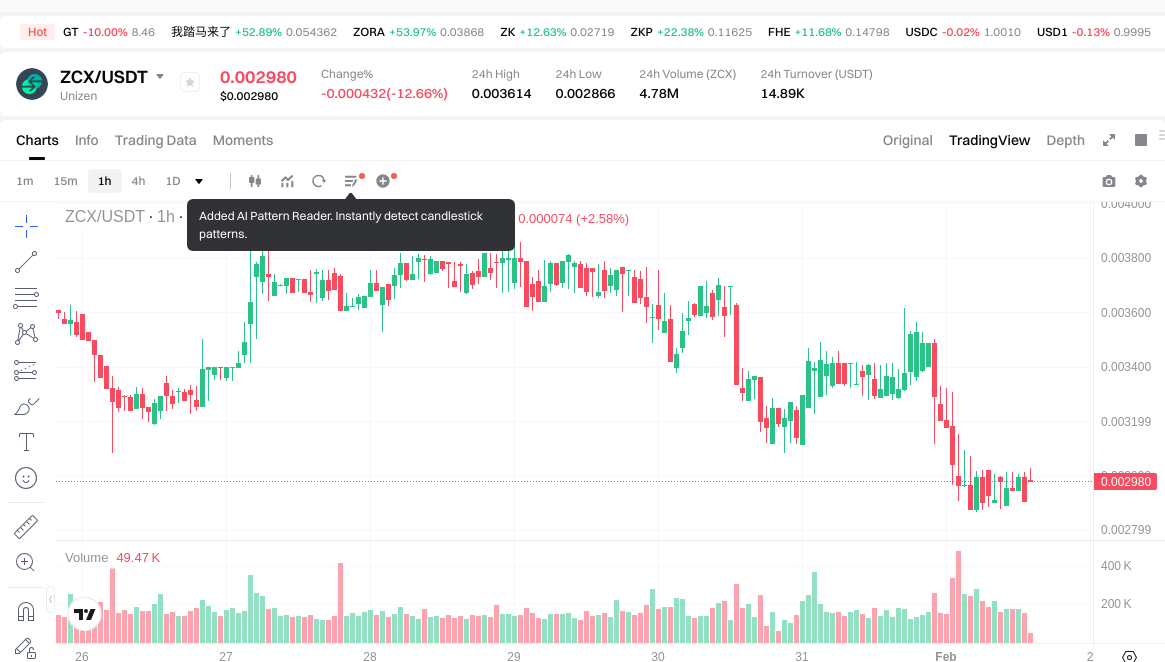
- Recent period: The token underwent considerable price adjustment → Trading activity showed mixed patterns with 24-hour volume at $14,948.10
Current ZCX Investment Market Status (February 2026)
- ZCX current price: $0.002984
- 24-hour trading volume: $14,948.10
- 24-hour price range: High $0.003614, Low $0.002866
- Market capitalization: $1,985,472.05
- Circulating supply: 665,372,670.03 ZCX (66.54% of total supply)
- Token holders: 18,537
Click to view real-time ZCX market price
II. Core Factors Influencing Whether ZCX is a Good Investment (Is Unizen(ZCX) a Good Investment)
Supply Mechanism and Scarcity (ZCX investment scarcity)
- Total Supply and Circulation → Impact on Price and Investment Value
- Unizen (ZCX) has a maximum supply of 1,000,000,000 tokens, with a circulating supply of approximately 665,372,670 tokens as of February 2026, representing a circulation ratio of approximately 66.54%.
- The relatively high circulation ratio suggests that a significant portion of the total supply is already in the market, which may limit immediate scarcity-driven price appreciation.
- Investment Significance: The balance between circulating and total supply remains a factor for investors evaluating long-term value retention.
Institutional Investment and Mainstream Adoption (Institutional investment in ZCX)
- Holder Base Trends: As of February 2026, Unizen has approximately 18,537 token holders, indicating a moderate level of community participation.
- Market capitalization stands at approximately $1,985,472, with fully diluted valuation at approximately $2,639,482, reflecting limited institutional presence compared to larger digital assets.
- Exchange Availability: ZCX is listed on 5 exchanges, which may constrain liquidity and mainstream accessibility relative to more widely adopted tokens.
Macroeconomic Environment Impact on ZCX Investment
- Monetary Policy and Interest Rate Changes → Alter Investment Attractiveness
- Market volatility remains a consideration, with ZCX experiencing notable price fluctuations, including a 1-hour change of +1.43%, a 24-hour change of -11.79%, and a 7-day change of -17.88% as of February 1, 2026.
- The broader crypto market environment and macroeconomic conditions continue to influence investor sentiment toward platform tokens like ZCX.
- Geopolitical Uncertainty and Market Conditions → May affect demand for exchange-based platform tokens.
Technology and Ecosystem Development (Technology & Ecosystem for ZCX investment)
- Platform Infrastructure: Unizen operates on infrastructure that includes integration with trading and security frameworks, positioning ZCX as a platform utility token.
- ZCX functions as an exchange-based platform token deployed on the Ethereum blockchain, with the contract address 0xc52c326331e9ce41f04484d3b5e5648158028804.
- Ecosystem Applications: The utility of ZCX within the Unizen platform and its potential expansion into DeFi, payment applications, and broader ecosystem use cases may influence long-term investment considerations.
- Technical development activity and community engagement through channels such as GitHub, Twitter, and Reddit provide transparency for investors monitoring project progress.
III. ZCX Future Investment Forecast and Price Outlook (Is Unizen(ZCX) worth investing in 2026-2031)
Short-term Investment Forecast (2026, short-term ZCX investment outlook)
- Conservative forecast: $0.0025 - $0.0030
- Neutral forecast: $0.0030 - $0.0035
- Optimistic forecast: $0.0035 - $0.0043
Mid-term Investment Outlook (2027-2029, mid-term Unizen(ZCX) investment forecast)
- Market stage expectation: ZCX may experience gradual recovery from current levels, with potential price consolidation and moderate growth trajectory over the mid-term period.
- Investment return forecast:
- 2027: $0.0020 - $0.0038
- 2028: $0.0020 - $0.0050
- 2029: $0.0038 - $0.0061
- Key catalysts: Market sentiment shifts, platform development progress, and broader cryptocurrency market conditions may influence mid-term performance.
Long-term Investment Outlook (Is ZCX a good long-term investment?)
- Base scenario: $0.0040 - $0.0063 (assuming steady platform development and maintained market presence)
- Optimistic scenario: $0.0063 - $0.0087 (assuming enhanced adoption and favorable market conditions)
- Risk scenario: $0.0020 - $0.0040 (under challenging market conditions or delayed development milestones)
Click to view ZCX long-term investment and price prediction: Price Prediction
2026-2031 Long-term Outlook
- Base scenario: $0.0025 - $0.0063 USD (corresponding to steady progress and gradual mainstream application improvement)
- Optimistic scenario: $0.0044 - $0.0087 USD (corresponding to large-scale adoption and favorable market environment)
- Transformative scenario: Above $0.0087 USD (such as breakthrough ecosystem progress and mainstream adoption)
- 2031-12-31 predicted high: $0.0087 USD (based on optimistic development assumptions)
Disclaimer: Price predictions are based on historical data analysis and market trend observations. Cryptocurrency investments carry substantial risk, and actual prices may vary significantly from forecasts due to market volatility, regulatory changes, and other unforeseen factors. This information should not be considered as investment advice.
| Year |
Predicted High Price |
Predicted Average Price |
Predicted Low Price |
Price Change |
| 2026 |
0.004321 |
0.00298 |
0.0025032 |
0 |
| 2027 |
0.00379652 |
0.0036505 |
0.00204428 |
22 |
| 2028 |
0.0049895034 |
0.00372351 |
0.0020106954 |
24 |
| 2029 |
0.00609910938 |
0.0043565067 |
0.003833725896 |
45 |
| 2030 |
0.007318931256 |
0.00522780804 |
0.004443636834 |
75 |
| 2031 |
0.00865725011424 |
0.006273369648 |
0.00395222287824 |
110 |
IV. ZCX Investment Strategy and Risk Management (How to invest in ZCX)
Investment Methodology (ZCX investment strategy)
Long-term Holding (HODL ZCX)
For conservative investors seeking steady exposure to the Unizen ecosystem, a long-term holding strategy may be appropriate. This approach involves acquiring ZCX tokens and maintaining positions through market cycles, focusing on the platform's development milestones rather than short-term price movements. Given ZCX's role as a platform token within the Unizen Exchange infrastructure, holders may benefit from potential ecosystem growth over extended periods.
Active Trading
Traders employing technical analysis and swing trading strategies may find opportunities in ZCX's price movements. With 24-hour price volatility and trading volume of approximately $14,948 as of February 1, 2026, active participants can utilize chart patterns, volume indicators, and momentum signals to identify entry and exit points. This approach requires continuous market monitoring and familiarity with technical analysis tools.
Risk Management (Risk management for ZCX investment)
Asset Allocation Ratios
- Conservative investors: Consider limiting ZCX exposure to 1-3% of total crypto portfolio
- Moderate investors: May allocate 3-7% depending on risk tolerance and market outlook
- Experienced investors: Could assign up to 10-15% based on comprehensive research and conviction
These allocations should be adjusted according to individual financial situations, investment goals, and risk appetite.
Risk Hedging Solutions
Implementing a diversified portfolio approach can help mitigate concentration risk. Consider combining ZCX holdings with:
- Established cryptocurrencies with larger market capitalizations
- Stablecoins for liquidity management
- Traditional assets to balance overall portfolio volatility
Position sizing and regular portfolio rebalancing are essential components of risk management.
Secure Storage
Given that ZCX operates on the Ethereum blockchain (contract address: 0xc52c326331e9ce41f04484d3b5e5648158028804), investors should prioritize secure storage solutions:
- Hot wallets: Suitable for active trading amounts, offering quick access but requiring strong security practices
- Cold wallets: Recommended for long-term holdings, providing enhanced security through offline storage
- Hardware wallets: Devices such as Ledger or Trezor offer robust protection for Ethereum-based tokens
Always verify contract addresses before transactions and never share private keys or seed phrases.
V. ZCX Investment Risks and Challenges (Risks of investing in ZCX)
Market Risks
ZCX exhibits notable price volatility, with recent performance showing a 24-hour decline of 11.79% and a 7-day decrease of 17.88% as of February 1, 2026. The token's price of $0.002984 represents a substantial distance from its previous peak of $7.03 recorded on September 14, 2021. Such volatility patterns are common in smaller market capitalization tokens, where price movements can be influenced by limited liquidity and trading volume. The current market capitalization of approximately $1.99 million and daily trading volume of around $14,948 suggest relatively modest market activity, which may contribute to price fluctuations.
Regulatory Risks
Platform tokens and exchange-related cryptocurrencies face varying regulatory frameworks across different jurisdictions. Policy developments regarding digital asset trading platforms, token classifications, and compliance requirements may impact ZCX's operational environment and market accessibility. Investors should stay informed about regulatory changes in their respective regions and understand how such developments might affect token utility and trading availability.
Technical Risks
As an Ethereum-based token, ZCX's functionality depends on the underlying blockchain infrastructure. Potential technical considerations include:
- Smart contract vulnerabilities that could affect token operations
- Network congestion on Ethereum that may impact transaction speeds and costs
- Platform-specific technical challenges related to the Unizen Exchange infrastructure
- Integration dependencies with third-party services and protocols
Investors should evaluate the project's technical development progress and security practices as part of their due diligence process.
VI. Conclusion: Is ZCX a Good Investment?
Investment Value Summary
ZCX presents characteristics typical of platform tokens within the cryptocurrency exchange sector. The token's performance has experienced significant fluctuations, with a one-year decline of 95.89% as of February 1, 2026, indicating substantial price volatility. The circulating supply represents approximately 66.54% of the maximum supply of 1 billion tokens, with the remaining tokens potentially affecting future supply dynamics.
The token's function within the Unizen Exchange ecosystem and its relationship to the platform's growth trajectory are key considerations for long-term evaluation. However, the current market metrics, including market capitalization and trading volume, suggest a relatively modest market presence compared to larger platform tokens.
Investor Recommendations
✅ Beginners: New participants should approach ZCX investment cautiously, conducting thorough research and understanding platform token mechanics before participation. If proceeding, consider starting with small allocations and utilizing secure wallet storage solutions for Ethereum-based tokens.
✅ Experienced Investors: Those familiar with cryptocurrency markets may evaluate ZCX as part of a diversified portfolio strategy, applying position sizing principles and monitoring platform development progress. Technical analysis tools can assist in identifying potential trading opportunities within the context of overall market conditions.
✅ Institutional Investors: Entities considering exposure to exchange platform tokens should conduct comprehensive due diligence on the Unizen ecosystem, regulatory compliance status, and competitive positioning within the exchange infrastructure landscape.
⚠️ Important Notice: Cryptocurrency investments carry substantial risks, including the potential loss of principal. This content is provided for informational purposes only and does not constitute investment advice. Market conditions can change rapidly, and past performance does not indicate future results. Investors should consult with qualified financial advisors and conduct independent research before making investment decisions.
VII. FAQ
Q1: What is the current market position of Unizen (ZCX) as of February 2026?
As of February 1, 2026, ZCX trades at approximately $0.002984 with a market capitalization of $1.99 million and a circulating supply of 665.37 million tokens (66.54% of total supply). The token operates as an exchange-based platform utility token on the Ethereum blockchain, with trading available on 5 exchanges. Recent performance shows significant volatility, with a 24-hour decline of 11.79% and 7-day decrease of 17.88%. The daily trading volume stands at approximately $14,948.10, indicating relatively modest market activity compared to larger platform tokens. The token has experienced substantial price adjustments from its all-time high of $7.03 recorded in September 2021.
Q2: What are the predicted price ranges for ZCX from 2026 to 2031?
Price forecasts suggest varied scenarios based on market conditions and platform development. For 2026, predictions range from $0.0025-$0.0043 depending on market sentiment. Mid-term projections for 2027-2029 indicate potential ranges between $0.0020-$0.0061. Long-term outlook through 2031 presents three scenarios: base scenario ($0.0040-$0.0063), optimistic scenario ($0.0063-$0.0087), and risk scenario ($0.0020-$0.0040). The 2031 predicted high reaches $0.0087 under favorable conditions. However, these projections are subject to significant uncertainty due to market volatility, regulatory developments, and platform evolution. Investors should note that cryptocurrency price predictions carry substantial limitations and actual outcomes may differ materially from forecasts.
Q3: What are the primary risks associated with investing in ZCX?
ZCX investment carries multiple risk categories. Market risks include high price volatility, with the token declining 95.89% over one year as of February 2026, and limited liquidity reflected in modest trading volumes. Regulatory risks encompass potential policy changes affecting exchange platform tokens and compliance requirements across jurisdictions. Technical risks involve smart contract vulnerabilities on the Ethereum network, platform-specific challenges, and dependencies on third-party integrations. The relatively small market capitalization of approximately $1.99 million may amplify price movements and liquidity constraints. Additionally, the concentration of remaining token supply (33.46% not yet in circulation) could impact future supply dynamics and price stability.
Q4: How should different investor types approach ZCX allocation?
Investment strategy should align with experience level and risk tolerance. Beginners should conduct extensive research on platform token mechanics before participation, starting with small allocations (1-3% of crypto portfolio) if proceeding, and prioritizing secure storage solutions for Ethereum-based tokens. Experienced investors may allocate 3-7% as part of diversified portfolio strategies, employing technical analysis tools and monitoring platform development milestones. Institutional investors should perform comprehensive due diligence on Unizen ecosystem development, regulatory compliance status, and competitive positioning within the exchange infrastructure landscape. All investor categories should implement risk management through position sizing, portfolio diversification with established cryptocurrencies and stablecoins, and regular rebalancing based on market conditions and investment objectives.
Q5: What factors should be considered when evaluating ZCX's long-term investment potential?
Several core factors influence long-term assessment. Supply dynamics show 66.54% circulation ratio with 1 billion maximum tokens, affecting scarcity considerations. Ecosystem development depends on platform infrastructure evolution, integration capabilities, and expansion into DeFi applications. Market presence indicators include 18,537 token holders and availability on 5 exchanges, suggesting limited mainstream adoption compared to larger platform tokens. Technology infrastructure relies on Ethereum blockchain with contract address 0xc52c326331e9ce41f04484d3b5e5648158028804, requiring evaluation of smart contract security and development activity. Macroeconomic conditions and broader cryptocurrency market trends significantly impact platform token valuations. Investors should monitor progress through official channels including GitHub development activity, community engagement metrics, and transparent project updates while understanding that platform token value correlates closely with underlying exchange ecosystem growth.
Q6: What are the recommended storage and security practices for ZCX tokens?
Secure storage is essential for protecting ZCX holdings as an Ethereum-based ERC-20 token. Hot wallets suit active trading amounts, offering quick access through software applications but requiring strong security practices including two-factor authentication and regular software updates. Cold wallets are recommended for long-term holdings, providing enhanced security through offline storage methods. Hardware wallets such as Ledger or Trezor offer robust protection specifically designed for Ethereum-based tokens, storing private keys in secure elements isolated from internet-connected devices. Critical security practices include verifying the official contract address (0xc52c326331e9ce41f04484d3b5e5648158028804) before transactions, never sharing private keys or seed phrases, using reputable wallet providers, maintaining backup copies of recovery phrases in secure physical locations, and staying vigilant against phishing attempts targeting cryptocurrency holders.
Q7: How does ZCX compare to other exchange platform tokens in the current market?
ZCX occupies a distinct position within the exchange platform token landscape. With a market capitalization of approximately $1.99 million as of February 2026, it represents a smaller-scale platform token compared to major exchange tokens that typically command billions in market valuation. The trading volume of around $14,948 daily indicates limited liquidity relative to established exchange tokens with millions in daily volume. Availability on 5 exchanges contrasts with broader distribution of larger platform tokens across dozens of trading venues. The token holder base of 18,537 suggests moderate community participation compared to exchange tokens with hundreds of thousands or millions of users. The operational framework utilizing Binance Cloud infrastructure provides technical foundation, though market presence remains more limited. Investors comparing ZCX to other platform tokens should consider these scale differences and evaluate growth potential within the context of the broader exchange token category.
Q8: What investment strategies are most suitable for ZCX based on current market conditions?
Two primary approaches align with ZCX's market characteristics as of February 2026. Long-term holding (HODL) suits conservative investors focusing on Unizen ecosystem development over extended periods rather than short-term price movements, requiring patience through market cycles and conviction in platform growth trajectory. This strategy involves acquiring tokens and maintaining positions while monitoring development milestones. Active trading accommodates participants employing technical analysis and swing trading strategies to capitalize on price volatility, utilizing the 24-hour price movements and technical indicators for entry and exit decisions. This approach demands continuous market monitoring, familiarity with chart patterns, and risk management discipline. Both strategies require secure storage implementation, with cold storage for long-term holdings and hot wallets for active trading amounts. Regardless of approach, investors should implement appropriate position sizing relative to total portfolio, maintain diversification across asset classes, and establish clear risk parameters aligned with individual financial circumstances and investment objectives.
* The information is not intended to be and does not constitute financial advice or any other recommendation of any sort offered or endorsed by Gate.