This comprehensive guide examines UNUS-SED-LEO (LEO) as an investment opportunity, analyzing its market position and value proposition through 2031. LEO, the native utility token of Bitfinex exchange, currently trades at $9.08 with an $8.36 billion market cap. The article reviews LEO's deflationary token burn mechanism, price history from $0.80 to $10.14, and institutional adoption trends. Key sections address investment value drivers including Ethereum-based infrastructure, platform utility benefits, and macroeconomic factors. Price forecasts span conservative to optimistic scenarios through 2031, with projections reaching $17.85 under optimal conditions. The guide provides tailored investment strategies for beginner, experienced, and institutional investors, emphasizing risk management through portfolio diversification, hardware wallet security, and stop-loss mechanisms. Essential risk considerations include market volatility, regulatory uncertainty, and technical vulnerabilities on the Ethereum network.
Introduction: UNUS SED LEO (LEO) Investment Status and Market Prospects
LEO is a significant asset in the cryptocurrency field. Since its launch in 2019, it has achieved notable presence as the core utility token of the iFinex ecosystem and the platform token of Bitfinex exchange. As of January 13, 2026, LEO holds a market capitalization of approximately $8.36 billion, with a circulating supply of around 921.69 million tokens, and the current price is maintained at approximately $9.08. With its positioning as a utility token offering benefits across iFinex's trading platform, products and services, LEO has gradually become a focal point for investors discussing "Is UNUS-SED-LEO (LEO) a good investment?" This article will comprehensively analyze LEO's investment value, historical trends, future price forecasts and investment risks to provide reference for investors.
I. LEO Price History Review and Current Investment Value Status
- December 2019: LEO recorded a price level of $0.799859, representing an early stage of market establishment following its initial offering at $1.00 per token.
- March 2025: The token reached a price point of $10.14, reflecting a period of notable market appreciation within the iFinex ecosystem.
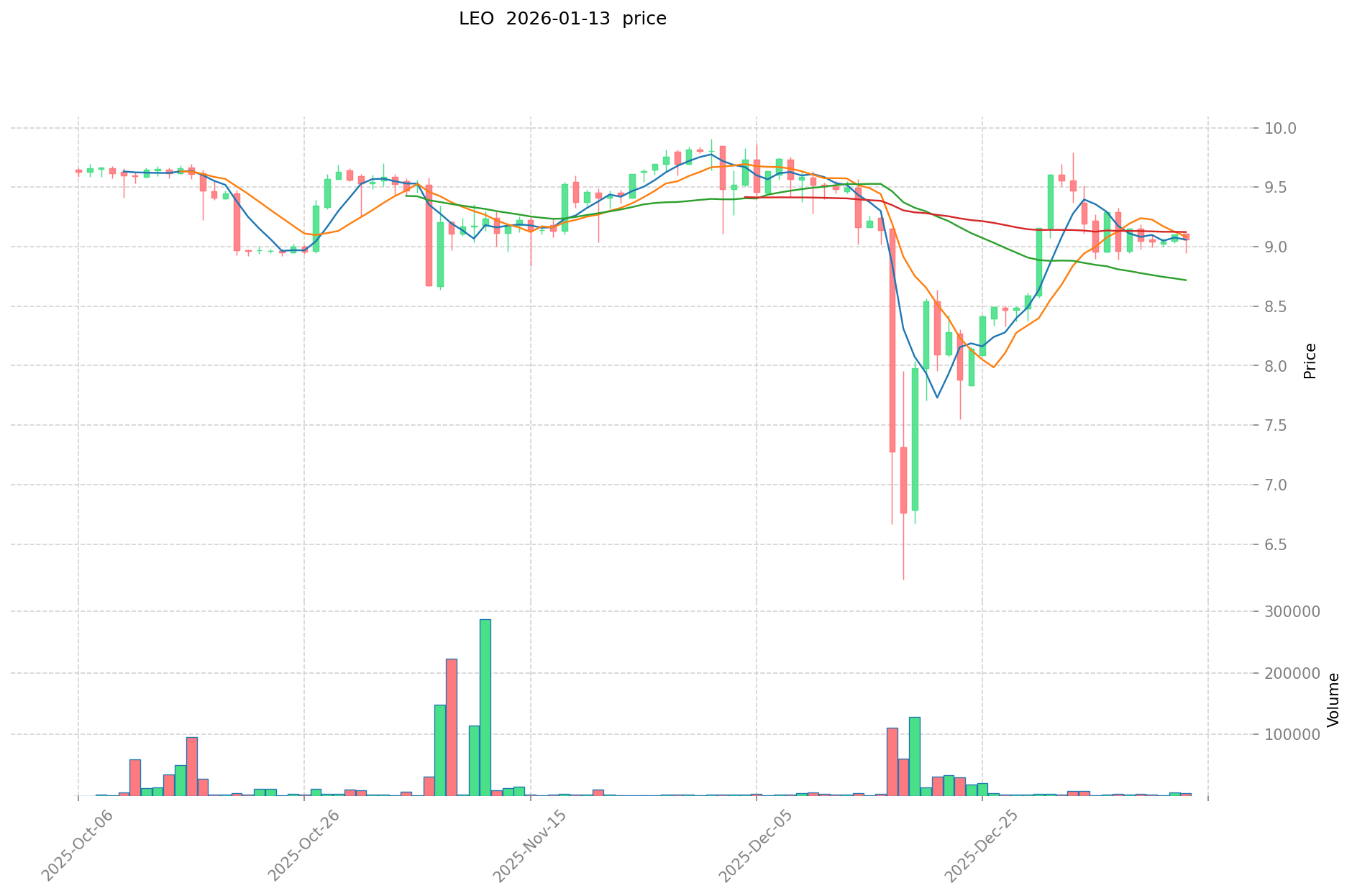
- January 2026: LEO is trading at $9.075, showing a recent decline from previous higher levels while maintaining proximity to the upper price range observed in its trading history.
Current LEO Investment Market Status (January 2026)
- LEO current price: $9.075
- 24-hour trading volume: $19,493.02
- Market capitalization: $8.364 billion
- Circulating supply: 921.69 million LEO (representing 92.17% of total supply)
Click to view real-time LEO market price
II. Core Factors Affecting Whether LEO is a Good Investment (Is UNUS-SED-LEO(LEO) a Good Investment)
Supply Mechanism and Scarcity (LEO investment scarcity)
- Token Burn Mechanism → Impacts Price and Investment Value
LEO implements a continuous deflationary model through monthly token burns backed by Bitfinex revenue. This systematic reduction in circulating supply creates a deflationary pressure that may support price appreciation over time. The token burn mechanism is directly funded by the operational revenue of iFinex and its subsidiaries, establishing a connection between platform performance and token value.
- Investment Significance: Scarcity is a Key Support for Long-term Investment
The deflationary supply model differentiates LEO from many other platform tokens. With a circulating supply of approximately 921.69 million tokens out of a total supply of 985.24 million tokens (representing a circulation ratio of 92.17%), the ongoing burn program progressively reduces available tokens. This scarcity mechanism may serve as a fundamental factor supporting long-term investment value, particularly as Bitfinex continues to generate revenue that fuels the buyback and burn operations.
Institutional Investment and Mainstream Adoption (Institutional investment in LEO)
- Institutional Holding Trends: Limited Public Data
As of January 2026, publicly available data indicates approximately 2,725 token holders. While specific institutional holdings are not widely disclosed, LEO's position as the native utility token of Bitfinex—one of the established cryptocurrency exchanges—suggests adoption primarily within the iFinex ecosystem and among Bitfinex users.
- Platform Adoption → Enhances Investment Value
LEO's utility extends across the iFinex ecosystem, providing holders with immediate benefits including trading fee discounts and access to platform products and services. The token's integration within Bitfinex operations creates a direct use case that may support its investment value, particularly for active traders on the platform.
Macroeconomic Environment's Impact on LEO Investment
- Monetary Policy and Interest Rate Changes → Alter Investment Attractiveness
As with the broader cryptocurrency market, LEO's investment appeal is influenced by global monetary policy shifts. Changes in interest rates can affect capital flows into digital assets. During periods of monetary tightening, risk assets including cryptocurrencies may face headwinds, while accommodative policies might support increased allocation to digital assets.
- Market Performance Context
Observations from various market sources indicate that LEO has demonstrated relative resilience compared to certain segments of the cryptocurrency market during specific periods. However, recent performance data shows the token experienced a price decline, with a 25% decrease noted in late 2024, followed by subsequent recovery patterns in early 2026.
Technology and Ecosystem Development (Technology & Ecosystem for LEO investment)
- Ethereum-Based Infrastructure: Enhanced Network Integration
LEO is deployed on the Ethereum blockchain (contract address: 0x2AF5D2aD76741191D15Dfe7bF6aC92d4Bd912Ca3), benefiting from Ethereum's established security infrastructure and network effects. This positioning within the Ethereum ecosystem provides technical stability and interoperability with decentralized applications.
- Ecosystem Utility → Long-term Value Support
The token's primary utility lies within the iFinex ecosystem, where it functions as a platform token for Bitfinex exchange. LEO holders receive various benefits including reduced trading fees, lending benefits, and withdrawal fee discounts. This utility-based value proposition creates ongoing demand among platform users, potentially supporting long-term investment value through actual usage rather than speculation alone.
- Integration with Trading and Financial Services
LEO's integration within Bitfinex—a platform that has been operational since 2012—connects the token to an established exchange infrastructure. The token's use cases span trading fee reductions and access to platform services, creating a direct relationship between platform activity levels and token utility.
III. LEO Future Investment Forecast and Price Outlook (Is UNUS-SED-LEO(LEO) worth investing in 2026-2031)
Short-term Investment Forecast (2026, short-term LEO investment outlook)
Based on available market analysis, short-term price projections for LEO in 2026 present varied scenarios. Conservative estimates suggest a potential range between $5.07 and $9.06, reflecting baseline market conditions. Neutral forecasts indicate average trading levels around $9.06, aligning with current market positioning. Optimistic scenarios project potential upside toward $13.50, contingent upon favorable market dynamics and sustained platform utility.
Mid-term Investment Outlook (2027-2029, mid-term UNUS-SED-LEO(LEO) investment forecast)
- Market Stage Expectation: The mid-term period may witness gradual price appreciation driven by evolving regulatory frameworks and technological advancements within the iFinex ecosystem.
- Investment Return Forecast:
- 2027: Projected range between $9.70 and $13.20, representing potential growth of approximately 24% from 2026 baseline
- 2028: Anticipated range between $10.04 and $14.07, indicating continued upward trajectory with approximately 34% growth potential
- 2029: Estimated range between $6.84 and $16.58, reflecting increased market volatility and potential growth up to 44%
- Key Catalysts: Token burn mechanisms, institutional participation dynamics, and macroeconomic conditions in the digital asset sector may influence price movements.
Long-term Investment Outlook (Is LEO a good long-term investment?)
- Baseline Scenario: $11.00 - $15.39 (under conditions of steady ecosystem development and moderate market adoption)
- Optimistic Scenario: $14.87 - $17.85 (assuming enhanced platform utility and favorable regulatory environment)
- Risk Scenario: $6.84 - $11.00 (under challenging market conditions or significant regulatory headwinds)
For detailed LEO long-term investment and price forecasts: Price Prediction
2026-01-13 to 2031 Long-term Outlook
- Base Scenario: $11.00 - $15.39 (corresponding to steady progress and gradual mainstream application enhancement)
- Optimistic Scenario: $14.87 - $17.85 (corresponding to large-scale adoption and favorable market environment)
- Transformational Scenario: Above $17.85 (contingent upon breakthrough ecosystem developments and mainstream penetration)
- 2031-12-31 Projected High: $17.85 (based on optimistic development assumptions)
Disclaimer: These projections are derived from historical data analysis and market research materials. Cryptocurrency markets exhibit significant volatility, and actual outcomes may differ materially from forecasts. Price predictions should not be construed as investment advice, and individuals should conduct independent research and risk assessment before making investment decisions.
| Year |
Predicted High Price |
Predicted Average Price |
Predicted Low Price |
Price Change |
| 2026 |
13.4994 |
9.06 |
5.0736 |
0 |
| 2027 |
13.197249 |
11.2797 |
9.700542 |
24 |
| 2028 |
14.074245675 |
12.2384745 |
10.03554909 |
34 |
| 2029 |
16.57701371025 |
13.1563600875 |
6.8413072455 |
44 |
| 2030 |
15.90735498179625 |
14.866686898875 |
11.0013483051675 |
63 |
| 2031 |
17.848944290789325 |
15.387020940335625 |
9.8476934018148 |
69 |
IV. LEO Investment Strategy and Risk Management (How to invest in LEO)
Investment Methodology (LEO investment strategy)
Long-term Holding (HODL LEO): Suitable for Conservative Investors
Long-term holding represents a passive investment approach that may suit investors seeking exposure to the iFinex ecosystem. As LEO serves as the utility token for Bitfinex and related platforms, holders potentially benefit from platform fee discounts and service advantages. This strategy typically involves purchasing LEO tokens and maintaining positions through market cycles, reducing the impact of short-term price fluctuations.
Active Trading: Relying on Technical Analysis and Swing Operations
Active trading strategies involve more frequent position adjustments based on technical indicators and market trends. LEO's 24-hour trading volume of approximately $19,493 suggests a level of market liquidity that may support trading activities. Traders often utilize chart patterns, volume analysis, and momentum indicators to identify entry and exit points. The token's recent price movements show varied performance across different timeframes, with a 1.12% increase over 24 hours and a -2.22% change over 7 days, indicating potential opportunities for swing trading strategies.
Risk Management (Risk management for LEO investment)
Asset Allocation Ratios: Conservative / Aggressive / Professional Investors
- Conservative Investors: May consider allocating a smaller portion (1-5%) of their crypto portfolio to LEO, focusing primarily on established assets with longer track records
- Aggressive Investors: Could allocate a moderate portion (5-15%) to LEO as part of a diversified crypto strategy, balancing platform token exposure with other digital assets
- Professional Investors: May implement dynamic allocation strategies based on market conditions, technical indicators, and ecosystem developments, potentially ranging from 10-25% depending on risk tolerance and portfolio objectives
Risk Hedging Approaches: Multi-asset Portfolio + Risk Mitigation Tools
Diversification across multiple digital assets can help mitigate concentration risk associated with single-token exposure. Investors might consider:
- Combining LEO with other established cryptocurrencies to reduce platform-specific risk
- Utilizing stablecoin allocations to maintain liquidity and reduce overall portfolio volatility
- Implementing stop-loss orders to limit potential downside exposure
- Considering derivatives or hedging instruments where available and appropriate for the investor's sophistication level
Secure Storage: Hot and Cold Wallets + Hardware Wallet Recommendations
Security remains a critical consideration for digital asset storage. LEO tokens, deployed on the Ethereum network as ERC-20 tokens, can be stored using various wallet solutions:
- Cold Wallets (Hardware Wallets): Hardware devices such as Ledger or Trezor provide offline storage, offering enhanced security against online threats. These are generally recommended for long-term holdings and larger amounts
- Hot Wallets: Software wallets and exchange wallets offer convenience for active trading but present higher security risks. These may be suitable for smaller amounts needed for frequent transactions
- Multi-signature Wallets: For institutional or high-net-worth investors, multi-signature solutions can provide additional security layers requiring multiple approvals for transactions
V. LEO Investment Risks and Challenges (Risks of investing in LEO)
Market Risk: High Volatility and Price Manipulation
LEO exhibits price volatility characteristic of digital assets. The token's historical price range spans from approximately $0.80 to $10.14, demonstrating significant price fluctuations. With a current market capitalization of approximately $8.36 billion and ranking at position 19, LEO maintains a notable market presence. However, the 24-hour trading volume of roughly $19,493 relative to market capitalization suggests considerations regarding liquidity depth. Market participants should be aware that cryptocurrency markets can experience rapid price movements influenced by various factors including market sentiment, trading activity, and broader crypto market trends.
Regulatory Risk: Policy Uncertainty Across Different Jurisdictions
The regulatory landscape for digital assets continues to evolve globally, presenting uncertainty for platform tokens like LEO. Different jurisdictions maintain varying approaches to cryptocurrency regulation, which may impact:
- The operational status of exchanges and platforms utilizing LEO
- Token classification and associated compliance requirements
- Cross-border transaction capabilities and restrictions
- Tax treatment and reporting obligations for token holders
Investors should monitor regulatory developments in their respective jurisdictions and consider how policy changes might affect LEO's utility and value proposition within the iFinex ecosystem.
Technical Risk: Network Security Vulnerabilities and Upgrade Failures
As an ERC-20 token on the Ethereum network, LEO inherits both the benefits and risks associated with this infrastructure:
- Smart Contract Vulnerabilities: Potential coding flaws or exploits in the token contract or related systems could pose security risks
- Network Congestion: Ethereum network congestion may result in higher transaction fees and slower processing times
- Upgrade Dependencies: Changes to the underlying Ethereum network or platform infrastructure could require adaptations and potentially introduce compatibility challenges
- Custody Risks: Security incidents affecting exchanges, wallets, or storage solutions could result in loss of access to tokens
VI. Conclusion: Is LEO a Good Investment?
Investment Value Summary: LEO demonstrates characteristics as a utility token within the iFinex ecosystem, with potential value derived from platform usage and services. The token maintains a significant market capitalization and has been operational since May 2019. However, like all digital assets, LEO experiences price volatility and faces multiple risk factors that investors should carefully evaluate.
Investor Recommendations:
✅ Beginners: Consider starting with small allocations through dollar-cost averaging strategies. Prioritize secure storage solutions using reputable hardware wallets. Focus on understanding the token's utility within the iFinex ecosystem before making investment decisions.
✅ Experienced Investors: May explore swing trading opportunities based on technical analysis while maintaining core long-term positions. Consider LEO as part of a diversified crypto portfolio strategy, balancing platform token exposure with other digital assets across different categories and use cases.
✅ Institutional Investors: Could evaluate LEO for strategic allocation within broader digital asset portfolios, considering factors such as ecosystem adoption, platform metrics, and token utility. Implement comprehensive risk management frameworks and custody solutions appropriate for institutional standards.
⚠️ Notice: Cryptocurrency investments carry substantial risks including potential loss of capital. This content is provided for informational purposes only and does not constitute investment advice, financial advice, trading advice, or any other type of advice. Investors should conduct their own research, consider their risk tolerance, and consult with qualified financial advisors before making investment decisions.
VII. FAQ
Q1: What is LEO and what makes it different from other cryptocurrency platform tokens?
LEO (UNUS SED LEO) is the native utility token of the iFinex ecosystem and Bitfinex exchange, launched in May 2019. What distinguishes LEO is its deflationary token burn mechanism funded by Bitfinex revenue, where the platform systematically reduces circulating supply through monthly token burns. This creates scarcity over time, differentiating it from many platform tokens with static or inflationary supply models. Additionally, LEO provides direct utility through trading fee discounts, lending benefits, and withdrawal fee reductions within the iFinex ecosystem, creating tangible use cases beyond speculative value.
Q2: How does the LEO token burn mechanism work and why does it matter for investors?
The LEO token burn mechanism operates through monthly buybacks funded by revenue generated from iFinex and its subsidiaries, including Bitfinex exchange. The platform uses a portion of its operational profits to purchase LEO tokens from the market and permanently remove them from circulation. This creates deflationary pressure that may support price appreciation over time by reducing available supply. For investors, this mechanism establishes a direct connection between platform performance and token value, as stronger revenue generation translates to larger burn amounts and greater supply reduction.
Q3: What are the primary risks associated with investing in LEO?
LEO faces several key risk categories. Market risk involves significant price volatility, with historical trading ranges from approximately $0.80 to $10.14, and relatively modest daily trading volume of around $19,493 compared to its market capitalization. Regulatory risk stems from evolving global cryptocurrency policies that may impact exchange operations and token utility across different jurisdictions. Technical risk includes potential smart contract vulnerabilities as an ERC-20 token on Ethereum, network congestion affecting transaction costs, and custody risks associated with exchange or wallet security incidents. Additionally, LEO's value is closely tied to Bitfinex platform performance and the broader iFinex ecosystem.
Q4: What is the projected price outlook for LEO from 2026 to 2031?
Price projections for LEO vary across different scenarios. For 2026, estimates range from conservative projections of $5.07-$9.06 to optimistic scenarios reaching $13.50. Mid-term forecasts for 2027-2029 suggest potential growth, with 2027 estimates between $9.70-$13.20, 2028 projections of $10.04-$14.07, and 2029 ranges from $6.84-$16.58. Long-term outlook through 2031 presents a base scenario of $11.00-$15.39, an optimistic scenario of $14.87-$17.85, and a risk scenario of $6.84-$11.00. However, cryptocurrency markets exhibit significant volatility, and actual outcomes may differ materially from forecasts based on market conditions, regulatory developments, and ecosystem adoption.
Q5: What investment strategies are most suitable for different types of LEO investors?
Investment strategies should align with risk tolerance and experience levels. Conservative investors may consider allocating 1-5% of their crypto portfolio to LEO through long-term holding strategies, benefiting from platform utility and fee discounts while minimizing short-term volatility exposure. Aggressive investors could allocate 5-15% using active trading approaches based on technical analysis and market momentum, capitalizing on price fluctuations. Professional investors might implement dynamic allocation strategies ranging from 10-25%, adjusting positions based on ecosystem developments, market conditions, and technical indicators. All strategies should incorporate proper risk management including diversification, secure storage using hardware wallets, and appropriate stop-loss mechanisms.
Q6: How does LEO's utility within the Bitfinex ecosystem impact its investment value?
LEO's utility creates direct value through practical benefits for platform users. Token holders receive immediate advantages including reduced trading fees, enhanced lending terms, and lower withdrawal costs on Bitfinex exchange. This utility-based value proposition generates ongoing demand among active traders and platform users, potentially supporting long-term investment value through actual usage rather than speculation alone. The token's integration within an established exchange infrastructure operational since 2012 creates a connection between platform activity levels and token utility, meaning increased trading volume and user engagement on Bitfinex may translate to greater demand for LEO tokens.
Q7: What security measures should investors implement when storing LEO tokens?
Security implementation should match holding size and time horizon. For long-term holdings and larger amounts, hardware wallets such as Ledger or Trezor provide optimal security through offline storage, protecting against online threats and exchange vulnerabilities. As an ERC-20 token on Ethereum, LEO is compatible with most Ethereum-supporting hardware devices. Software wallets and exchange wallets offer convenience for active trading but present higher security risks, making them suitable only for smaller amounts needed for frequent transactions. Institutional or high-net-worth investors should consider multi-signature wallet solutions requiring multiple approvals for transactions, adding additional security layers against unauthorized access.
Q8: How do macroeconomic factors and regulatory changes affect LEO's investment potential?
Macroeconomic conditions significantly influence LEO's investment dynamics. Global monetary policy shifts, particularly interest rate changes, affect capital flows into digital assets—monetary tightening may create headwinds for cryptocurrency investments while accommodative policies might support increased allocation to digital assets. Regulatory developments present both opportunities and challenges, as evolving cryptocurrency policies across different jurisdictions can impact exchange operations, token classification requirements, and cross-border transaction capabilities. The regulatory landscape's effect on Bitfinex's operational status directly influences LEO's utility value proposition, making regulatory monitoring essential for investors assessing long-term investment potential.
* The information is not intended to be and does not constitute financial advice or any other recommendation of any sort offered or endorsed by Gate.