Upcx (UPC) is an ERC20 token focused on financial smart contracts, multi-asset payments, and cross-asset transactions, currently trading at $0.3913 with a $1.62 million market cap. This analysis evaluates whether UPC represents a viable investment by examining its market fundamentals, price history, and risk factors. UPC has experienced significant volatility, declining 86.61% annually while showing extreme price swings from $0.3614 to $5.358, with modest trading volume of $17,316.48 on 5 exchanges including Gate. The article provides comprehensive price forecasts for 2026-2031, ranging from conservative to optimistic scenarios, alongside detailed investment strategies for beginners, experienced, and institutional investors. Key considerations include substantial dilution risk (only 0.53% circulating supply), regulatory uncertainty affecting payment platforms, and technical vulnerabilities. Investor recommendations emphasize cautious positioning with 1-10% portfolio allocation depending on risk tolerance, dol
Introduction: Upcx (UPC) Investment Position and Market Outlook
Upcx (UPC) represents a notable digital asset in the cryptocurrency sector, focusing on financial smart contracts and multi-asset payment solutions. As of February 2, 2026, UPC is trading at approximately $0.3913, with a market capitalization of around $1.62 million and a circulating supply of approximately 4.15 million tokens. The project positions itself as a platform enabling the development of financial smart contracts, issuance of fungible and non-fungible tokens, and facilitation of cross-asset transactions through its decentralized infrastructure.
UPC operates as an ERC20 token with a total supply of 780 million tokens, of which roughly 0.53% is currently in circulation. The asset is listed on 5 exchanges and maintains a holder base of approximately 38,930 addresses. The platform's core functionality includes scheduled payments, recurring payments, automatic withdrawals, non-custodial escrow services, and multi-signature permission payments, targeting business operators requiring diverse payment scenarios.
Recent price trends indicate notable volatility: UPC experienced a 3.62% increase over 24 hours, a 1.45% gain over 7 days, but faced a decline of approximately 39.98% over 30 days and a significant decrease over the past year. The token's price history shows a range between $0.3614 and $5.358 since its launch in November 2023. Currently ranking at position 2176 in the cryptocurrency market with a 0.011% market dominance, UPC presents a case study in emerging digital asset investment considerations.
This analysis examines UPC's investment characteristics, historical performance patterns, potential price trajectory factors, and associated risk elements to provide factual reference material for those evaluating the question "Is Upcx (UPC) a good investment?" within the broader context of cryptocurrency market dynamics.
I. Upcx (UPC) Price History Review and Investment Value Status
- 2025: UPC's market capitalization reached $6.15 million with a circulating supply of approximately 4.15 million tokens → The asset demonstrated its role in financial smart contracts and asset tokenization, though investors experienced significant volatility throughout the year.
- March 2025: UPC reached a notable price level of $5.358 → This represented a period of elevated market interest, reflecting investor attention to the project's capabilities in enabling financial smart contracts and decentralized asset trading.
- January 2026: Market correction brought prices to $0.3614 → UPC experienced downward pressure, with the token trading near lower price ranges as broader market conditions shifted.
Current UPC Investment Market Status (February 2026)
- Current UPC price: $0.3913
- 24-hour trading volume: $17,316.48
- 24-hour price change: +3.62%
- 7-day price change: +1.45%
- 30-day price change: -39.98%
- 1-year price change: -86.61%
- Circulating supply: 4,148,712.80 UPC
- Market capitalization: $1.62 million
- Total supply: 780,000,000 UPC
- Fully diluted market cap: $305.21 million
- Number of holders: 38,930
- Trading on 5 exchanges
Click to view real-time UPC market price
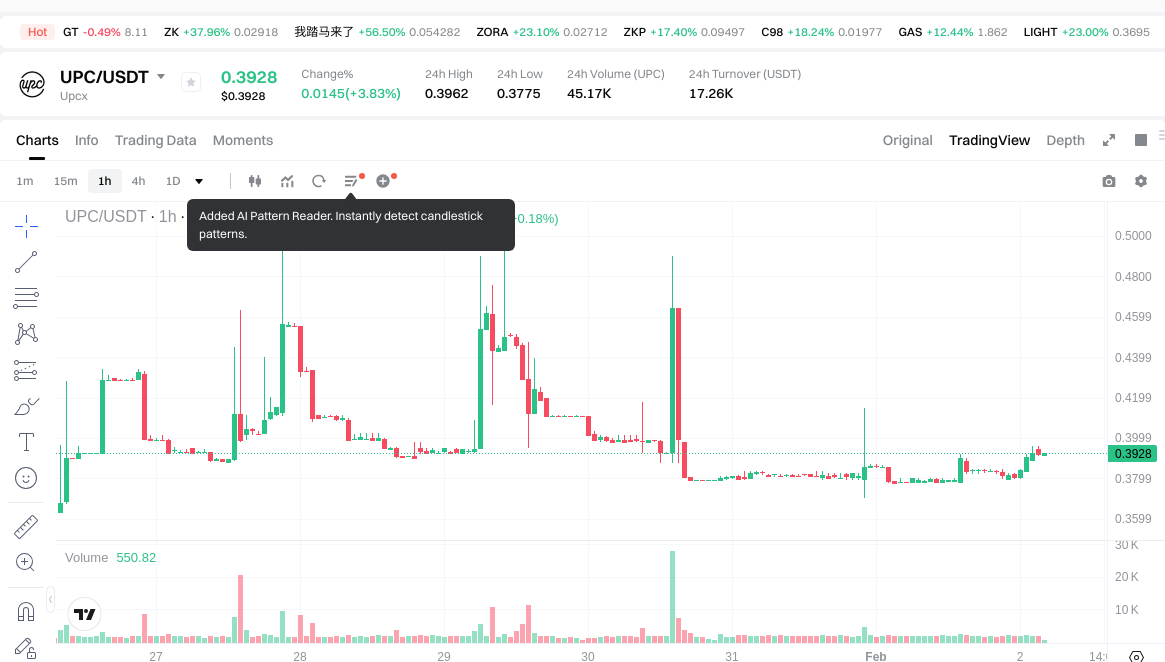
II. Core Factors Influencing Whether UPC is a Good Investment (Is Upcx(UPC) a Good Investment)
Supply Mechanism and Scarcity (UPC investment scarcity)
- Total Supply and Circulation → Impact on Price and Investment Value
- UPCX has a maximum supply of 780,000,000 UPC tokens, with a circulating supply of approximately 4,148,712.80 tokens as of February 02, 2026, representing about 0.53% of the total supply. This relatively low circulation ratio may contribute to potential scarcity dynamics in the market.
- The token operates on an ERC20 standard, which facilitates liquidity across Ethereum-compatible platforms. The limited current circulation compared to maximum supply suggests that future token releases could influence price dynamics.
- Investment Implication: The significant gap between circulating supply and maximum supply indicates that investors should monitor token unlock schedules and distribution plans, as these factors may affect long-term scarcity and valuation.
Institutional Investment and Mainstream Adoption (Institutional investment in UPC)
- Holder Base Expansion: As of the latest data, UPCX has approximately 38,930 token holders, indicating a growing community base. The token is listed on 5 exchanges, with Gate.com being a primary trading venue.
- Trading Activity: The 24-hour trading volume stands at $17,316.48, reflecting moderate market activity for a token ranked at position 2176 by market capitalization.
- Ecosystem Utilization: UPCX's design focuses on financial smart contracts, payment solutions, and cross-asset transactions through its decentralized exchange (DEX). The platform supports User Issued Assets (UIA) and Non-Fungible Assets (NFA), as well as stablecoin issuance pegged to real-world assets.
Macroeconomic Environment Impact on UPC Investment
- Market Volatility Context: UPC experienced substantial price fluctuations, with a 1-year price change of -86.61%, declining from higher levels to $0.3913 as of February 02, 2026. The 30-day performance shows a -39.98% decline, indicating sensitivity to broader market conditions.
- Price Range History: The token reached a notable price level of $5.358 on March 24, 2025, and touched a lower point of $0.3614 on January 25, 2026, demonstrating significant volatility within a relatively short timeframe.
- Market Sentiment: Current technical indicators and market analysis suggest mixed predictions for 2026, with some forecasts indicating bearish trends while others project potential recovery scenarios.
Technology and Ecosystem Development (Technology & Ecosystem for UPC investment)
- Financial Smart Contract Capabilities: UPCX enables development of various payment mechanisms including scheduled payments, recurring payments, automatic withdrawals with permission, non-custodial escrow, and multi-signature permission payments. These features position the platform for practical business applications.
- Asset Management Infrastructure: The platform supports creation and issuance of fungible and non-fungible tokens, along with stablecoin issuance through price oracles that connect to real-world asset prices including fiat currencies and commodities.
- Cross-Asset Transaction Support: UPCX is designed to facilitate transactions where senders and receivers use different assets, with integrated DEX functionality for asset trading. The UPCX software wallet enables payment and transfer capabilities across all platform assets.
- Development Activity: The project maintains a GitHub presence (https://github.com/UPCX-TEAM-B) and has published a whitepaper (https://upcx.io/whitepaper/), providing technical documentation for review by potential investors and developers.
III. UPC Future Investment Forecast and Price Outlook (Is Upcx(UPC) worth investing in 2026-2031)
Short-term Investment Forecast (2026, short-term UPC investment outlook)
- Conservative forecast: $0.2475 - $0.3928
- Neutral forecast: $0.3928
- Optimistic forecast: $0.3928 - $0.4596
Mid-term Investment Outlook (2027-2029, mid-term Upcx(UPC) investment forecast)
-
Market stage expectation: The token may enter a gradual recovery phase following its recent decline, with potential for stabilization as the platform's financial smart contract capabilities and cross-asset transaction features gain recognition in the decentralized finance space.
-
Investment return forecast:
- 2027: $0.2600 - $0.5029
- 2028: $0.4460 - $0.5296
- 2029: $0.4722 - $0.6810
-
Key catalysts: Expansion of user-issued assets (UIA) and non-fungible assets (NFA) creation on the platform, adoption of UPCX's decentralized exchange (DEX), implementation of financial smart contracts for scheduled payments and multi-signature transactions, and potential partnerships in the payment and remittance sectors.
Long-term Investment Outlook (Is UPC a good long-term investment?)
-
Base scenario: $0.4300 - $0.7716 (assuming steady development of the UPCX ecosystem and moderate adoption of its payment infrastructure and stablecoin issuance capabilities)
-
Optimistic scenario: $0.5890 - $0.9456 (assuming increased adoption of UPCX's cross-asset transaction technology, successful integration with real-world asset trading, and expansion of its non-custodial escrow and automatic withdrawal features)
-
Risk scenario: $0.2475 - $0.4150 (under conditions of limited market penetration, competitive pressure from established payment platforms, or regulatory challenges affecting decentralized financial services)
For detailed UPC long-term investment and price predictions: Price Prediction
2026-2031 Long-term Outlook
-
Base scenario: $0.3928 - $0.6810 (corresponding to steady progress and gradual increase in mainstream application adoption)
-
Optimistic scenario: $0.5890 - $0.9456 (corresponding to large-scale adoption and favorable market conditions)
-
Transformative scenario: Above $0.9456 (if the ecosystem achieves breakthrough developments and mainstream popularization)
-
2031-12-31 predicted high: $0.9456 (based on optimistic development assumptions)
Disclaimer: The above forecasts are for reference only and do not constitute investment advice. Cryptocurrency markets are highly volatile and unpredictable. Past performance does not guarantee future results. Investors should conduct their own research and consider their risk tolerance before making any investment decisions.
| Year |
Predicted High Price |
Predicted Average Price |
Predicted Low Price |
Price Change |
| 2026 |
0.459576 |
0.3928 |
0.247464 |
0 |
| 2027 |
0.50290184 |
0.426188 |
0.25997468 |
8 |
| 2028 |
0.5295812088 |
0.46454492 |
0.4459631232 |
18 |
| 2029 |
0.680976398228 |
0.4970630644 |
0.47220991118 |
27 |
| 2030 |
0.77161584802134 |
0.589019731314 |
0.42998440385922 |
50 |
| 2031 |
0.945641727638061 |
0.68031778966767 |
0.414993851697278 |
73 |
IV. Upcx Investment Strategy and Risk Management (How to invest in UPC)
Investment Methodology (UPC investment strategy)
Risk Management (Risk management for UPC investment)
-
Asset Allocation Ratio: Conservative / Aggressive / Professional investors
- Conservative: Consider allocating 1-3% of crypto portfolio to UPC
- Aggressive: May allocate 5-10% depending on risk tolerance
- Professional: Strategic allocation based on comprehensive market analysis
-
Risk Hedging Solutions: Multi-asset portfolio + hedging tools
- Diversify across different blockchain projects and asset classes
- Consider stablecoin positions to manage exposure during volatile periods
-
Secure Storage: Hot/cold wallets + hardware wallet recommendations
- UPC operates on the Ethereum network (ERC20 standard)
- Recommended storage options include hardware wallets compatible with Ethereum-based tokens
- Contract address: 0x487d62468282bd04ddf976631c23128a425555ee
V. Upcx Investment Risks and Challenges (Risks of investing in UPC)
-
Market Risk: High volatility and price manipulation concerns
- The token has experienced substantial price fluctuations, including a 1-year decline of -86.61%
- With relatively modest trading volume and market capitalization of approximately $1.62 million, the token may be susceptible to significant price movements
- Market cap to fully diluted valuation ratio of 0.53% indicates substantial dilution potential
-
Regulatory Risk: Policy uncertainty across different jurisdictions
- As a platform facilitating financial smart contracts and asset tokenization, regulatory developments in digital securities and payment systems may impact the project
- Stablecoin issuance features may face evolving regulatory scrutiny
-
Technical Risk: Network security vulnerabilities and upgrade failures
- Dependency on Ethereum network security and performance
- Smart contract risks inherent in DeFi and payment applications
- Development and maintenance risks associated with the UPCX ecosystem
VI. Conclusion: Is UPC a Good Investment?
-
Investment Value Summary: UPC presents a project focused on financial smart contracts, cross-asset transactions, and real-world asset integration. However, the token has demonstrated considerable price volatility with significant declines over the past year.
-
Investor Recommendations:
-
✅ Beginners: Consider dollar-cost averaging + secure wallet storage
- Start with small positions to understand market behavior
- Utilize hardware wallets for long-term storage
-
✅ Experienced Investors: Swing trading + portfolio diversification
- Monitor technical indicators and market sentiment
- Maintain disciplined position sizing
-
✅ Institutional Investors: Strategic long-term allocation considerations
- Conduct thorough due diligence on project fundamentals
- Assess liquidity constraints given current market metrics
⚠️ Disclaimer: Cryptocurrency investment carries substantial risk. This content is for informational purposes only and does not constitute investment advice. The market for UPC has shown significant volatility, and investors should conduct their own research and consider their risk tolerance before making investment decisions.
VII. FAQ
Q1: What is Upcx (UPC) and what makes it different from other cryptocurrencies?
Upcx (UPC) is an ERC20 token designed for financial smart contracts and multi-asset payment solutions, enabling scheduled payments, recurring payments, automatic withdrawals, non-custodial escrow services, and cross-asset transactions. Unlike many cryptocurrencies focused solely on value transfer, UPC differentiates itself through its comprehensive financial infrastructure that supports User Issued Assets (UIA), Non-Fungible Assets (NFA), and stablecoin issuance pegged to real-world assets. The platform's integrated decentralized exchange (DEX) allows users to conduct transactions where senders and receivers utilize different assets, positioning it as a practical solution for business operators requiring diverse payment scenarios rather than just a speculative digital asset.
Q2: Has UPC been a profitable investment historically?
No, UPC has not demonstrated strong historical performance for most investors. The token has experienced significant volatility and declining value over the past year, with a 1-year price change of -86.61%, dropping from a high of $5.358 in March 2025 to approximately $0.3913 as of February 2026. The 30-day performance shows a -39.98% decline, indicating sustained downward pressure. While the token showed modest short-term gains of +3.62% in 24 hours and +1.45% over 7 days, these minor recoveries do not offset the substantial long-term losses. Investors who purchased during the 2025 peak period have experienced considerable capital erosion, highlighting the asset's significant risk profile.
Q3: What are the main risks associated with investing in UPC?
The primary risks include substantial market volatility, as evidenced by the token's 86.61% annual decline and price swings between $0.3614 and $5.358. With a relatively modest market capitalization of approximately $1.62 million and daily trading volume of around $17,316, UPC faces liquidity constraints that can amplify price movements. The token's circulating supply represents only 0.53% of its total supply, creating potential dilution risk as additional tokens enter circulation. Regulatory uncertainty affects the project's financial smart contract and stablecoin issuance features, which may face evolving legal scrutiny. Technical risks include dependency on Ethereum network security, smart contract vulnerabilities inherent in DeFi applications, and execution risks associated with the UPCX ecosystem's development and maintenance.
Q4: What is the realistic price outlook for UPC through 2026-2031?
Price forecasts for UPC suggest moderate recovery potential but remain conservative relative to historical peaks. For 2026, projections range from a conservative $0.2475-$0.3928 to an optimistic $0.3928-$0.4596, with neutral forecasts around $0.3928. Mid-term outlooks project 2027 at $0.2600-$0.5029, 2028 at $0.4460-$0.5296, and 2029 at $0.4722-$0.6810. Long-term scenarios through 2031 range from a base case of $0.4300-$0.7716 to an optimistic scenario of $0.5890-$0.9456, with a predicted 2031 high of $0.9456. These forecasts assume steady ecosystem development and gradual adoption, but remain well below the March 2025 peak of $5.358, suggesting limited expectations for near-term recovery to previous highs.
Q5: How should different types of investors approach UPC?
Conservative investors should consider allocating only 1-3% of their cryptocurrency portfolio to UPC and employ dollar-cost averaging strategies to manage volatility exposure, utilizing hardware wallets for secure long-term storage. Aggressive investors with higher risk tolerance may allocate 5-10% of their crypto portfolio, focusing on swing trading opportunities created by the token's price volatility while maintaining disciplined position sizing. Professional investors should conduct comprehensive due diligence on the project's fundamentals, assess liquidity constraints given the modest $17,316 daily trading volume, and carefully evaluate the token's real-world adoption potential for financial smart contracts. All investor types should diversify across different blockchain projects, maintain stablecoin positions for hedging, and recognize that UPC's historical performance indicates substantial downside risk.
Q6: What factors could drive UPC's value in the future?
Future value drivers for UPC depend primarily on ecosystem adoption and practical utility implementation. Key catalysts include expansion of User Issued Assets (UIA) and Non-Fungible Assets (NFA) creation on the platform, increased utilization of UPCX's decentralized exchange for cross-asset transactions, and successful implementation of financial smart contract features for business payment scenarios. The platform's stablecoin issuance capabilities linked to real-world assets could attract users seeking asset-backed digital currencies. Potential partnerships in payment processing and remittance sectors may enhance practical adoption. However, these positive scenarios face challenges from established payment platforms, limited current market penetration (38,930 holders across 5 exchanges), and the need to demonstrate tangible real-world use cases beyond speculative trading.
Q7: Is UPC suitable for beginners in cryptocurrency investment?
UPC presents significant challenges for beginners due to its high volatility, substantial historical losses, and relatively low liquidity compared to established cryptocurrencies. The token's 86.61% annual decline and dramatic price swings indicate elevated risk that may exceed typical beginner risk tolerance. However, beginners interested in UPC should start with minimal position sizes representing no more than 1-2% of their overall investment portfolio, employ dollar-cost averaging to mitigate timing risk, and prioritize secure storage through hardware wallets compatible with ERC20 tokens. New investors must understand that UPC operates in the specialized niche of financial smart contracts and payment infrastructure rather than functioning as a straightforward store of value, requiring additional research to comprehend the project's technical fundamentals and market positioning.
Q8: Where can I trade UPC and how liquid is the market?
UPC is currently listed on 5 cryptocurrency exchanges, with Gate.com serving as one of the primary trading venues. The token maintains relatively modest liquidity with a 24-hour trading volume of approximately $17,316.48 as of February 2026. This limited trading volume compared to major cryptocurrencies means investors may experience slippage during larger trades and potentially wider bid-ask spreads. The token's market capitalization of $1.62 million and ranking at position 2176 indicate a smaller market presence that can contribute to price volatility during periods of increased buying or selling pressure. Investors should be prepared for potential liquidity constraints, particularly when attempting to execute larger position entries or exits, and may need to split orders or accept less favorable pricing during market transactions.
* The information is not intended to be and does not constitute financial advice or any other recommendation of any sort offered or endorsed by Gate.