This comprehensive analysis examines USD Coin (USDC) as an investment asset, evaluating its stability, market position, and suitability for different investor types in 2024-2026. With a market capitalization of $74.34 billion and deployment across 17 blockchain networks, USDC functions primarily as a value preservation tool rather than a growth investment, maintaining its dollar peg through full collateralization and institutional-grade transparency. The article explores USDC's price history including the March 2023 depegging event, current market status, and institutional adoption patterns showing $18.3 trillion transaction volume in 2025. Key investment considerations include supply mechanisms, macroeconomic factors, and multi-chain ecosystem development, while risk management strategies address regulatory compliance, counterparty dependencies, and technical vulnerabilities. The outlook maintains price stability between $0.995-$1.005 through 2031, supported by growing DeFi integration and institutional acce
Introduction: USD Coin (USDC) Investment Position and Market Outlook
USD Coin (USDC) represents a significant asset in the cryptocurrency sector, launched in September 2018 as a fully collateralized stablecoin pegged to the US dollar. As of January 13, 2026, USDC maintains a market capitalization of approximately $74.34 billion with a circulating supply of 74.34 billion tokens, currently trading at $1. Ranking 7th in the cryptocurrency market with a 2.28% market dominance, USDC has established itself as a major stablecoin operating within the framework of US monetary circulation laws.
Developed as Centre's first open-source stablecoin project, USDC distinguishes itself through detailed financial and operational transparency, collaborating with multiple banking institutions and audit teams. The token demonstrates broad ecosystem adoption, with contract deployments across 17 blockchain networks including Ethereum (ETH), Solana (SOL), Arbitrum (ARBEVM), Base (BASEEVM), Polygon (MATIC), and others, reflecting its multi-chain infrastructure approach.
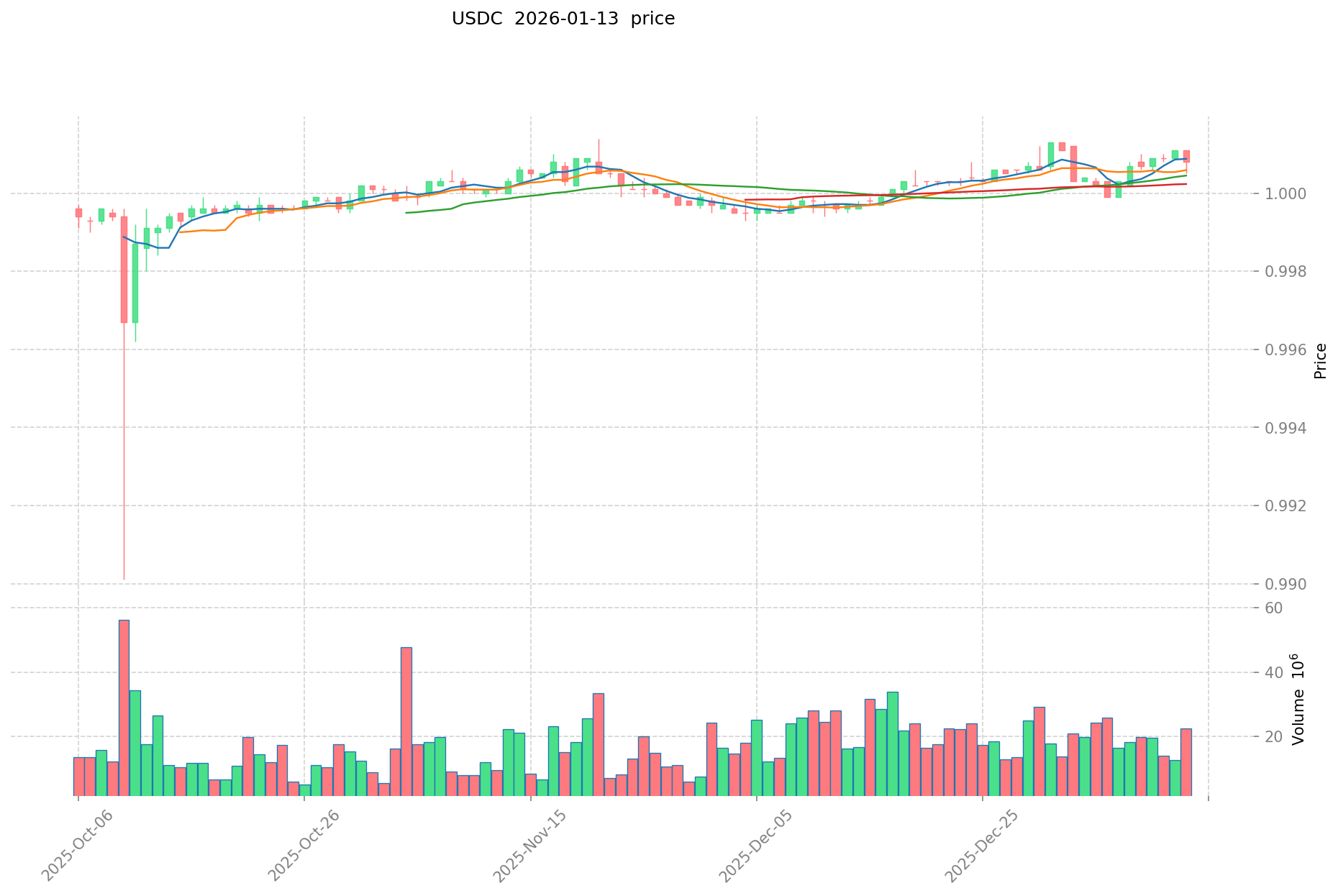
With over 5.84 million holders and trading availability on 66 exchanges, USDC has shown relatively stable price performance. Recent data indicates minor fluctuations: 0.01% increase over 1 hour, -0.03% over 24 hours, 0.09% over 7 days, 0.11% over 30 days, and 0.03% over the past year. The historical price range extends from $0.877647 (recorded in March 2023) to $1.17 (recorded in May 2019), demonstrating the typical volatility patterns associated with algorithmic stablecoin mechanisms.
When evaluating "Is USD Coin (USDC) a good investment?", market participants examine its role in digital asset trading, decentralized finance (DeFi) applications, and cross-border payment solutions. This analysis provides a comprehensive examination of USDC's investment characteristics, historical performance trends, future price projections, and associated risk factors to inform investor decision-making.
I. USDCoin (USDC) Price History Review and Current Investment Value
USDC Historical Price Trends and Investment Returns
-
2018: USDC launched in September 2018 as a fully-collateralized stablecoin pegged to the US dollar at a 1:1 ratio. Since inception, it maintained price stability near $1.00, serving primarily as a trading and settlement tool rather than a speculative investment asset.
-
2020-2021: During the DeFi Summer period, USDC experienced significant circulation growth, expanding from approximately $400 million to several billion dollars. The token maintained its peg stability while becoming integrated across multiple blockchain networks including Ethereum and Solana, enhancing its utility in decentralized finance protocols.
-
2022: USDC circulation reached approximately $55-56 billion by mid-2022 during market expansion, though it briefly experienced minor volatility dropping to $0.97 during May market turbulence before quickly recovering its $1.00 peg.
-
2023: In March 2023, USDC faced a significant de-pegging event when Circle disclosed $3.3 billion in reserves held at Silicon Valley Bank following its sudden collapse. The token temporarily dropped to $0.88 before regulatory intervention and Circle's reassurance restored confidence, with USDC recovering to $1.00 within days. Following this incident, circulation declined from approximately $40 billion to around $30 billion as some users shifted to alternative stablecoins.
-
2024-2025: USDC circulation recovered to over $60 billion by early 2025, supported by improved regulatory clarity expectations and Circle's public listing on the NYSE in June 2025. The stablecoin maintained its peg stability throughout this period, with typical daily price fluctuations remaining within $0.9995 to $1.0010.
Current USDC Investment Market Status (January 2026)
- Current USDC Price: $1.00 (with 24-hour range between $1.0005 and $1.0011)
- Market Sentiment: USDC functions as a stability-focused asset rather than a speculative investment; its role centers on payment settlement, cross-border transfers, and DeFi collateral rather than price appreciation
- 24-Hour Trading Volume: Approximately $23.97 million reported on January 13, 2026
- Total Market Capitalization: Approximately $74.34 billion with circulating supply of 74.34 billion USDC tokens
- Institutional Adoption: Circle maintains reserves primarily in short-term US Treasury securities and cash equivalents, with monthly attestations from major accounting firms; major exchanges including Coinbase, Binance, and traditional financial institutions increasingly integrate USDC for settlement purposes
Click to view real-time USDC market price
II. Core Factors Influencing Whether USDC is a Good Investment
Supply Mechanism and Scarcity (USDC Investment Scarcity)
- USDC operates under a reserve-backed supply mechanism where each token is backed 1:1 by cash and cash equivalents held in reserve, with independently verified attestations
- Unlike traditional cryptocurrencies with finite supplies, USDC's circulating supply adjusts based on demand, with approximately 74.34 billion tokens in circulation as of January 2026
- The stability mechanism maintains price parity with the U.S. dollar around $1.00, which limits price appreciation potential but provides predictable value preservation
- Investment consideration: USDC's value proposition centers on stability rather than scarcity-driven appreciation, differentiating it from speculative crypto assets
Institutional Investment and Mainstream Adoption (Institutional Investment in USDC)
- USDC has established significant institutional presence, with DeFi users showing preference for the stablecoin when moving in and out of positions, according to data from Artemis Analytics
- Transaction volume reached $18.3 trillion in 2025, representing notable growth in institutional and retail usage
- USDC holds approximately $76 billion market capitalization, positioning it as the second-largest stablecoin
- Regulatory compliance framework: USDC operates within U.S. monetary circulation regulations and maintains partnerships with multiple banking institutions and audit teams
- Transparency initiatives include detailed financial and operational disclosure, contributing to institutional confidence
Macroeconomic Environment's Impact on USDC Investment
- As a dollar-pegged stablecoin, USDC reflects U.S. dollar dynamics rather than serving as a traditional inflation hedge
- Monetary policy considerations: interest rate changes affect the opportunity cost of holding stablecoins versus interest-bearing instruments
- Geopolitical uncertainty scenarios: USDC may serve as a stable digital asset option during market volatility, though its dollar peg means it shares characteristics with traditional dollar holdings
- Stablecoin market expansion context: global stablecoin transaction values increased 72% in 2025, reaching $33 trillion, indicating growing acceptance of digital dollar alternatives
Technology and Ecosystem Development (Technology & Ecosystem for USDC Investment)
- Multi-chain deployment: USDC maintains presence across multiple blockchain networks including Ethereum, Solana, Arbitrum, Base, Polygon, Avalanche, and others, enhancing accessibility and utility
- DeFi integration: widespread adoption in decentralized finance protocols, with some platforms offering yield opportunities
- Payment infrastructure: USDC functions in both DeFi trading scenarios and business transaction contexts
- Centre consortium framework: operates as an open-source project providing foundation for stablecoin infrastructure
- Technical considerations: smart contract implementations vary across chains, with verified contract addresses available on major blockchain explorers
III. USDC Future Investment Prediction and Price Outlook (Is USDCoin(USDC) worth investing in 2026-2030)
Short-term Investment Prediction (2026, short-term USDC investment outlook)
As a USD-pegged stablecoin, USDC is designed to maintain price stability around $1.00. Short-term price fluctuations are typically minimal.
- Conservative prediction: $0.998 - $1.002
- Neutral prediction: $0.999 - $1.001
- Optimistic prediction: $0.999 - $1.001
Mid-term Investment Outlook (2027-2029, mid-term USDCoin(USDC) investment forecast)
- Market stage expectation: USDC is expected to maintain its position as a leading USD-backed stablecoin, with stable circulation and continued adoption across DeFi platforms and payment systems.
- Investment return prediction:
- 2027: $0.998 - $1.002
- 2029: $0.998 - $1.002
- Key catalysts: Regulatory clarity in major markets, expansion of institutional adoption, and integration with traditional financial infrastructure.
Long-term Investment Outlook (Is USDC a good long-term investment?)
As a stablecoin, USDC's primary function is to serve as a stable medium of exchange and store of value rather than appreciate significantly in price. Long-term value is derived from its utility and stability rather than price appreciation.
- Baseline scenario: $0.995 - $1.005 (assuming continued regulatory compliance and reserve backing)
- Optimistic scenario: $0.998 - $1.002 (with enhanced transparency and expanded use cases)
- Risk scenario: Temporary deviation from peg during extreme market stress
Click to view USDC long-term investment and price prediction: Price Prediction
2026-01-13 - 2031 Long-term Outlook
- Base scenario: $0.995 - $1.005 (corresponding to stable reserve backing and consistent regulatory compliance)
- Optimistic scenario: $0.998 - $1.002 (corresponding to increased institutional adoption and enhanced market infrastructure)
- Transformative scenario: Maintains peg stability while expanding utility across multiple blockchain ecosystems
- 2031-12-31 predicted range: $0.995 - $1.005 (based on continued stability assumptions)
Disclaimer: This analysis is for informational purposes only and does not constitute investment advice. Cryptocurrency investments carry inherent risks, and past performance does not guarantee future results. Investors should conduct their own research and consider their risk tolerance before making investment decisions.
| Year |
Predicted High Price |
Predicted Average Price |
Predicted Low Price |
Price Change |
| 2026 |
1 |
1 |
1 |
0 |
| 2027 |
1 |
1 |
1 |
0 |
| 2028 |
1 |
1 |
1 |
0 |
| 2029 |
1 |
1 |
1 |
0 |
| 2030 |
1 |
1 |
1 |
0 |
| 2031 |
1 |
1 |
1 |
0 |
IV. USDC Investment Strategy and Risk Management (How to invest in Stablecoins)
Investment Methodology (USDC investment strategy)
-
Long-term Holding (HODL USDC): Suitable for conservative investors seeking stable value preservation. As a fully-collateralized stablecoin pegged to the US dollar, USDC provides financial transparency and operates within the US monetary framework, making it appropriate for those prioritizing capital stability over growth.
-
Active Trading: While USDC maintains price stability around $1, investors may utilize it as a base currency for cryptocurrency trading, liquidity provision in DeFi protocols, or yield-generating strategies through staking and lending platforms.
Risk Management (Risk management for USDC investment)
-
Asset Allocation Ratio:
- Conservative investors: May allocate significant portions to stablecoins like USDC for capital preservation
- Aggressive investors: Use USDC as a temporary parking position during market volatility
- Professional investors: Employ USDC for liquidity management and strategic rebalancing
-
Risk Hedging Solutions: Diversify across multiple stablecoins and maintain exposure to other asset classes. Consider regulatory-compliant platforms and monitor reserve transparency reports.
-
Secure Storage: Cold wallet storage for large holdings, hot wallets for active trading. Hardware wallet solutions include Ledger and Trezor devices that support ERC-20 tokens and other blockchain standards where USDC is deployed.
V. USDC Investment Risks and Challenges (Risks of investing in Stablecoins)
-
Market Risk: While USDC maintains relative price stability, historical data shows price fluctuations with a recorded high of $1.17 and low of $0.877647. Depeg events, though rare, can occur during market stress periods.
-
Regulatory Risk: Operating under US monetary circulation laws, USDC faces ongoing regulatory scrutiny. Policy changes across different jurisdictions may impact accessibility, usage, and operational framework.
-
Technical Risk: Smart contract vulnerabilities across multiple blockchain deployments (ETH, BSC, Arbitrum, Polygon, Solana, and others), potential security breaches at partner banking institutions, and risks associated with the Centre consortium's operational framework.
-
Counterparty Risk: Dependence on Circle's financial health, banking partner stability, and audit team reliability for maintaining full collateralization.
VI. Conclusion: Is Stablecoin a Good Investment?
-
Investment Value Summary: USDC serves primarily as a value preservation tool rather than a growth investment. With a market capitalization exceeding $74 billion and deployment across 17+ blockchain networks, it functions as a critical infrastructure component in the digital asset ecosystem. The token demonstrates utility for capital preservation, transaction facilitation, and DeFi participation.
-
Investor Recommendations:
✅ Beginners: Utilize USDC for learning cryptocurrency operations, maintaining stable value during portfolio rebalancing, and reducing exposure to volatile assets. Store in reputable wallet solutions with proper security practices.
✅ Experienced Investors: Leverage USDC for strategic liquidity management, DeFi yield optimization, and tactical trading positions. Monitor regulatory developments and reserve attestation reports.
✅ Institutional Investors: Consider USDC for treasury management, payment settlement, and strategic dollar-denominated positioning within digital asset portfolios. Evaluate regulatory compliance requirements and custody solutions.
⚠️ Disclaimer: Cryptocurrency investments carry inherent risks. This content is for informational purposes only and does not constitute investment advice. Conduct thorough due diligence and consider consulting financial professionals before making investment decisions.
VII. FAQ
Q1: Is USDC a good investment for wealth appreciation?
No, USDC is not designed for wealth appreciation. As a stablecoin pegged 1:1 to the US dollar, USDC maintains price stability around $1.00 rather than offering capital growth opportunities. Its primary function serves as a stable medium of exchange, value preservation tool, and liquidity management asset within the cryptocurrency ecosystem. Historical data shows USDC trading between $0.877647 and $1.17, with typical daily fluctuations remaining within $0.9995 to $1.0010. Investors seeking appreciation should consider alternative assets, while those prioritizing stability may find USDC suitable for capital preservation, DeFi participation, and reducing portfolio volatility.
Q2: What risks should investors consider when holding USDC?
The primary risks include: (I) Depeg events - as demonstrated in March 2023 when USDC temporarily dropped to $0.88 following Silicon Valley Bank's collapse before recovering; (II) Regulatory risk - operating under US monetary laws means policy changes may impact accessibility and operations; (III) Counterparty risk - dependence on Circle's financial health, banking partner stability, and reserve backing integrity; (IV) Technical risk - smart contract vulnerabilities across 17+ blockchain deployments and potential security breaches. While USDC maintains relatively high transparency with monthly attestations and reserve backing primarily in short-term US Treasury securities, investors should diversify across multiple stablecoins and monitor regulatory developments regularly.
Q3: How does USDC differ from other stablecoins like USDT?
USDC distinguishes itself through enhanced transparency and regulatory compliance. As Centre's open-source stablecoin project, USDC provides detailed financial disclosures with monthly attestations from major accounting firms and maintains reserves primarily in short-term US Treasury securities and cash equivalents. With approximately $74.34 billion market capitalization and deployment across 17 blockchain networks, USDC operates within US monetary circulation laws and has established partnerships with multiple banking institutions. Unlike some competitors, USDC emphasizes institutional-grade compliance, making it preferred among DeFi users and institutional investors. However, this regulatory-compliant approach may also introduce jurisdiction-specific restrictions compared to alternatives operating with different frameworks.
Q4: Can investors earn yield on USDC holdings?
Yes, investors can generate returns on USDC through several mechanisms: (I) DeFi lending platforms - supplying USDC as liquidity to protocols like Aave, Compound, or similar platforms; (II) Liquidity provision - participating in automated market maker (AMM) pools on decentralized exchanges; (III) Staking programs - certain platforms offer staking rewards for USDC deposits; (IV) Centralized exchange products - some exchanges provide interest-bearing accounts for USDC holdings. However, yield opportunities carry additional risks including smart contract vulnerabilities, platform insolvency, and regulatory uncertainty. Investors should carefully evaluate platform security, assess counterparty risks, and understand that yield rates fluctuate based on market conditions and demand for borrowing stablecoins.
Q5: What is the outlook for USDC adoption through 2030?
USDC adoption is projected to expand steadily through 2030, supported by several catalysts: (I) Growing institutional acceptance - with $18.3 trillion transaction volume in 2025 and continued integration into traditional financial infrastructure; (II) Multi-chain expansion - maintaining presence across major blockchain networks enhancing accessibility; (III) Regulatory clarity - potential establishment of comprehensive stablecoin frameworks in major jurisdictions; (IV) Global stablecoin market growth - with transaction values increasing 72% in 2025 to $33 trillion. Price stability is expected to remain between $0.995-$1.005 through 2031, assuming continued regulatory compliance and reserve backing. However, competitive pressure from central bank digital currencies (CBDCs) and alternative stablecoins may influence market share dynamics.
Q6: How should beginners start investing in USDC?
Beginners should approach USDC investment with the following steps: (I) Establish accounts on reputable exchanges supporting USDC such as Coinbase, Binance, or Gate.com; (II) Complete identity verification (KYC) requirements to comply with regulatory standards; (III) Start with small allocations to understand functionality without significant capital exposure; (IV) Utilize USDC for learning cryptocurrency operations, portfolio rebalancing, and reducing exposure to volatile assets; (V) Implement proper security practices including two-factor authentication and secure wallet storage - hardware wallets like Ledger or Trezor for large holdings, verified hot wallets for active trading. Beginners should avoid chasing yield opportunities without understanding underlying risks and maintain awareness that USDC serves primarily as a stability tool rather than a growth investment.
Q7: What role does USDC play in a diversified crypto portfolio?
USDC functions as a strategic stability anchor within diversified cryptocurrency portfolios: (I) Capital preservation - maintaining dollar-denominated value during market volatility; (II) Liquidity management - providing readily deployable capital for opportunistic investments; (III) Risk mitigation - reducing overall portfolio volatility through stable asset allocation; (IV) Tactical rebalancing - facilitating quick position adjustments without converting to fiat currency; (V) DeFi participation - serving as collateral for lending, borrowing, and yield generation activities. Conservative investors may allocate substantial portions (30-50%) to stablecoins like USDC, while aggressive investors might maintain smaller positions (5-15%) for strategic flexibility. Professional investors typically employ USDC for liquidity management and systematic rebalancing strategies. The appropriate allocation depends on individual risk tolerance, investment objectives, and market conditions.
Q8: What factors could cause USDC to lose its dollar peg?
Several factors could potentially cause USDC depegging: (I) Reserve backing concerns - if Circle fails to maintain full collateralization or faces banking partner failures (as occurred with Silicon Valley Bank in March 2023); (II) Regulatory actions - government interventions, legal challenges, or policy changes restricting operations; (III) Market panic - widespread fear-driven redemptions creating temporary liquidity imbalances; (IV) Technical failures - smart contract exploits across deployed blockchains or infrastructure vulnerabilities; (V) Macroeconomic shocks - severe US dollar volatility or systemic financial crises affecting underlying reserve assets. Circle's monthly attestations, reserve composition primarily in short-term US Treasury securities, and regulatory compliance framework provide safeguards, but investors should monitor transparency reports, maintain diversification across multiple stablecoins, and understand that temporary depegging events remain possible during extreme market stress conditions.
* The information is not intended to be and does not constitute financial advice or any other recommendation of any sort offered or endorsed by Gate.