This comprehensive analysis examines whether Useless Coin (USELESS) represents a viable investment opportunity. The article covers USELESS's current market position at $0.09991 with a $99.91 million market cap, historical price volatility ranging from $0.05458 to $0.443, and growth projections through 2031. Key sections analyze supply mechanisms, community-driven model, and price forecasts across conservative and optimistic scenarios. Investment strategies for different investor profiles include long-term HODL approaches and active trading methodologies, supported by detailed risk management frameworks. Critical risk factors include extreme volatility, regulatory uncertainty, and lack of fundamental utility as a meme token. The analysis concludes USELESS suits only high-risk-tolerance investors with strict portfolio allocation limits, emphasizing the importance of position sizing, diversification, and secure storage on Gate and compatible Solana wallets.
Introduction: Useless Coin (USELESS) Investment Position and Market Outlook
Useless Coin (USELESS) represents a distinctive asset in the crypto market, launched as a decentralized meme token with no presale, no team allocation, and no roadmap. As of January 17, 2026, USELESS holds a market capitalization of approximately $99.91 million, with a circulating supply of 1,000,000,000 tokens and a current price of $0.09991. The token operates on the Solana blockchain and is held by 37,558 addresses. With its positioning as a community-driven experiment in irony and internet culture, USELESS has attracted attention in discussions about "Is Useless Coin (USELESS) a good investment?" The token has demonstrated notable price volatility, with a 30-day increase of 60.08% and a 7-day decline of 7.51%. This article provides a comprehensive analysis of USELESS's investment characteristics, historical performance, future price outlook, and associated risks to serve as reference for investors.
I. USELESS Price History Review and Current Investment Value
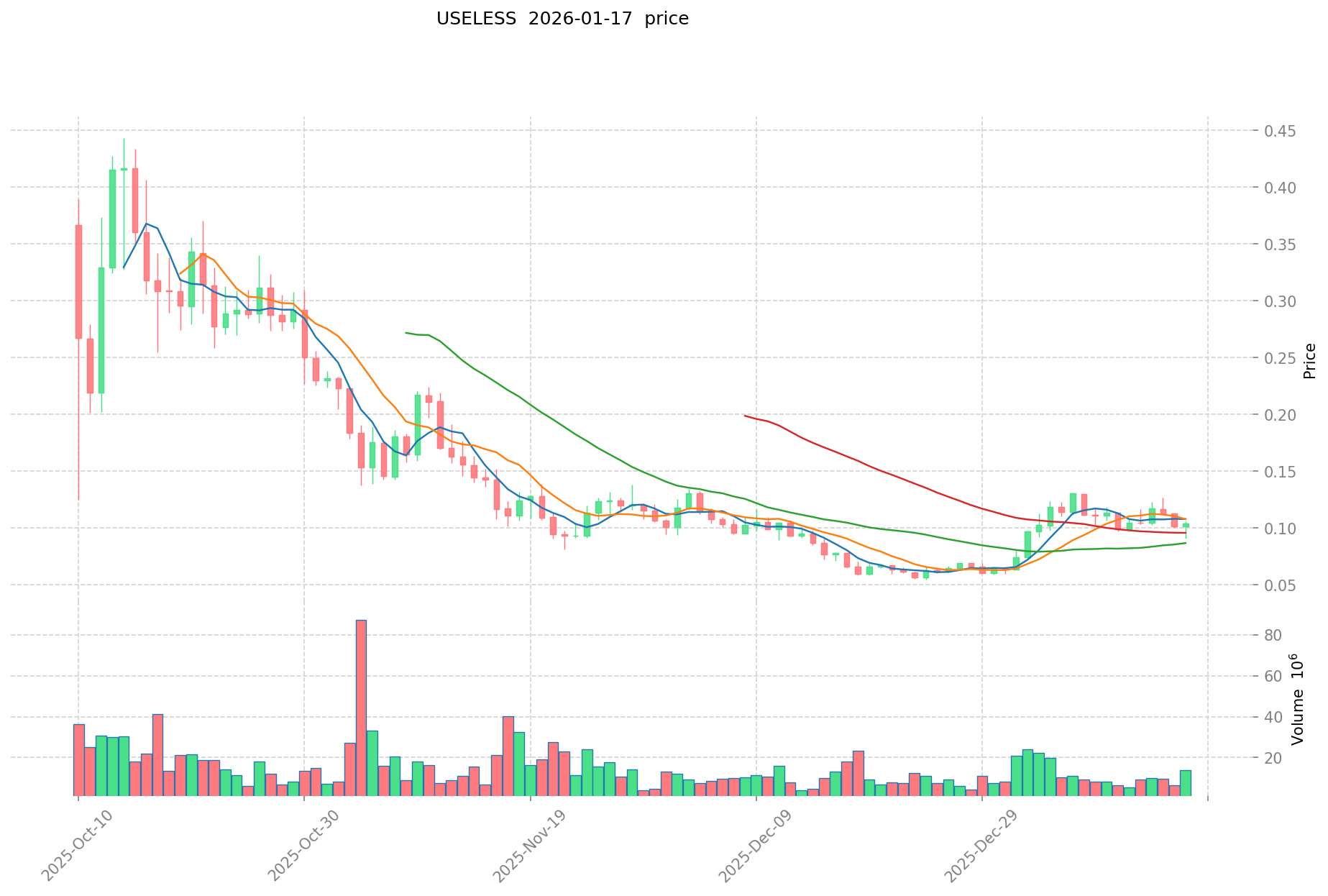
- 2025-10-14: USELESS recorded a price level of $0.443
- 2025-12-24: Token experienced price movement to $0.05458
- Recent period: Price fluctuation observed from previous levels to current $0.09991
Current USELESS Investment Market Status (January 2026)
- USELESS current price: $0.09991
- Market sentiment (Fear & Greed Index): Moderate volatility observed
- 24-hour trading volume: $1,319,861.20
- Token holders: 37,558 addresses
Click to view real-time USELESS market price
II. Core Factors Affecting Whether USELESS Is a Good Investment
Supply Mechanism and Scarcity (USELESS investment scarcity)
- Fixed total supply of 1,000,000,000 tokens with 100% already in circulation → affects price dynamics and investment value assessment
- All tokens are currently circulating with no future supply inflation planned, creating a defined scarcity model
- Investment consideration: The complete circulation of supply means no dilution risk from future token releases, though this also limits potential supply-driven price catalysts
- Recent price fluctuations show significant volatility: +60.08% over 30 days, contrasted with -7.51% over 7 days, indicating high short-term trading risk
- 24-hour trading volume of $1,319,861 represents substantial activity relative to market cap
- Historical price range between $0.05458 and $0.443 demonstrates considerable price swings characteristic of speculative assets
Community-Driven Model and Speculative Nature
- Operates as a decentralized meme token with no presale, no team allocation, and no formal roadmap
- Community of approximately 37,558 holders suggests some level of distributed ownership
- Investment consideration: As a self-described experiment in irony and internet culture, the project emphasizes community participation over traditional utility metrics
Market Position and Competition
- Ranks #357 by market capitalization with approximately $99.91 million in total market value
- Market dominance of 0.0029% indicates relatively small presence in the broader cryptocurrency ecosystem
- Listed on 24 exchanges, providing some degree of liquidity access for potential investors
III. USELESS Future Investment Forecast and Price Outlook (Is Useless Coin(USELESS) worth investing in 2026-2031)
Short-term Investment Forecast (2026, short-term USELESS investment outlook)
- Conservative forecast: $0.0729 - $0.0999
- Neutral forecast: $0.0900 - $0.1234
- Optimistic forecast: $0.1200 - $0.1469
Based on historical data, USELESS has experienced notable volatility, with a 1-year growth rate of over 145,000%, though this reflects movement from an extremely low base. The 30-day performance shows a 60% increase, while the 7-day trend indicates a decline of approximately 7.5%. Current market positioning suggests the token remains in a consolidation phase following earlier rapid gains.
Mid-term Investment Outlook (2027-2029, mid-term Useless Coin(USELESS) investment forecast)
- Market stage expectation: Price discovery and community-driven momentum phase, with potential expansion dependent on continued engagement and market sentiment toward meme tokens.
- Investment return forecast:
- 2027: $0.0901 - $0.1789
- 2028: $0.0907 - $0.2222
- 2029: $0.1195 - $0.2184
- Key catalysts: Sustained community activity, broader meme token market trends, exchange listing expansion, and social media-driven viral momentum.
Historical price patterns indicate USELESS experienced an all-time high of $0.443 in October 2025 before retreating. The token's mid-term trajectory will likely depend on its ability to maintain holder engagement and capitalize on periods of heightened interest in meme-based assets.
Long-term Investment Outlook (Is USELESS a good long-term investment?)
- Base scenario: $0.1094 - $0.2026 (assuming steady community participation and stable market conditions)
- Optimistic scenario: $0.1855 - $0.3003 (assuming increased adoption, sustained social media presence, and favorable meme token market cycles)
- Risk scenario: Below $0.0730 (in scenarios involving significant community attrition or broader market downturns)
View USELESS long-term investment and price forecast: Price Prediction
2026-01-17 to 2031 Long-term Outlook
- Base scenario: $0.1094 - $0.2026 (corresponding to gradual holder base expansion and stable market sentiment)
- Optimistic scenario: $0.1855 - $0.3003 (corresponding to viral growth phases and increased exchange support)
- Transformative scenario: Above $0.3003 (in cases of breakthrough community initiatives or mainstream meme token adoption)
- 2031-12-31 forecasted high: $0.3003 (based on optimistic development assumptions)
Disclaimer: The forecasts presented are derived from historical data and market analysis. Cryptocurrency investments involve substantial risk, and past performance does not guarantee future results. Price predictions should not be construed as financial advice. Investors are encouraged to conduct independent research and consult with qualified financial professionals before making investment decisions.
| Year |
Predicted High Price |
Predicted Average Price |
Predicted Low Price |
Price Change |
| 2026 |
0.1468971 |
0.09993 |
0.0729489 |
0 |
| 2027 |
0.1789496475 |
0.12341355 |
0.0900918915 |
23 |
| 2028 |
0.2222369501625 |
0.15118159875 |
0.09070895925 |
51 |
| 2029 |
0.218449851113812 |
0.18670927445625 |
0.119493935652 |
86 |
| 2030 |
0.239043884086336 |
0.202579562785031 |
0.109392963903916 |
102 |
| 2031 |
0.30030394387253 |
0.220811723435684 |
0.185481847685974 |
121 |
IV. Useless Coin Investment Strategy and Risk Management (How to invest in meme tokens)
Investment Methodology (Useless Coin investment strategy)
Long-term Holding (HODL Useless Coin): Suitable for Conservative Investors
For investors with a long-term perspective, holding USELESS may align with the broader meme token narrative. Given its community-driven nature and absence of team allocations, the token's value proposition relies heavily on sustained community engagement and viral adoption. Long-term holders should monitor community activity levels, holder growth trends, and overall market sentiment toward decentralized meme projects.
Active Trading: Relying on Technical Analysis and Swing Operations
Active traders may find opportunities in USELESS's price volatility. Recent data shows a 24-hour price fluctuation range between $0.09072 and $0.10562, indicating potential for short-term trading strategies. The 1-hour price change of -0.71% and 24-hour change of 1.69% suggest moderate intraday volatility. Traders should employ technical indicators, volume analysis (current 24h volume: $1,319,861.20), and support/resistance levels to identify entry and exit points.
Risk Management (Risk management for Useless Coin investment)
Asset Allocation Ratio: Conservative / Aggressive / Professional Investors
- Conservative Investors: Should limit USELESS exposure to 1-3% of total portfolio due to high volatility and speculative nature
- Aggressive Investors: May allocate 5-10% while maintaining diversification across multiple meme tokens and established cryptocurrencies
- Professional Investors: Can consider up to 15% allocation with active monitoring and hedging strategies
Investors should diversify holdings across different crypto categories (Layer 1, DeFi, stablecoins) to offset meme token volatility. Consider maintaining stablecoin reserves for opportunistic buying during market corrections. Position sizing and stop-loss orders are essential for managing downside risk in highly volatile meme tokens.
Secure Storage: Hot and Cold Wallets + Hardware Wallet Recommendations
USELESS is deployed on the Solana blockchain (contract address: Dz9mQ9NzkBcCsuGPFJ3r1bS4wgqKMHBPiVuniW8Mbonk), requiring Solana-compatible wallet solutions. For long-term storage, hardware wallets such as Ledger or Trezor that support Solana provide enhanced security. For active trading, reputable hot wallets with strong security features should be used, while keeping only necessary amounts for trading purposes.
V. Useless Coin Investment Risks and Challenges (Risks of investing in meme tokens)
Market Risk: High Volatility and Potential Price Manipulation
USELESS exhibits significant price volatility, with a 7-day decline of -7.51% and a 30-day increase of 60.08%. The token's price ranged from a low of $0.05458 to a high of $0.443. Such extreme price swings indicate substantial market risk. The relatively modest 24-hour trading volume of approximately $1.32 million may increase susceptibility to price manipulation by large holders. With 37,558 holders and a fully diluted market cap of $99.91 million, concentration risk should be carefully evaluated.
Regulatory Risk: Policy Uncertainty Across Different Countries
Meme tokens face heightened regulatory scrutiny globally due to their speculative nature and lack of fundamental utility. Different jurisdictions maintain varying stances on cryptocurrency classification, taxation, and trading restrictions. As USELESS operates without a traditional organizational structure or roadmap, regulatory classification may be ambiguous. Investors should stay informed about evolving regulations in their respective countries and potential impacts on meme token trading and holdings.
Technical Risk: Network Security Vulnerabilities and Upgrade Failures
As a token built on the Solana blockchain, USELESS inherits both the benefits and risks of the underlying network. Solana has experienced network congestion and outages in the past, which could affect token transferability and trading. The community-driven nature of USELESS means there is no dedicated development team to address technical issues or implement upgrades. Smart contract vulnerabilities, though not specifically identified, remain a general risk for all blockchain-based tokens.
VI. Conclusion: Is Meme Token a Good Investment?
Investment Value Summary
Useless Coin represents a highly speculative investment within the meme token category. While the project has demonstrated notable price appreciation over longer time periods, it carries substantial short-term volatility and inherent risks associated with community-driven, narrative-based tokens. The token's value proposition relies primarily on viral adoption, community engagement, and broader meme token market sentiment rather than fundamental utility or technological innovation.
Investor Recommendations
✅ Beginners: Implement a dollar-cost averaging (DCA) strategy with small, regular investments; prioritize secure wallet storage; limit allocation to 1-2% of total portfolio; thoroughly research meme token dynamics before investing
✅ Experienced Investors: Consider swing trading strategies based on technical analysis; maintain diversified portfolio allocation across multiple crypto categories; actively monitor community sentiment and holder metrics; use position sizing and stop-loss orders
✅ Institutional Investors: Evaluate as a minor speculative allocation within broader crypto exposure; implement comprehensive risk management frameworks; consider liquidity constraints given current trading volumes; maintain strict compliance with regulatory requirements
⚠️ Disclaimer: Cryptocurrency investment carries significant risk, including potential loss of principal. This article is for informational purposes only and does not constitute investment advice. Conduct thorough research and consult with financial professionals before making investment decisions.
VII. FAQ
Q1: Is Useless Coin (USELESS) a good investment for beginners?
USELESS is generally not recommended as a primary investment for beginners due to its highly speculative nature and extreme volatility. The token has experienced price swings ranging from $0.05458 to $0.443, with a 30-day gain of 60.08% followed by a 7-day decline of 7.51%. Beginners should limit exposure to 1-2% of their total portfolio and implement a dollar-cost averaging strategy if they choose to invest. It's crucial to understand that USELESS operates as a community-driven meme token with no roadmap, no team allocation, and no inherent utility, making it fundamentally different from traditional investment assets. New investors should prioritize learning about cryptocurrency fundamentals, secure wallet storage, and risk management before considering meme token investments.
Q2: What factors most significantly affect USELESS token price movements?
USELESS price is primarily driven by community sentiment, viral social media trends, and broader meme token market cycles rather than fundamental metrics. With 37,558 holders and a market cap of approximately $99.91 million, the token's value relies heavily on sustained community engagement and holder participation. Trading volume of $1,319,861.20 over 24 hours indicates moderate liquidity, but concentration among large holders could enable price manipulation. External factors include Solana network performance (as USELESS operates on this blockchain), general cryptocurrency market sentiment, and regulatory developments affecting meme tokens. Unlike utility-focused cryptocurrencies, USELESS lacks traditional value drivers such as technological innovation, partnership announcements, or product development milestones.
Q3: What is the realistic long-term price outlook for USELESS through 2031?
Based on current market analysis, USELESS presents three potential long-term scenarios through 2031. The base scenario projects a price range of $0.1094 to $0.2026, assuming steady community participation and stable market conditions. The optimistic scenario forecasts $0.1855 to $0.3003, contingent upon increased adoption, sustained social media presence, and favorable meme token market cycles. The risk scenario suggests prices could fall below $0.0730 if community engagement diminishes or broader market downturns occur. The 2031 forecasted high of $0.3003 represents a potential 200% gain from current levels but requires sustained viral growth and mainstream meme token adoption. These projections carry significant uncertainty, as meme tokens lack traditional valuation frameworks and depend heavily on unpredictable social dynamics and market sentiment shifts.
Q4: How should investors manage risk when investing in USELESS?
Risk management for USELESS requires strict position sizing, diversification, and security protocols. Conservative investors should limit USELESS exposure to 1-3% of total portfolio value, while aggressive investors may allocate 5-10% with active monitoring. Implement stop-loss orders to protect against sudden price drops, given the token's historical volatility. Diversify holdings across multiple cryptocurrency categories including Layer 1 protocols, DeFi tokens, and stablecoins to offset meme token risk. For storage, use hardware wallets like Ledger or Trezor for long-term holdings, as USELESS operates on the Solana blockchain (contract address: Dz9mQ9NzkBcCsuGPFJ3r1bS4wgqKMHBPiVuniW8Mbonk). Keep only necessary amounts in hot wallets for active trading. Regularly monitor community activity metrics, holder distribution, and trading volume patterns to assess ongoing investment viability.
Q5: What are the main risks associated with investing in USELESS?
USELESS carries multiple distinct risk categories that investors must acknowledge. Market risk includes extreme volatility (7-day changes from -7.51% to 30-day gains of 60.08%) and potential price manipulation due to relatively low trading volumes of $1.32 million daily. Regulatory risk stems from uncertain classification of meme tokens across different jurisdictions, with potential for sudden trading restrictions or taxation changes. Technical risk involves dependency on Solana network stability, which has experienced outages previously, and the absence of a dedicated development team to address smart contract vulnerabilities or implement upgrades. Liquidity risk exists despite 24 exchange listings, as concentrated holder positions (37,558 total holders) could impact exit opportunities during market stress. Additionally, as a self-described "experiment in irony," USELESS lacks traditional value preservation mechanisms, making it susceptible to complete value loss if community interest dissipates.
Q6: What investment strategies work best for trading USELESS?
Two primary strategies suit different investor profiles when trading USELESS. For long-term holders, the HODL approach focuses on accumulating tokens during market corrections and holding through volatility cycles, relying on potential viral adoption and community growth. This strategy requires monitoring holder growth trends, community engagement metrics, and broader meme token market sentiment. For active traders, technical analysis and swing trading capitalize on USELESS's intraday volatility, with recent 24-hour ranges between $0.09072 and $0.10562 providing short-term opportunities. Effective swing trading requires analyzing support and resistance levels, volume patterns, and employing indicators like RSI and moving averages. Both strategies should incorporate strict risk management, including predetermined entry and exit points, position sizing rules, and regular portfolio rebalancing. Avoid emotional trading decisions driven by FOMO or panic selling, and maintain disciplined adherence to your chosen strategy parameters.
Q7: How does USELESS compare to other meme tokens in terms of investment potential?
USELESS occupies a unique position within the meme token ecosystem due to its explicit positioning as an experiment in irony with no roadmap or team allocation. Unlike prominent meme tokens with established communities or celebrity endorsements, USELESS relies purely on decentralized community-driven momentum. With a market cap of $99.91 million and ranking #357, it represents a mid-tier meme token with moderate liquidity across 24 exchanges. The token's 100% circulating supply eliminates dilution risk from future releases, distinguishing it from projects with locked team tokens. However, this also removes potential supply-driven catalysts. Its Solana blockchain foundation provides faster transaction speeds compared to Ethereum-based meme tokens, but inherits Solana network risks. The absence of traditional utility, partnerships, or development roadmap means USELESS competes purely on community narrative and viral potential, making direct comparison with utility-focused or celebrity-backed meme tokens challenging. Investment decisions should weigh USELESS's unique characteristics against individual risk tolerance and portfolio objectives.
* The information is not intended to be and does not constitute financial advice or any other recommendation of any sort offered or endorsed by Gate.