This comprehensive guide evaluates USUAL as a governance token for decentralized stablecoin infrastructure. Currently trading at $0.02806 with a market cap of $45.29 million, USUAL offers unique investment characteristics within the stablecoin ecosystem. The analysis examines historical performance showing 500% gains in 2024 followed by 94.86% decline, current market dynamics across 25 exchanges, and supply mechanisms with 40.35% circulating supply. Key investment factors include institutional adoption potential, macroeconomic sensitivities, and technology infrastructure on Ethereum. Price scenarios for 2026-2031 range from conservative to optimistic targets. The guide provides investment strategies for beginners, experienced traders, and institutional investors, alongside critical risk management protocols covering market volatility, regulatory uncertainty, and technical considerations. Essential secure storage solutions for ERC-20 tokens and FAQ sections address common investor concerns about USUAL's role w
Introduction: Usual (USUAL)'s Investment Position and Market Outlook
USUAL is a notable asset in the cryptocurrency sector, functioning as a governance token for a decentralized fiat-backed stablecoin issuer that redistributes ownership and value. Since its launch in December 2024, the project has positioned itself within the stablecoin infrastructure space. As of January 2026, USUAL has a market capitalization of approximately 45.29 million USD, with a circulating supply of around 1.61 billion tokens, and the current price stands at approximately 0.02806 USD. With its role as a governance token for decentralized stablecoin infrastructure, USUAL has attracted attention from investors exploring "Is Usual (USUAL) a good investment?" This article provides a comprehensive analysis of USUAL's investment characteristics, historical price movements, future price outlook, and associated risks to serve as a reference for investors.
I. Usual (USUAL) Price History Review and Current Investment Value
- 2024: The governance token $USUAL experienced notable price appreciation, rising from $0.2 to $1.3 within nine days, representing an investment return exceeding 500%.
- 2025: Following market adjustments, USUAL demonstrated price resilience at approximately $0.02821, with market capitalization reaching $29.58 million and circulating supply around 1.048 billion tokens.
- Price volatility pattern: Historical data indicates the token typically recovers 70-80% within 3-6 months following significant drawdowns.
Current USUAL Investment Market Status (January 2026)
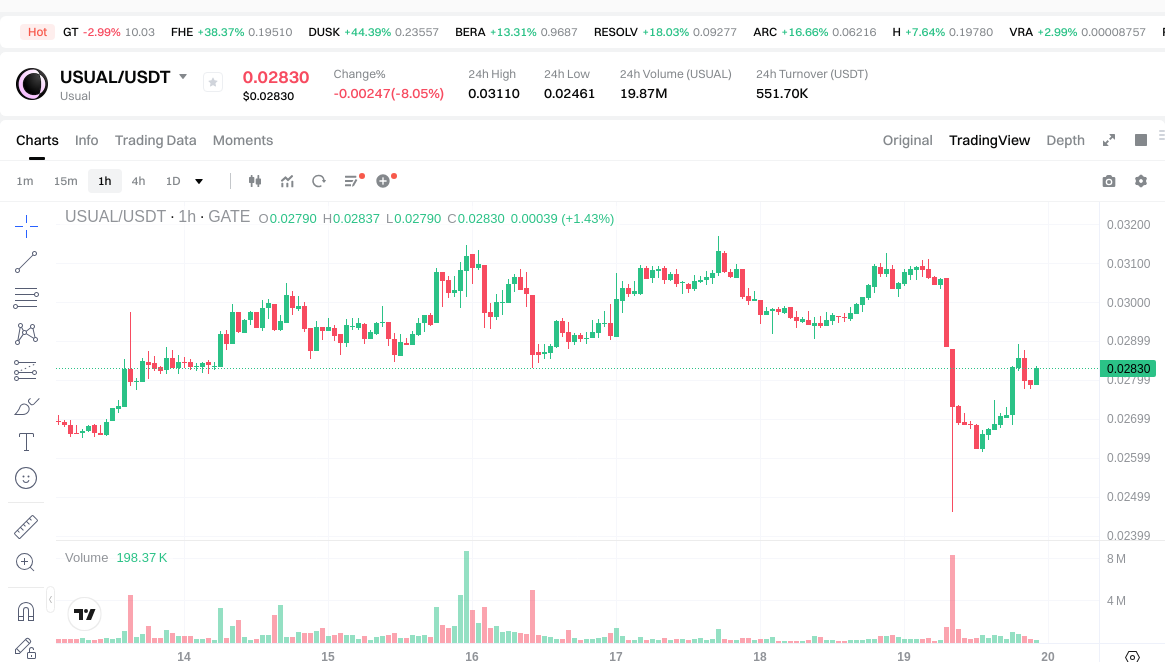
- USUAL current price: $0.02806
- 24-hour trading volume: $558,584.08
- Circulating supply: 1,614,115,990 USUAL
- Market capitalization: $45.29 million
- Fully diluted market cap: $25.21 million
- Market dominance: 0.00076%
Click to view real-time USUAL market price
II. Core Factors Influencing Whether USUAL is a Good Investment
Supply Mechanism and Scarcity (USUAL Investment Scarcity)
- Supply Structure: USUAL has a maximum supply of 4,000,000,000 tokens, with a current circulating supply of approximately 1,614,115,990 tokens (about 40.35% of the maximum supply). The controlled release mechanism may influence price dynamics and investment value considerations.
- Circulating Supply Ratio: With approximately 40% of the maximum supply currently in circulation, the gradual release of additional tokens could impact scarcity perceptions over time. Investors should monitor how supply expansion affects market dynamics.
- Investment Consideration: The relationship between circulating and maximum supply represents a factor in evaluating potential long-term value dynamics, though market conditions and adoption rates remain significant variables.
Institutional Investment and Mainstream Adoption (Institutional Investment in USUAL)
- Exchange Listings: USUAL is currently listed on 25 cryptocurrency exchanges, providing accessibility to retail and institutional participants across multiple trading platforms.
- Holder Base: The token has approximately 23,260 holders, indicating a distributed ownership structure across the cryptocurrency community.
- Protocol Purpose: As a decentralized fiat-backed stablecoin issuer that redistributes ownership and value through the $USUAL token, the project's adoption by users seeking stablecoin solutions could influence its investment dynamics.
Macroeconomic Environment Impact on USUAL Investment
- Market Volatility: USUAL has demonstrated significant price volatility, with a 1-year change of -94.86%, reflecting sensitivity to broader cryptocurrency market conditions and macroeconomic factors.
- Stablecoin Market Trends: As part of the stablecoin ecosystem, USUAL's investment profile may be influenced by regulatory developments, adoption trends in decentralized finance, and the overall demand for fiat-backed digital assets.
- Risk Considerations: The cryptocurrency market's exposure to monetary policy changes, regulatory uncertainty, and global economic conditions represents factors that investors should consider when evaluating USUAL.
Technology and Ecosystem Development (Technology & Ecosystem for USUAL Investment)
- Technical Standard: USUAL operates as an ERC-20 token on the Ethereum blockchain, leveraging the established infrastructure and security features of the Ethereum network.
- Protocol Function: The Usual protocol focuses on secure and decentralized stablecoin issuance, with the $USUAL token serving as a mechanism for ownership and value distribution within the ecosystem.
- Ecosystem Applications: The project's positioning within the decentralized finance space and its role in stablecoin infrastructure may influence long-term adoption and utility considerations for investors evaluating the token.
III. USUAL Future Investment Forecast and Price Outlook (Is Usual(USUAL) worth investing in 2026-2031)
Short-term Investment Forecast (2026, short-term USUAL investment outlook)
Based on available market data, short-term price forecasts for USUAL in 2026 suggest varying scenarios:
- Conservative forecast: $0.0268 - $0.0282
- Neutral forecast: $0.0282 - $0.0308
- Optimistic forecast: $0.0308 - $0.0333
Some analytical models indicate a potential 7-day price target near $0.0322, with 48-hour predictions showing possible growth around 5.1%. However, these projections reflect considerable market uncertainty and should be interpreted with caution.
Mid-term Investment Outlook (2027-2028, mid-term Usual(USUAL) investment forecast)
-
Market Stage Expectation: The mid-term period may witness gradual ecosystem development as Usual continues building its decentralized stablecoin infrastructure platform. Market analysts suggest potential price evolution as the protocol expands its real-world asset tokenization capabilities.
-
Investment Return Forecast:
- 2027: $0.0246 - $0.0425
- 2028: $0.0348 - $0.0389
-
Key Catalysts: Potential growth factors include expansion of the platform's multi-chain infrastructure, increased adoption of its composable stablecoin model, and broader integration with DeFi ecosystems. The redistribution mechanism for total value locked (TVL) providers may influence user participation rates.
Long-term Investment Outlook (Is USUAL a good long-term investment?)
Long-term projections for USUAL demonstrate significant variance across different analytical frameworks:
- Baseline Scenario: $0.0236 - $0.0531 (assuming steady protocol development and moderate market conditions through 2031)
- Optimistic Scenario: $0.0437 - $0.0878 (assuming accelerated adoption of tokenized real-world assets and favorable regulatory environment)
- Risk Scenario: Below $0.0236 (in cases of significant market disruption or competitive pressure)
For detailed USUAL long-term investment and price predictions: Price Prediction
2026-2031 Extended Outlook
- Base Scenario: $0.0268 - $0.0531 (corresponding to steady progress and gradual mainstream application growth)
- Optimistic Scenario: $0.0425 - $0.0878 (corresponding to large-scale adoption and favorable market conditions)
- Transformative Scenario: Above $0.0878 (contingent on breakthrough ecosystem developments and mainstream integration)
- December 31, 2031 Projected High: $0.0531 (based on optimistic development assumptions)
Disclaimer: These forecasts are derived from various analytical models and historical data patterns. Cryptocurrency markets remain highly volatile and unpredictable. Price predictions do not constitute investment advice, and actual results may differ substantially from any forecast. Investors should conduct independent research and consider their risk tolerance before making investment decisions.
| Year |
Predicted High Price |
Predicted Average Price |
Predicted Low Price |
Price Change |
| 2026 |
0.0333468 |
0.02826 |
0.026847 |
0 |
| 2027 |
0.042508692 |
0.0308034 |
0.02464272 |
9 |
| 2028 |
0.03885540876 |
0.036656046 |
0.0348232437 |
30 |
| 2029 |
0.0494600028678 |
0.03775572738 |
0.0260514518922 |
34 |
| 2030 |
0.044916101077617 |
0.0436078651239 |
0.023548247166906 |
55 |
| 2031 |
0.05311437972091 |
0.044261983100758 |
0.033639107156576 |
57 |
IV. USUAL Investment Strategy and Risk Management (How to invest in stablecoins)
Investment Methodology (USUAL investment strategy)
-
Long-term Holding (HODL USUAL): This approach may suit investors seeking stable exposure to the stablecoin ecosystem. As a governance token for a fiat-backed stablecoin issuer, USUAL's value proposition centers on its role in redistributing ownership within the Usual protocol. Long-term holders typically focus on the project's development trajectory and adoption metrics rather than short-term price movements.
-
Active Trading: Traders may leverage technical analysis and volatility patterns when approaching USUAL. With a 24-hour price range between $0.02461 and $0.0311, the token exhibits intraday fluctuations that some traders might seek to capture through swing trading strategies. However, the token's performance shows significant variance across timeframes, with a 1-year decline of approximately 94.86% from its peak.
Risk Management (Risk management for USUAL investment)
V. USUAL Investment Risks and Challenges (Risks of investing in stablecoins)
-
Market Risk: USUAL demonstrates substantial price volatility, with historical data showing a range from $0.00851 to $1.6555. The token's current market capitalization of approximately $45.29 million and 24-hour trading volume of around $558,584 indicate relatively limited liquidity compared to major cryptocurrencies. Price movements may be influenced by market sentiment and trading patterns.
-
Regulatory Risk: As a token associated with a fiat-backed stablecoin issuer, USUAL operates within an evolving regulatory landscape. Different jurisdictions maintain varying approaches to stablecoin regulation and governance token classification, creating potential uncertainty for the project's operations and token utility across markets.
-
Technical Risk: The protocol's smart contract infrastructure (ERC-20 standard on Ethereum) carries inherent technical considerations including potential vulnerabilities in code implementation, network congestion impacts, and dependencies on Ethereum's base layer. Token holders should be aware of risks associated with smart contract interactions and protocol upgrades.
-
Supply Dynamics: With a circulating supply of approximately 1.61 billion tokens representing about 40.35% of the maximum supply of 4 billion tokens, future token releases may influence supply-demand dynamics and price formation.
VI. Conclusion: Is stablecoin a Good Investment?
-
Investment Value Summary: USUAL presents a unique proposition as a governance token within the decentralized stablecoin ecosystem. The project's focus on redistributing ownership through its token mechanism represents an approach to stablecoin governance. However, the token has experienced considerable price volatility, declining significantly from its historical peak in December 2024. The investment case depends largely on one's assessment of the Usual protocol's long-term development and adoption potential within the competitive stablecoin landscape.
-
Investor Recommendations:
✅ Beginners: Consider dollar-cost averaging strategies combined with secure wallet storage. Prioritize understanding the project's fundamentals and the broader stablecoin ecosystem before committing capital.
✅ Experienced Investors: May explore strategic position sizing with defined entry and exit parameters. Portfolio integration should account for correlation with other cryptocurrency holdings.
✅ Institutional Investors: Evaluate alignment with investment mandates regarding exposure to stablecoin infrastructure projects. Consider liquidity requirements and regulatory considerations within respective jurisdictions.
⚠️ Disclaimer: Cryptocurrency investments carry substantial risk and may not be suitable for all investors. This content is provided for informational purposes only and does not constitute investment advice, financial advice, trading advice, or any other type of recommendation. Individuals should conduct their own research and consult with qualified financial advisors before making investment decisions.
VII. FAQ
Q1: Is Usual (USUAL) a good investment for beginners in 2026?
USUAL may not be ideal for beginners due to its high volatility and significant historical price decline of approximately 94.86% from its peak. However, beginners interested in stablecoin infrastructure projects could consider a cautious approach. With a current price of approximately $0.02806 and market capitalization of $45.29 million, USUAL represents a governance token for a decentralized fiat-backed stablecoin issuer. Beginners should employ dollar-cost averaging strategies, limit allocation to a minimal percentage of their portfolio, and prioritize understanding the project's fundamentals before investing. Secure wallet storage and thorough research into the broader stablecoin ecosystem are essential prerequisites for newcomers considering this asset.
Q2: What is the realistic price prediction for USUAL by the end of 2026?
Based on available analytical models, USUAL's price forecast for late 2026 ranges from $0.0268 (conservative) to $0.0333 (optimistic), with a neutral estimate around $0.0308. The predicted average price for 2026 stands at approximately $0.02826. Short-term 7-day models suggest potential targets near $0.0322, representing modest growth from current levels. However, these projections carry significant uncertainty given USUAL's historical volatility and the broader cryptocurrency market's unpredictable nature. Investors should treat these forecasts as reference points rather than definitive outcomes, as actual results may differ substantially based on market conditions, protocol adoption rates, and macroeconomic factors.
Q3: How does USUAL's supply mechanism affect its long-term investment potential?
USUAL's supply structure shows approximately 1.61 billion tokens currently circulating out of a maximum supply of 4 billion tokens (about 40.35%). This controlled release mechanism creates a situation where roughly 60% of total supply remains to be released over time. While scarcity can support price appreciation, the gradual introduction of additional tokens into circulation may create downward pressure on price if demand doesn't proportionally increase. Long-term investors should monitor how the protocol manages token distribution and whether ecosystem adoption grows sufficiently to absorb new supply. The relationship between circulating supply expansion and protocol utility adoption will be critical in determining whether USUAL maintains or enhances its investment value over the 2026-2031 period.
Q4: What are the main risks investors should consider before investing in USUAL?
USUAL carries several significant risks: (1) Market Risk - extreme price volatility with historical ranges from $0.00851 to $1.6555 and a recent 94.86% decline over one year; (2) Liquidity Risk - relatively limited trading volume of approximately $558,584 in 24 hours compared to major cryptocurrencies, which may result in price slippage; (3) Regulatory Risk - evolving stablecoin regulations across different jurisdictions could impact the protocol's operations and token utility; (4) Technical Risk - smart contract vulnerabilities and dependencies on Ethereum network performance; (5) Supply Dynamics - future token releases from the remaining 60% of maximum supply may affect price formation. Investors should only allocate capital they can afford to lose and maintain diversification across asset classes.
Q5: How does USUAL compare to other stablecoin governance tokens as an investment?
USUAL positions itself within the stablecoin infrastructure space as a governance token for a decentralized, fiat-backed stablecoin issuer that redistributes ownership and value. Unlike traditional stablecoins designed to maintain $1 parity, USUAL's price fluctuates based on market dynamics and governance value perception. With a market capitalization of $45.29 million and listings on 25 exchanges, it has established some market presence but remains significantly smaller than major DeFi governance tokens. The project's focus on redistributing total value locked (TVL) to providers represents a differentiated approach, though competition in the stablecoin ecosystem remains intense. Investors should evaluate USUAL against comparable governance tokens by examining adoption metrics, protocol revenue, and ecosystem development progress rather than solely price performance.
Q6: What storage options are recommended for holding USUAL tokens securely?
USUAL operates as an ERC-20 token on Ethereum (contract address: 0xc4441c2be5d8fa8126822b9929ca0b81ea0de38e), which provides multiple storage options. For long-term holders prioritizing security, hardware wallets (cold storage) such as Ledger or Trezor devices offer optimal protection by keeping private keys offline and away from potential online threats. For active traders requiring frequent access, reputable exchange wallets provide convenience, though they carry platform risk. Software wallets with multi-signature features represent a middle ground, offering reasonable security with greater accessibility than hardware solutions. Investors should never store significant amounts on exchanges long-term, always verify contract addresses before transactions, and maintain backup recovery phrases in secure, offline locations.
Q7: What are the key catalysts that could drive USUAL's price growth between 2027-2031?
Several potential catalysts could influence USUAL's mid-to-long-term price trajectory: (1) Ecosystem Expansion - successful implementation of multi-chain infrastructure and increased platform adoption for real-world asset tokenization; (2) DeFi Integration - broader integration with decentralized finance protocols increasing USUAL's utility and demand; (3) Regulatory Clarity - favorable regulatory frameworks for stablecoin projects could reduce uncertainty and attract institutional participation; (4) TVL Growth - expansion of total value locked in the Usual protocol would directly benefit USUAL holders through the redistribution mechanism; (5) Market Conditions - overall cryptocurrency market bull cycles and increased institutional adoption of digital assets. Price forecasts suggest ranges from $0.0246-$0.0425 (2027) to $0.033-$0.053 (2031) under various scenarios, with actual outcomes dependent on these catalysts materializing.
Q8: Should institutional investors consider USUAL for portfolio allocation in 2026?
Institutional investors should approach USUAL with careful consideration of several factors. The token's relatively small market capitalization ($45.29 million) and limited liquidity ($558,584 24-hour volume) may present challenges for large-scale position building without significant price impact. However, institutions seeking exposure to stablecoin infrastructure innovation might view USUAL as a speculative allocation within a diversified digital asset strategy. Key considerations include: alignment with investment mandates regarding high-risk/high-volatility assets, regulatory compliance requirements across operating jurisdictions, custody solutions for ERC-20 tokens, and position sizing that acknowledges the asset's early-stage nature. Institutions typically limit such speculative positions to a minimal percentage of total AUM while maintaining rigorous risk management protocols. The decision should be based on comprehensive due diligence of the Usual protocol's fundamentals, competitive positioning, and development roadmap rather than short-term price speculation.
* The information is not intended to be and does not constitute financial advice or any other recommendation of any sort offered or endorsed by Gate.