This comprehensive analysis examines whether Usual (USUAL) represents a viable investment opportunity within the decentralized stablecoin ecosystem. Launched in December 2024, USUAL trades at $0.02858 with a market capitalization of $46.12 million across 25 exchanges on Gate and other platforms. The analysis evaluates historical price performance, supply mechanics, and tokenomics while presenting price projections ranging from $0.0177 to $0.0334 for 2026, with long-term scenarios reaching $0.0683 by 2031. Key considerations include market volatility, regulatory uncertainty, smart contract security, and protocol development risks. The guide provides differentiated investment strategies for beginners through institutional investors, emphasizing risk management through asset allocation, diversification, and secure storage solutions to navigate USUAL's emerging market position effectively.
Introduction: Usual (USUAL)'s Investment Position and Market Outlook
Usual (USUAL) represents a notable asset in the cryptocurrency sector, positioned as a secure and decentralized fiat-backed stablecoin issuer that redistributes ownership and value through its native token. As of January 19, 2026, USUAL maintains a market capitalization of approximately $46.12 million with a circulating supply of around 1.61 billion tokens, trading at $0.02858. The token ranks 551st in the market with a market share of 0.00077%, supported by 23,260 holders across 25 exchanges. With its ERC-20 implementation on the Ethereum blockchain and a maximum supply of 4 billion tokens, USUAL has demonstrated notable price volatility since its launch in December 2024, experiencing a 7.72% gain over the past week and a 17.1% increase over 30 days, despite facing significant annual price fluctuations. As investors examine whether Usual (USUAL) presents a viable investment opportunity, this analysis provides a comprehensive examination of the token's investment value, historical performance trends, future price projections, and associated investment risks to inform decision-making processes.
I. Usual (USUAL) Price History Review and Current Investment Value
- 2024: Governance token $USUAL experienced notable growth from $0.2 to $1.3 within nine days → representing returns exceeding 500% for early participants
- 2025: Token underwent market adjustment phases → USUAL price demonstrated resilience, with historical patterns showing recovery of 70-80% within 3-6 months following pullbacks
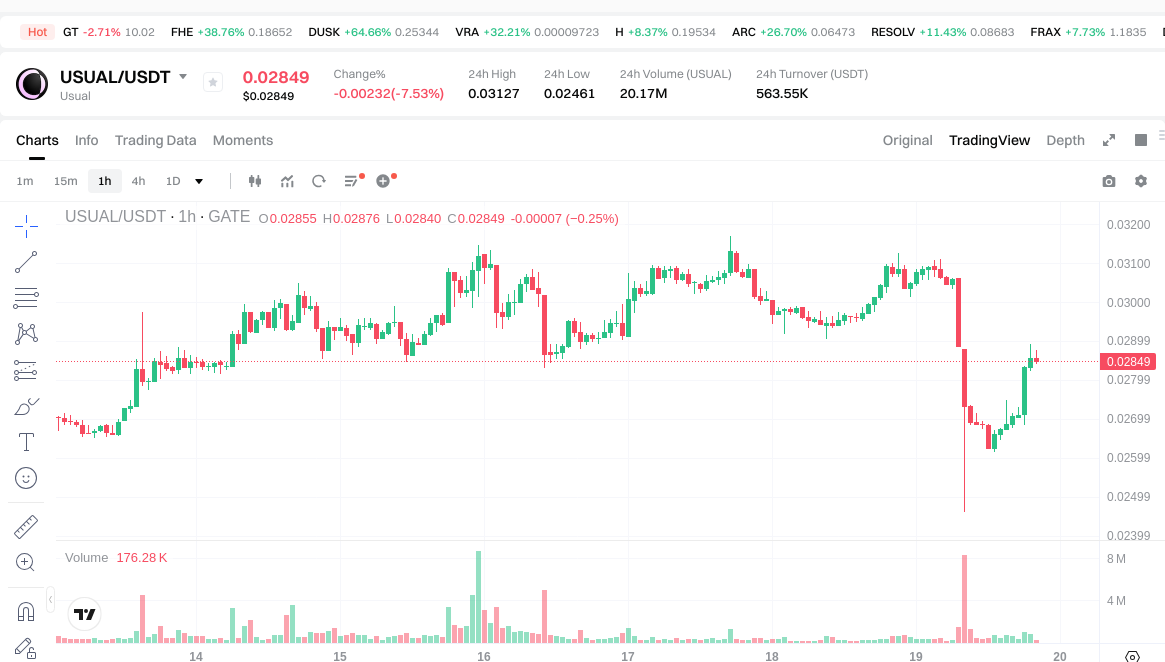
- Recent Period: Price fluctuated from $0.03127 (24-hour high) to $0.02461 (24-hour low) as of January 19, 2026
Current USUAL Investment Market Status (January 2026)
- USUAL current price: $0.02858
- 24-hour trading volume: $569,508.46
- Circulating supply: 1,613,861,393.55 USUAL tokens
- Market capitalization: $46,124,158.63
- Fully diluted market cap: $25,676,467.89
- Circulating supply ratio: 40.35%
- Holder count: 23,260 addresses
Check real-time USUAL market price
II. Core Factors Influencing Whether USUAL is a Good Investment
Supply Mechanism and Scarcity (USUAL Investment Scarcity)
- Supply Structure → Impacts price and investment value
- USUAL has a maximum supply of 4,000,000,000 tokens, with current circulating supply at approximately 1,613,861,393 tokens (40.35% of total supply)
- The circulating supply represents a relatively controlled portion of the maximum supply, suggesting potential for gradual token releases
- Total supply currently stands at 898,406,854 tokens, indicating a structured distribution mechanism
- Historical Price Patterns: USUAL has experienced notable price fluctuations since its launch in December 2024
- Price variations have occurred within a range, with the token trading at $0.02858 as of January 19, 2026
- The 24-hour trading range shows movement between $0.02461 and $0.03127, reflecting active market dynamics
- Investment Significance: The controlled supply release mechanism and market cap to fully diluted valuation ratio of 40.35% may influence long-term value considerations
Institutional Investment and Mainstream Adoption (Institutional Investment in USUAL)
- Exchange Presence: USUAL is listed on 25 exchanges, indicating moderate market accessibility
- Market Positioning: The token maintains a market ranking of 551 with a market capitalization of approximately $46.12 million
- Holder Base: The token has attracted 23,260 holders, suggesting a developing community engagement level
- Trading Activity: 24-hour trading volume stands at $569,508.46, reflecting ongoing market interest
Macroeconomic Environment's Impact on USUAL Investment
- Market Volatility Considerations: The cryptocurrency market continues to experience fluctuations influenced by broader economic conditions
- Stablecoin Market Dynamics: As a protocol related to fiat-backed stablecoin issuance, USUAL's performance may be influenced by trends in the stablecoin sector
- Market Sentiment: Current market analysis suggests cautiously bullish perspectives, balancing innovative tokenomics against historical volatility patterns
Technology and Ecosystem Development (Technology & Ecosystem for USUAL Investment)
- Protocol Foundation: Usual operates as a decentralized fiat-backed stablecoin issuer, utilizing the $USUAL token to redistribute ownership and value
- Technical Standard: The token is deployed as an ERC-20 token on the Ethereum network (contract address: 0xc4441c2be5d8fa8126822b9929ca0b81ea0de38e)
- Governance Framework: The $USUAL token enables users to participate in operational framework decisions and asset management within the protocol
- Revenue Model: The protocol incorporates revenue-sharing mechanisms through its tokenomics structure
- Documentation: The project maintains technical documentation including a whitepaper available at docs.usual.money
- Long-term Value Considerations: The protocol's approach to stablecoin infrastructure and value distribution represents its core proposition for potential long-term ecosystem development
III. USUAL Future Investment Forecast and Price Outlook (Is Usual(USUAL) worth investing in 2026-2030)
Short-term Investment Forecast (2026, short-term USUAL investment outlook)
Based on available market analysis, USUAL presents varied short-term price scenarios for 2026:
- Conservative forecast: $0.0177 - $0.0286
- Neutral forecast: $0.0286 - $0.0310
- Optimistic forecast: $0.0310 - $0.0334
Market data suggests potential near-term price movements ranging from +5.78% over one month to approximately +9.52% over seven days, reflecting moderate volatility patterns typical of emerging DeFi tokens.
Mid-term Investment Outlook (2027-2028, mid-term Usual(USUAL) investment forecast)
-
Market phase expectation: USUAL may enter a consolidation and growth phase during 2027-2028, with price projections indicating gradual upward momentum as the platform's decentralized stablecoin infrastructure matures.
-
Investment return forecast:
- 2027: $0.0260 - $0.0462 (potential increase of approximately 8% from 2026 baseline)
- 2028: $0.0197 - $0.0475 (potential increase of approximately 35% from 2026 baseline)
-
Key catalysts: Expansion of tokenized real-world asset integration, growth in total value locked (TVL), broader adoption of the platform's composable stablecoin model, and partnerships within the DeFi ecosystem may serve as significant price drivers.
Long-term Investment Outlook (Is USUAL a good long-term investment?)
- Baseline scenario: $0.0349 - $0.0436 (2030, assuming steady ecosystem development and moderate market conditions)
- Optimistic scenario: $0.0436 - $0.0480 (2030, assuming accelerated adoption of Usual's multi-chain infrastructure and favorable regulatory environment)
- Risk scenario: $0.0252 - $0.0349 (2030, under conditions of reduced market liquidity or competitive pressure from alternative stablecoin platforms)
Click to view USUAL long-term investment and price forecast: Price Prediction
2026-2031 Long-term Outlook
- Base scenario: $0.0349 - $0.0480 (corresponding to steady progress and gradual mainstream application enhancement)
- Optimistic scenario: $0.0480 - $0.0683 (corresponding to large-scale adoption and favorable market environment)
- Transformative scenario: Above $0.0683 (conditional on breakthrough ecosystem developments and mainstream popularization)
- 2031-12-31 projected high: $0.0683 (based on optimistic development assumptions)
Disclaimer
The price forecasts presented above are derived from historical data analysis and market projections as of January 2026. Cryptocurrency markets are inherently volatile and subject to rapid changes influenced by technological developments, regulatory shifts, macroeconomic factors, and investor sentiment. Past performance does not guarantee future results. These projections should not be interpreted as financial advice or investment recommendations. Investors are advised to conduct independent research and consider their risk tolerance before making any investment decisions regarding USUAL or any other digital asset.
| Year |
Predicted High Price |
Predicted Average Price |
Predicted Low Price |
Price Change |
| 2026 |
0.0334269 |
0.02857 |
0.0177134 |
0 |
| 2027 |
0.0461876905 |
0.03099845 |
0.026038698 |
8 |
| 2028 |
0.0474694764075 |
0.03859307025 |
0.0196824658275 |
35 |
| 2029 |
0.044322211528612 |
0.04303127332875 |
0.038728145995875 |
50 |
| 2030 |
0.048044416671549 |
0.043676742428681 |
0.034941393942945 |
52 |
| 2031 |
0.068332263529671 |
0.045860579550115 |
0.025223318752563 |
60 |
IV. USUAL Investment Strategy and Risk Management (How to invest in USUAL)
Investment Methodology (USUAL investment strategy)
Long-term Holding (HODL USUAL)
For conservative investors seeking stable exposure to decentralized stablecoin infrastructure, a long-term holding strategy may be considered. This approach focuses on the fundamental value proposition of Usual's secure, decentralized fiat-backed stablecoin issuance model and its ownership redistribution mechanism through the $USUAL token. Given the token's historical price volatility, with fluctuations between $0.00851 and $1.6555, long-term holders should maintain patience through market cycles.
Active Trading
Active traders may leverage technical analysis and swing trading strategies based on USUAL's price movements. Recent data shows varied performance across different timeframes: a 1.06% increase over 1 hour, -7% over 24 hours, and +7.72% over 7 days. These fluctuations present opportunities for traders who can identify support and resistance levels, though such strategies require continuous market monitoring and risk assessment.
Risk Management (Risk management for USUAL investment)
Asset Allocation Ratios
- Conservative Investors: May consider allocating 1-3% of their cryptocurrency portfolio to USUAL, focusing on its utility within the stablecoin ecosystem
- Aggressive Investors: Could allocate 5-10% while actively monitoring market conditions and protocol developments
- Professional Investors: May take larger positions of 10-15% with sophisticated hedging strategies and deep protocol analysis
Risk Hedging Solutions
Investors should consider diversifying across multiple asset classes rather than concentrating solely in USUAL. Portfolio construction may include established cryptocurrencies, stablecoins, and traditional assets to mitigate sector-specific risks. Given USUAL's 0.00077% market dominance and current circulating supply of approximately 1.61 billion tokens (40.35% of total supply), understanding supply dynamics is important for risk assessment.
Secure Storage
- Hot Wallets: Suitable for tokens intended for active trading, offering quick access but requiring strong security practices
- Cold Wallets: Recommended for long-term holdings, providing offline storage with enhanced security
- Hardware Wallets: Ledger and Trezor devices support ERC-20 tokens like USUAL (contract address: 0xc4441c2be5d8fa8126822b9929ca0b81ea0de38e on Ethereum), offering a balance between security and accessibility
V. USUAL Investment Risks and Challenges (Risks of investing in USUAL)
Market Risks
High Volatility: USUAL has demonstrated significant price fluctuations, with a 1-year performance showing a -94.81% change from previous levels. The 24-hour trading range between $0.02461 and $0.03127 illustrates ongoing price volatility. With a current market capitalization of approximately $46.12 million and 24-hour trading volume of $569,508, liquidity considerations should be factored into trading decisions.
Price Discovery Phase: As a relatively new token (launched in December 2024), USUAL is still establishing price equilibrium, which may contribute to elevated volatility compared to more established cryptocurrencies.
Regulatory Risks
Policy Uncertainty: Decentralized stablecoin issuers operate in an evolving regulatory landscape. Different jurisdictions have varying approaches to stablecoin regulation, which could impact Usual's operations and token utility. Investors should monitor regulatory developments in key markets.
Compliance Requirements: Future regulatory frameworks may impose additional compliance obligations on stablecoin protocols, potentially affecting the project's operational model and tokenomics.
Technical Risks
Smart Contract Security: As an ERC-20 token operating on Ethereum, USUAL depends on smart contract integrity. While blockchain explorers provide transparency (https://etherscan.io/token/0xc4441c2be5d8fa8126822b9929ca0b81ea0de38e), investors should be aware that smart contracts may contain vulnerabilities.
Protocol Development: The ongoing development and potential upgrades to Usual's protocol introduce technical risks. Implementation challenges or unexpected issues during upgrades could temporarily affect token utility or user confidence.
Network Dependencies: USUAL's operation on the Ethereum network means it is subject to Ethereum's network conditions, including gas fees and network congestion, which may impact transaction costs and user experience.
VI. Conclusion: Is USUAL a Good Investment?
Investment Value Summary
USUAL represents a token within the decentralized stablecoin infrastructure sector, featuring an ownership redistribution model. The project's approach to secure, fiat-backed stablecoin issuance presents a distinct value proposition in the cryptocurrency ecosystem. However, the token has experienced considerable price movements, as evidenced by its performance metrics and historical price range.
Investor Recommendations
✅ Beginners: Consider starting with small allocations through dollar-cost averaging (DCA) to mitigate timing risks. Prioritize secure storage solutions, utilizing hardware wallets for holdings intended for long-term investment. Dedicate time to understanding Usual's protocol mechanics and the broader stablecoin ecosystem before committing significant capital.
✅ Experienced Investors: May employ swing trading strategies based on technical analysis, while maintaining core positions for protocol developments. Diversify holdings across multiple projects within the DeFi and stablecoin sectors to reduce concentration risk. Monitor the project's holder count (currently 23,260) and exchange listings (25 exchanges) as liquidity indicators.
✅ Institutional Investors: Could consider strategic allocations as part of a broader cryptocurrency infrastructure portfolio. Conduct thorough due diligence on protocol security, tokenomics (including the maximum supply of 4 billion tokens), and governance mechanisms. Evaluate the project's competitive positioning within the decentralized stablecoin market.
⚠️ Disclaimer: Cryptocurrency investments carry substantial risks, including the potential loss of principal. This content is provided for informational purposes only and does not constitute financial advice, investment recommendations, or an endorsement of any investment strategy. Market conditions, regulatory environments, and project fundamentals can change rapidly. Individuals should conduct independent research and consult with qualified financial advisors before making investment decisions.
VII. FAQ
Q1: What is USUAL's current market position and how does it compare to other cryptocurrencies?
USUAL currently ranks 551st in the cryptocurrency market with a market capitalization of approximately $46.12 million as of January 19, 2026. The token trades at $0.02858 with a circulating supply of 1.61 billion tokens (40.35% of its 4 billion maximum supply). With 23,260 holders across 25 exchanges and a 24-hour trading volume of $569,508, USUAL maintains a relatively modest market presence with a 0.00077% market dominance. This positioning reflects its status as an emerging project in the decentralized stablecoin infrastructure sector, where it competes alongside more established protocols with significantly larger market capitalizations and trading volumes.
Q2: How volatile has USUAL's price been since its launch?
USUAL has demonstrated substantial price volatility since its December 2024 launch. The token initially experienced dramatic growth, rising from $0.2 to $1.3 within nine days (representing over 500% gains for early participants). However, it has since undergone significant corrections, with a 1-year performance showing a -94.81% change. Recent trading activity indicates continued volatility, with a 24-hour range between $0.02461 and $0.03127, though shorter timeframes show mixed results: +1.06% over 1 hour, -7% over 24 hours, and +7.72% over 7 days. Historical patterns suggest recovery periods of 70-80% within 3-6 months following major pullbacks, though past performance does not guarantee future results.
Q3: What is USUAL's projected price range for the next 5 years?
Based on market analysis and historical data, USUAL's price forecasts vary significantly depending on market conditions and adoption rates. For 2026, projections range from $0.0177 (conservative) to $0.0334 (optimistic). By 2028, estimates suggest a range of $0.0197 to $0.0475, representing a potential 35% increase from 2026 baseline levels. Long-term projections for 2030 indicate a base scenario of $0.0349 to $0.0436, with an optimistic scenario reaching $0.0480, and a risk scenario dropping to $0.0252. By 2031, the projected high reaches $0.0683 under favorable conditions. These forecasts assume steady ecosystem development, increased adoption of Usual's stablecoin infrastructure, and favorable market conditions, though actual results may vary substantially due to market volatility, regulatory changes, and technological developments.
Q4: What are the primary risks associated with investing in USUAL?
Investing in USUAL carries several significant risks. Market risks include high volatility, as evidenced by the token's -94.81% decline from peak levels and ongoing price fluctuations. With a relatively modest market cap of $46.12 million and daily trading volume of $569,508, liquidity concerns may impact larger transactions. Regulatory risks stem from the evolving legal landscape surrounding stablecoin issuers, with different jurisdictions implementing varying compliance requirements that could affect operations. Technical risks include smart contract vulnerabilities inherent to ERC-20 tokens, potential protocol development challenges, and dependencies on Ethereum network conditions (including gas fees and congestion). Additionally, as a token launched in December 2024, USUAL remains in a price discovery phase, contributing to elevated volatility compared to more established cryptocurrencies.
Q5: What investment strategy should different types of investors consider for USUAL?
Investment strategies should align with investor experience and risk tolerance. Beginners should consider small allocations (1-3% of crypto portfolio) using dollar-cost averaging (DCA) to mitigate timing risks, prioritize secure storage in hardware wallets, and dedicate time to understanding Usual's protocol before increasing exposure. Experienced investors may employ swing trading strategies based on technical analysis while maintaining core positions for protocol developments, with allocations of 5-10%, and diversify across multiple DeFi and stablecoin projects to reduce concentration risk. Institutional investors could consider strategic allocations (10-15%) as part of a broader cryptocurrency infrastructure portfolio, conducting thorough due diligence on protocol security, tokenomics, and governance mechanisms. All investors should implement risk management practices, monitor the project's holder count and exchange listings as liquidity indicators, and understand that cryptocurrency investments carry substantial risks including potential loss of principal.
Q6: How does USUAL's tokenomics and supply mechanism affect its investment potential?
USUAL's tokenomics structure plays a crucial role in its investment characteristics. The token has a maximum supply of 4 billion tokens, with approximately 1.61 billion currently in circulation (40.35% of total supply), indicating a controlled distribution mechanism with potential for gradual future releases. The current total supply stands at 898.4 million tokens, suggesting structured distribution phases ahead. This supply structure creates potential scarcity dynamics, though the significant gap between circulating supply and maximum supply means substantial dilution could occur through future token releases. The protocol's revenue-sharing mechanism and governance rights provide utility beyond speculation, as $USUAL token holders participate in operational decisions and asset management. However, the market cap to fully diluted valuation ratio of 40.35% indicates that if all tokens entered circulation at current prices, the market capitalization would increase substantially, potentially exerting downward pressure on token price unless offset by increased demand through ecosystem growth.
Q7: What role does USUAL play in the decentralized stablecoin ecosystem?
USUAL serves as the governance and value-capture token for a decentralized fiat-backed stablecoin issuer, representing a distinct approach within the stablecoin infrastructure sector. Unlike traditional stablecoin models where value accrues primarily to centralized issuers, Usual's protocol redistributes ownership and value to $USUAL token holders, creating a more decentralized governance structure. The protocol focuses on secure, composable stablecoin issuance backed by real-world assets, with token holders participating in decisions regarding operational frameworks and asset management. This model positions USUAL as an infrastructure play within the broader DeFi ecosystem, where growth potential depends on the protocol's ability to attract total value locked (TVL), expand partnerships, develop multi-chain implementations, and differentiate from competing stablecoin platforms. The project's technical documentation and whitepaper (available at docs.usual.money) outline its approach to addressing centralization concerns in the stablecoin market while maintaining the security and reliability expected of fiat-backed assets.
Q8: How should investors evaluate USUAL's long-term investment potential?
Evaluating USUAL's long-term investment potential requires consideration of multiple factors beyond price projections. Fundamentally, investors should assess the protocol's competitive positioning within the decentralized stablecoin sector, examining its technical differentiation, security measures, and governance model compared to alternatives. The token's utility framework—including revenue-sharing mechanisms and governance rights—provides a basis for fundamental value beyond speculative trading. Key metrics to monitor include holder growth (currently 23,260 addresses), exchange adoption (25 exchanges), total value locked in the protocol, and partnership developments. The project's ability to navigate regulatory challenges facing stablecoin issuers will significantly impact long-term viability. Technical considerations include smart contract security audits, protocol upgrade capabilities, and the sustainability of the Ethereum network for operations. Market positioning factors such as the 40.35% circulating supply ratio and planned token release schedules will influence supply-demand dynamics. Investors should recognize that despite optimistic long-term scenarios projecting prices up to $0.0683 by 2031, the token's historical volatility and -94.81% decline from peaks demonstrate substantial risk, necessitating careful portfolio allocation and continuous monitoring of project developments.
* The information is not intended to be and does not constitute financial advice or any other recommendation of any sort offered or endorsed by Gate.